- 394 pages
- English
- ePUB (mobile friendly)
- Available on iOS & Android
eBook - ePub
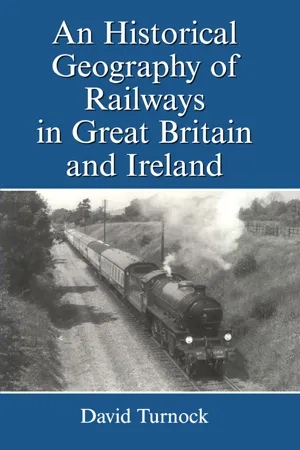
An Historical Geography of Railways in Great Britain and Ireland
About this book
Although a great deal has been published on the economic, social and engineering history of nineteenth-century railways, the work of historical geographers has been much less conspicuous. This overview by David Turnock goes a long way towards restoring the balance. It details every important aspect of the railway's influence on spatial distribution of economic and social change, providing a full account of the nineteenth-century geography of the British Isles seen in the context of the railway. The book reviews and explains the shape of the developing railway network, beginning with the pre-steam railways and connections between existing road and water communications and the new rail lines. The author also discusses the impact of the railways on the patterns of industrial, urban and rural change throughout the century. Throughout, the historical geography of Ireland is treated in equal detail to that of Great Britain.
CHAPTER ONE
Introduction: The Railway Age
Railways in Britain have attracted a remarkably varied and comprehensive literary output which shows little sign of abatement at the present time. There is clearly a great deal of material provided for the railway enthusiast, particularly with regard to motive power, rolling stock and train services generally.1 But the community of railway ‘buffs’ is sufficiently large and diverse to justify publications on such matters as company structures, management practices, architectural tastes and technical innovations.2 So the literary spectrum extends continuously into the academic sphere where railways slot into a complex picture of transport revolutions which exerted a major influence on the economy and society of the country during the nineteenth century.3 Academic work on railways has come mainly from economists and economic historians who have been keen to assess the efficiency of a major industry and the precise impact of improvements in transport on the economy as a whole.4 Elsewhere in social science the pace of social and political change during the nineteenth century has been examined with the significance of the railway in mind.5 And, of course, British literature on the Victorian period shows a sharp awareness of new transport arrangements so that contemporary novels constitute a useful source of information which is reviewed later in this introduction.6
Meanwhile geographers have been rather inconspicuous. There have certainly been several important contributions on railway networks, notably the works of J.H. Appleton and J.A. Patmore,7 but with few exceptions the railway theme creeps into the textbooks largely by way of a chapter contributed towards a review of Britain’s economic geography in general.8 The same observation may be made with respect to historical geography for even works devoted to the nineteenth century alone offer only a limited assessment of the railway’s influence on patterns of economic and social change.9 The author has ventured into this fertile field on one previous occasion, concentrating attention on the changes occurring on the railway network during the present century.10 This perspective is now developed into a fuller examination of Britain’s nineteenth-century geography, seen in the context of the railway. The whole of the British Isles is considered, since this area comprised the United Kingdom during the ‘Railway Age’. There are three essays on the development of the railway network followed by a further trilogy dealing with the complex question of the railway’s impact. However, in each chapter some attempt is made at generalization and this introduction is also geared to discussion of salient themes underpinning the whole work. Each chapter also contains a detailed case study.
Railways in the early nineteenth century: a leap in the dark?
It is a sure indication of public esteem for the railway that writers should sometimes give the impression of complete inevitability of mania-scale development such as was witnessed in the middle of the last century. Writing in the comparative calm of the twentieth century complicates the essential exercise of slipping into the shoes of innovators for whom the future was anything but assured. So it has been asserted with genuine regret that ‘the shape and size of the railway network owed little to rational planning or any agreed scale of social and economic priorities … Parliament was unwilling, often incapable, of pursuing a coherent policy and much was left to the forces of enterprise, haste and greed’.11 But this reflects a rather sweeping assumption over both the inherent superiority of railway technology and the inevitability of commercial success for railway companies. They also suggest, with the same idealism which has become typical of enthusiasts offended by the post-war demise of so much of the national network, that in its formative period the railway industry should have been treated in a manner fundamentally different from that involved in parliamentary scrutiny of other major economic developments. In fact there was a very considerable degree of state regulation of the railways, as this introduction will later emphasize, and authorities such as M. Robbins have seen such co-ordination as one of the fundamental characteristics of Britain’s ‘Railway Age’.12 But perhaps the most important contextual point about the early years of railway development involves a complex web of uncertainties which were not entirely dispelled until the explosive mania years of the 1850s.13
Problems of technology
Despite the rise of science, which conditioned people to accept technological change, there was genuine doubt about the success of railway technology. A later chapter will explore some aspects of the development of the steam locomotive, culminating in the amazing success of George Stephenson’s ‘Rocket’ at the Rainhill Trials of 1829.14 But it is often overlooked that this achievement was based in part on the development of suitable track, consisting of iron edge rails which were preferred to the ‘L’ section plates previously favoured by railway engineers of the pre-locomotive phase.15 And it is equally easy to forget the ‘rail versus road’ debate raging at the turn of the eighteenth century. There was an interesting notion of compromise in the call by J. Anderson in 1800 for railways to be built at the side of turnpikes, following the established alignments apart from occasional diversions around the edge of hills and some construction of tunnels and viaducts.16 But T. Telford was a firm believer in steam traction on normal highway surfaces and ‘in 1831 he tried to make an experimental run from London to Birmingham in one of Dance’s carriages, which unfortunately broke down on the way’.17 However, he still dreamt of steam coaches eventually operating over the entire London-Holyhead road and was supported by other visionaries such as A. Gordon in 1832. For some years there was a serious belief that road transport could cope with the challenge of the railways even without the locomotive. Contemporaneous with the construction of the London & Birmingham Railway was easing of the road gradients between Towcester and Weedon in Northamptonshire (cutting through the tops of hills) and the use of granite (from Aberdeen and Mountsorrel) to create a stone tramway at the side of the road for the use of stage coaches.18 Meanwhile the stage-coach businesses of Chaplin and Home were combined into a single company at the time the railway opened in 1838.19 The efforts by road transport interests to adopt elements of railway technology were evidently frustrated in the end. But this is a phase of the story which merits further research to fill out such clear-cut conclusions as that by H. Ellis: ‘public indifference, official obstruction and bad business did their worst’.20
Once the issue had been decided in favour of steam traction on rails (and specifically edge rails) there was the troublesome matter of the gauge; both the loading gauge (critical for clearances at bridges and tunnels as well as platforms and railways with more than a single track) and the rail gauge.21 The latter has attracted most comment in view of the fact that the gauge eventually laid down as standard in Great Britain (4 feet 8.5 inches) was a mineral gauge adopted by Stephenson for main line purposes in contrast to broader gauges (such as I.K. Brunei’s 7-foot gauge for the Great Western) advocated with the long-distance steam railway concept particularly in mind.22 Fortunately an early decision on standardization was made by government, favouring the gauge most widely used at the time (on which basis the 5 feet 3 inch gauge was adopted in Ireland). This was a far-sighted decision which some authorities evidently considered premature. For when the Ulster Company set out from Belfast to Portadown using a gauge of 6 feet 2 inches and complained that the Dublin & Drogheda was advancing from the south with a narrower gauge of 5 feet 2 inches, the Irish Board of Works felt that ‘there was little chance of the intervening part ever being finished and therefore there was no harm done’.23 Little awareness here of the possibility that railways would ever be more extensive than short branches to connect a port with its immediate hinterland.
Techniques of railway engineering had to be developed to a large extent from scratch. Buildings could be adapted easily enough and so the turnpike cottage appeared on railway inclines while the basic arched bridge could be taken from the canals and multiplied as necessary to produce the early railway viaducts.24 Tunnelling techniques were also readily available. But the optimum railway alignment rested on a new set of ground rules since there was freedom from the onerous constraint imposed on canal engineers regarding summit levels but only within the uncertain limits arising from operating costs in general and the efficient use of steam locomotives in particular.25
Ideas were exchanged on two particular matters relating to the directness of a railway running between its point of origin and its ultimate destination. All things being equal a route that was as near as possible a straight line would be the cheapest for both construction and operation. It would also be most expeditious in the minds of those passengers and freight customers concerned about fares/tarriffs per mile and journey times. However, this simple principle was frequently upset by difficult terrain and by opportunities to generate traffic at intermediate stations. It was the practice of the Stephensons ‘to secure a road as nearly as possible on a level, following the course of the valleys and the natural line of the country … often making a considerable circuit to secure good, workable gradients’ which were set at a maximum of 1 in 330 (16 feet per mile) for the London & Birmingham Railway.26 Although construction costs would be increased by lengthening the line or by carrying out major engineering works (involving long tunnels and viaducts; cuttings and embankments) the operating costs would be reduced through maximizing the weight of the train that a single locomotive could cope with at all stages of the journey. But engineers like D. Lardner were, initially at any rate, more sceptical and thought that ‘undulating lines’ were quite acceptable while others such as Badnell argued that they were definitely superior.27 Even when these contrary expressions had been silenced there remained the option of a direct approach through hilly country, securing rapid progress at relatively low cost but at the expense of operating difficulties over the longer term.
The approach of the Stephensons to the scarplands of Northamptonshire, taking the London & Birmingham Railway through Roade cutting and Kilsby tunnel, lies at the opposite end of the spectrum from W.S. Moorsome’s decision to take the Birmingham & Bristol line straight across the Lickey Hills, accepting gradients ten times as severe as the maximum that the Stephensons would contemplate. In this way improvements to the locomotive were ‘neutralised by the steep gradients which the new school of engineers were setting it to overcome’ (Figure 1.1).28 Further differences of opipion then nrose ever the importance of traffic from intermediate stations and the desirability of...
Table of contents
- Cover
- Half Title
- Title Page
- Copyright Page
- Table of Contents
- List of Figures
- List of Tables
- Preface
- List of Abbreviations
- 1 Introduction: The Railway Age
- Part One Railway Networks
- Part Two The Railway Impact
- Conclusion
- Notes
- Select Bibliography
- Index
Trusted by 375,005 students
Access to over 1.5 million titles for a fair monthly price.
Study more efficiently using our study tools.
Frequently asked questions
Yes, you can cancel anytime from the Subscription tab in your account settings on the Perlego website. Your subscription will stay active until the end of your current billing period. Learn how to cancel your subscription
No, books cannot be downloaded as external files, such as PDFs, for use outside of Perlego. However, you can download books within the Perlego app for offline reading on mobile or tablet. Learn how to download books offline
Perlego offers two plans: Essential and Complete
- Essential is ideal for learners and professionals who enjoy exploring a wide range of subjects. Access the Essential Library with 800,000+ trusted titles and best-sellers across business, personal growth, and the humanities. Includes unlimited reading time and Standard Read Aloud voice.
- Complete: Perfect for advanced learners and researchers needing full, unrestricted access. Unlock 1.5M+ books across hundreds of subjects, including academic and specialized titles. The Complete Plan also includes advanced features like Premium Read Aloud and Research Assistant.
We are an online textbook subscription service, where you can get access to an entire online library for less than the price of a single book per month. With over 1.5 million books across 990+ topics, we’ve got you covered! Learn about our mission
Look out for the read-aloud symbol on your next book to see if you can listen to it. The read-aloud tool reads text aloud for you, highlighting the text as it is being read. You can pause it, speed it up and slow it down. Learn more about Read Aloud
Yes! You can use the Perlego app on both iOS and Android devices to read anytime, anywhere — even offline. Perfect for commutes or when you’re on the go.
Please note we cannot support devices running on iOS 13 and Android 7 or earlier. Learn more about using the app
Please note we cannot support devices running on iOS 13 and Android 7 or earlier. Learn more about using the app
Yes, you can access An Historical Geography of Railways in Great Britain and Ireland by David Turnock in PDF and/or ePUB format, as well as other popular books in History & World History. We have over 1.5 million books available in our catalogue for you to explore.