eBook - ePub
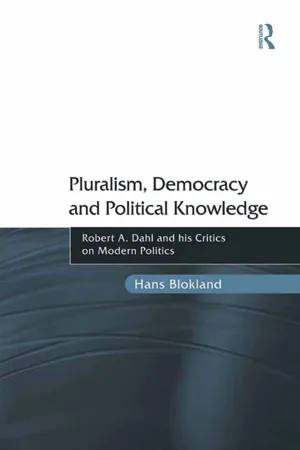
Pluralism, Democracy and Political Knowledge
Robert A. Dahl and his Critics on Modern Politics
- 392 pages
- English
- ePUB (mobile friendly)
- Available on iOS & Android
eBook - ePub
Pluralism, Democracy and Political Knowledge
Robert A. Dahl and his Critics on Modern Politics
About this book
The political discontent or malaise that typifies most modern democracies is mainly caused by the widely shared feeling that the political freedom of citizens to influence the development of their society and, related to this, their personal life, has become rather limited. We can only address this discontent when we rehabilitate politics, the deliberate, joint effort to give direction to society and to make the best of ourselves. In Pluralism, Democracy and Political Knowledge, Hans Blokland examines this challenge via a critical appraisal of the pluralist conception of politics and democracy. This conception was formulated by, above all, Robert A. Dahl, one of the most important political scholars and democratic theorists of the last half century. Taking his work as the point of reference, this book not only provides an illuminating history of political science, told via Dahl and his critics, it also offers a revealing analysis as to what progress we have made in our thinking on pluralism and democracy, and what progress we could make, given the epistemological constraints of the social sciences. Above and beyond this, the development and the problems of pluralism and democracy are explored in the context of the process of modernization. The author specifically discusses the extent to which individualization, differentiation and rationalization contribute to the current political malaise in those countries which adhere to a pluralist political system.
Information
Chapter 1
Introduction
In western democracies, there is a progressive decline in the political freedom of citizens to influence the development of their society and, by extension, their personal lives. Our political systems seem less and less able to steer social change and to formulate solutions to pressing social and political problems. The endeavor to realize political ideals about the Good Life in the Good Society is considered by many as meaningless, a lost cause. In the same vein, citizens seem to be less and less able to identify with each other and to organize themselves on the basis of a substantial political program. As a result, political interest declines and political cynicism flourishes. This tendency is manifest in the rather vague complaints about “the cleavage” between politicians and citizens, “the end of politics,” and what the Germans duly call “Politikverdrossenheit.” These complaints, in turn, translate into lower voter turnout, dwindling membership of political parties, increasing difficulty in finding appropriate candidates for political and governmental positions, gradually growing groups of “floating voters” whose voting behavior seems to be mainly driven by the emotions and images of the day, and the popularity of populist politicians and movements, ranging from Pim Fortuyn and Geert Wilders in the Netherlands, Silvio Berlusconi in Italy to the Tea Party in the United States.
The underlying cause of the powerlessness pervading the current political system could be modernization. Taking the work of Max Weber, Karl Mannheim, and Joseph Schumpeter as a point of departure, I examined this process in Modernization and its Political Consequences (2006). Central questions were the consequences of modernization for the ways we can and do give meaning to politics and democracy, and especially the consequences for the political freedom of citizens to influence the course of their society via democratic politics. This exploration is continued here under the title Pluralism, Democracy and Political Knowledge. In the present book I set out to analyze the development of the political theory of pluralism, a development that largely coincides with that of postwar political science. Now, as my point of reference, I take the thinking of Robert A. Dahl. This book concentrates on the period between the 1930s and the 1970s. That was when Dahl and others formulated the original notion of political pluralism, a concept with which many in the practical political world seem to concur today. Pluralism is a pre-eminent articulation of modernization, a quality that explains its current popularity and one that makes it exceptionally suitable for an analysis of politics and democracy in a modern society.
The leitmotif of this study is the question of how modernization affects citizens’ possibilities and abilities to give their society meaning and direction. These possibilities and abilities constitute what I define as “positive political freedom.” This dimension of freedom can be distinguished from “negative freedom:” the domain in which one can do or be what one is able to do or be without interference from others (Berlin 1958; Blokland 1997a). Invariably, a conflict looms between positive and negative freedom: enlarging the first could endanger the second. To a much higher degree than authoritarian systems, democracies can invade the negative freedom of individuals. Accordingly, any plea for a rehabilitation of politics to counter the detrimental consequences of modernization has to confront this conflict.
Modernization consists of roughly three related processes: differentiation, individualization, and rationalization (cf. Blokland 2006). Differentiation means that a growing number of human activities are coordinated in specialized associations. As a result, social complexity increases. So do, on the one hand, functional interdependencies and, on the other hand, autonomy within the different associations. Social pluralism, the existence of a variety of partly autonomous associations, is fostered by differentiation. In the theory of political pluralism social pluralism plays a pivotal role: it makes possible many alternative ways for meaningful political participation, it fosters the dispersion of power, it enhances the quality of public decision making.
The process of individualization is partly related to that of differentiation. People derive their identity from an ever greater diversity of associations. As a consequence, their identity seems to become more and more unique. At the same time, their identity becomes more abstract. While the volume, diversity, and complexity of their repertoire of roles expand, the identity that this repertoire offers them becomes less and less stable, coherent, concrete, and self-evident. Also because of this, people can get the impression that they are unique, autonomous individuals who are fully in charge of their lives and who define their values, aims, and identity independent of the culture of a specific group. As a consequence, the values they pursue become mainly personal rather than collective. Yet a decreasing affiliation with groups—and, related to this, an increasing negative freedom— would not imply a proportional increase of individual positive freedom or personal autonomy, the ability to take charge of one’s life on the basis of self-chosen values. On the contrary, this process of detachment and disengagement can frustrate the development of the capacity for personal and political positive freedom or autonomy (cf. Blokland 1997a). The stimuli people need to develop their capacity for freedom become less and less significant and their identifications with others and common causes become so weak that the chances for political organization and activity evaporate.
Rationalization, finally, means a growing importance in more and more spheres of life of what Mannheim (1940) called functional rationality. Though not logically connected to this, it also means a declining importance of substantial rationality. We may speak of functional rationality when there is a series of actions organized in such a manner that they lead, at the least possible cost, to a goal that is set beforehand. A person in a given situation engages in substantial rational action when his act is deliberately based on his own insight in the interrelated events of which this situation consists and when the judgments and choices underlying this act are based on a careful assessment of the values that are relevant to this situation. Hence, the capacities for substantial rational thinking and personal autonomy are closely related.
A consequence of the process of rationalization is that people increasingly seem to become prisoners of, as Weber (1904) put it, the “iron cages” of bureaucracies and markets. These structures impose conditions and choices on people, situations that are ever more difficult to escape and that people are less and less able to question and discuss. To think outside “the system” becomes a daunting task. Moreover, individualization, differentiation, and the fading of shared substantial rationalities make it harder for citizens to identify with each other or with a public interest. There is consequently an absence of shared conceptions of the Good Life and the Good Society, conceptions that form the basis of collective political action to give shape to society (cf. Taylor 1991).
The original conception of pluralism, formulated in the 1950s and 1960s of the last century, can be regarded as a typical product of modernization. Therefore, to a large degree, the theory of pluralism mirrors current western political orders. It describes and justifies their structure; at the same time, it helped to mold this structure. Hence, to analyze the social and political problems that trouble these orders today, it is imperative to evaluate the assumptions underlying the theory of pluralism. It is there that the seeds of the current problems could be found. Along these lines, in the general introduction to Modernization and its Political Consequences, I maintained that the current models of politics and policymaking also might be unable to counterbalance modernization because they are to a great extent a manifestation of this very process. In addition, I argued that the processes of “privatization,” “deregulation,” “decentralization,” “flexibilization,” “farming out,” and “marketization”—all of which have been put into motion since the 1980s—have given an enormous additional impetus to the process of modernization. Thereby, they have mainly amplified the feeling of political impotence and malaise. Therefore, also referring to the lessons Dahl and Lindblom themselves have learned from the experiences with pluralism, I will make a case for a rehabilitation of politics, a rehabilitation of the determined steering of social processes on the basis of a well-wrought program.
1 The Three Theoretical Levels or Discourses of this Book
This book contains “narratives,” so to speak, on several theoretical levels. Therefore, it can be read from different perspectives and with different interests. In the first place, one can read the book simply as an analysis of the development of the thinking of Dahl until the 1970s. He and his colleague Charles E. Lindblom (to whom I will devote a separate study) are among the most important representatives of pluralism. They are also two of the most distinguished and acclaimed political scientists of our time.1 If only for this reason, an intellectual biography of Dahl, a biography that has been lacking until now, has great intrinsic value.
Pluralism, however, is not an arbitrarily selected school of thought, not just one of many. Until the 1970s, it was by far the most dominant paradigm within political science—both in the United States and in the many countries where political scientists were strongly influenced by their American colleagues. Because Dahl and Lindblom have repeatedly played a vital role in key debates within political science in the second part of the last century, or held very representative positions in these debates, this book analyzes the development of political science as well. I consider which scientific and societal problems were judged relevant or urgent in which period, how scholars tried to study these problems, and what research results were produced. Furthermore, the period after pluralism had lost its hegemony can, to a large extent, only be understood as a reaction to this paradigm. In that sense, the history of American pluralism is largely the history of political science as well.2
It has often been remarked that modern political scientists know little about the history of their discipline. Thus, they can reinvent the wheel over and over again (Dahl 1961b: 25; Garson 1974: 1505; Ricci 1984: 313; Farr 1988: 1175; Farr, Dryzek and Leonard 1995: 5; Gunnell 2005: 597). If one would want to find out about this history and if one would want to avoid endless repetition, a historical analysis of the political theory of pluralism could be highly instructive. In this respect, the present book is also a kind of protest against the incapacity of political scientists—as well as politicians, policymakers, and opinion leaders—to build on earlier insights. This impotence is regularly the outcome of arrogance: modern people assume that there is hardly anything to learn from the experiences and insights of their predecessors. The societal costs of this assumption are repeatedly huge.
However, is there anything we can learn from our predecessors? In connection with the above, but on a higher theoretical level, in this book the question is posed whether there has been, or could be, any scientific progress on the issues that Weber, Mannheim, and Schumpeter raised 70 to 90 years ago and those that Dahl and Lindblom raised at the beginning of their career. Dahl especially has often been regarded as an exponent of behavioralism, the philosophy or view of science that had dominated political science since the 1950s. Many of its advocates hoped to transform the study of politics or government into a hard science modeled on the natural sciences. However, over the years, some have become progressively skeptical about the success of this project. In 1996, Lindblom stated that debate in a real science leads to convergence of ideas and to a broadly accepted “body of knowledge.” Then he concluded that “In political science, debate rarely leads to findings. And on any given big issue of fact or value, debate in political science tends to be endless rather than declining (or terminating in a finding)” (1996: 243). In his view, the debates on incrementalism and pluralism are good examples: “forty long years of inclusive debate [have been] devoid of scientific finding.” They have been “endless on fact and value alike” (1996: 243). At issue is to what extent this is an accurate description of the state of political science. Have we indeed learned nothing at all since, for example, the publication in 1953 of Dahl and Lindblom’s joint masterpiece, Politics, Economics, and Welfare? In other words, do Dahl and Lindblom still hold the very same convictions as half a century ago, or have they changed their minds? And if such change has indeed occurred, what has caused or induced it? Are the current convictions of Dahl and Lindblom better founded than those of the people who have moved in the opposite direction? In general, can we make any progress with our political thinking? Or is the academic and societal popularity of political ideas just a matter of fashion, convention, and socialization?
The subject of modernization constitutes the highest theoretical level of this study. As noted earlier, at issue here are the consequences of this process for the positive political freedom of people to give direction to their society. To what extent does pluralism reflect or even boost the process of modernization? To what extent is pluralism inherently incapable to solve the social problems created by the very same process? Have alternatives to the current political orders, orders described and justified by pluralism, been made socially unthinkable and unacceptable by the processes of differentiation, individualization, and rationalization?
2 Structure of the Argument
One of the reasons I went into the work of Weber, Mannheim, and Schumpeter in Modernization and its Political Consequences was to explore the general intellectual environment in which pluralism had developed. Taken together, these authors explicitly and cogently present a view on politics and democracy permeated by modernity. This view constitutes a framework of interpretation for pluralism. Moreover, each of them has, to a greater (Mannheim) or lesser degree (Schumpeter), directly influenced Dahl and Lindblom as well as many other social and political scholars of the 1940s and 1950s.
Even so, it should be kept in mind that political pluralism developed in a typically American context. Before I focus on Dahl’s pluralism, I will address this context in the next chapter. It will be shown that, contrary to what is often supposed or contended, the inspirations or foundations of pluralism are tremendously diverse, complex, and frequently contradictory.
Then, in Chapter 3, I will examine Dahl’s first book, Congress and Foreign Policy (1950). In this book he asks himself how the rationality and the democratic character of the decision-making process on foreign policy could be enhanced. His analysis will turn out to have a remarkable (and also depressing) theoretical and practical topicality. To demonstrate this, I will address the decision-making process that preceded the war in Iraq.
In Chapter 4 I will analyze in depth Dahl and Lindblom’s joint publication, Politics, Economics, and Welfare (1953). This book will serve as a point of reference for my analysis of the development of their work. In the chapters that follow, I will study Dahl’s development mainly in chronological order. I choose to take this approach because I want to do justice to the fact that Dahl did not subscribe to a single static theory of pluralism or stick to a particular formulation of it, come what may. Instead, under the influence of changing circumstances, Dahl continuously adapted his standpoint. The same goes for Lindblom. These modifications, and especially their underlying motivations, are of evident significance. They help us analyze to what extent and in what sense there has been scientific progress.
The subject of Chapter 5 is behavioralism. Historically, this view of science is closely related to pluralism. Like pluralism it was dominant within political science during the 1950s and 1960s. During these years, the scientific ambitions of political scientists reached their peak. Their relative consensus on the methods and the potential of political science contrasts sharply with the disagreements and the confusion during the pre- and post-behavioralistic years. Also for this reason, behavioralism is a watershed in the history of political science. If one wants to explore the possibilities to accumulate knowledge on politics, policymaking, and governance, an analysis of this school is essential. Likewise, much of the critique of political science—and accordingly of pluralism—that emerged during the 1960s and 1970s (and, again, at the beginning of this century) can only be understood if we take its behavioralistic assumptions into consideration.
In Chapters 6 and 7, I examine the original conception of polyarchy. Primarily formulated by Dahl, it describes the actual political practices in what we as a rule—though not entirely correctly—would call democracy. First I concentrate on Dahl’s A Preface to Democratic Theory, published in 1956. This is one of the most frequently cited, reprinted, and translated works in the field of American political science. Moreover, it is a first and emblematic product of Dahl’s behavioralistically inspired attempts to develop a more scientific political science. One of his key theses is that during the normal practice of political decision making in the United States, all the active and legitimate groups in the population can make themselves effectively heard at some crucial stage. Partly as a result of this, the citizen’s desires and interests shape public policy to a large extent. Thus, power and influence are fairly diffusely distributed across competing elites. Furthermore, inequalities in political resources, the existence of which Dahl certainly does not deny, are not cumulative. People with above-average resources in one sphere do not necessarily have more resources in other spheres too.
With these theses, Dahl emphatically takes sides in the debate between pluralists and elitists. Referring to empirical research in a number of political communities, the elitists assert that a single socio-economic elite decisively steers the decision-making process in all important policy domains. Dahl challenges this conclusion, initially on theoretical grounds. Later, however, he also weighs in with empirical research of his own, notably his studies on power relations in New Haven. He gives an account of this research in Who Governs? Democracy and Power in an American City (1961), a book that ranks among the classics in pluralist–behavioralistic scholarship. This phase in Dahl’s career, a phase dominated by empirical research and coinciding with the heyday of behavioralism, is addressed in Chapter 7. In addition, that chapter goes into Dahl’s comparative research on the conditions under which democracies can exist.
In this way a picture of the initial theory of pluralism emerges. As stated above, from the 1980s onward, most western politicians, policymakers, a...
Table of contents
- Cover Page
- Dedication
- Title Page
- Copyright Page
- Contents
- Preface
- Acknowledgements
- 1 Introduction
- 2 An American Preamble
- 3 Foreign Policy and Political Competence
- 4 A Common Point of Departure
- 5 The Behavioralist Mood
- 6 A Logical Analysis of Polyarchy
- 7 Empirical Research on Polyarchy
- 8 Arguments in Defense of Democratic Participation
- 9 Power and Powerlessness Under Polyarchy
- 10 Epistemological Reservations
- 11 Modern Political Science and Rationalization
- 12 Modern and Old-fashioned Politics
- Bibliography
- Index
Trusted by 375,005 students
Access to over 1.5 million titles for a fair monthly price.
Study more efficiently using our study tools.
Frequently asked questions
Yes, you can cancel anytime from the Subscription tab in your account settings on the Perlego website. Your subscription will stay active until the end of your current billing period. Learn how to cancel your subscription
No, books cannot be downloaded as external files, such as PDFs, for use outside of Perlego. However, you can download books within the Perlego app for offline reading on mobile or tablet. Learn how to download books offline
Perlego offers two plans: Essential and Complete
- Essential is ideal for learners and professionals who enjoy exploring a wide range of subjects. Access the Essential Library with 800,000+ trusted titles and best-sellers across business, personal growth, and the humanities. Includes unlimited reading time and Standard Read Aloud voice.
- Complete: Perfect for advanced learners and researchers needing full, unrestricted access. Unlock 1.5M+ books across hundreds of subjects, including academic and specialized titles. The Complete Plan also includes advanced features like Premium Read Aloud and Research Assistant.
We are an online textbook subscription service, where you can get access to an entire online library for less than the price of a single book per month. With over 1.5 million books across 990+ topics, we’ve got you covered! Learn about our mission
Look out for the read-aloud symbol on your next book to see if you can listen to it. The read-aloud tool reads text aloud for you, highlighting the text as it is being read. You can pause it, speed it up and slow it down. Learn more about Read Aloud
Yes! You can use the Perlego app on both iOS and Android devices to read anytime, anywhere — even offline. Perfect for commutes or when you’re on the go.
Please note we cannot support devices running on iOS 13 and Android 7 or earlier. Learn more about using the app
Please note we cannot support devices running on iOS 13 and Android 7 or earlier. Learn more about using the app
Yes, you can access Pluralism, Democracy and Political Knowledge by Hans Blokland in PDF and/or ePUB format, as well as other popular books in Politics & International Relations & Essays in Politics & International Relations. We have over 1.5 million books available in our catalogue for you to explore.