eBook - ePub
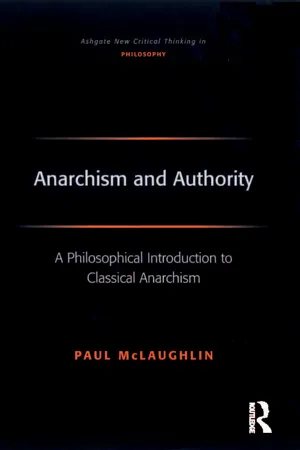
Anarchism and Authority
A Philosophical Introduction to Classical Anarchism
- 210 pages
- English
- ePUB (mobile friendly)
- Available on iOS & Android
eBook - ePub
About this book
Examining the political theory of anarchism from a philosophical and historical perspective, Paul McLaughlin relates anarchism to the fundamental ethical and political problem of authority. The book pays particular attention to the authority of the state and the anarchist rejection of all traditional claims made for the legitimacy of state authority, the author both explaining and defending the central tenets of the anarchist critique of the state. The founding works of anarchist thought, by Godwin, Proudhon and Stirner, are explored and anarchism is examined in its historical context, including the influence of such events as the Enlightenment and the French Revolution on anarchist thought. Finally, the major theoretical developments of anarchism from the late-nineteenth century to the present are summarized and evaluated. This book is both a highly readable account of the development of anarchist thinking and a lucid and well-reasoned defence of the anarchist philosophy.
Information
PART 1
Anarchism and the Problem of
Authority
Chapter 1
Defining Anarchism
Anarchism has been defined in numerous ways. Negatively, it has been defined as the rejection of rule, of government, of the state, of authority, of society, or of domination. Less frequently, it has been defined positively as a theory of voluntary association, of decentralization, of federalism, of freedom, and so on. Whether any of these – or three of the more common and plausible – definitions is satisfactory will be evaluated below. However, a more basic question is begged, as to whether any seemingly ‘simplistic definition’ could possibly prove satisfactory. John P. Clark argues that it could not: ‘any definition which reduces anarchism to a single dimension, such as its critical element, must be judged seriously inadequate’. Clark himself thinks ‘a more comprehensive definition’ is required, one ‘which takes into account all significant aspects of anarchism: both theory and practice, both past historical forms and contemporary manifestations’. What he comes up with is the following:
In order for a political theory to be called ‘anarchism’ in a complete sense, it must contain: (1) a view of an ideal, non-coercive, non-authoritarian society; (2) a criticism of existing society and its institutions, based on this anti-authoritarian ideal; (3) a view of human nature that justifies the hope for significant progress toward the ideal; and (4) a strategy for change, involving immediate institution of non-coercive, non-authoritarian, and decentralist alternatives. This definition would allow for use of the term ‘anarchist’ in both a strong and in several weaker senses.1
This seems like a reasonable summary of the components that make up the anarchist ideology, but it is cumbersome as a definition. Surely a definition such as ‘anarchism is the ideology of non-authoritarianism’ would suffice, even if it appears to simplify anarchism or to reduce it to ‘its critical element’.2 This definition implies both (1) an ethico-social ideal (that is, ‘non-authoritarianism’) and (2) criticism of existing institutions that fall short of the ideal (that is, more or less ‘authoritarian’ institutions). Moreover, the ideology of non-authoritarianism would presumably be premised on (3) some more or less coherent view of human nature – at least in the sense that every ideology is. Of course, as Clark is aware, there is no single anarchist conception of human nature. In fact, there is huge disagreement between social anarchists, who believe in ‘the human capacity for mutual aid, cooperation, respect, and communal relationships’, and individualist anarchists, who believe in the centrality of ‘rational self-interest’ or even ‘ruthless egoism’. All that constitutes common ground here is a shared belief that ‘libertarian potential [is] a constituent of human nature’.3 But this belief is implicit in the abbreviated version of Clark’s definition. One who holds a non-authoritarian ideal presumably believes that humans are capable of existing and prospering in a free society.
Finally, it might also be assumed that the ideology of non-authoritarianism has (4) some conceivable practical applications in line with its ideal, at least if it is not a complete irrelevance. It is surely true to say, then, that ‘Anarchism can have no meaning as a social and political theory if it says nothing about praxis’. However, in our view, Clark overstates this component of the anarchist ideology. It is not obvious that the anarchist must, by definition, be an activist of some kind, as Clark implies – that the anarchist must do something in terms of praxis. Adopting the theory-praxis dualism that was discussed in the Introduction, Clark distinguishes between ‘writers about anarchism’ and (genuine) ‘anarchists’, the difference being that the latter attempt to put practical proposals ‘into immediate practice among themselves, as an alternative to the dominant institutions’, while the former do not.4However, it is difficult to accept an activist stipulation on the anarchist ideology when such a stipulation does not apply to other ideologies, even ideologies of a fundamentally revolutionary nature. For instance, nobody (apart from, say, a fanatic of sorts) objects to a Marxist intellectual being called a Marxist. They may think less of that person for it, but they don’t go so far as to say that he or she is not really a Marxist. Ultimately, what determines one’s ideological position is the beliefs one holds, whether or not one acts in accordance with those beliefs. Again, one may have a low opinion of the person who lacks the courage of their convictions, but this has no ideological significance in itself.
Clark’s concerns about this issue appear to derive from his hostility to Robert Paul Wolff, a ‘philosophical anarchist’ who didn’t just write from the Ivory Tower, but who appeared to develop an explicitly non-practical anarchism. ‘The work that has done most to retard meaningful analysis and criticism of the anarchist position is’, Clark asserts, ‘Wolff’s In Defence of Anarchism’. He continues: ‘Whatever support Wolff’s ethical position might give to anarchism is effectively undermined by his statement that he sees no practical proposals that follow from his theoretical acceptance of anarchism. Anarchists have differed greatly on the issue of the degree of activism demanded by their position, but never before to my knowledge has any theorist claiming to be an anarchist presented no proposals for action at all’.5 Sharing some of Clark’s antipathy towards Wolff (or at least his metaphysical assumptions), we are still reluctant to accept the activist stipulation on anarchism. If Wolff isn’t really an anarchist, it is not because of the ‘non-practicality’ of his position, but because he backs away from his anarchist conclusion, a conclusion with which ‘I confess myself unhappy’ and ‘am unwilling to accept’.6
While the abbreviated version of Clark’s definition doesn’t say everything about the anarchist ideology (and will be disputed anyhow), it says no less than his ‘comprehensive’ – or rather pedantic – version. In any case, we take it that no definition is ‘comprehensive’ – that every definition is an abstraction and therefore inadequate – but that definitions are necessary for conceptual work. Defining liberalism, for instance, as ‘the political philosophy of individual liberty’ may be simplistic, but it provides a framework in which liberalism can be discussed – along lines which any remotely intelligent person can grasp. Presumably a similarly intelligent person could assess Clark’s version of anarchism, defined in the abbreviated way, along much the same lines.
What we are looking for at the outset, then, is a definition of anarchism, a definition that will provide the framework for our analysis. Why not accept the abbreviated version of Clark’s definition? Why not say that anarchism is the ideology or the political philosophy of non-authoritarianism? The answer should be clear from what has been said about our approach in the Introduction. The ‘non-authoritarian ideal’ is, as Clark specifies, the basis for anarchist criticism; it is the ethical standard by which existing institutions are measured. While interpreting anarchism in this way seems fair, and facilitates philosophical analysis of it, there still seems to be something rather disingenuous about it. It is not clear that anarchism – or most anarchists – establish their moral groundwork before engaging in critical analysis. Something else appears to be going on in anarchist theory. Criticism appears to have some value in itself: not to be morally sufficient in itself, but to be an essential moral point of departure. Why this is so should become a little clearer in our discussion of anarchist scepticism.
Leaving ‘comprehensive’ definitions aside, let’s take a look at some of the more common definitions of anarchism. Three definitions are familiar enough from the literature: the etymological definition, the anti-statist definition, and the anti-authoritarian definition. None of these definitions is satisfactory. According to the etymological definition, anarchism is the belief that society should be without (an-) rule (arch×). This definition is, however, unhelpful and simply lends itself to the pejorative sense of anarchism as the belief in social disorder or chaos. It is doubtful, in any case, that mere etymology could suffice to tell us anything, or to define even minimally, a substantive social philosophy with a complex history – and this is clearly true of liberalism and socialism too.
Anarchism, according to the anti-statist definition, is the belief that ‘society without the state, or government, is both possible and desirable’.7 It is not false to attribute this belief to anarchists (at least insofar as the state is concerned8), but it is certainly inadequate as a definition of anarchism. Anarchists do reject the state, as we will see. But to claim that this central aspect of anarchism is definitive is to sell anarchism short.9 Anarchists do not simply disapprove of the state; they disapprove of it as a particular (if particularly important) and unjustifiable instance of a more widespread social phenomenon. It is this phenomenon, namely authority, which is of fundamental interest to anarchists. (The anarchism of Bakunin, for one, may seem to be identifiable with anti-statism. Indeed, he calls anarchists ‘anti-state socialists’.10 Anarchists are, on this view, socialists who are simply distinguished or defined by their anti-statism. However, this does not define anarchism as such, but only its relation in one form (anarchist ‘collectivism’) to one form of socialism (Marxist ‘communism’). Even at this level, the definition is inadequate, for it obscures fundamental philosophical differences between Bakunin and Marx that are key to an understanding of the philosophical development of anarchism.)
According to the anti-authoritarian definition, anarchism is the belief that authority as such is illegitimate and should be overcome in its entirety. (Thus, ‘All anarchists deny authority’.11) This definition would seem to surmount the difficulties with the anti-statist definition. Nevertheless, it does so at the cost of an over-extensive simplification of anarchism, as will be demonstrated below. (Proudhon appears to define anarchism in the anti-authoritarian way. The revolutionary message of anarchism, he writes, can be summed up as: ‘No more Authority!’12 Even if this statement reflects his anarchist position accurately, it must be seen as a conclusion to his sceptical inquiry rather than as, let us say, a metaphysical prejudice. He may arrive at a position where he rejects all forms of authority under consideration (though not necessarily all forms of authority, real or conceivable), but this is no a priori judgement. These forms of authority are merely held, on rational reflection, to lack moral legitimacy.)
Scepticism Towards Authority
Anarchism is best defined, in my view, as scepticism towards authority. This is a somewhat controversial definition, though one hinted at by Richard T. De George: ‘The anarchist … is a sceptic in the political arena. He insists on the complete justification for any political or legal system prior to accepting it’. This characterization, like the anti-statist definition of anarchism, is inadequate, for anarchists scrutinize more than politico-legal authority, and would be better described as sceptics in the social arena. De George adds, importantly, that ‘it is not authority as such that the anarchist attacks, his words to the contrary notwithstanding. Rather he implicitly and rightly attacks authoritarianism, which anarchists have tended to equate with established authority’. While this is essentially correct, De George’s ‘minarchist’ conclusion does not necessarily follow: ‘if anarchist principles provide the basis for something like government, it is the basis for a minimal government, closely controlled from below and responsive to those below’.13
De George’s ‘analogy’ of anarchism with scepticism has been taken up and challenged by Rex Martin. ‘The philosophical anarchist … is one who doubts and is prepared to deny any assertion of rightful or “legitimate” authority on behalf of a government. So conceived, might not the philosophical anarchist have much in common with the philosophical sceptic?’ (Again, this conception of anarchism, as scepticism towards governmental authority, is too narrow, as we will demonstrate below.) While many anarchists assert the falsity of actual claims made for governmental authority, this falls short of ‘philosophical’ scepticism according to Martin; it is only a ‘preliminary’ scepticism. A ‘genuine’ scepticism would involve an assertion of the impossibility of any valid claim for governmental authority. But if anarchism were actually analogous to scepticism of this kind, it would be ‘self-contradictory’. This is so because ‘to assert, characteristically, that no true claim’ for legitimate governmental authority can be made, ‘the philosophical anarchist requires the coherence of the concept of a government’s “legitimate” authority’. And to allow for the coherence of this concept is, ‘in effect, to assert that there are conditions under which such [claims] could be true’.
Accordingly, the philosophical anarchist could not say that statements claiming rightful authority for governments can never possibly be true. Since this is the very proposition that the philosophical anarchist needs to assert, it would appear that his position breaks down internally [and that we should, therefore,] abandon the analogy [with scepticism] suggested by De George …14
Martin states that while anarchism cannot...
Table of contents
- Cover Page
- Half-Title Page
- Series Page
- Title Page
- Copyright Page
- Contents
- Acknowledgements
- Introduction
- Part 1 Anarchism and the Problem of Authority
- Part 2 Anarchism and the History of Ideas
- Bibliography
- Index
Trusted by 375,005 students
Access to over 1.5 million titles for a fair monthly price.
Study more efficiently using our study tools.
Frequently asked questions
Yes, you can cancel anytime from the Subscription tab in your account settings on the Perlego website. Your subscription will stay active until the end of your current billing period. Learn how to cancel your subscription
No, books cannot be downloaded as external files, such as PDFs, for use outside of Perlego. However, you can download books within the Perlego app for offline reading on mobile or tablet. Learn how to download books offline
Perlego offers two plans: Essential and Complete
- Essential is ideal for learners and professionals who enjoy exploring a wide range of subjects. Access the Essential Library with 800,000+ trusted titles and best-sellers across business, personal growth, and the humanities. Includes unlimited reading time and Standard Read Aloud voice.
- Complete: Perfect for advanced learners and researchers needing full, unrestricted access. Unlock 1.5M+ books across hundreds of subjects, including academic and specialized titles. The Complete Plan also includes advanced features like Premium Read Aloud and Research Assistant.
We are an online textbook subscription service, where you can get access to an entire online library for less than the price of a single book per month. With over 1.5 million books across 990+ topics, we’ve got you covered! Learn about our mission
Look out for the read-aloud symbol on your next book to see if you can listen to it. The read-aloud tool reads text aloud for you, highlighting the text as it is being read. You can pause it, speed it up and slow it down. Learn more about Read Aloud
Yes! You can use the Perlego app on both iOS and Android devices to read anytime, anywhere — even offline. Perfect for commutes or when you’re on the go.
Please note we cannot support devices running on iOS 13 and Android 7 or earlier. Learn more about using the app
Please note we cannot support devices running on iOS 13 and Android 7 or earlier. Learn more about using the app
Yes, you can access Anarchism and Authority by Paul McLaughlin in PDF and/or ePUB format, as well as other popular books in Philosophy & Philosophy History & Theory. We have over 1.5 million books available in our catalogue for you to explore.