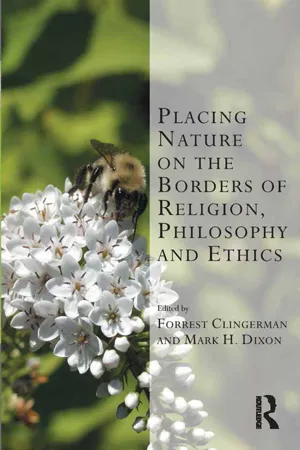
eBook - ePub
Placing Nature on the Borders of Religion, Philosophy and Ethics
- 238 pages
- English
- ePUB (mobile friendly)
- Available on iOS & Android
eBook - ePub
Placing Nature on the Borders of Religion, Philosophy and Ethics
About this book
The natural world has been "humanized": even areas thought to be wilderness bear the marks of human impact. But this human impact is not simply physical. At the emergence of the environmental movement, the focus was on human effects on "nature." More recently, however, the complexity of the term "nature" has led to fruitful debates and the recognition of how human individuals and cultures interpret their environments. This book furthers the dialogue on religion, ethics, and the environment by exploring three interrelated concepts: to recreate, to replace, and to restore. Through interdisciplinary dialogue the authors illuminate certain unique dimensions at the crossroads between finding value, creating value, and reflecting on one's place in the world. Each of these terms has diverse religious, ethical, and scientific connotations. Each converges on the ways in which humans both think about and act upon their surroundings. And each radically questions the damaging conceptual divisions between nature and culture, human and environment, and scientific explanation and religious/ethical understanding. This book self-consciously reflects on the intersections of environmental philosophy, environmental theology, and religion and ecology, stressing the importance of how place interprets us and how we interpret place. In addition to its contribution to environmental philosophy, this work is a unique volume in its serious engagement with theology and religious studies on the issues of ecological restoration and the meaning of place.
Information
Chapter 1
On the Spiritual Understanding of Nature
Páll Skúlason
I
Some years ago I wrote a book which I called Meditation at the Edge of Askja where I tried to explain some of the thoughts that Askja, a volcano in Iceland, had awakened in me after my first visit there in 1994. When I was walking back from Askja, some very speculative questions were growing in my mind: how do totalities, self-contained wholes, come to be, and what kind of totalities are there? And how do connections come to be, and what kinds of connections are there?1 Some months later, after having spent some months in Paris carrying with me a stone from Askja, I started reflecting upon my encounter with Askja and comparing it to my experience of the city of Paris.
Coming to Askja was for me like coming to Earth for the first time and discovering myself as an earthling: a being whose very existence depends on the Earth, a being who can only be itself by relating to this strange, overwhelming and fascinating totality, which is already there and forms an independent, objective, natural world. Askja symbolized for me an “objective reality, independent of all thought, belief and expression, independent of human existence.”2 Askja, I said, “is the earth itself as it was, is, and will be, for as long as this planet continues to orbit in space, whatever we do and whether or not we are here on this earth. Askja was formed, the earth was formed, long before we were created. And Askja will be here long after we are gone.”3 For me it was suddenly evident that everything else, every totality or connection that I could discover or imagine, could only be a reality because of its relation to the natural reality which Askja symbolized so marvelously. By contrast Paris, that fascinating city, was a man-made totality of an entirely different kind, but dependent upon the existence of nature as an autonomous and independent reality.
My thesis in the former book—if one can call it a thesis—was, in short, that to be “an earthling is to feel one’s life to be bound to the earth, or deriving from it, to feel the earth to be the fundamental premise of one’s life.” I argued for this thesis in the following way: “I am I, you are you, and we are we because we place ourselves, are and cannot be what we are except in the face of Askja (or other, comparable, symbol of the earth), to which we can turn again and again, if not in actuality, then in our thoughts. We stand upon the earth—build, work, and destroy it, if it comes to that—because we are born to the earth and can only find ourselves in relation to it, in the light of it or in its embrace. The earth is thus the beginning and the end of all our feeling for reality as a unified totality, and thus of all our feeling for ourselves as inhabitants of the world. The earth is the premise of our being ourselves, of our existing together and being aware of ourselves.”4
In the book I am referring to, my main aim was to illustrate this spiritual understanding of the Earth in all its natural glory as an independent reality into which we are born and with which we engage in a complex relationship.5 I call this understanding “spiritual” because it has to do with our feelings and our sense of value, of belonging to and being separated from, of being afraid and being fascinated. It is an understanding that has to do with religion rather than science, magic rather than technology. Its religious connotation does not make it any the less important. On the contrary, it reveals a problem which is not primarily a scholarly problem, but concerns the most basic connections of the mind to reality, and all the uncertainty and insecurity that pertain to our relations as sentient and reflecting beings to natural reality itself.
In the present chapter I want to explore some aspects of this spiritual understanding of nature, which I tried to illustrate in the former book. Such an understanding does not of course replace the scientific understanding of nature to which we are all accustomed and which is the basis for our technological powers. But it may help us to see and to think about issues that we might otherwise overlook, issues that concern how we are to realize the basic values and ultimate goals of our existence. It is the function of civilization, or if you like, of culture, of politics and of economics, to secure these values and goals. But a civilization may also conceal the issues that need to be dealt with, and the question that confronts humanity now is whether we recognize and work toward what ultimately matters and whether we may have to change radically the ways in which we are developing our civilization.
One way of criticizing our present civilization is to say that it has made the value of efficiency, which pertains to certain means that are at our disposal, into an ultimate value, that is to say into a sacred value, and that this spiritual error, if I may call it that, is leading us astray. This criticism, which we can find in the writings of many thinkers of the last century, among them Heidegger and Wittgenstein, must certainly be taken seriously. But if this error is to be corrected we need to develop a proper understanding of the reality of which we are a part and which may enable us to develop more appropriate relations to our fellow beings and to the world as a whole. I believe that both Heidegger and Wittgenstein, along with many other scholars, poets and philosophers, contributed significantly to such an understanding—a spiritual understanding. One of their lessons is that we should not expect to find solutions to our existential worries in a grandiose theory but rather in a humble way of reflecting upon our own experience and what others can tell us about their experience of the world.
II
Bearing this in mind, let us return to the experience of Askja with the help of another story of a first encounter with that magnificent volcano. In the year 1923 an Icelandic scientist, Pálmi Hannesson, came to Askja for the first time. I discovered his account of his first encounter with Askja by chance, only a few months ago. Hannesson speaks of walking toward Askja, enjoying the wonderful views of the Icelandic highlands, when we enter his adventure:
After a short while I arrived at the edge of a sheer cliff and saw Askja lying before me—or was it I who lay before Askja? At my first glimpse, I had to look away. Nothing like that has happened to me before or since, to be struck dumb by landscape. But there is some magic attached to Askja, some awesome, disturbing force that took me unawares and that I could not at first withstand, there in my solitude. I have never seen anything as astonishing or powerful. It was as if the magnificent view which I had enjoyed just a moment before had been erased from my mind, and with the terror of animate flesh, I was confronted by this awesome wonder of inanimate nature. There is no hope of describing Askja in any meaningful way. Who can describe a great work of art? Words and images are like the mere clanging of metal or the beating of a bell. And the same applies to any attempt to describe Askja.6
Two essential elements are clear in this account. The first is the overwhelming impression made by Askja upon the mind of the perceiver: he has to look away, he cannot face this reality. He finds himself “struck dumb” (in fact the metaphor is melting), he was unprepared and had no defense against the awesome, disturbing force of Askja. Everything else fades away and he is experiencing the “terror of animate flesh” (“the fear of the living flesh”) in face of this mysterious and tremendous power of “inanimate nature.” The second aspect is his “speechlessness”: he is deprived of the power to describe or explain what he is discovering, but nevertheless tries to say something.
What Pálmi Hannesson is telling us about is an experience of what Rudolf Otto has described in his book, The Idea of the Holy, as the experience of the numinous.7 “Numinous” is a word coined by Otto in order to denote what we take to be “holy” or “sacred,” but without any ethical or rational connotation. The numinous is a specific category of value which can only be encountered in a special experience that gives rise to a unique state of mind: “This mental state is perfectly sui generis and irreducible to any other; and therefore, like every absolutely primary and elementary datum, while it admits of being discussed, it cannot strictly be defined.”8 Otto’s book, which was first published in English in 1923 (the year that Hannesson visited Askja!), is an attempt to discuss and clarify the nature of the numinous “by means of the special way in which it is reflected in the mind in terms of feeling.”9 In this experience we are, according to Otto, “dealing with something for which there is only one appropriate expression ‘mysterium tremendum’.”10 He distinguishes between three basic elements in such an experience. First is the element of Awefulness, which is the tremor, the fear, the dread, or the “symptom of ‘creeping flesh’.”11 The “Wrath of Yahweh” in the Old Testament has something to do with this. “There is something very baffling in the way in which [the ‘Wrath of Yahweh’] ‘is kindled’ and manifested. It is, as has been well said, ‘like a hidden force of nature’, like stored-up electricity, discharging itself upon anyone who comes too near.”12 The second element, closely connected to the first, is that of “Overpoweringness” or what Otto names majestas. It is the feeling of an absolute dependency: “Thus, in contrast to ‘the overpowering’ of which we are conscious as an object over against the self, there is the feeling of one’s own submergence, of being but ‘dust and ashes’ and nothingness.”13 The third element is that of the “energy” or urgency of the numinous object; this element is already involved in those of tremendum and majestas. Everywhere it “clothes itself in symbolical expressions—vitality, passion, emotional temper, will, force, movement, excitement, activity, impetus.”14
For Otto the category of the Holy or the numinous object is a purely a priori category in the Kantian sense. It is neither a supra-natural object nor can it be reduced to sense-experience or said to be evolved from some sort of sense-perception.15 “It issues from the deepest foundations of cognitive apprehension that the soul possesses, and, though it of course comes into being in and amid the sensory data and empirical material of the natural world and cannot anticipate or dispense with those, yet it does not arise out of them, but only by their means.”16
To come back to Hannesson’s experience of Askja, and to mine as well, it is obvious that both these personal experiences bear all the marks of “numinous consciousness” as if Askja had been an occasion for us to discover the numinous object. Askja was, to use Otto’s terms, “the sensory data and empirical material of the natural world” by means of which we were filled with the emotion of the numinous. Askja had awakened in us “a numinous consciousness” which, according to Otto, points to “a hidden substantive source, from which the religious ideas and feelings are formed, which lies in the mind independently of sense-experience.”17
Now my question is: what lessons concerning our understanding of nature and of our relationship with Earth as our home in the natural world can be drawn from this experience of the numinous awakened by the volcano Askja?
I will proceed from the abstract to the concrete and start with a reflection about experience in general and the way in which it connects with reality, then proceed to a reflection on the experience of the numinous as such and what it means for our understanding of reality, and finally discuss the meaning of the specific experience of Askja for our actual understanding of Nature and Earth.
III
In order to make clear to ourselves what experience means for us I think it may be useful to take into account what Hegel has in mind when he discusses the concept of experience in the introduction to his Phenomenology of Spirit.18 Hegel explains in this introduction how he understands the logic implicit in the process by which we gain experience of the world and of ourselves. The experience he has in mind is not only sense-perception, although he sees that as the very beginning of the process of human experience. The experience Hegel is dealing with is that of the conscious being that is at the same time conscious of the reality outside itself and of its own internal reality. In short, the process of experience that Hegel describes implies two steps. The first one is the discovery of something that exists outside of, and independently of, our consciousness; the second step is the arrival on the scene of a new object, created by the encounter of human consciousness with the first object. The first object, which existed only in itself and independently of our consciousness, still exists, of course, in itself but now also for our consciousness.
Hegel points out that there is a certain ambiguity here concerning the truth. Our consciousness has two objects: the reality which is there and the reality which is there for consciousness. Now the second object is apparently only the knowledge we have of the first object. According to our ordinary understanding of experience, we gain this knowledge by correcting an imperfect notion we had beforehand of the first object. But what we do not realize, Hegel remarks, is tha...
Table of contents
- Cover Page
- Title Page
- Copyright Page
- Contents
- List of Contributors
- Preface
- 1 On the Spiritual Understanding of Nature
- PART 1: RESTORING PLACE AND MEANING
- PART 2: RECREATING PLACE, RECONNECTING WITH OTHERS
- Index
Trusted by 375,005 students
Access to over 1.5 million titles for a fair monthly price.
Study more efficiently using our study tools.
Frequently asked questions
Yes, you can cancel anytime from the Subscription tab in your account settings on the Perlego website. Your subscription will stay active until the end of your current billing period. Learn how to cancel your subscription
No, books cannot be downloaded as external files, such as PDFs, for use outside of Perlego. However, you can download books within the Perlego app for offline reading on mobile or tablet. Learn how to download books offline
Perlego offers two plans: Essential and Complete
- Essential is ideal for learners and professionals who enjoy exploring a wide range of subjects. Access the Essential Library with 800,000+ trusted titles and best-sellers across business, personal growth, and the humanities. Includes unlimited reading time and Standard Read Aloud voice.
- Complete: Perfect for advanced learners and researchers needing full, unrestricted access. Unlock 1.5M+ books across hundreds of subjects, including academic and specialized titles. The Complete Plan also includes advanced features like Premium Read Aloud and Research Assistant.
We are an online textbook subscription service, where you can get access to an entire online library for less than the price of a single book per month. With over 1.5 million books across 990+ topics, we’ve got you covered! Learn about our mission
Look out for the read-aloud symbol on your next book to see if you can listen to it. The read-aloud tool reads text aloud for you, highlighting the text as it is being read. You can pause it, speed it up and slow it down. Learn more about Read Aloud
Yes! You can use the Perlego app on both iOS and Android devices to read anytime, anywhere — even offline. Perfect for commutes or when you’re on the go.
Please note we cannot support devices running on iOS 13 and Android 7 or earlier. Learn more about using the app
Please note we cannot support devices running on iOS 13 and Android 7 or earlier. Learn more about using the app
Yes, you can access Placing Nature on the Borders of Religion, Philosophy and Ethics by Forrest Clingerman,Mark H. Dixon in PDF and/or ePUB format, as well as other popular books in Biological Sciences & Religion. We have over 1.5 million books available in our catalogue for you to explore.