In Asia, amidst its varied levels of economic development and diverse cultural traditions and political regimes, the Internet and mobile communications are increasingly used in every aspect of life. Yet the analytical frames used to understand the impact of digital media on Asia predominantly originate from the Global North, neither rooted in Asia's rich philosophical traditions, nor reflective of the sociocultural practices of this dynamic region. This volume examines digital phenomena and its impact on Asia by drawing on specifically Asian perspectives. Contributors apply a variety of Asian theoretical frameworks including guanxi, face, qing, dharma and karma. With chapters focusing on emerging digital trends in China, Hong Kong, India, Japan, Korea, Philippines, Singapore, and Taiwan, the book presents compelling and diverse research on identity and selfhood, spirituality, social networking, corporate image, and national identity as shaped by and articulated through digital communication platforms.
eBook - ePub
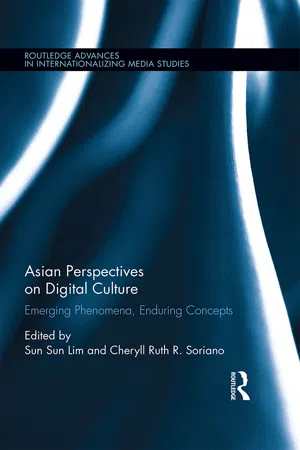
Asian Perspectives on Digital Culture
Emerging Phenomena, Enduring Concepts
- 214 pages
- English
- ePUB (mobile friendly)
- Available on iOS & Android
eBook - ePub
Asian Perspectives on Digital Culture
Emerging Phenomena, Enduring Concepts
About this book
Information
Part I Overview
DOI: 10.4324/9781315731650-1
1 A (Digital) Giant Awakens—Invigorating Media Studies with Asian Perspectives
DOI: 10.4324/9781315731650-2
The Emergence of Digital Asia
Digital, networked media have been embraced by countries around the globe, and Asia is at the very forefront of this trend. Amidst the region’s diverse cultural traditions and political systems, internet and mobile communication are increasingly deployed in every aspect of life, instigating novel modes of interaction and collaboration and birthing technological breakthroughs and innovative applications (Lim & Goggin, 2014). The region’s rapid economic growth and its youthful and increasingly well-educated populace have catalyzed the adoption, consumption, appropriation, and production of digital media content and new technology.
Indeed, Asia’s internet users constitute just under half of the world’s internet population at 45.6% (Internet World Statistics, 2015a). Chinese, Japanese, Arabic, and Korean are among the top ten most used languages on the web and Chinese speakers alone form almost a quarter (23.2%) of the world’s internet population (Internet World Statistics, 2015b). Besides the sheer magnitude of Asia’s online population, the relative youth and technophily of Asian consumers have contributed to an insatiable appetite for internet-related products and services (Lim, Sison, & Kim, 2008). The result is a boost in domestic innovation in information technology (IT), considerable growth in the quantity and quality of the region’s IT clusters (Parthasarathy & Aoyama, 2006; Tseng, 2009; J. Wang, Cheng, & Ganapati, 2012), and a thriving start-up ecosystem (Anjum, 2014). Asian countries that first cut their teeth in electronics production are now making the most of technological leapfrogging (Rasiah, Xiao-Shan, & Chandran Govindaraju, 2014) to generate trend-setting innovations in social media (S. Chen, Zhang, Lin, & Lv, 2011), online games (Jin, 2010), mobile commerce (Zhang & Dodgson, 2007) and mobile health (Ganapathy & Ravindra, 2008), just to name a few.
Technology penetration is further bolstered in many Asian countries by concerted state support in educational initiatives and information and communication technology (ICT) infrastructure (Baskaran & Muchie, 2006; Franda, 2002; Wilson, 2004; Yue, 2006). Notably, though, the region is underscored by rising income inequalities, varying internet governance systems, and geographical diversity that translate into striking variations and experiences in internet and mobile access (Cortada, 2012). Widening rural-urban divides (Fan, Chen-Kang, & Mukherjee, 2005; Gugler, 2004) and migrant labor flows within and beyond Asia (Athukorala, 2006; Wickramasekera, 2002) have also generated new practices in person-to person, business-to-business and state-citizenry communication, generating demands for novel services that ride on the enhanced online and mobile networks.
Underlying this bustling digital landscape is Asia’s rich tapestry of history. The region is home to some of the world’s oldest, most advanced civilizations, with lasting legacies of artistic, cultural, and scientific innovation of widespread influence. Asian philosophical traditions such as Indian, Chinese, Japanese, Buddhist and Islamic have also stood the test of time, serving as the foundational principles of governance, education, social interaction, and enterprise. The transformations in Asia’s increasingly digitized sociotechnological landscape are as much shaping, as being shaped by, these enduring cultural and philosophical traditions. Yet the analytical frames used to understand the impact of digital media on Asia predominantly originate from the Global North, neither rooted in Asia’s sophisticated intellectual heritage nor reflective of the sociocultural practices of this dynamic region. This edited volume seeks to remedy this imbalance by assembling the work of media scholars who use Asian concepts and precepts to understand, interpret, and explain media appropriation in the rapidly changing digital media landscape. In so doing, this volume aims to internationalize media studies by infusing critical research topics and established theoretical frames with Asian perspectives.
The Internationalization Imperative
This push toward the internationalization of media studies is by no means new. Many scholars have long called for more sedulous efforts to advance this cause. Thussu (2009 a) traced the evolutionary trajectory of media studies and observed that three critical interventions have been undertaken to broaden the field: the first with perspectives from feminism, and the second from race and ethnicity. He argues that internationalization is the third key intervention as the globalization of media and higher education warrants enhancing media studies with global perspectives, “making it imperative to invest in new research angles, approaches and methodologies” (Thussu, 2009 a, p. 3). Similarly, Curran and Park (2000) recognized the intensification of globalization as an impetus for ‘de-Westernising’ media studies, while Goggin and McLelland (2009) urged scholars to venture beyond Anglophone paradigms.
While such calls for greater diversity of intellectual perspectives have resonated, internationalization has been slow to gain momentum. Notably, significant impediments stand in the way of an Asia-centered and Asia-driven internationalization of media studies. Several issues need to be resolved, or acknowledged in the first instance, before a distinct shift from Anglo-American domination of the discipline can be achieved. First, curricula, syllabi, and pedagogies have to be made far more inclusive and international (Thussu, 2009 b). Presently, higher education and scholarship in media and communication worldwide, including in Asia, are predominantly framed by Western paradigms (Dissanayake, 1988, 2009 a; Erni & Chua, 2005; Goggin & McLelland, 2009) that fail to accommodate historically- and culturally-specific imaginaries of technology (Goggin, 2011).
Second, a culture of knowledge and information sharing across nations needs to be developed and actively sustained in Asia. Unlike in the U.S. where reliable data on media use is made available by independent institutions such as Pew Research Center, or in Europe where EU-funded studies generate regional data, what little pan-Asian data available is neither particularly comprehensive nor objective, being often produced by market research companies with specific commercial agenda. Currently, different Asian countries fund research captured only in their native languages. Such nationally-defined and locally-focused research effectively resides in silos and fail to inform, influence or initiate meaningful comparative research. Instead, there should be a concerted effort to exploit digital communication platforms for intra-regional exchange of data and knowledge for greater cross-fertilization of ideas with a view towards more broadly grounded theorization. Failing which, Asian researchers will be unable to engage in cultural synthesis and chart new directions in thinking (G. Wang & Shen, 2000).
Third, a key obstacle to more active knowledge sharing within Asia is linguistic differences. While there is an active pool of media and communication scholars in Asia, those who publish in English form a significantly smaller group. The research conducted by these two groups remains quite discrete, resulting in very little mutual influence. By dint of their Anglophone bent, Asian scholars who write in English are likely to have been schooled in the West, thereby being more receptive towards Western theoretical concepts, more inclined to write in a manner that resonates with a Western audience, and seek international endorsement by publishing in high impact English journals. This inclination is exacerbated by the growing interest in global rankings of universities that assess research output on the basis of citation counts and impact factor indices (Hazelkorn, 2015). Conversely, scholars who publish in Asian languages may be more inclined to incorporate Asian concepts into their analytical endeavors, possibly developing new paradigms that will unfortunately fall outside the radar of the Anglophone academic world. Such trends contribute to more entrenched domination of Western concepts in research on media and communication in Asia. We propose that the Western domination of Asian communication research can be stemmed if more active attempts are made to translate work in Asian languages into English. When more resources are channelled into increasing the exposure of such works, Asian and international scholars alike will enjoy access to a wider body of research that incorporates a more encompassing range of theoretical, cultural and empirical insights, and media and communication research will be the richer for it.
Encouragingly, more scholars are steering Asian academics towards drawing inspiration from Asian cultures to develop theoretical concepts, expanding the geographical scope of research, actively juxtaposing and comparing different Asian cultures, infusing theoretical frames with historical dimensions and multiple perspectives and engaging with metatheoretical issues (G.-M. Chen, 2006; Miike & Chen, 2006). At the same time, the study of media and communication in Asia is intensifying, with tertiary programs being offered and students enrolled in unprecedented numbers (Cheung, 2009). Media and communication research in and around the region is also thriving, with a growing selection of communication journals and book series that adopt an explicitly Asian focus and the existence of more than 12 professional associations and research institutes that concentrate on Asian communication studies (G.-M. Chen & Miike, 2006). Asian representation at international communication and media studies conferences and communication publications by Asian scholars are also on the ascent.
Imaginaries of Asian Digital Cultures and Modernities
The concepts ‘Asian’ and ‘Asian digital cultures’ or a set of cultures forged from core beliefs and experiences unique to a geographically vast region has been the subject of active intellectual debate (Dissanayake, 2003, 2009 a, 2009 b; Massey & Chang, 2002; Miike, 2006, 2007; G. Wang & Kuo, 2010). Increasingly, the use of the internet and digital technologies accompanied by the rapid movement of people and ideas across physical and virtual spaces intensifies the overlapping of cultures and spaces for cultural articulation, production, and belonging. These continuing global flows of culture, technology, media, finance, and ideology, which Appadurai (1990) has earlier conceptualized as “scapes” are promoting ethnic, cultural, religious, and linguistic diversity even within national boundaries. These flows create “large and complex repertoires of images, narratives and ethnoscapes” that may alienate people from the direct experiences of geographically based metropolitan life and lead them to construct imagined worlds and communities (Appadurai, 1990, pp. 298–299). As the world becomes more enmeshed through global networks and imaginaries, the divisions between inside and outside, as well as between Asia and the West, appear to be more blurry and problematic. Further, as G. Wang and Kuo (2010) argued, with globalizat...
Table of contents
- Cover Page
- Half Title Page
- Title Page
- Copyright Page
- Dedication
- Table of Contents
- Figures and Tables
- Part I Overview
- A (Digital) Giant Awakens—Invigorating Media Studies with Asian Perspectives
- Part II Self and Identity
- Part III Group Processes and Collective Imaginaries
- Part IV Discourses and Discursive Constructions of Meaning
- Part V Conclusions and Ruminations
- Glossary
- Notes on Contributors
- Index
Trusted by 375,005 students
Access to over 1.5 million titles for a fair monthly price.
Study more efficiently using our study tools.
Frequently asked questions
Yes, you can cancel anytime from the Subscription tab in your account settings on the Perlego website. Your subscription will stay active until the end of your current billing period. Learn how to cancel your subscription
No, books cannot be downloaded as external files, such as PDFs, for use outside of Perlego. However, you can download books within the Perlego app for offline reading on mobile or tablet. Learn how to download books offline
Perlego offers two plans: Essential and Complete
- Essential is ideal for learners and professionals who enjoy exploring a wide range of subjects. Access the Essential Library with 800,000+ trusted titles and best-sellers across business, personal growth, and the humanities. Includes unlimited reading time and Standard Read Aloud voice.
- Complete: Perfect for advanced learners and researchers needing full, unrestricted access. Unlock 1.5M+ books across hundreds of subjects, including academic and specialized titles. The Complete Plan also includes advanced features like Premium Read Aloud and Research Assistant.
We are an online textbook subscription service, where you can get access to an entire online library for less than the price of a single book per month. With over 1.5 million books across 990+ topics, we’ve got you covered! Learn about our mission
Look out for the read-aloud symbol on your next book to see if you can listen to it. The read-aloud tool reads text aloud for you, highlighting the text as it is being read. You can pause it, speed it up and slow it down. Learn more about Read Aloud
Yes! You can use the Perlego app on both iOS and Android devices to read anytime, anywhere — even offline. Perfect for commutes or when you’re on the go.
Please note we cannot support devices running on iOS 13 and Android 7 or earlier. Learn more about using the app
Please note we cannot support devices running on iOS 13 and Android 7 or earlier. Learn more about using the app
Yes, you can access Asian Perspectives on Digital Culture by Sun Sun Lim,Cheryll Soriano in PDF and/or ePUB format, as well as other popular books in Computer Science & Computer Science General. We have over 1.5 million books available in our catalogue for you to explore.