- 352 pages
- English
- ePUB (mobile friendly)
- Available on iOS & Android
eBook - ePub
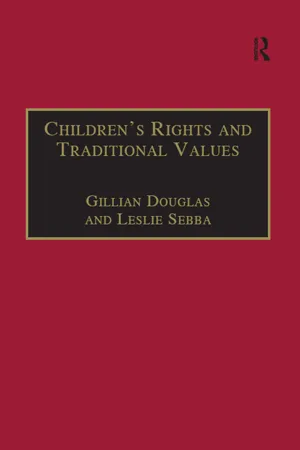
Children's Rights and Traditional Values
About this book
This book of essays by legal scholars from the United Kingdom, Eire, Israel and Palestine explores the extent to which the recognition of the concept of children's rights is affected by adherence to religious, cultural and ethnic traditions. The aim is twofold: first, to illuminate the interface between internationally-agreed norms of conduct regarding children and national and cultural determination to preserve traditional approaches; and secondly, to reflect upon the conflicts within societies between different cultural and religious groups in their attempts to determine whether 'liberal/secular' or 'conservative/religious' norms predominate in attitudes to children's upbringing. This is the first collection of papers covering and comparing the UK and Israeli/Palestinian jurisdictions. The particular blends of social, religious and cultural diversity in both regions, mingled with the political factors operating as well, render these jurisdictions of special interest as case-studies in the reception of 'western/liberal' norms and values. Moreover, Israel and Palestine, despite their manifestly different cultures as compared with Britain, have been influenced by the colonial legacy of the common law, rendering this particular east-west comparison of special interest.
1 | ‘You Have to Start Somewhere’ |
I
In today’s world of moral uncertainty one needs to raise questions about the justice-seeking activities of lawyers. How is it possible to be a moral lawyer and how is it possible to be a lawyer and a moral being? These questions tend to be answered by invoking political realities. What constitutes injustice or immorality is likely to relate to reference points along a political continuum where democracy is being denied, power abused, rights ignored or overridden. From the legal perspective, the role of law becomes in essence one of rectifying such irregularities and, where appropriate, punishing such illegality and preventing and deterring its future occurrence. Legal morality for those active in the field of human rights is seen to proceed, therefore, through a process of redressing unlawful imbalances of power and so of promoting or restoring the world to a state of equilibrium and legality. As with retributionist justifications for making immoral acts crimes, law and morality are seen as reinforcing each other with law reinforcing and intensifying the opprobrium with which the immoral act is regarded.1
The difficulty for lawyers engaged in such balance-restoring activities who wish to claim the moral high ground is that critical observers of law and politics may well situate the endeavours of both law and lawyers on one side of a distinction rooted in political difference, whether this difference is based on party politics, gender politics, racial politics or cultural politics. In itself this would not create problems for law’s moral objectives if there could be some guarantee that legality would always correspond to the positive side of the chosen political distinction. Unfortunately, there can be no such guarantee. Lawyers who claim justice (and not just law) is on their side might welcome being seen as a thorn in the flesh of governments, big business and state bureaucracies, but may well be unhappy to be presented with an image of themselves as the oppressors of minorities or destroyers of cultural heritage and traditional values or of Habermas’s ‘life world’. From within the legal system the only method of avoiding the risk of attracting such a negative image is to draw a distinction between those practices (of ministers, civil servants, minority groups, cultures, traditions etc.) which may be classified as valid, normal, healthy or lawful and those which infringe some fundamental principles. These fundamental principles may be based on ‘natural law’, human rights, children’s welfare, according to the particular circumstances. It may be that invoking these higher authorities may rescue individual lawyers from a crisis of confidence in the moral righteousness of their enterprise, but it may also plunge the legal system into an even deeper crisis, as the search intensifies to discover exactly where law should mark out these fundamental principles and on what basis they are to be justified?2
Why then may not society simply elevate morality to the status of final arbiter, for such a move would clearly remove the paradox of the oppressive seeker-after-justice or the destructive redresser of power imbalances? Such a possibility would depend upon communications based upon the moral distinction between good and evil being or becoming functional for all society’s operations. In other words it would be conditional upon society’s acceptance of a moral code as capable of generating the knowledge and shared meanings necessary for all social performance. When in the past society was able to present itself as a collective version of individual consciousness, governed by obedience to God’s precepts or loyalty to the king or the flag, such a possibility did indeed seem probable. To insist today, however, that an authoritative evaluation of social events could be determined by individuals following some universally acceptable moral code, which could then be enforced by law is to suggest that what was possible in pre-modern societies is still possible today. It is unlikely that even the most optimistic contemporary moral philosophers would not wish to be associated with this suggestion,3 for society has evolved in ways which appear to construct an impenetrable barrier between moral codes and social performance.
The important difference between modern society and traditional, archaic or primitive societies, which may account for this barrier, lies in the organisation of social structures. In modern society this takes the form predominantly of functional differentiation.4 It is the simultaneous existence of these different function systems, such as politics, economics, law, religion, and science, which produce communications capable of providing meaning for social interaction and so allow society to exist in its modern form. The structure and operations of these subsystems reflect their specific functions within society. They consist, not of people or ideologies, but of communications organised in such a way that they always refer back to previous communications of the same kind.
Within this vision of society, therefore, the difficulty for a moral code, existing at the level of individual consciousness, to operate as a system of communications at the social level lies in the fact that there can be no guarantee that moral principles will be translatable into social action. Despite the efforts of some sociologists, social psychologists, and moral philosophers to convince us to the contrary, all their attempts to present today’s society as an aggregate of individual consciousnesses necessarily create a belief that social imperfection is a direct product of human imperfection and that the way to a better world is to produce better people. According to this view, if society is defective, only bad motives or perhaps insufficient self-knowledge stands between us and the creation of a perfect society.5 The autopoietic view of society as a system of social communications, by contrast, draws a clear distinction between individuals and society, with the latter consisting of communications and nothing but communications. Attempts to transfer moral precepts, which have served the individual well in his or her interpersonal relationships, to the level of social performance, result invariably in these precepts being reconstituted as legal, political, religious, scientific or economic communications, which refer back, not to morality, but to law, politics, religion, science, economics etc. for their authority and legitimacy.
This relatively new theoretical perspective also offers a very different vision of the relationship between social systems than that which most moral philosophers and legal theoreticians would accept. In the particular case of law and morality, it does not see these two systems as involved in some kind of collective endeavour to make people behave in desirable ways, the systems sometimes overlapping and at other times in conflict one with the other.6 Instead, autopoietic theory regards each of these two systems’ normative operations as quite independent of the other. Each, on the other hand, is quite capable of reconstructing information from the other system, but always on its own terms. Now the important questions no longer revolve around issues of what is law and what is morality and whether or not the one reflects the other, but regard rather the ways that law makes use of moral communications and morality of legal communications.
Using this perspective any solution to problems is necessarily a product of one society’s communicative subsystems, and not of ‘people’ or ‘society’ since neither people nor society can know of the existence of problems except in terms generated by social subsystems.7 This does not mean that what are referred to as ‘social problems’ are always either exclusively legal or exclusively political – they may also be moral or interpersonal, but what appears as a social problem at any one time must owe its existence to the unique coding of one among several co-existing, self-referring communicative systems. These may include law, politics, science, religion, interpersonal relations and economics. Furthermore, within the conditions of functional differentiation pertaining in modern society there is no possibility of deliberately appointing any one of these systems to a position of supreme authority over all the others and, therefore, no possibility of knowing what has ‘really’ caused the problem or where the ‘right’ solution may be found. Even though judges, ethics committees or evangelists may sometimes talk as if they had access to universal truths, there is nothing to prevent critical observers from remarking that these truths are in fact falsehoods or that their application is relative only to particular cultures or ideologies. Consequently, the solutions to ongoing problems which these ‘truths’ are expected to offer will continue to be contingent in nature, in the sense that there are unforeseen possibilities which lie beyond the formulation of both the problem and its solution, beyond the horizon of the system’s experience and action. The presence (invisible to the system) of these possibilities indicates that things may turn out differently than expected and that appearances given form by and within the system may turn out to be deceptive.8
II
There was nothing inevitable about the emergence of children’s rights as a category within international law with the creation of the United Nations Convention. Philip Alston attributes the appearance of this ‘most detailed and comprehensive of all the existing international human rights instruments’ to an unlikely sequence of political events which started with an attempt by Poland to ‘seize at least some of the human rights initiative from Jimmy Carter’.9 Yet, for such an event to take place within the arena of international politics, one needs to acknowledge a pre-existing set of concepts which situated the enforcement and protection of ‘rights’ within the realm of attainability and another set of which presented children as a distinctive group, separate from other adults, and having their own particular needs and interests which could be converted into rights. To an observer of international politics this combination of children with rights may seem as unlikely and as fortuitous as the political events identified by Alston. And yet, it led eventually, as we all know, to the creation of the Children’s Rights Convention and to its widespread ratification.
Historically, children, at least in the context of European society, had before the latter half of this century been defined by their lack of rights, reinforced by a legal system, which went out of its way to emphasise the rights of others (particularly fathers) to make decisions or veto the decisions of those who had not reached an age when they were legally competent to own property.10 It is true that from the 18th century onwards the incompetence of age also carried with it some benefits, such as that of not being accountable contractually for debts relating to non-necessaries and not having to suffer the upper range of criminal penalties,11 but these could hardly have been seen and were certainly never referred to as ‘rights’.
Why then should society have wanted to grant children, meaning all people under eighteen years old,12 special rights which it does not accord to adults? Observers of social movements might want to explain the emergence of children’s rights as the product of some inexorable, universal victim-rescuing crusade, which once it had exhausted the available supply of oppressed groups, the poor, indigenous people, women, psychiatric patients, prisoners, animals etc. turned its attention to the plight of children. Such an explanation, however, does not address the particular issues either of children or of rights.
Ever since the European romantic movement of the late eighteenth and early nineteenth centuries, it has been fashionable to regard children as a special group, having special interests. While beliefs about the nature of childhood tended at this time to be rooted in the romantic Rousseauesque notion of children as ‘noble savages’, needing protection against the corrupting adult world, those who seek actively to protect children are more likely to look for the foundations of children’s rights in the realms of the human and medical sciences. Here children, both during and way beyond infancy, make their appearance as impressionable creatures in the process of formation, whose future may be blighted by insensitivity, ignorance or irresponsibility on the part of adults.13 The influences of Freud and, to a lesser extent, Piaget on modern psychological ideas concerning what children are and how they should be brought up are everywhere. Yet the shift towards the end of the last century from Rousseau’s unnatural or Darwin’s natural evolution of the child towards today’s ‘psychology of child development’ did not represent simply a change in notions of childhood. What was of particular importance was the fact that the formation of children rapidly became a scientific enterprise. In Foucault’s terms, the technologies were put in place for a discipline of child development to operate effectively through the medium of expert systems. Today, we now believe that we know or have the means of knowing scientifically what is good or bad for children and that knowledge provides the panoply of techniques and practices for protecting children and promoting their welfare.
In a recent development in the philosophy of science, however, theorists who see themselves as post-modern have rejected any possibility of applying science to identify what children need psychologically and what causes them psychological harm. For them ‘the psychological child’, as well as childhood itself, is a product of social conditions and changes in response to changes in the social world. The identification of the needs of and harms to the ‘psychological child’ are to be found in such contemporary phenomena as compulsory schooling, small family units, the organisation of work, and restricted expressions of sexuality.14 This, as we shall see, is likely increasingly to represent a serious challenge to the efforts of international children’s rights lawyers to ground their claims for fundamental principles in scientific knowledge. It may also throw serious doubts on the ability of moral philosophy to extricate lawyers from their dilemma, for any attempt to transform morality into legal formulae relating to the interests of and harms to children may itself depend upon ‘scientific truths’.
III
If we turn now to the ‘legal child’ and more particularly to children’s legal rights, it does not seem too outrageous to claim from the outset that rights cannot be anything but a product of decisions. You cannot have rights without some notion that whatever is in issue can be resolved throug...
Table of contents
- Cover
- Half Title
- Title Page
- Copyright Page
- Table of Contents
- List of Contributors
- Series Preface
- Acknowledgements
- Editors’ Introduction
- 1. ‘You Have to Start Somewhere’
- 2. Children’s Rights: Balancing Traditional Values and Cultural Plurality
- 3. Children’s Rights, Cultural Diversity and Private International Law
- 4. The Interpretation of the Concept ‘The Best Interest of the Child’ in Israel
- 5. A Note on Children’s Rights in Islamic Law
- 6. ‘Honour Thy Father and Thy Mother’: Children’s Rights and Children’s Duties
- 7. Rights and Autonomy – or the Best Interests of the Child?
- 8. Multiculturalism, Parental Choice and Traditional Values: A Comment on Religious Education in Israel
- 9 Child-Parent-State: The Absence of Community in the Courts’ Approach to Education
- 10. Tradition and the Right to Education: The Case of the Ultra-Orthodox Community in Israel
- 11. A Child’s Right to Privacy or Open Justice?
- 12. Who is the Father? Access to Information on Genetic Identity
- 13. Crimes of War, Culture, and Children’s Rights: The Case of Female Palestinian Detainees under Israeli Military Occupation
- 14. Protection for Whom and from What? Protection Proceedings and the Voice of the Child at Risk
- 15. The Child’s Right to Make Mistakes: Criminal Responsibility and the Immature Minor
- 16. Traditional Values, Children’s Rights and Social Justice: English Youth Justice in the 1990s
- 17. Afterword: Choosing Rights for Children
Trusted by 375,005 students
Access to over 1.5 million titles for a fair monthly price.
Study more efficiently using our study tools.
Frequently asked questions
Yes, you can cancel anytime from the Subscription tab in your account settings on the Perlego website. Your subscription will stay active until the end of your current billing period. Learn how to cancel your subscription
No, books cannot be downloaded as external files, such as PDFs, for use outside of Perlego. However, you can download books within the Perlego app for offline reading on mobile or tablet. Learn how to download books offline
Perlego offers two plans: Essential and Complete
- Essential is ideal for learners and professionals who enjoy exploring a wide range of subjects. Access the Essential Library with 800,000+ trusted titles and best-sellers across business, personal growth, and the humanities. Includes unlimited reading time and Standard Read Aloud voice.
- Complete: Perfect for advanced learners and researchers needing full, unrestricted access. Unlock 1.5M+ books across hundreds of subjects, including academic and specialized titles. The Complete Plan also includes advanced features like Premium Read Aloud and Research Assistant.
We are an online textbook subscription service, where you can get access to an entire online library for less than the price of a single book per month. With over 1.5 million books across 990+ topics, we’ve got you covered! Learn about our mission
Look out for the read-aloud symbol on your next book to see if you can listen to it. The read-aloud tool reads text aloud for you, highlighting the text as it is being read. You can pause it, speed it up and slow it down. Learn more about Read Aloud
Yes! You can use the Perlego app on both iOS and Android devices to read anytime, anywhere — even offline. Perfect for commutes or when you’re on the go.
Please note we cannot support devices running on iOS 13 and Android 7 or earlier. Learn more about using the app
Please note we cannot support devices running on iOS 13 and Android 7 or earlier. Learn more about using the app
Yes, you can access Children's Rights and Traditional Values by Gillian Douglas,Leslie Sebba in PDF and/or ePUB format, as well as other popular books in Law & Civil Rights in Law. We have over 1.5 million books available in our catalogue for you to explore.