eBook - ePub
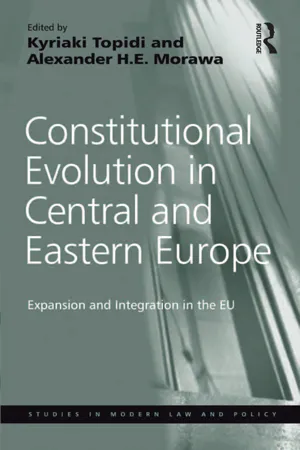
Constitutional Evolution in Central and Eastern Europe
Expansion and Integration in the EU
- 292 pages
- English
- ePUB (mobile friendly)
- Available on iOS & Android
eBook - ePub
Constitutional Evolution in Central and Eastern Europe
Expansion and Integration in the EU
About this book
This book examines EU enlargement by studying how domestic constitutional evolution in the new member states contributes to European integration. In contrast to the usual top-down analytical pattern, it reverses the paradigm by looking at constitutional developments and dynamics from the bottom-up, studying how domestic constitutional evolution contributes to European integration. The authors analyze constitutional trends from the perspective of 'new Member States' as policy-makers and not strictly as policy-takers. The issue of conditionality is also explored in a discussion of the extent to which pre-2004 and 2007 conditionality has had lasting effects at the level of constitutionalization of different areas and norms and if so, of what kind. The exploration of Europeanization effects in recent Member States substantiates and demonstrates how enlargement has been an important driving-force for the effective export of EU legal rules in this region. The book utilizes a comparative approach to highlight the merits and obstacles created by the growing diversity in the constitutional rules and patterns of the new Member States. It also contains a section that places the CEE constitutionalizing map in a broader comparative European and global context, establishing links with similar transitional regimes in the continent and elsewhere.
Chapter 1
Prologue: Constitutional Transition in Central and Eastern Europe
It would have been difficult - if not impossible - to predict in 1989 that the European Union would embrace the process of transition of Central and Eastern European states to the extent of assisting the states concerned to move from repression and communism to democracy in a relatively short period. The laborious and highly complex adjustment to the acquis communautaire accompanied by fundamental reforms in the direction of more open and democratic governance allowed states in that region to satisfy their desire for redress of the historical balance in the European continent and the creation of new opportunities.1 The transformation of post-communist societies contributed to the otherwise difficult realignment of ideas for two parts of the same continent that had followed substantially different directions for a good part of the twentieth century. Enlargement was about making the “parallelism of the unparallel” a possibility, even a reality.2 As a result of the process, the enlarged EU, according to Bet-El, resembles today a modern couple that has learned to live together, but refuses absolute final commitment.3 Ambiguity is present with regards to the future direction of European integration and we are still investigating whether “there will be enough affection to keep the family together”.4
Perceptions, narratives and expectations on and from the European Union have not always been shared between “old” and “new” Member States. Martin Krygier in his Parables of Hope and Disappointment pertinently noted that questions posed in Central and Eastern Europe about the benefits of EU membership have not stopped changing ever since the collapse of communism in 1989.5 While in the first years after the collapse there was question of free elections, politicians being voted out of office, important court decisions being finally followed with no objections by the executive and other equivalent developments, such achievements soon lost their novel character. Following signs of transition to more democratic practices and particularly with the admission of a large number of states in the region to the European Union, new questions emerged. This book was born out of the need to discuss these new questions. There is little disagreement among the authors of this volume that as soon as these questions begin to receive some answers a new set of questions will automatically surface to replace the previous ones. In that sense, the goal of the book is to advance discussion on the current issues pertaining to constitutionalization in Central and Eastern Europe and not to provide definite, permanent answers. In a construction that evolves in the way that the European Union does, such as an assumption would be too perilous.
To return to Krygier once more, the end of communism delivered high hopes for a successful “return to Europe”, but at the same time it also brought disappointment with regards to the price that the peoples of Central and Eastern Europe have had to pay in order to leave behind any and all of the attachments to their communist past.6 Following a decade (which in some cases stretched longer than that) of intense economic and political reforms, applicant countries of the region joined the Union in two waves in 2004 and 2007. Their legal systems were required to respond and adapt to a complex and highly novel body of rules. Earlier experiences of statehood and of constitutional practice have inevitably been challenged, but overall it would be difficult and perhaps unfair to claim that these newly independent states have not passed the “beginner course in constitutional democracy”.7
Following Ralf Dahrendorfs conceptualization of constitutional democracy as comprised of a constitution laying down the values and principles of the polity, of a market economy and finally of an active civil society,8 the contributions in this book focus on the first element, but occasionally intersect with the other two in their analyses. While Dahrendorf suggested that the stage of constitution-making would last six months, the underlying assumption in all of the chapters to this volume is that we have not finished dealing with the effects of this first stage despite the fact that the constitutions of certain states have been in existence for two decades. These effects in the aftermath of constitution-making have been made even more prominent by the complexities of the EU legal order.
Judge Maruste is right to point out that constitutional law, along with its implementation and supervision, in the form of judicial review, remain the most political and legal activities of all both during and after transition.9 It is precisely these intensely political and legal activities, particularly their methods and limits that one finds challenging to observe within the perspective of the European legal order, as it was experienced in the “new” Member States.
The sensitive balance of power in a constitutional democracy requires the distribution of tasks to three sovereign centres of power: the parliament, the executive and the courts. In the case of transition in Central and Eastern Europe, the last centre of power has emerged prominently and has voiced relevant questions of a constitutional and occasionally of a political nature, at the domestic, regional and supra-national levels.10 The task for legal systems and their actors in Central and Eastern Europe was not simple, it was complex. On the one hand, institutions and actors had to consolidate democracy and, on the other hand, they had to align themselves to the requirements of EU/EC law. The latter aspect has proved more complex, especially with an eye to the development of a common European legal area and the new needs that arise from it. If we are to argue thus that the main constitutional parameters in Europe are being harmonized, then the immediate question that is asked is whether the current domestic constitutional arrangements are adequate to address these parameters and, if not, how should they be redesigned. In other words, would a mere adaptation in the form of, perhaps, a differing interpretation be sufficient to respond to these needs or is a new constitutional arrangement required to satisfy the new constitutional demands? There are of course a number of nuances between the two options, but the question remains intact. The various options that courts tend to favour in the region of the world concerned range from ignorance of the domestic constitutional text, to favourable interpretation of the constitution to meet the new juridical requirements (in essence adaptation), to adoption of a new constitutional text that fits precisely the needs and requirements of the present circumstances.
In retrospect, and perhaps surprisingly for some, constitutional experimentation in Central and Eastern Europe was not as intense as one could have foreseen in the early 1990s. Sadurski has put forward two factors that explain, but not justify, the lack of constitutional boldness:11 first, the force of emulation and, second, the relevance of post-communist transition. For the first factor, the explanation that is offered advances the requirements of EU membership, in the form of conditionality, that have dictated the vast number of constitutional and constitutionalizing reforms in Central and Eastern Europe. The point immediately becomes weaker once the author observes, a bit further through his analysis, that EU conditionality did not contain any precise benchmarks on preferred models for the exercise of constitutional democracy. What counts, however, is that despite this noticeable gap in the transition process, Central and Eastern European states seemed to perceive a certain type of constitutional arrangement as the “most favoured” in Western Europe. The perception of European norms as a factor of legitimization of the process is not, after all, a unique phenomenon in the history of international and comparative law. It is therefore not surprising that a degree of convergence, with a strong preference for the Kelsenian features of constitutionalism, has been observed, with only a handful of exceptions.
Sadurski’s second determining factor that led to uniformity in the constitutional feature of the newly independent states stems from the very essence and purpose of democratic transition. The underlying tension between continuity and rupture with the past triggered distrust towards politics and politicians, and left ample scope for constitutional courts, in particular, to emerge as key players in the transition process. What mattered most at the time was to create constitutional texts that reflected the “safe” aspects of Western-style democracy. The “return to normalcy” proved stronger in that sense than experimentation in constitutional design. The strongly perceived need for control of power and efficient checks and balances elevated these courts to a moral position beyond reach for other institutions, and with the task of interpreting the new constitutions in accordance with the recently declared democratic values. As contributions in this book will also support in various ways and domestic contexts, the activism of these courts has been and continues to be considered determinant in the consolidation of democracy. More than 20 years after the beginning of transition, this sort of activism has moved beyond consolidation of democracy and has also undertaken the crucial task of consolidating European integration too. This gradual shift or expansion in the courts’ targets has meant that what has been of interest in the past few years for these bodies increasingly revolves around their understanding of the limits of the constitutional relationship between their state and the EU as a whole. Constitutional dialogue in Central and Eastern Europe is about methods and principles as interpreted by national supreme courts and the implications of the new relationship(s) that arose from EU membership in policymaking. Trapped between the desire to secure continuity with pre-existing law and the need to proceed with transformation that was called for by appurtenance to the EU, legal systems in Central and Eastern Europe were led to reflect on their own position within the European legal landscape.
In essence, this book attempts to offer Central and Eastern European perspectives on the way legal systems and institutions are taking stock and problematizing their future within the European legal order. There are of course few, or often no, straightforward solutions as to the most efficient way to ensure harmony between the domestic and the supranational. But is that not the case with most transnational legal phenomena? Previous scholarship has focused on the question of the fit of constitutional cultures of new member states with the common constitutional traditions of older Member States.12 We add to this question the following one: has the body of constitutional cultures of traditions of a Union of 27 Member States been affected by the 2004 and 2007 enlargement and, if so, in what ways? Methodologically, the contributions in the book do not adopt a uniform approach. In addition to their diverse geographical focus, they tend also to take quite different approaches to the epiphenomenon of enlargement in Central and Eastern European legal systems. What seems important, however, to any student of European integration is not uniformity, but the study of diversity and the impact that it has had in the shaping of a common European constitutional future.
In line with our earlier observation that the current questions - determined by equally current and thus fluctuating political and societal realities - will be replaced by other ones sooner or later, the contributors to the present volume were asked to link the historical, contemporary and future dimensions of constitutionalization by means of both Europeanization and intra-state consolidation. With this agenda, the authors embarked on an adventurous journey exploring the processes of adjustment of the legal orders of Central and Eastern Europe to the European “ideal” and the actors instrumental in that venture. Like every process that involves learning, the initial one-way street that positioned the West as the teachers and the East as the eager students changed over time - one might say rather rapidly - and acquired a new dimension. In today’s constitutionalization reality, the former students have become influential young graduates with minds of their own, knowledge that matches that of their teachers and agendas that make them players of influence on the European stage.
The volume is organized in three sections, with most of the authors in each one combining a topical focus with a corresponding look at a particular country. This can be explained by the special local expertise of the authors, but also by the need to examine the particularities of the new EU Member States in the East. Too many times the accession states have been placed in a box and labelled superficially and incorrectly as synonymous. The historical contexts of each country differ profoundly, however, and so do the details of their legal systems and state structures, with the constitutions being the prominent feature.
The first cluster of contributions centres around the foundations and methods of constitutional dialogue in Central and Eastern Europe. Tanel Kerikmae advances the concept of “deliberative supranationalism” as a suitable tool for new Members States to become not just efficient, but influential, EU actors that can help shape the emerging European constitution, as well as the changing national constitutions - the Estonian constitution in particular. Simina Tanasescu explores international constitutionalism in the broader sense with a particular focus on the Romanian judiciary’s response to European “duties”. Her contribution points towards the prevalent question of transnational constitutional borrowing, supremacy and/or primacy of supranational law, and the struggles of domestic actors to consolidate such external influences with the supposedly firm ground of national law they are used to. Kyriaki Topidi focuses on the role that fundamental rights have played in demonstrating the possibilities and need for constitutional dialogue in a European Union of 27 Member States. She argues more specifically that, following enlargement, fundamental rights are necessary to foster essential constitutional communication between the various “languages” that courts speak within and beyond Central and Eastern Europe.
The second cluster of chapters pertinently emphasizes the relevance of courts in establishing - and sometimes challenging - the new legal order of pan-European constitutionalism. Tomas Dumbrovsky sets the stage by discussing the Czech and Solvak courts’ response to demands of adopting European law. He introduces us to what he calls a “dense and complicated net of channels and modes of [judicial] cooperation” which is, however, compromised by a mentality that places national unilateralism above the common goals of an ever-closer union. This, the question of whether inter-judicial dialogue is sufficient for European constitutionalization, reappears in the other contributions in this section. Piotr Mikuli in his contribution calls for both a more refined and better defined role of national as European judges, but also for an explicit formulation of the status of national constitutions in primary EU law. Jiri Zemanek then explores the Czech Constitutional Court’s Lisbon Treaty cases in light of a pluralistic judicial dialogue and calls for a respect-based approach to the primacy of EU law. Alexander H.E. Morawa’s contribution concludes this section, and he proposes both to reconsider the Kelsenian triangle as a suitable basis for building a multi-layered substantive European constitution and to empower the European citizenry to become strong actors of future European constitutionalization by making the best use of litigation strategies aimed at advancing a beneficial give-and-take between the European Court of Justice (ECJ) and national constitutional courts.
The third cluster of chapters addresses the rule of law and poli...
Table of contents
- Cover Page
- Half-Title Page
- Title Page
- Copyright Page
- Table of Contents
- List of Contributors
- Foreword by Lech Garlicki
- Acknowledgements
- Dedication
- 1 Prologue: Constitutional Transition in Central and Eastern Europe
- PART I Foundations and Methods of Constitutional Dialogue in CEE
- Part II The Role of Courts in the New Legal Order
- Part III The Rule of Law and Policy-Making in ECC After Enlargement
- Index
Trusted by 375,005 students
Access to over 1.5 million titles for a fair monthly price.
Study more efficiently using our study tools.
Frequently asked questions
Yes, you can cancel anytime from the Subscription tab in your account settings on the Perlego website. Your subscription will stay active until the end of your current billing period. Learn how to cancel your subscription
No, books cannot be downloaded as external files, such as PDFs, for use outside of Perlego. However, you can download books within the Perlego app for offline reading on mobile or tablet. Learn how to download books offline
Perlego offers two plans: Essential and Complete
- Essential is ideal for learners and professionals who enjoy exploring a wide range of subjects. Access the Essential Library with 800,000+ trusted titles and best-sellers across business, personal growth, and the humanities. Includes unlimited reading time and Standard Read Aloud voice.
- Complete: Perfect for advanced learners and researchers needing full, unrestricted access. Unlock 1.5M+ books across hundreds of subjects, including academic and specialized titles. The Complete Plan also includes advanced features like Premium Read Aloud and Research Assistant.
We are an online textbook subscription service, where you can get access to an entire online library for less than the price of a single book per month. With over 1.5 million books across 990+ topics, we’ve got you covered! Learn about our mission
Look out for the read-aloud symbol on your next book to see if you can listen to it. The read-aloud tool reads text aloud for you, highlighting the text as it is being read. You can pause it, speed it up and slow it down. Learn more about Read Aloud
Yes! You can use the Perlego app on both iOS and Android devices to read anytime, anywhere — even offline. Perfect for commutes or when you’re on the go.
Please note we cannot support devices running on iOS 13 and Android 7 or earlier. Learn more about using the app
Please note we cannot support devices running on iOS 13 and Android 7 or earlier. Learn more about using the app
Yes, you can access Constitutional Evolution in Central and Eastern Europe by Alexander H.E. Morawa, Kyriaki Topidi in PDF and/or ePUB format, as well as other popular books in Law & International Law. We have over 1.5 million books available in our catalogue for you to explore.