
eBook - ePub
Shipping, Trade and Crusade in the Medieval Mediterranean
Studies in Honour of John Pryor
- 448 pages
- English
- ePUB (mobile friendly)
- Available on iOS & Android
eBook - ePub
Shipping, Trade and Crusade in the Medieval Mediterranean
Studies in Honour of John Pryor
About this book
The cutting-edge papers in this collection reflect the wide areas to which John Pryor has made significant contributions in the course of his scholarly career. They are written by some of the world's most distinguished practitioners in the fields of Crusading history and the maritime history of the medieval Mediterranean. His colleagues, students and friends discuss questions including ship construction in the fourth and fifteenth centuries, navigation and harbourage in the eastern Mediterranean, trade in Fatimid Egypt and along the Iberian Peninsula, military and social issues arising among the crusaders during field campaigns, and wider aspects of medieval warfare. All those with an interest in any of these subjects, whether students or specialists, will need to consult this book.
Shipping
Chapter 1
Prolegomena to a World History of Harbour and River Chains
Benjamin Z. Kedar*
On a sweltering day in August 2004 John Pryor and I strolled down from Istanbul’s Taksim Square to the Naval Museum on the Bosphorus to examine a section of what probably had been the chain of Constantinople in 1453. During the long walk I asked John whether he intended to deal some day with the history of harbour chains at large. He replied that, although such a history should be written, he was currently preparing an article on the role of the chain of the Golden Horn during the conquest of Constantinople in 1203. That article appeared in the volume my students and colleagues published three years later on the occasion of my retirement.1 In the present Festschrift, honouring Professor Pryor’s outstanding contributions to the naval history of the crusades and of the medieval Mediterranean, I reciprocate with a preliminary sketch of a world history of harbour and river chains.
Quite soon after I had begun to research the subject I realized how extensive it is, requiring the team-work of specialists in various periods and areas. This is why I shall restrict myself here to posing some basic questions and offering some tentative answers based on the data, by no means exhaustive, that I have been able to collect. The questions are: How far back can one trace the history of the harbour chain? When and where did it play a significant role? What were its functions? Which stratagems were employed for overcoming it? Which types of chains can be discerned? In areas and periods in which chains were prominent, what was the proportion of harbours employing chains? Has the river chain a history of its own, or is it concomitant with that of the harbour chain? When and why did the harbour chain disappear?
I: A Sketch of the Chain’s History
In Antiquity, Greeks, Phoenicians and Romans used chains to defend several of their harbours.2 Frontinus, in about 90 CE, described the successful surmounting of a chain that stretched across the entrance to the harbour of Syracuse; the incident supposedly took place in 260 BCE, during the First Punic War.3 Appian of Alexandria (fl. c. 150 CE) wrote that at the time of the Third Punic War (149-146 BCE) the seventy-foot-wide entrance to the harbours of Carthage could be closed with iron chains.4 Appian mentioned chains in two further instances: in 74 BCE, Mithridates forced the chain that closed the entrance to the harbour of Chalcedon; in 42 BCE Lentulus, a lieutenant to Caesar’s assassin Cassius, broke the chain of the harbour of Andriace.5 Dio Cassius (fl. c. 200 CE), describing the struggle of the town of Byzantium against the emperor Septimius Severus in 194, relates that “the harbours within the wall had both been closed with chains".6 The fourth-century historian Ammianus Marcellinus, in his account of a rebellion against the emperor Valens in 365, reports that one of the rebels succeeded in breaking “the very strong iron chain”, fastened at either end to the land, that barred the entrance to the port of Cyzicus, whereupon the city was taken.7 And Procopius of Caesarea, describing the attack of Belisarius on Vandal-ruled Carthage in 533, writes that the citizens of Carthage “removed the iron chains of the harbour which they call Mandracium”, enabling thereby the Byzantine fleet to enter it.8 In 697/8, another Byzantine fleet arrived at Carthage, now already ruled by the Arabs, and “opened by force of arms the chain of the harbour that is there”. But the Byzantine victory was short-lived and the Arabs soon re-conquered the area for good - so reports the Byzantine chronicler Theophanes (d. 817).9
In addition to these instances in which a chain is explicitly mentioned, some modern writers have assumed the presence of a chain also in cases where the sources merely mention the closing up of a harbour, as in Piraeus in 429 BCE during the Peloponnesian War, or where they speak of kleithra (commonly translated as harbour booms), as in Tyre at the time of the siege by Alexander the Great in 332 BCE. 10 Yet a harbour need not have been necessarily closed by a chain. Excavations of the classical-period city of Halieis in the Argolid peninsula revealed two towers that guarded a seven-metre-wide opening to the harbour, as well as a series of cuttings in adjacent blocks which presumably allowed a wooden boom to be raised or lowered, thereby controlling passage through the narrow opening.11 A harbour could also have been shut by ropes, boats12 or booms of floating timber, and its entrance blocked by sunken ships. Neither must a kleithron have been an iron chain: Aeneas Tacticus, writing in 357-56 BCE, mentions a man who betrayed Chios by deceitfully persuading his colleagues “to draw the kleithron of the harbour up on land for drying and caulking"13 - terms leaving little doubt that this kleithron consisted largely of wood.
Antiquity knew not only harbours closed by chains, but also some theorizing about them. Philo of Byzantium (fl. c. 240 BCE) laid down that entrances to harbours should be closed with obstacles hanging on chains and fastened to iron buoys.14 And Vitruvius, in his On Architecture of c. 25 BCE, dwells on the advantage of natural harbours formed by two curved promontories, and advises to erect at the edge of each of them towers “from which chains can be drawn by machines".15 As we shall see, the layout advocated by Vitruvius, and partially prefigured by the classical-period harbour of Halieis, was destined to have a long history.
The most famous chain of the subsequent period was the one that guarded the Golden Horn between Constantinople and Galata. It is first mentioned during the Muslim siege of 717-18 when, according to Theophanes, emperor Leo III had it drawn up on the Galata side, probably in order to lure the Muslim ships into the Horn and entrap them there.16 The two modern studies of the history of the chain of the Golden Horn claim that it is known to have been used on only four other occasions during Byzantium’s long history: during warfare, actual or anticipated, in 821, 969, 1203, and 145317 (Fig. 1.1). Yet when one ventures beyond the “canonical” sources one encounters two mentions of the employment of the chain in peaceful times. The Muslim geographer Ibn Hawqal, whose travels took place in the years 943-69, writes that at the “Channel of Constantinople” a chain is drawn up to prevent the entrance of ships that did not obtain a certified permission, and adds that a custom-house stands at the chain’s end.18 And the Icelandic chronicler Snorri Sturluson relates that when Harald Hardrada, the future king of Norway, escaped from Constantinople, he made his galley ride over the iron chains [sic] stretched over the Sound; the incident can be dated to 1042.19 In addition to the chain guarding the Golden Horn, emperor Manuel Komnenos (1143-80) erected two towers on opposite shores of the Bosphorus, and strung an iron chain between them so as to grant further security to Constantinople. In the early fifteenth century, the memory of this feat was still alive.20 A chain made its appearance also at the northwestern periphery of Byzantium’s sphere of influence. In 900, Doge Pier Tribuno of Venice fortified the Rialto and stretched a maxima catena ferrea across the southern entrance to the Canal Grande, so as to ensure that no ship could enter it unless the chain was slackened.21
In the early Middle Ages, chaining was more common in the Muslim-ruled parts of the Mediterranean. In 854, after a Byzantine attack on Damietta, the caliph al-Mutawakkil gave orders for an iron chain to be stretched between the “Tower of the Chain” that stood in the middle of the Nile not far from its mouth, and another tower built on land just west of Damietta;22 this early river chain, which controlled the Nile’s only navigable channel, was to play a major role in 1169, during the Franco-Byzantine attack on Damietta, and in 1218, during the Fifth Crusade. About the time at which that chain was strung across the Nile at Damietta, ships entered the port of Tyre every night, whereupon a chain was drawn across its mouth. The Jerusalem-born geographer al-Muqaddasi, writing toward the end of the tenth century, reports that Ahmad b. Tulun, who ruled Syria and Palestine from 878 to 884, rebuilt the harbour of Acre and erected a bridge over its entrance;23 just as at Tyre, the chain was raised once the ships entered the harbour for the night.24 Ibn Hawqal, too, mentions the chain of Tyre, as well as one in Beirut.25 In the central Mediterranean, three major Muslim ports could be closed by chains. Writing in 1068, the Andalusian geographer Abu’Ubayd al-Bakri relates that at al-Mahdiyya - the town founded in 916-18 by the first Fatimid caliph and named after him - the harbour, which can hold 30 ships, is shut by an iron chain that stretches between two towers located on the two sides of its entrance. When the wardens of the towers wish to allow a ship to enter, they loosen a piece of the chain; once the ship has entered they tighten the chain once again, protecting thereby the harbour from attacks by vessels of the Rūm (Byzantines or Western Europeans). Likewise, the harbour of Tunis is defended at its entrance by an iron chain that can be extended between the Castle of the Chain and a stretch of wall.26 The map of Sicily contained in the recently discovered Book of Curiosities, probably compiled about 1020-50, shows two Towers of the Chain on either side of the port of Palermo.27 Finally, the Muslim chains were not limited to the Mediterranean. In the mid-tenth century Ibn Hawqal wrote that at Bab al-Abwab (i.e., Darband on the western shore of the Caspian Sea) ships entered into the harbour through an opening in the mole that could be blocked by a chain of the kind used in Tyre, Beirut, and Constantinople. Its padlock was held by a sea warden without whose permission no ship could leave or enter.28 And in about 1220 access from the Atlantic to the port of Almohad-ruled Seville was controlled by two towers on opposite banks of the Guadalqivir and a chain stretched between them.29
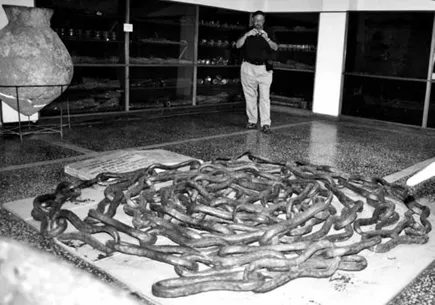
Figure 1.1 Turkish Naval Museum, Istanbul. A part of the Golden Horn chain of 1453 (Photo: author).
I...
Table of contents
- Cover Page
- Half Title page
- Title Page
- Copyright Page
- Contents
- List of Figures and Tables
- List of Contributors
- John Pryor: A Tribute
- The Publications of John Pryor
- Part I Shipping
- Part II Trade
- Part III Crusade
- Index
Trusted by 375,005 students
Access to over 1.5 million titles for a fair monthly price.
Study more efficiently using our study tools.
Frequently asked questions
Yes, you can cancel anytime from the Subscription tab in your account settings on the Perlego website. Your subscription will stay active until the end of your current billing period. Learn how to cancel your subscription
No, books cannot be downloaded as external files, such as PDFs, for use outside of Perlego. However, you can download books within the Perlego app for offline reading on mobile or tablet. Learn how to download books offline
Perlego offers two plans: Essential and Complete
- Essential is ideal for learners and professionals who enjoy exploring a wide range of subjects. Access the Essential Library with 800,000+ trusted titles and best-sellers across business, personal growth, and the humanities. Includes unlimited reading time and Standard Read Aloud voice.
- Complete: Perfect for advanced learners and researchers needing full, unrestricted access. Unlock 1.5M+ books across hundreds of subjects, including academic and specialized titles. The Complete Plan also includes advanced features like Premium Read Aloud and Research Assistant.
We are an online textbook subscription service, where you can get access to an entire online library for less than the price of a single book per month. With over 1.5 million books across 990+ topics, we’ve got you covered! Learn about our mission
Look out for the read-aloud symbol on your next book to see if you can listen to it. The read-aloud tool reads text aloud for you, highlighting the text as it is being read. You can pause it, speed it up and slow it down. Learn more about Read Aloud
Yes! You can use the Perlego app on both iOS and Android devices to read anytime, anywhere — even offline. Perfect for commutes or when you’re on the go.
Please note we cannot support devices running on iOS 13 and Android 7 or earlier. Learn more about using the app
Please note we cannot support devices running on iOS 13 and Android 7 or earlier. Learn more about using the app
Yes, you can access Shipping, Trade and Crusade in the Medieval Mediterranean by Ruthy Gertwagen, Elizabeth Jeffreys in PDF and/or ePUB format, as well as other popular books in History & Australian & Oceanian History. We have over 1.5 million books available in our catalogue for you to explore.