eBook - ePub
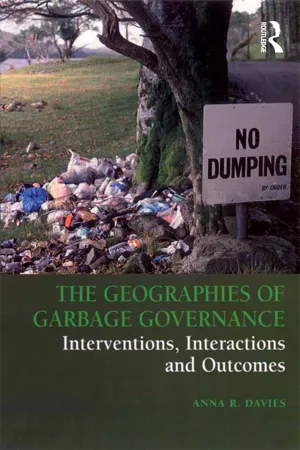
The Geographies of Garbage Governance
Interventions, Interactions and Outcomes
- 214 pages
- English
- ePUB (mobile friendly)
- Available on iOS & Android
eBook - ePub
About this book
Previously perceived as a local, technical issue for governments, waste management is now also a global, socio-political process involving complex patterns of multi-level governance. Yet these geographical complexities have not previously been considered in any detail. This book examines the neglected geographies of waste management, in particular, the integral processes of trans-localization and politicization that are emerging in waste networks. Illustrated by in-depth case studies from New Zealand and Ireland, it critically analyzes the interaction between political scales of governing waste, from the local to the supra-national level. It also looks at the impact of wider systems of governance, civil society and the private sector on waste management policy and practices. In doing so, the book provides a better understanding of waste governance and recommendations for better management of the waste sector in the future.
Theories, Concepts and Frameworks
Chapter 2
Governance, Environmental Governance and Garbage
Introduction
It was established in the previous chapter that how issues are governed and the relative role of actors and institutions in those governing practices is becoming a central concern for society. In the context of this research governing is understood to refer to the guiding, directing or steering of society (Jordan et al. 2005, 479). While historically attention to governing focused on formal practices of government, and particularly the nation state, it is increasingly common to find analyses of governing that engage, both empirically and theoretically, with the broader notion of governance. Governance studies predominantly initiate their discussions with a baseline position that the ‘[r]ules and institutions for the authoritative organization of collective life’ (Donahue 2002, 1) are no longer the preserve of nation states and are formulated and reformulated through complex interactions at a range of scales and involving actors from civil society and the private sector. The commonality of this position is however quickly overshadowed by a diversity of arguments about how exactly those multiple actors come together in particular contexts and, from a more normative perspective, how those interactions should themselves been operationalized in order to facilitate good governance.
This chapter provides a broad overview of recent governance debates highlighting the main areas of convergence and divergence in empirical and conceptual studies. These foundational debates are then used to explore more recent attention to environmental and then waste governance. Finally it is established that, while currently limited in scope, studies of waste governance are forming an increasingly important site of discussion about how society deals with the by-products of its activities.
Governance
There has been growing consideration of governance processes within a range of academic and political debates stimulated by concerns that the state is becoming overburdened by societal demands for services in an increasingly globalized economic and political environment (Pierre 2000). This burgeoning attention has evolved through different disciplinary and practitioner lenses to produce a heavily contested landscape of governance studies. The term governance itself has been much debated with commentators deliberating both on practical applications of the term and with respect to more fundamental definitional issues. Within the field of political science for example Kjaer (2004, 3) illustrates the diversity of definitions by contrasting the work of Rhodes (1997), Rosenau (1995) and Hyden (1999)
Governance refers to self-organizing, interorganizational networks characterized by interdependence, resource-exchange, rules of the game, and significant autonomy from the state (Rhodes 1997, 15).
Global governance is conceived to include systems of rule at all levels of human activity – from the family to the international organization – in which the pursuit of goals through the exercise of control has transnational repercussions (Rosenau 1995, 13).
Governance is the stewardship of formal and informal political rules of the game. Governance refers to those measures that involve setting the rules for the exercise of power and settling conflicts over such rules (Hyden 1999, 185).
An explanation for the diversity in definitions that these quotations illustrate is that the definitions come from divergent sub-fields of social and political science. Whereas Rhodes is talking about governance in the sense of a process of reform occurring in public administration Rosenau is referring to the emergence of, and attempts to resolve, global problems and Hyden adopts governance as a means to engage with theories of third world development. These three areas of social science – public administration, international relations and comparative politics – have been at the leading edge of governance studies, but there are increasingly high profile interventions from geography, sociology and economics that are enriching debates by paying attention to issues of scale, society and efficiency in governing matters.
Disciplinary and definitional divergence has led a number of governance theorists to acknowledge that we ‘are still in a period of creative disorder concerning governance’ (Kooiman 2003, 5). Nevertheless while analyses of governance are diverse they tend to fall into two main camps. The first is focused primarily on empirical descriptions of processes that relate to the governing within contemporary society while the second adopts a conceptual consideration of the role of the state within social systems (Pierre 2000). Within the conceptual literature Peters (2000) suggests a delineation between research that examines the role of the state in influencing social and economic developments (state-centric or ‘old’ governance) and that which adopts a broader analysis of formal and informal associations particularly through networks and partnerships (society-centred or ‘new governance’).
At the forefront of analyses, empirical or conceptual, has been the question of whether there has been a shift from government to governance and if so whether the authority and power of the nation state has been eroded by such a shift. There are those who argue that there has been a hollowing out of the nation state as functions are dispersed to supranational entities, localities and to non-state actors (Jessop 1994; Macleod and Goodwin 1999). However others question whether such processes are indicative of states losing control, suggesting instead that they may reflect attempts by states to reorganize in the face of changing conditions. Fundamentally this position is based on the view that it is erroneous to conflate state structures with state power (Pierre 2000; Pierre and Peters 2000; Swyngedouw 2000). The work detailed in Pierre (2000) in particular clearly supports the view that current trends demonstrate a process of state transformation rather than a decline in state authority. Equally it is oversimplistic to suggest that there has been a smooth, linear trajectory from a position of pure government to one of multifaceted governance. Many studies have demonstrated that government-governance practices can ebb and flow over time and across space (Jessop 2004; MacLeod and Goodwin 1999) as a result of jockeying between actors, institutions and organizations (Rhodes 2000). Nevertheless much of the work on governance concurs that the authoritative allocation of values is not the sole preserve of formal nation-state governments, rather it is dependent on interactions with and relationships between manifold institutions and actors from public and private sectors and civil society at a range of scales and at particular moments (Kjaer 2004) thus creating new ‘geographies of governance’ (MacLeod and Goodwin 1999, 505). Central to these geographies are governing structures operating at and across a range of scales and through networks of associations (Hooghe and Marks 2003).
In the light of these apparently new geographies of governance there has been considerable attention to the methods or mechanisms that might facilitate actors to generate mutually satisfactory and binding decisions through negotiation and deliberation (Martello and Jasanoff 2004; Schmitter 2001). These normative debates have focused on good governance, defined as ‘rules, processes, and behaviour that affect the way in which powers are exercised … particularly as regards openness, participation, accountability, effectiveness and coherence’ (CEC 2001, 8), thereby resurrecting old debates about legitimacy in decision making and demanding discussions of power and interests in governing practices (Kjaer 2004). From a critical perspective Stoker (2000) engages explicitly with these issues of legitimacy, power and interests through his analysis of governance failure. He identifies a lower tier of governance failure, which he sees as a lack of engagement resulting from weakly defined opportunities for dialogue and negotiation between partners leading to a failure to achieve some social purpose. He also identifies a higher tier of governance failure referred to as an inability to produce ‘more effective long-term outcomes than could have been produced using markets or imperative co-ordination by the state’ (Stoker 2000, 105). Consideration of governance failure is useful because it draws attention to not only the practice of governance (how governance happens) but also its impacts and how those impacts are contested.
Despite the plethora of governance studies there are critical positions that question whether such a broad term can be useful in developing a coherent analytical framework (Marinetto 2003). There are also concerns that theory rather than grounded, empirical investigation of governing practices dominates the governance field. Indeed numerous authors call for more detailed empirical testing of theoretical models of governance (Eberlein and Kerwer 2004; Kjaer 2004; Kooiman 2003; van Kersbergen and van Waarden 2004) in order to facilitate a deeper understanding of the approaches and abilities of nation states to govern in an increasingly complex world. Such testing could, as Jordan et al. (2005, 477) propose, provide useful commentary on the divergent claims made about the extent and/or timing of governance transformations. The challenge for governance analysts therefore is to ‘preserve the conceptual breadth of the term [governance], whilst simultaneously gaining analytical precision needed to empirically assess any relevant temporal, spatial and sectoral patterns’ (Jordan et al. 2005, 478). One area where researchers are attempting to respond to this call for the co-development of theory and empirical understanding is within the field of environmental governance.
Environmental Governance
Increasingly studies of environmental issues are adopting and adapting notions of governance to help explain the complex processes of policy making and implementation that include not only the participation of national governments but also international and local government and non-government actors. The aims of these environmental governance studies have been to two-fold, first to re-scale issues that had previously been seen as either the preserve of nation state negotiation, such as global climate change, or of only local concern, such as air quality. Second to recognize the role of non-state participants in policy making, whether they be civil society organizations (Keck and Sikkink 1998; McCarthy 2005) or the private sector (Grossman 2000; Kolk 2000; Roome 1998). As Bulkeley and Betsill (2003, 9) argue, following Auer (2000), while the distinction is often made between ‘global’ processes and actors, and those which are ‘local’ such a binary opposition does not take account of the scalar transcendence of environmental issues nor the multidimensional nature of their politics.
Of course attention to the governing of environmental matters is not a new phenomenon. As Davidson and Frickel (2004) point out studies relating to the environment that engage with governance, broadly defined, have been in existence for the past fifty years in the social sciences. Early environmental governance research was conducted for the most part by political scientists who critically analysed the formation and implementation of environmental policy (as detailed in Sabatier 1979) while more recently conceptual developments such as risk society (Beck 1995), ecological modernization (Hajer 1995) and global environmentalism (Young 1999) have become prominent features of debates within sociology, economics and geography elevating environmental governance to what has been described as metatheory (Davidson and Frickel 2004). The metatheoretical concern of these more recent developments still focus primarily on nation states and their role in creating or resolving environmental problems although a number of authors have sought to bring other levels of government (Bulkeley and Betsill 2003) and other spheres of governance (Keck and Sikkink 1998) into the frame of analysis.
It is through examination of the scalar evolution of governance that the environmental field has been particularly innovative. For example, Martello and Jasanoff (2004) note the juxtaposition of global and local, and of the universal and the particular, in international regimes and policy discourses of environment and development, not least within the realms of sustainability. Environmental issues have sought recognition on the global stage since the 1970s with limits to growth discourses highlighting concerns about the finite carrying capacity of the earth and emphasising the interconnectedness of ecological systems. These themes were developed with explicit political articulation following the publication of Our Common Future (WCED 1987) and subsequently the documents that emerged from the negotiations at the global Rio Earth Summit in 1992. Global institutions such as the World Bank and the United Nations have incorporated environmental management discourses in their operations and multilateral environmental agreements have proliferated with the support of scientific and expert bodies such as the Intergovernmental Panel on Climate Change. At the same time non-governmental environmental organizations have also globalized their campaigns, building their knowledge base and producing their own strategies for environmental protection and sustainable development that have not always coincided with the moves proposed by other global institutions. However critiques of global environmental governance analyses suggest that dominant theories emerging from international relations, be they focused on regimes or notions of global civil society, tend to underplay the role of the sub-national state. In response Bulkeley and Betsill (2003) use the development of scientific and political responses to climate change research as an exemplar of the rediscovery of the local in global environmental governance. They highlight how initial studies of climate change focused on providing evidence of impacts on social and ecological systems at a transnational scale, while newer studies have downscaled their analyses to national and sub-national arenas. The downscaling has led to the recognition of diversity in local knowledges that in turn has generated calls for greater stakeholder and community participation in environmental governance activities. The creation of locally resonant analyses has also created new communities and coalitions of interest such as the Alliance of Small Island States (AOSIS) a group of nations united by a precarious position in the light of climate change and rising seas. As Martello and Jasanoff (2004, 5) conclude, it appears that ‘global solutions to environmental governance cannot realistically be contemplated without at the same time finding new opportunities for local self-expression’. The complexity and uncertainty of environmental issues also means that their governance cannot be simply assigned to technical or scientific resolutions that ignore normative issues and value judgements relating to equitable burdens of responsibility (Agarwal and Narain 1991). Yet incorporating local knowledges in decision making is not easily achieved within the confines of modern decision making systems that are replicated in global environmental regimes. Although there have been moves to introduce more participatory practices it is asserted that scientific knowledge is still seen as separate from (and frequently universal and free from subjective bias) and often superior to local understandings within global environmental governance arenas (Martello and Jasanoff 2004). It is also argued that where a local governance perspective, which by its very nature explicitly considers the role of the sub-national state, has been developed there are assumptions made that governance of environmental issues considered to be ‘global’ still emerges on a international stage to be imposed subsequently at the national and local scale – sometimes called the trickledown model of governance (Bulkeley et al. 2003). Whichever kind of knowledge is invoked in environmental governance it remains that those with power and resources tend to be able to define whether certain issues merit the world’s attention (Martello and Jasanoff 2004).
There is a synergy here between the work on governance and environmental governance that suggest new geographies of governing are emerging across scales and in places, with coalitions developing between divergent actors seeking to bring about collective solutions to problems (Hajer 1995; Keck and Sikkink 1998; Liftin 1994). These new geographies are time and place specific in that the same scientific knowledge has been used to develop divergent regulatory decisions in countries that are economically and politically similar (Brickman et al. 1985) and it is increasingly recognized that ‘social interests and relationships are every bit as critical in the formation of scientific consensus as in any other domain of human activity’ (Martello and Jasanoff 2004, 337). Therefore environmental issues traditionally conceptualized as being place-specific have been embraced on the global stage while at the same time attention on the global stage has attempted to reclaim space for local conditions.
The nature of locality is commonly used and understood in everyday language to denote a geographical unit that is encompassed within a larger geographical, political or administrative entity such as the nation state.1 In the arena of environmental governance however Martello and Jasanoff (2004) argue that the category of local does not necessarily have to be grounded in particular places, but can be equally assigned to communities of interest that are bonded through institutions or united through common histories or knowledges such that it might more accurately be described as glocal (Fagan 2004). Central to this glocal reconceptualization of environmental governance is a challenge to the traditional view that policies simply trickledown from one level of government to the next at which point non-state actors have the opportunity to influence them. The challenge to this trickledown model proposes that relationships can and do emerge between diverse actors operating across non-contiguous scales through networks. Networks of local authorities, for example, may seek to influence debates about climate change at the European level without necessarily going through nation state channels to do so (Bulkeley et al 2003).
The identification of networks, networking and partnerships as ‘sites where governance can, and does, take place’ (Bulkeley and Betsill 2003, 18) is another key area of convergence between governance and environmental governance literature and there is a general acceptance that networks are a ‘defining characteristic of the new [environmental] governance’ (Leach and Percy-Smith 2001, 30). Here the contribution of environmental governance is an extension of the network approaches developed by Rhodes (1997), Castells (1997) and Jessop (1995), amongst others, particularly in the light of EU environmental policy analysis where states are seen as ‘one among a variety of actors contesting decisions that are made at a variety of levels’ (Hooghe and Marks 1997, 23). The argument that environmental governance is not strictly ordered or hierarchical allows for the possibility that non-state actors and institutions can be active in seeking partnerships or associations to influence, even propose, policies at a range of scales from the sub- to the supra-national. According the O’Riordan and Church (2001, 22) this view of governance ‘offers opportunities and threats to various social groups, depending on their access to resources and support, and on their collective capacity to identify and accommodate change’ as policy networks differ in structure and nature and not all nodes within networks have equal influence over policy outcomes. Marsh and Rhodes (1992) and O’Riordan and Jordan (1996) argue that networks can be placed along a spectrum. At one extreme is a tightly organized policy community based on a single department alone with a loose network at the other where a broader range of actors, that engage with government departments on a less predictable basis, come together over issues where there is a significant degree of contention. Nonetheless across this spectrum is the assumption that for the achievement of policy outcomes with a minimal level of conflict governments need ‘the assistance and co-operation of other groups’ (Smith 1997, 35). Networks are also seen as a manifestation of the diffusion of governance away from the nation state to both the global and local levels and as a site of governance innovation in their own right with networks acquiring authority by generating and disseminating knowledge as information, ideas and values (Bulkeley and Betsill 2003; Lipschutz 1997).
Policy networks have been critically analysed by a range of authors in terms of how networks are formed and how policy change occurs through them. Most pertinently difficulties are demonstrated where, with issues such as climate change, there are many government departments implicated and a range of actors with varied interests involved. Bulkeley (2000a) suggests, for example, that rather than a single network within climate change policy there are actually layered, intersecting networks operating which demand more nuanced analysis than simply asserting the existence of networks. This would require a detailed understanding of the actors and institutions involved, the ways in which they attempt to govern and the outcomes of those governing practices. While networks have been promoted as mechanisms to create consensus on governing through negotiation they have also emerged as channels through which systems of governance can be resisted when environmental resources have not been protected (Keck and Sikkink 1998; Yearley 1995).
Initially empirical studies of environmental governance tended to focus on the global institutions of governing in particular sectors, such as climate change (Paterson 1996), ozone depletion (Liftin 1994), desertification (Porter et al. 2000) and hazardous waste (Wapner 1998). However the terrain of environmental governance studies is diversifying with an increasing number of studies examining particular actors within governance environments such as environmental non-governmental organizations (McCarthy 2005), new policy instruments (Jordan et al. 2005) and corporate environmental responsibility (Lund-Thomsen 2005) as well as the complexities of interactions between scales and spheres of governance (Jordan and Schout 2005; Klooster 2005; Thompson 2005; Vogler 2005). The environmental governance field is thus replete with empirical work and theoretical advances from a range of disciplines and sub-disciplines within the social sciences, typical of what Spaargaren et al. (2000, 2) term the ‘scattered landscapes of environmental studies’. Yet there are opportunities for advancement both in terms of sectoral coverage and analytical endeavours. Most significantly are calls to expand the number of comparative studies (Jordan et al. 2005), to expand the analysis of governance to consider other aspects of environmental concern and to broaden research beyond a state-centred or society-centred approach in order to engage with an ‘explicit examination of state-societal relations’ (Davidson and Frickel 2004, 472). It is in response to these gaps in research that this book has been developed as comparing the governing of municipal solid waste provides an arena through which to address these three developmental avenues. However this book is not the first foray into waste governance per se as the following section demonstrates.
Waste Governance
If environmental governance is indicated by multiscalar interactions of different actors from a range of state and non-state organizations then the management of waste is no exception. Waste is already a matter for global environmental governance through the Basel Convention for the transnational movement of hazardous waste (...
Table of contents
- Cover Page
- Half Title Page
- Dedication
- Title Page
- Copyright Page
- Contents
- List of Figures
- List of Tables
- Acknowledgements
- List of Abbreviations
- Glossary of Foreign Words (Irish and Māori)
- Introduction
- Part 1 Theories, Concepts and Frameworks
- Part 2 Governing Garbage: Case Studies
- Part 3 Comparisons and Conclusions
- Bibliography
- Index
Trusted by 375,005 students
Access to over 1.5 million titles for a fair monthly price.
Study more efficiently using our study tools.
Frequently asked questions
Yes, you can cancel anytime from the Subscription tab in your account settings on the Perlego website. Your subscription will stay active until the end of your current billing period. Learn how to cancel your subscription
No, books cannot be downloaded as external files, such as PDFs, for use outside of Perlego. However, you can download books within the Perlego app for offline reading on mobile or tablet. Learn how to download books offline
Perlego offers two plans: Essential and Complete
- Essential is ideal for learners and professionals who enjoy exploring a wide range of subjects. Access the Essential Library with 800,000+ trusted titles and best-sellers across business, personal growth, and the humanities. Includes unlimited reading time and Standard Read Aloud voice.
- Complete: Perfect for advanced learners and researchers needing full, unrestricted access. Unlock 1.5M+ books across hundreds of subjects, including academic and specialized titles. The Complete Plan also includes advanced features like Premium Read Aloud and Research Assistant.
We are an online textbook subscription service, where you can get access to an entire online library for less than the price of a single book per month. With over 1.5 million books across 990+ topics, we’ve got you covered! Learn about our mission
Look out for the read-aloud symbol on your next book to see if you can listen to it. The read-aloud tool reads text aloud for you, highlighting the text as it is being read. You can pause it, speed it up and slow it down. Learn more about Read Aloud
Yes! You can use the Perlego app on both iOS and Android devices to read anytime, anywhere — even offline. Perfect for commutes or when you’re on the go.
Please note we cannot support devices running on iOS 13 and Android 7 or earlier. Learn more about using the app
Please note we cannot support devices running on iOS 13 and Android 7 or earlier. Learn more about using the app
Yes, you can access The Geographies of Garbage Governance by Anna R. Davies in PDF and/or ePUB format, as well as other popular books in Technology & Engineering & Geography. We have over 1.5 million books available in our catalogue for you to explore.