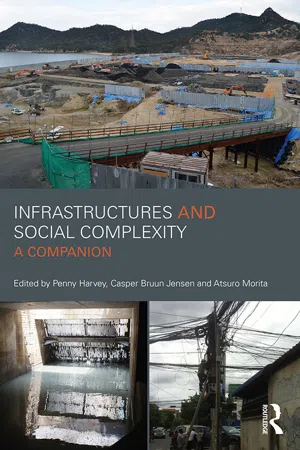
Contemporary forms of infrastructural development herald alternative futures through their incorporation of digital technologies, mobile capital, international politics and the promises and fears of enhanced connectivity. In tandem with increasing concerns about climate change and the anthropocene, there is further an urgency around contemporary infrastructural provision: a concern about its fragility, and an awareness that these connective, relational systems significantly shape both local and planetary futures in ways that we need to understand more clearly. Offering a rich set of empirically detailed and conceptually sophisticated studies of infrastructural systems and experiments, present and past, contributors to this volume address both the transformative potential of infrastructural systems and their stasis. Covering infrastructural figures; their ontologies, epistemologies, classifications and politics, and spanning development, urban, energy, environmental and information infrastructures, the chapters explore both the promises and failures of infrastructure. Tracing the experimental histories of a wide range of infrastructures and documenting their variable outcomes, the volume offers a unique set of analytical perspectives on contemporary infrastructural complications. These studies bring a systematic empirical and analytical attention to human worlds as they intersect with more-than-human worlds, whether technological or biological.
eBook - ePub
Infrastructures and Social Complexity
A Companion
- 424 pages
- English
- ePUB (mobile friendly)
- Available on iOS & Android
eBook - ePub
Infrastructures and Social Complexity
A Companion
About this book
Information
1 Introduction
Infrastructural complications
Over the past decade, infrastructures have emerged as compelling sites for qualitative social research. This occurs in a general situation where the race for infrastructural investment has become quite frenzied as world superpowers compete for the most effective means to circulate energy, goods, and money. At the same time, millions of people disenfranchised by trade corridors, securitized production sites, and privatized service provision seek\ to establish their own possibilities that intersect, disrupt, or otherwise engage the high-level investments that now routinely reconfigure their worlds. The projects of the powerful and the engagements of the poor are thus thoroughly entangled in this contemporary drive to “leverage the future.”1
The study of infrastructure can lead researchers in multiple directions. Some take an interest in embedded power relations or their symbolic or spectacular dimensions. Others focus on the effects of categorization and standardizations and the modes of support and connectivity enabled by infrastructural systems, including the reconfigurations of the lives and subjectivities of those who live in and around them. Yet others emphasize their scale-making capacities, their recursive, or loopy, relations with social formations, and their role in the emergence of new ontologies. This volume offers a compendium of approaches to this increasingly populated field of social research.
For obvious reasons, the selection is far from comprehensive. This introductory essay discusses a range of issues that we have been particularly interested in, and engaged by. At the end, we set out the principles that have guided the selection of contributions, some of which are written by established figures, many others by new voices. Our hope is that others will find inspiration and their own sense of possibility for engaging what can appear as vast, uncontainable networks that may be resistant to established social methods. The aim is to exhibit a range of ways to examine the textures, social complexities, and complications of infrastructure.
The volume grew out of overlaps that appeared between two research groups, one affiliated with the Centre for Research on Socio-Cultural Change (CRESC) based at the University of Manchester and the Open University in the UK and one centered at Osaka University in Japan, in collaboration with Danish researchers at the IT University of Copenhagen and the University of Copenhagen. Our shared interests coalesced at a time when each project was beginning to work on edited collections. Rather than joining our projects, we joined our networks; yet much of the impetus of the original projects remains visible within the collection.
At CRESC, Penny Harvey and her colleagues were exploring how infrastructures such as roads, airports, or digital information systems draw together political and economic forces in complicated ways and often with unexpected effects. This focus had developed from previous interests in the role that objects and materials play in the shaping of social worlds and the dynamic configuration of social relations (Harvey et al. 2013). Following diverse practices of standardization, engineering, gridding, contractual negotiation, resource allocation, and scientific investigation, the research group had tracked the ways in which infrastructural practices were implicated in broader dynamics of social change.2
Based at Osaka University, Atsuro Morita, and Casper Bruun Jensen, formerly at the IT University in Copenhagen, were developing a focus on infrastructure to think about the challenges of environmental transformation. The original impetus for this project was the observation that “infrastructure” and “nature” both often operate as unseen backgrounds for the study of social relations and practices. As it unfolded, the project gradually came to zoom in on infrastructure as a double means to know and control environments.
Environmental infrastructures turned out to be about the making and remaking of worlds at once material and semiotic and inhabited not only by people but also by a multiplicity of nonhumans. Focusing on these under-the-radar entanglements allowed project members to explore the involvement of a wide range of entities – from bacteria and landforms to rice and spirits – in infrastructural projects, while also paying attention to the involvement of infrastructures in multiple world-shaping, or ontological, projects (see Jensen and Morita 2015). Similarly, the CRESC research group was finding that entities such as soil, concrete, fake passports, airport lounges, cats, ghosts, digital data, and earth beings were integral to infrastructural systems and to the worlds that these systems brought into being.
What coincided across these projects was thus an interest in several aspects of infrastructural formations that resonate with multiple conceptual concerns of contemporary anthropologists, sociologists, historians, cultural geographers, STS scholars, artists and others. These aspects relate to the experimental, uncertain, affective, temporal, and political dimensions of infrastructures, seen as relational worlds. Thus, we shared an orientation to the interfaces between infrastructure and social formations, as exemplified by projects and designs of the engineering sciences, currently being implemented and planned at an unprecedented rate on a planetary scale. Our interests also converged around conceptual and empirical questions of how to get the social complexities and other complications of such projects adequately into view.
In spite of our projects’ aspirations to novelty, they are in many ways indebted to existing scholarship as well as to recent research taking part in the unfolding “turn” to infrastructure in the social sciences and humanities.3 In the following sections we spell out what we see as particularly exciting about the way in which this infrastructural turn turns.
Turning to infrastructure: some inversions
In the mid-1990s, a time at which infrastructures generated less excitement than presently, Geoffrey C. Bowker (1995) developed the idea of infrastructural inversion. Infrastructural inversion aimed to address the tendency of infrastructures to remain as invisible backdrops to social action, their characteristics instead seen as explainable by the social forces, interests, or ideologies that went into making them. Crudely put, American automobile culture might be said to reflect individualism, while the reliance of the Japanese on jam-packed trains would mirror their group orientation. According to such views, infrastructures were surfaces from which social, cultural, or political motives could be decoded.
Compared with these kinds of approaches, infrastructural inversion entailed a figure-ground reversal. The insistence that our analytical attentiveness to infrastructures must be inverted was grounded in the realization that, short of breakdown, infrastructures tend to remain invisible at the level of use and experience. Rather than assuming cultural, political, or knowledge-based explanations of infrastructures, Bowker thus suggested an analytical entry-point via a focus on materiality. He noted, for example, that while it used to be thought that advances in life expectancy in the nineteenth century were due to improved scientific knowledge, the major causes actually related to changing systems of food production and consumption, and to improved sewage systems (1995: 235). Bringing the infrastructural “ground” up front in this way facilitated understanding of how complex chains of material relations reconfigure bodies, societies, and also knowledge and discourse in ways often unnoticed.4
Inversion thus drew attention to the silent, unnoticed work done by infrastructures. Indeed, in Susan Leigh Star and Karen Ruhleder’s (1996) classic definition, this invisibility is central to the infra-structural quality of a system. Their focus on the “when” rather than the “what” of infrastructure highlighted that seamless flow was a fragile achievement. In contexts where such flows have been achieved, inversion emerged as the key methodological and conceptual move by which analysts were able bring to light the hidden relations on which smooth circulation depended. This also meant, though, that infrastructural inversion seemed particularly relevant in contexts where infrastructures did work quite well. In many situations, however, infrastructures do not generate anything resembling smooth flows.
A significant impetus behind the current vogue for infrastructural analysis is the increasingly obvious fragility of many infrastructures. Where breakdown is regular (Harvey 2005; Campbell 2012), or where infrastructures have collapsed (Simone 2004; Harvey 2015; Jensen 2016), patterns of visibility are quite different from those where connectivity can be routinely assumed.
In a much cited review article, Brian Larkin (2013) highlighted that infrastructures are in fact often not unnoticed. Instead, he argued, they inhabit a whole spectrum of visibilities, from opacity to spectacle. Larkin pointed to diverse cases, like Indonesian satellites (Barker 2005), Mongolian electricity (Sneath 2009), or the urban development of Congo’s Kinshasa (de Boeck 2011), in which infrastructures, far from being invisible, were designed to elicit awe and admiration. If premised on the idea of an initial invisibility that must be foregrounded by the analysis, the notion of infrastructural inversion would have no purchase in these situations. Its use would be delimited to a subset of infrastructures falling on the low-end of the scale of visibility.
Arguably, however, the significance of infrastructural inversion is not obviated by these spectacular examples. For whereas Larkin’s use of visibility centers on infrastructure as public displays, the invisibility to which Bowker attends refers to mundane operational processes. These are not immediately comparable forms of visibility, since the regular operations of infrastructures may remain opaque or unknown, even as the infrastructure is publically exhibited. At the very least, these entry points for the study of infrastructure tend to configure them as quite different kinds of objects. This observation encourages further questions about the specific relational forms or collectives that constitute various infrastructural systems, including the patterns of visibility and invisibility to which they give rise.
Thus, even if television shows and advertisement posters represent infrastructural development as testimony to national innovation and achievement, or to the prowess and foresight of a particular politician, we need to also understand how exactly satellite images enter Indonesian homes. We also need to attend to the specific material relations, ideas and expectations that accompany the arrival of electricity (Boyer 2015), the appearance of a road (Harvey and Knox 2015), or a database (Jensen and Winthereik 2013). As Tess Lea and Paul Pholeros (2010) have shown in the context of aboriginal housing, the public exhibit of material artifacts, like pipes, is no guarantee of a functioning infrastructure.
To our minds, however, infrastructural inversion poses a different kind of difficulty, relating to the relatively sharp distinction it assumes between the conceptual-analytic and the empirical-ethnographic (cf. Jensen 2014). In the original formulation, as noted, it is the analyst that brings to light infrastructural invisibilities. In situations where infrastructural problems or breakdowns are at once ubiquitous and highly visible, however, we come across some different kinds of inversion.
For one thing, some situations elicit naturally occurring inversions in which various exigencies make infrastructural operations abundantly visible to some people (Blok this volume; Fennell 2011; Nakazora this volume), or that induce new forms of practical engagement, tinkering, or sabotage (Anand 2012; Howe 2014; von Schnitzler 2008). In these situations, where the relations that working infrastructures depend on are revealed through disruption, disturbance, or absence, inversion is an empirical condition before becoming an analytical tool. Second, naturally occurring inversions may induce among the users of infrastructure and analysts alike radically new ideas of what infrastructure is. Atsuro Morita (2016) has thus documented how changing relations between delta infrastructures and rice farming gradually led engineers and hydrologists to see rice not as an end product supported by an external hydraulic infrastructural system but rather as infrastructural in its own right. As these examples suggest, it is not so much that the importance of inversion has been obviated by the recognition of new forms of infrastructural visibility, but rather that the forms of inversion have multiplied in a way that blurs the distinction between the conceptual and the empirical.
But what is infrastructure? A minimal point of entry
Indicating an unstable relation between the conceptual and the empirical situations of naturally occurring inversion obliges us to address a question, confounding in its seeming simplicity: what, actually, do we mean by an infrastructure?
Even when we have quite a good grasp of the questions addressed to us by infrastructures, it is far more difficult to define them in general. The significantly variable perspectives discussed above exemplify this difficulty. Provisionally, and minimally, we might say that we are dealing with technologically mediated, dynamic forms that continuously produce and transform socio-technical relations. That is, infrastructures are extended material assemblages that generate effects and structure social relations, either through engineered (i.e. planned and purposefully crafted) or non-engineered (i.e. unplanned and emergent) activities. Seen thus, infrastructures are doubly relational due to their simultaneous internal multiplicity and their connective capacities outwards (Harvey 2017). If infrastructures fail, this can accordingly be due either to internal disruption or because of a breakdown in the relations between the infrastructure and the domain of activity it is expected to sustain. The tension between the engineered and the non-engineered system is important here. It also introduces new complexities because an engineered system might break down, or fail to deliver as intended, yet continue to give rise to emergent effects. Dysfunctional or collapsed sewage systems, for example, continue to generate health hazards across urban space (Jensen this volume).
In spite of our provisional clarifications, a definitive definition of infrastructure remains elusive. Yet, given the ongoing transformation and emergence of sites taken by other actors to be infrastructural, the aspiration to unequivocal specification can be seen as itself conceptually and empirically counter-productive. Though minimal, the characterization offered above allows us to begin inquiry with firm focus on the “infra” qualities of these systems, on their temporal and spatial reach, and, crucially, on the complexities and complications attending their open-ended relational capacities (Carse this volume). It does not, however, allow us to predict how people will apprehend and identify infrastructures as relevant in their lives, or even what they will see as infrastructural. Nor does it allow us to know just where or how radically new forms of infrastructure might emerge as significant forces.
We thus embrace the diverse possibilities that a focus on infrastructure affords in the broadest sense – looking for those underlying configurations that are not necessarily the site of active reflection on the part of those whose lives they shape, while also attending to the ways in which people do sometimes reflect on the socio-material conditions that shape their life worlds. In this way, we think, a focus on infrastructure can cut across the tensions between surface and depth that mark social theory. Once we approach infrastructures as dynamic and emergent forms, it is clear that we cannot specify their contours in advance. The question “what is infrastructure” must therefore be addressed, and experimen...
Table of contents
- Cover
- Half Title
- Title Page
- Copyright Page
- Table of Contents
- List of figures
- List of contributors
- Acknowledgment
- 1. Introduction: Infrastructural complications
- PART I: Development infrastructures
- PART II: Urban infrastructures
- PART III: Energy infrastructures
- PART IV: Environmental infrastructures
- PART V: Infrastructural figures
- PART VI: Digital infrastructures
- Index
Trusted by 375,005 students
Access to over 1.5 million titles for a fair monthly price.
Study more efficiently using our study tools.
Frequently asked questions
Yes, you can cancel anytime from the Subscription tab in your account settings on the Perlego website. Your subscription will stay active until the end of your current billing period. Learn how to cancel your subscription
No, books cannot be downloaded as external files, such as PDFs, for use outside of Perlego. However, you can download books within the Perlego app for offline reading on mobile or tablet. Learn how to download books offline
Perlego offers two plans: Essential and Complete
- Essential is ideal for learners and professionals who enjoy exploring a wide range of subjects. Access the Essential Library with 800,000+ trusted titles and best-sellers across business, personal growth, and the humanities. Includes unlimited reading time and Standard Read Aloud voice.
- Complete: Perfect for advanced learners and researchers needing full, unrestricted access. Unlock 1.5M+ books across hundreds of subjects, including academic and specialized titles. The Complete Plan also includes advanced features like Premium Read Aloud and Research Assistant.
We are an online textbook subscription service, where you can get access to an entire online library for less than the price of a single book per month. With over 1.5 million books across 990+ topics, we’ve got you covered! Learn about our mission
Look out for the read-aloud symbol on your next book to see if you can listen to it. The read-aloud tool reads text aloud for you, highlighting the text as it is being read. You can pause it, speed it up and slow it down. Learn more about Read Aloud
Yes! You can use the Perlego app on both iOS and Android devices to read anytime, anywhere — even offline. Perfect for commutes or when you’re on the go.
Please note we cannot support devices running on iOS 13 and Android 7 or earlier. Learn more about using the app
Please note we cannot support devices running on iOS 13 and Android 7 or earlier. Learn more about using the app
Yes, you can access Infrastructures and Social Complexity by Penelope Harvey, Casper Jensen, Atsuro Morita, Penelope Harvey,Casper Jensen,Atsuro Morita,Casper Bruun Jensen, Penelope Harvey, Casper Bruun Jensen, Atsuro Morita in PDF and/or ePUB format, as well as other popular books in Scienze sociali & Sociologia. We have over 1.5 million books available in our catalogue for you to explore.