eBook - ePub
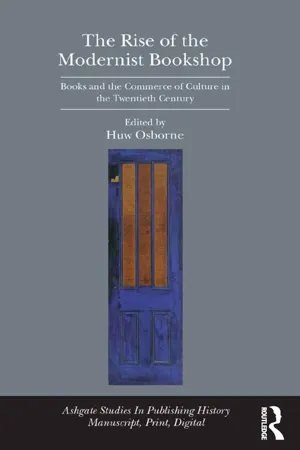
The Rise of the Modernist Bookshop
Books and the Commerce of Culture in the Twentieth Century
- 234 pages
- English
- ePUB (mobile friendly)
- Available on iOS & Android
eBook - ePub
The Rise of the Modernist Bookshop
Books and the Commerce of Culture in the Twentieth Century
About this book
The trade in books has always been and remains an ambiguous commercial activity, associated as it is with literature and the exchange of ideas. This collection is concerned with the cultural and economic roles of independent bookstores, and it considers how eight shops founded during the modernist era provided distinctive spaces of literary production that exceeded and yet never escaped their commercial functions. As the contributors show, these booksellers were essential institutional players in literary networks. When the eight shops examined first opened their doors, their relevance to literary and commercial life was taken for granted. In our current context of box stores, online shopping, and ebooks, we no longer encounter the book as we did as recently as twenty years ago. By contributing to our understanding of bookshops as unique social spaces on the thresholds of commerce and culture, this volume helps to lay the groundwork for comprehending how our relationship to books and literature has been and will be affected by the physical changes to the reading experience taking place in the twenty-first century.
Information
Chapter 1
‘We Have Come to Stay’: The Hampshire Bookshop and the Twentieth-Century ‘Personal Bookshop’
Early in the fifty-five-year history of the Hampshire Bookshop of Northampton, Massachusetts, Robert Frost described the enterprise as ‘one of the few bookshops in the world where books are sold in something like the spirit they were written in’.1 To mark the Bookshop’s twenty-fifth anniversary in 1936, manager Marion Dodd cannily reprinted his words in a limited-edition keepsake, a booklet of Frost’s poems that patrons snapped up and collectors today still seek. Turn the pages of the handsomely printed ‘From Snow to Snow’ and you will readily grasp what set this institution apart, for it encapsulates the founders’ aim to draw author, book, and reader into intimate proximity. This was not only a humanistic goal; it was good business sense, establishing a model for bookselling that persists – though severely challenged by chain-store incursions – nearly a century later.
On that same anniversary, Frederic Melcher of The Publishers’ Weekly toasted the store as ‘the most influential bookshop that this country has had during my time of watching the book business’2 – and if his appreciation was coloured by celebratory hyperbole, he nonetheless recognised that something was distinctive about this one small business and its principals, something that changed the way Americans bought, read, and thought about books.
Among the numerous women-run ‘personal bookshops’ that sprang up during the World War I era and wielded such influence, Hampshire Bookshop cofounders Marion Dodd and Mary Byers Smith claimed theirs was the first.3 This new boutique approach to bookselling – ‘personal’ not only because it emphasised one-on-one service bolstered by an ingrained knowledge of books but because it reflected the taste and character of the bookseller – opened up new ways of connecting books with the reading public. The personal bookshop contributed to the rise of literary modernism, in the way the urban coffeehouse would fuel the Beat movement in the 1950s and the chain megastore would drive book-buying habits in the 1990s. Through a hand-picked and hand-sold inventory, regular involvement in the emerging profession, a slate of popular book-and-author events, and a cosy and inviting retail space, ‘the Hamp’ and other personal bookshops set the standard. Such bookselling enterprises also provided attractive employment and entrepreneurial opportunities for women. And soon they fostered new patterns of consumer and materialist attitudes, changing the way the American public – in particular, women – purchased and perceived books.
Not all the personal bookshops lasted for long. The trend, largely sparked in 1915 by an Atlantic Monthly article suggesting bookselling as the ideal occupation for throngs of recent female college graduates, yielded at least forty-four new enterprises throughout the United States by 1920.4 Within a decade, some of the most promising of these, including the pioneering Sunwise Turn of New York City, were gone. Others fell victim to the Great Depression or simply to changing priorities. But the Hampshire Bookshop, launched in a small central Massachusetts town with only the pooled resources of two Smith College graduates and their handful of investors, remained a going concern through 1971 and a fond memory long after.
Soon after the Bookshop’s opening, Northampton’s daily newspaper reported that the store seemed ‘already to have climbed at least the first rung of its ladder … And if you question Miss Dodd as to the stability of the organisation, she will reply quickly, “It is very permanent indeed; we have come to stay”’.5 The Hampshire Bookshop’s staying power, more than its sales volume or other measures of success, accounts for the disproportionate breadth of its influence. It served a culturally important region of the United States not only as general and college bookstore, but also as gathering place, purveyor of rare and collectible books, promoter, reviewer, and even editor and publisher. Among the Bookshop’s staunchest partisans were publisher Alfred Knopf, author and book-trade wit Christopher Morley, British authors Vita Sackville-West and Harold Nicolson, Dr Doolittle creator Hugh Lofting, and Imagist poet Amy Lowell; dozens of writers of national and international repute, such as William Butler Yeats, Carl Sandburg, Dorothy Canfield Fisher, Thornton Wilder, Archibald MacLeish, Padraic Colum, James Stephens, Edna St Vincent Millay, G.K. Chesterton, Vachel Lindsay, and Bennett Cerf, came to Northampton audiences through the Bookshop’s agency. Robert Frost was not alone in recognising the ways the Hampshire Bookshop could aid his publishing career, and he, like many others, remained a friend of the institution throughout his life.
Primed for a Bookselling Partnership
Marion Elza Dodd, Smith College class of 1906, and Mary Byers Smith (no relation to college founder Sophia Smith), class of 1908, had been close friends throughout college though separated by a few years in age. New Jersey native Marion, whose grandfather Moses Dodd had established an esteemed New York publishing house and whose uncles and cousins were also renowned in the book business, met Andover, Massachusetts-born Mary through college clubs. After graduation from Smith, the women maintained their friendship while working at various jobs back home – Marion as a librarian, Mary as a hospital volunteer. But by 1915, as the US was anxiously occupied with events on the European front, each had become restless with life in the parental household. Now in their thirties and both unmarried, they sought a new and worthy challenge.6
An inheritance from a wealthy aunt provided Mary a windfall that year, and the pair lighted on the idea of establishing a bookstore in the college town to which they felt such strong ties. Within a few short months, they formed a corporation and enlisted officers and directors (primarily from the ranks of Smith faculty), obtained letters of introduction to jobbers, secured credit, and located a place of business. The $25,000 in capital they had raised through sale of stock to initial shareholders no doubt helped ensure a sound footing from the outset.7 The Hampshire Bookshop was launched in April 1916 with the slogan ‘There Is No Frigate Like a Book’, borrowed from an Emily Dickinson poem. By October the shelves were stocked, and the doors were opened to the public and flocks of Smith students.
Marion Dodd, outgoing and assertive, was a natural organiser and manager. Her authoritative manner commanded respect from associates and employees. At the time she became involved in the Bookshop venture, she had already served as managing editor of a social-work journal and librarian to John D. Rockefeller’s General Education Board; as she matured in her professional role, she became quite comfortable dealing with authors, influential publishers, and the media. Her standards of performance were exacting, her expectations of staff high.
While both women were avid readers and informed critics, it was Mary Byers Smith, the poet and volunteer social worker, who reviewed books in the house promotional newsletter and provided guidance on the shop layout and decor. In the store, they used some pieces of furniture that Marion had built, and they chose motifs of ships and the sea that held special meaning for them both.
Since neither Dodd nor Smith left behind correspondence of a personal nature, and since neither took a public stand on issues of women’s political or sexual rights, questions about their romantic lives remain matters of speculation. As social critic Betsy Israel points out in her perceptive study of unmarried women of the era, ‘the term “lesbian” – the very idea – did not in its current sense yet exist’ at the time, and it is unlikely that Dodd or Smith (or their literary, business, or college peers) would have thought of themselves in that sense even if their relationship went deeper than platonic friendship.8 Certainly they saw themselves as part of a homosocial, female-centric community built on friendship and mutual empowerment, and even in the mid-1920s when rumours circulated that Dodd’s new attachment and cohabitation with college professor Esther Cloudman Dunn led Mary Byers Smith to bow out of her ten-year partnership in the Hampshire Bookshop, Dodd and Smith remained lifelong friends.
This sense of community was central to the Bookshop’s identity and mission from the outset. Its founders laid out five specific goals:
1. To give all people the variety of pleasures that association with good books always provides: to make itself an indispensable aid to scholarship and research, thereby filling in the gaps of a college curriculum; to increase the reading habit by providing students with a selection of books which will develop a catholic taste in literature; to encourage the collecting of fine books as a means of developing sound criticism and discriminating judgment.
2. To offer students the opportunity to save money by establishing a co-operative department somewhat similar to the plan in operation at Yale or Harvard which paid a certain percentage on student purchases at the end of the year in proportion to the profits of the business …
3. To prove the aptitude of women for the book business.
4. To demonstrate the fact that a college book store can sell all kinds of good books, instead of merely text books and stationery and possibly doughnuts.
5. To make contacts between the author and his public.9
Dodd and Smith wisely envisioned the Bookshop as a bookstore to serve both community and college, modelling it on features of the groundbreaking Harvard ‘Coop’. Following the rapid growth of American post-secondary education in the late nineteenth century, several colleges and universities had established campus bookstores: the Harvard Co-operative Society (founded 1882) was, and is, among the earliest and best known. Some were owned by the institution, others were completely independent, and some set up a cooperative plan and were even owned and managed by students themselves.10
Beyond simply making available the goods students sought, the Hampshire Bookshop’s principals actively promoted a cooperative arrangement that would reward buyers for their loyalty and help ensure a steady market. As Dodd put it in a later document, the Bookshop was ‘an economic experiment in the selling of books to students, which would give them an opportunity to buy books and supplies more cheaply’.11 Although the firm was not extended the option of an exclusive contract with Smith College or an official endorsement, it enjoyed the blessing of college president Marion LeRoy Burton and his successor Laurenus Clark Seelye and the encouragement generally of alumnae, faculty, and students.12
The first such cooperative bookstore at a women’s college, the experiment quickly proved successful: halfway through the shop’s first year, the cooperative department reported that it had enlisted more than 1,250 Smithies who had each paid a membership fee of one dollar. At the end of the year, members would receive dividends on the store’s profits in proportion to the purchases they had made. Though the plan was initially open only to Smith students, the directors promised to extend membership to alumnae if it met their expectations.13
Mary Byers Smith was careful to distinguish between the Hampshire Bookshop and the garden-variety campus store. However, as she explained to readers of The Publishers’ Weekly:
[T]he fact that we have had from the first a broad, modern conception of bookselling has kept us from even appearing to be a ‘college bookstore’. To those of you who do [sic – not?] know us and to whom the term means one of those barren distribution centers for pads and pens and Livys and zoo instruments, we state emphatically that we are not a college bookstore … Our aims are less finite, less easily attained – and more alluring.14
Dodd and Smith would be instrumental, a few years later, in changing the role and image of the college bookstore on a much broader scale. Dodd made professionalisation of college bookselling a special project, and under her leadership the Hampshire Bookshop became one of the founding members of the College Bookstore Association (later the National Association of College Stores). The organisation’s aim was to counter the situation, as described in the Boston Transcript in 1922, that
American communities have been, on the whole, slow to recognize the bookstore as an integral part in the educational system. Of course every one knows that a university town must necessarily be a distribution point for pads, pencils and recommended textbooks. That the university bookstore should not merely supply an existing demand but create a need for books – inspire a thirst for learning, is to some people an entirely new idea … Curiously enough the faculties of schools and colleges are by no means whole souled abettors of these new ideas … [T]here still lingers a conservatism that hesitates to recommend book ownership to students with the necessary definiteness of price and edition.
The editor went on to comment (perhaps persuaded by the Hampshire Bookshop’s active publicity efforts), ‘I have often heard it said that the Smith College student who is working her way through college buys more books outright than the careless wealthy student who is apt to borrow or buy in groups’.15 In the years to come, Dodd would find it necessary on occasion to remind the Smith community that the Bookshop’s cooperative plan was available to benefit them, especially at times when the college students complained about textbook prices or floated the idea of a college-sanctioned store.16 But a brisk trade in textbooks, supplies, and supplemental readings would sustain the Bookshop for decades and also forge a mutually beneficial partnership between town and gown.
With the enthusiastic backing of President Seelye and a solid ...
Table of contents
- Cover Page
- Title Page
- Copyright Page
- Contents
- List of Figures
- Notes on Contributors
- Acknowledgements
- Introduction: Openings
- 1 ‘We Have Come to Stay’: The Hampshire Bookshop and the Twentieth-Century ‘Personal Bookshop’
- 2 The Sunwise Turn and the Social Space of the Bookshop
- 3 Frank Shay’s Greenwich Village: Reconstructing the Bookshop at 4 Christopher Street, 1920–1925
- 4 ‘Lady Midwest’: Fanny Butcher – Books
- 5 ‘A Place Known to the World as Devonshire Street’: Modernism, Commercialism, and the Poetry Bookshop
- 6 Counter-Space in Charles Lahr’s Progressive Bookshop
- 7 The Grolier Poetry Book Shop: From Couch to Cultural Icon
- 8 Sylvia & Company
- Coda
- References
- Index
Trusted by 375,005 students
Access to over 1.5 million titles for a fair monthly price.
Study more efficiently using our study tools.
Frequently asked questions
Yes, you can cancel anytime from the Subscription tab in your account settings on the Perlego website. Your subscription will stay active until the end of your current billing period. Learn how to cancel your subscription
No, books cannot be downloaded as external files, such as PDFs, for use outside of Perlego. However, you can download books within the Perlego app for offline reading on mobile or tablet. Learn how to download books offline
Perlego offers two plans: Essential and Complete
- Essential is ideal for learners and professionals who enjoy exploring a wide range of subjects. Access the Essential Library with 800,000+ trusted titles and best-sellers across business, personal growth, and the humanities. Includes unlimited reading time and Standard Read Aloud voice.
- Complete: Perfect for advanced learners and researchers needing full, unrestricted access. Unlock 1.5M+ books across hundreds of subjects, including academic and specialized titles. The Complete Plan also includes advanced features like Premium Read Aloud and Research Assistant.
We are an online textbook subscription service, where you can get access to an entire online library for less than the price of a single book per month. With over 1.5 million books across 990+ topics, we’ve got you covered! Learn about our mission
Look out for the read-aloud symbol on your next book to see if you can listen to it. The read-aloud tool reads text aloud for you, highlighting the text as it is being read. You can pause it, speed it up and slow it down. Learn more about Read Aloud
Yes! You can use the Perlego app on both iOS and Android devices to read anytime, anywhere — even offline. Perfect for commutes or when you’re on the go.
Please note we cannot support devices running on iOS 13 and Android 7 or earlier. Learn more about using the app
Please note we cannot support devices running on iOS 13 and Android 7 or earlier. Learn more about using the app
Yes, you can access The Rise of the Modernist Bookshop by Huw Osborne in PDF and/or ePUB format, as well as other popular books in Literature & Publishing. We have over 1.5 million books available in our catalogue for you to explore.