- 204 pages
- English
- ePUB (mobile friendly)
- Available on iOS & Android
eBook - ePub
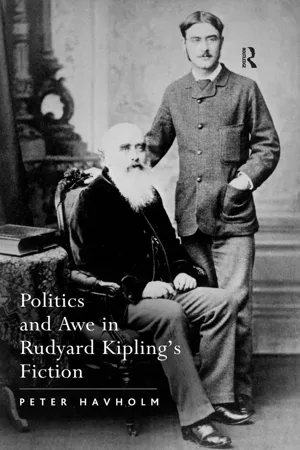
Politics and Awe in Rudyard Kipling's Fiction
About this book
There has been a resurgence of interest in Kipling among critics who struggle to reconcile the multiple pleasures offered by his fiction with the controversial political ideas that inform it. Peter Havholm takes up the challenge, piecing together Kipling's understanding of empire and humanity from evidence in Anglo-Indian and Indian newspapers of the 1870s and 1880s and offering a new explanation for Kipling's post-1891 turn to fantasy and stories written to be enjoyed by children. By dovetailing detailed contextual knowledge of British India with informed and sensitive close readings of well-known works like 'The Man Who Would Be King',' Kim', 'The Light That Failed', and 'They', Havholm offers a fresh reading of Kipling's early and late stories that acknowledges Kipling's achievement as a writer and illuminates the seductive allure of the imperialist fantasy.
Information
Chapter 1
“In All this Tumult”: Rudyard Kipling’s University Year
The first three chapters of this book examine the men and women of British India in the 1880s, how they acted and the thought that underlay their actions. The aim is to construct from their recorded words the audience for whom the young Kipling wrote and from whom he learned how to think about life. It is important to investigate his sources because their clear effect on Kipling puts into question a long-standing thread of argument, appearing most influentially in Edmund Wilson's 1941 essay "The Kipling that Nobody Read": the attempt to separate Kipling's views on British policy in India or Ireland or South Africa from his best stories' underlying ethic. Typical and summative of its contemporary form is Thomas Pinney's 1986 characterization of a Kipling who had "two broadly different ways of looking at India," one "official" and the other "more personal and humane" (1986. 18).1
In fact fresh evidence of the discourse the young Kipling read and heard in 1883—as subeditor of the Civil and Military Gazette (CMG) and living with his parents in Lahore—suggests another view of the thought in Kipling's fiction set in India. It is derived from the understanding of British India expressed in the journalism of Lockwood Kipling, Rudyard's father, and it includes the combination of Orientalist assumptions about cultural hierarchy and sympathy for the Indian people that Edward Said describes. Anglo-Indians who adopted this way of thinking believed that their sympathy for the Indians justified their Imperial rule. That there might have been such thinking should come as no surprise if we assume that English, Scottish, and Irish servants of Empire and their families thought of themselves as people of good will.
John Lockwood Kipling worked at the Sir Jamsetjee Jeejeebhoy School of Art in Bombay from 1865 through 1876, when he took the position of director of the School of Art and curator of the Museum of Indian Arts and Crafts in Lahore. In Bombay and Lahore, he wrote columns for the Allahabad Pioneer, the Pioneer Mail and Weekly News, and the CMG from 1870 through at least 1887. (As pointed out below, there is good evidence that Rudyard's mother Alice Kipling wrote several of the Bombay columns that appeared under her husband's name, and Charles Carrington, Kipling's authorized biographer, says that she "wrote occasionally for the Pioneer" (83). Given the habit within the Kipling family of sharing writing tasks, I shall give credit for Rudyard's family education to both parents, though my evidence will come almost exclusively from writing for which his father was paid.) The thought in Lockwood's columns suggests parallels with the notion of two Kiplings, but while Lockwood makes both positive and negative judgments of the Indian people, they mark coherence rather than disjunction. Indeed, both his columns and the 1883 Ilbert Bill resistance by the Anglo-Indian community display rejection of and sympathy for the other; they also show criticism of the colonizer from the perspective of the colonized and the most strident colonial contempt for the colonized—all making mutually-supportive sense. Looking back on this view now, we may see it as obfuscatory. But the "ease of atmosphere" in Kim is not there because Kipling was "blinded by his own insights about India" into reifying British India, as Said maintains (193, 196). Rather, there was a set of insights waiting for him in Lahore; he did not need to develop his own. Further, the complexity of these Anglo-Indian insights did not require the erasure of colonial power. They made, rather, a coherent, conscious subjectivity that thought of itself as fundamentally humane, using its power for good. This line of Anglo-Indian thought in 1883 seems clearly the source of the benign hierarchy that makes Kim a success.
Some years ago, I was encouraged by Patrick Williams and Laura Chrisman's suggestion that "native presences, locations, and political resistance need to be further theorized as having a determining or primary role in colonial discourse" (16). Perhaps there was evidence outside Kipling's fictions—in comments by the Indian people whom he encountered in Lahore—that would allow one to characterize the results of the cross-cultural confrontations that must have occurred. Such evidence might helpfully contextualize the stories and perhaps further illuminate the critics' divided Kipling. But a brief item in one of the Indian Government's confidential weekly reports on the Vernacular Newspapers Published in the Punjab from 1883 stopped this inquiry cold:
The Koh-i-Nur (Lahore), of the 7th of February, on the authority of a local correspondent, complains that native visitors to the Museum at Lahore are not allowed to sign the visitors' book kept at the museum. Moreover, natives are not allowed to enter the museum with native shoes on, and consequently they are exposed to great inconvenience from walking on the pavement with naked feet, especially in the cold weather (150).2
The Koh-i-Nur's observation about native shoes is confirmed by Lockwood's "Report on the Lahore Central Museum for 1879–80," in the 1880 Punjab Government Gazette in the British Library's India Office collection. There, Lockwood quotes the text on a notice board he has recently placed outside the museum, and it includes the line, "Native shoes must be put off at the side of the entrance door."
That Lockwood took the imperious approach in the matter of native shoes was suprising. After all, famously at the beginning of Kim, "the wonder house," curated by a "white-bearded Englishman" (who is Lockwood Kipling), is a place in which a "stone Bodhisat...looks down upon the patent self-registering turnstiles" (410)-where East and West meet in love and respect. But the notice board asserts the sharpest of separations: West snubbing East. It sent me back to the biographers.
The customary narrative of Kipling in India explains why this writer, unlike the Anglo-Indian writers who preceded him,3 was able to make enduring art with British India as its subject. Stimulated by his youth, intelligence, and endless energy, the young Kipling explored Indian and Anglo-Indian by-ways alike. As was to be true throughout his life, men and women chose to confide in the young reporter because he listened with closest attention to their difference. Thus, the boy's contact with British and Indian and Eurasian people in Lahore and Simla and Allahabad allowed him to develop new pictures of British India because they were more true than what had gone before. His friend Kay Robinson, who became Kipling's editor on the CMG in March 1887, was first to sound this note in several reminiscent articles published in the 1890s. In a typical passage, he remarks:
But most wonderful is his [Kipling's] insight into the strangely mixed manners of life and thought of the natives of India.... Show him a native, and he would tell you his rank, caste, race, origin, habitat, creed, and calling. He would speak to the man in his own fashion, using familiar homely figures which brightened the other's surprised eyes with recognition of brotherhood and opened a straight way into his confidence (Orel, 82).
One finds the same story in other biographers, and prominent in its renditions after the posthumous publication of Kipling's autobiography in 1937 are the "night walks." Kipling writes in Something of Myself. "Often the night got into my head... and I would wander till dawn in all manner of odd places" (33). Carrington elaborates, "During that hot weather of 1883, for the first time in his life, [Kipling] knew loneliness and found it unbearable....After the paper had been put to press in the sultry Indian midnight, he would find his way into the old walled city, penetrating into courts and alleys where few Europeans went" (86). Harry Ricketts puts the night walks later, in 1884, leading to the September 1884, story "The Gate of the Hundred Sorrows." whose details suggest "Rud had begun his night-ramblings in the old, walled Mohammedan city" (69). Thomas Pinney notes that it was not until 1884 that Stephen Wheeler, his editor, "began to entrust [him] with important work for his paper" (Letters, 4).
It is unlikely that the night walks began in 1883. Carrington's only evidence is "The City of Dreadful Night," published in 1885. There are no night walks in Kipling's letters of 1883—whereas in 1884 his letters are full of his meetings with Indian people.4 And while the 1885 diary seems always partial, it does record what might have been "night walks," but only beginning 1 March(Pinney, 1990, 195–218). It also records an enormous amount of work for the CMG and on early stories (like "The Strange Ride of Morrowbie Jukes"), and the young writer's determination to keep up "my average" of words per day (see 199–218). Moreover, it is doubtful that a seventeen-year-old boy, eight months in the country and living with his parents, can be assumed to have visited the old city late at night. Andrew Lycett's account, like Ricketts', suggests that Kipling did not get there until 1884, after taking opium. Then, Lycett believes, "[t]he neophyte...was freed to step out of his own cultural and intellectual environment and make something more substantial of his immediate experience" (97).
But the year before he "stepped out" was packed with stimulus for the 17-year-old's imagination. The rhetoric of 1883 provided his Anglo-Indian introduction to critical thinking: a university year denied him in England, but one unique to a country where a city of 300,000 Indians might be ruled by seventy "white faces." and a country of 200 million by a proportionate handful living and working apart. These men worked hard, and their style of initiation was correspondingly abrupt. Indeed, a note published near the end of the year in the CMG offers contemporary context for Kipling's introduction to Anglo-Indian thinking. Since it was on page one, it was probably written by Rudyard's first editor, Stephen Wheeler, whom the standard Kipling narrative frequently castigates as blind to the talent of his new employee.5 Perhaps Wheeler, after a year's work with a very young subeditor who enjoyed having strong views, could write feelingly about the zealotry of new members of the Indian Civil Service. This was a consequence of the lowering to 19 of the upper age limit at which the Civil Service examination could be taken. (As the note acknowledges, everyone knew that the limit had been lowered to make it more difficult for Indians to enter the Service.6)
These "civilians-in-arms," the item grumbles, now arrive at "the precise stage in their lives when the boy is turning into a man; and education, as distinct from instruction, is beginning to be possible for him." The problem is that:
if there is one way better calculated than another to secure that a youngster shall be narrow-minded and one-sided, it is to... send him to a country where officialism is rampant, where men of cultured leisure are almost unknown, and where the nature of his occupation tends necessarily to force his ideas into grooves, many and various perhaps, but each in itself narrow (5 December 1883).
Whether or not this note was written with the young Rudyard Kipling in mind, it affirms the possibility that Kipling's earliest contacts with India could have narrowed rather than broadened his understanding. And indeed, an examination of the views he encountered in 1883 shows that just such narrowing texts flooded his working days.
Kipling's letters confirm that that year was packed with reading. He wrote to the Rev. George Willes (to be "the Padre" in Stalky) in November 1882, "One of the first things a subeditor has to learn is to altogether give up original writing" (Letters I, 24). And while he very soon began to write "reviews," brief "editorial notes," and "scraps" (24–52), most of his time that first year was spent on "scissor work" (to Cornell Price—"the Head" in Stalky—28). As he wrote to Willes, "Some thirty papers go through my hand daily," from which he clipped "exchanges," to help fill pages three through seven or eight of the paper. "My files are waiting for the shears in long rows," he wrote to his cousin Edith Macdonald; "I am responsible for everything in the paper after the first two pages" (34). The papers from which he clipped "exchanges" included Anglo-Indian newspapers like the Calcutta Englishman and Indian Daily News, the Bombay Gazette and Times of India, the Madras Times, the Karachi Sind Gazette, and the CMG's sister paper, the Allahabad Pioneer. He also clipped newspapers from England like The Times, the Pall Mall Gazette, and the St. James's Gazette.
Kipling writes about this period in his autobiography, "If I tripped over detail, the Club attended to me" (Something, 28). That is the experienced men with whom he dined at Lahore's Punjab Club set him straight if they found errors in his newspaper. But the example of the Club's attending to him that he remembers fifty-two years later has nothing to do with a detail of Indian life. "All [his] universe hisses" him one evening because his paper has printed the wrong opinion on the Bill for the Amendment of the Criminal Procedure Code, familiarly known as the Ilbert Bill (after Courtney Ilbert, the Legislative Council's legal member who introduced it on 2 February 1883). In the terms set out by the CMG's note on the indoctrination of youth quoted above, Kipling was hissed by "rampant officialism" for stepping out of an approved, narrow "groove." In 1935, at work on his autobiography, he remembers the Ilbert Bill as a naive liberal Viceroy's endangerment of British women (Something, 31). This is precisely the opinion that dominated his reading and his talk with his father and mother in 1883, a sign of the life-long influence of the ideas and attitudes he encountered in that year.
Eighteen eighty-three was a critical year for British India and for its Viceroy. Appointed in 1880 after Gladstone had brought the Liberals to power, Lord Ripon (see Figure 5) wanted to "raise the people of this country politically and socially... [and make] the educated natives the friends instead of the enemies of our rule" (Ripon to W.E. Forster, 19 May 1883, quoted in Sarvepalli Gopal, 84). The Ilbert Bill proposed a small change consistent with these principles. It would have allowed Indian judges in the mofussil, the country outside the Presidency districts (of Bombay, Madras, and Calcutta), to try European British subjects.
The bill proposed to eliminate an anomaly introduced into the Indian Criminal Procedur...
Table of contents
- Cover
- Half Title
- Dedication
- Title
- Copyright
- Contents
- List of Illustrations
- Acknowledgments
- Preface
- Introduction: Guilty Pleasures
- 1 "In All this Tumult": Rudyard Kipling's University Year
- 2 Let the Sovereign Speak
- 3 Attending to Cultural Context
- 4 For to Admire
- 5 The Uncomplicated Soul
- 6 Day spring Mishandled
- Appendix 1 "Kidnapped'" as first published in the Civil and Military Gazette
- Appendix 2 A Word on Indian Progress by John Lockwood Kipling
- Works Cited
- Bibliography
- Index
Trusted by 375,005 students
Access to over 1.5 million titles for a fair monthly price.
Study more efficiently using our study tools.
Frequently asked questions
Yes, you can cancel anytime from the Subscription tab in your account settings on the Perlego website. Your subscription will stay active until the end of your current billing period. Learn how to cancel your subscription
No, books cannot be downloaded as external files, such as PDFs, for use outside of Perlego. However, you can download books within the Perlego app for offline reading on mobile or tablet. Learn how to download books offline
Perlego offers two plans: Essential and Complete
- Essential is ideal for learners and professionals who enjoy exploring a wide range of subjects. Access the Essential Library with 800,000+ trusted titles and best-sellers across business, personal growth, and the humanities. Includes unlimited reading time and Standard Read Aloud voice.
- Complete: Perfect for advanced learners and researchers needing full, unrestricted access. Unlock 1.5M+ books across hundreds of subjects, including academic and specialized titles. The Complete Plan also includes advanced features like Premium Read Aloud and Research Assistant.
We are an online textbook subscription service, where you can get access to an entire online library for less than the price of a single book per month. With over 1.5 million books across 990+ topics, we’ve got you covered! Learn about our mission
Look out for the read-aloud symbol on your next book to see if you can listen to it. The read-aloud tool reads text aloud for you, highlighting the text as it is being read. You can pause it, speed it up and slow it down. Learn more about Read Aloud
Yes! You can use the Perlego app on both iOS and Android devices to read anytime, anywhere — even offline. Perfect for commutes or when you’re on the go.
Please note we cannot support devices running on iOS 13 and Android 7 or earlier. Learn more about using the app
Please note we cannot support devices running on iOS 13 and Android 7 or earlier. Learn more about using the app
Yes, you can access Politics and Awe in Rudyard Kipling's Fiction by Peter Havholm in PDF and/or ePUB format, as well as other popular books in Literature & Literary Criticism. We have over 1.5 million books available in our catalogue for you to explore.