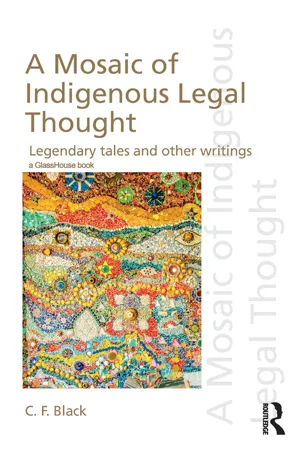
This book offers an Indigenous supplement to the rich and growing area of visual legal scholarship. Organized around three narratives, each with an associated politico-poetic reading, the book addresses three major global issues: climate change, the trade in human body parts and bio-policing. Manifesting and engaging the traditional storytelling mode of classical Indigenous ontology, these narratives convey legal and political knowledge, not merely through logical argument, but rather through the feelings of law and the understanding of lawful behaviour produced by their rhythm. Through its own performativity, therefore, the book demonstrates how classical Indigenous legal traditions remain vital to the now pressing challenge of making peace with the earth.
- 180 pages
- English
- ePUB (mobile friendly)
- Available on iOS & Android
eBook - ePub
About this book
Information
Part I
Visualizing Indigenous jurisprudence
Chapter 1
A poem
The originals
The originals,
they came long before us,
seeking out food and shelter,
harbouring their own ways of thinking,
their own ways of knowing the land.
So very different from us.
They held their nightly feasts
in places unseen by us.
They shared their knowledge
and built their towers of mud and clay
or burrowed deep underground.
Those on high chirped and discussed
the pervading winds
and the knowledge borne
by the spirits of the winds of the West.
They took their direction from the Unseen
and knew of places that we could not see
So very different from us.
As they spread with ease
and gentleness across the land,
their direction guided
by a collective unknown.
Their expectation was much
and their lives were devoid of stuff.
They fought and breed at the speed
that Nature preordained.
And so the balance came
and went and so did they.
No need of despair
that they no longer bore
nor breed.
So very different from us.
Their intention was not
to rule the world
for they barely noticed it
as their lives passed
with speed and intent.
Intent borne of survival
and rapture in the moment.
So very different from us.
Chapter 2
Video clip
As we are all basically cyber-connected through our handy mobile phones, it would not seem out of order to ask the reader to watch this short video clip of Marshall McLuhan before reading on, as it will contextualize my book and also show just how far we are behind in our understanding of the present world of technological development and control of the way we do things.
https://www.youtube.com/watch?v=viuIKgjLnDE
Chapter 3
Visualizing Indigenous jurisprudence through a diverse range of narratives
The manner in which primitive, tribal people understood the world and the way we must now understand the world are identical. We stand at the dawn of a new creation, for we can no longer process our experience into predetermined categories of explanation; we require a generalised approach to life which can give us meaning that transcends the immediate intake of data.
– Vine Deloria Jr1
But now, gazing across a landscape that has shown us the consequences of the Cartesian model as it has played out from early to late modernity, it has become apparent a new paradigm is needed. We have come full circle and the renewal of the very impulse that gave birth to modernity, in the face of comparable epistemological crises, now calls for an integral rhetoric that complements the virtues and counters the defects of critical reason with the sublime elegance and binding power of ethical wisdom.
– Richard Sherwin2
Although we know a tremendous amount about the nuances of cognitive processing, that knowledge does not go all the way toward explaining human behavior. In fact, emotion turns out to be an enormously powerful predictor of behavior, especially in the area of politics and policy.
– Jennifer Lerner3
This book offers a timely departure from the standard form of Indigenous legal argumentation within the discourses of laws and returns to the ‘old’ for guidance on preparing text that may transition into the visual vortex now surrounding us with meaning. The exponential speed and volume of data upon us each day call for a different approach to understanding the world, as do the ways in which connectivity is eroding traditional power structures.4
Google alone is teaching us new ways of understanding our knowledge – the shift from the knowledge worker to the smart creative typifies the new employee in the internet century.5 This book is written for the smart creative – that person whose understanding of the world is lateral and diverse. Google rose as the shift from the dominance of the supplier moved to that of the ‘informed’ consumer: a consumer whose world is saturated with visual stimuli cached in tantalizing storylines. A consumer with an expectation that they must be entertained on the one hand, but choose the meaning they wish to draw from the information being offered on the other. The legal world is also subject to this fundamental power shift in meaning-making. We can no longer dictate who or what is an expert because the internet century is one of speed and constant change in social norms and geopolitics. Just as the nineteenth-century male legal theorist is now suspect in a world in which women and ‘the other’ have a voice and a right to practise their laws, so too is the manner in which we present knowledge. Therefore, this book offers a mosaic of writings that are more aligned to a matrix structure, and encourages the reader to connect with the stories and other writings in order to form their own opinions. The intention is not to offer a complete thesis on one subject, but rather to present a new paradigm as suggested by Sherwin – one built on Deloria’s call for a generalized approach to life – which can give us a meaning that transcends the immediate intake of data. Furthermore, it is designed to align the reader’s feelings about a topic rather than suggest that they try to ‘take in the immediate data’ on the subject being discussed, because:
when law migrates to the screen it lives there as other images do, motivating belief and judgement on the basis of visual delight and unconscious fantasies and desires. This condition of ontological and ethical uneasiness threatens the legality of law’s claim to power.6
Sherwin cautions that new factors have begun to influence judgement and belief and, as neurologists have discovered, it is emotions and experiences that shape decision-making; this points to the importance of storytelling, which I suggest is an important skill in the new paradigm. Just as legal judgments often come down to who tells the most compelling story, the same principle applies in the visual world.
The mosaic is therefore made up of a group of loosely interconnected themes and characters, meant to stimulate the reader to make connections to their own understandings of law and lawful behaviour in the Indigenous world and the world around them. This book does not guide or encourage the traditional ways of critical thinking, but instead follows the path of the traditional story and offers an opportunity for the reader to consider an issue by reading my account, in both narrative and rhetoric form, of how I came to an understanding of it. Just as anthropomorphic tales are not written for critical analysis, the mosaic of works can be said to be a series of journeys or songs through which the reader may move at their own pace. Like all journeys/songs, some are of interest and others are not. This certainly applies to the following works. I am not setting out a definitive account of any particular issue; rather, I invite the reader into the world of my moral compass and the ways in which I find meaning. I therefore take the reader on a journey/song to make their own connections, and to evoke their own emotions and experiences, which may help to formulate their own decisions and to guide their moral compass in these times of exponential growth of data and visual stimulation. My approach is a response to Sherwin’s argument that ‘motivating belief and judgement on the basis of visual delight and unconscious fantasies and desires’ requires a new approach to Legal Studies.7 This book offers a matrix of writing to bring forth the jurisprudence of ‘feeling the law’ or song of the law, as well as returning to a ‘tribal way’ of understanding Indigenous legal thought.
Building on that jurisprudence, this book is held together thematically by three anthropomorphized animal tales, which make up the Legendary Tales of the Wind Watchers. Each tale develops a narrative loosely centred on a major global issue. Those three issues are climate change, the trade in human body parts and bio-policing. The intention is not to turn the global issue into the central theme of each story, but rather to influence the interaction of the characters in the stories and also in the other writings.
Interwoven through the themes are a series of subtexts that are impacted by these global dilemmas, together with a smattering of poetry. Once again, the poetry is highly visual, and is an emotive response to the issues dealt with in the writings that follow each tale. The three themes, and the decision...
Table of contents
- Cover
- Half Title
- Title Page
- Copyright Page
- Dedication
- Table of Contents
- Acknowledgements
- Part I Visualizing Indigenous jurisprudence
- Part II Climate change
- Part III The trade in body parts
- Part IV Bioinsecurity
- Part V Last words
Trusted by 375,005 students
Access to over 1.5 million titles for a fair monthly price.
Study more efficiently using our study tools.
Frequently asked questions
Yes, you can cancel anytime from the Subscription tab in your account settings on the Perlego website. Your subscription will stay active until the end of your current billing period. Learn how to cancel your subscription
No, books cannot be downloaded as external files, such as PDFs, for use outside of Perlego. However, you can download books within the Perlego app for offline reading on mobile or tablet. Learn how to download books offline
Perlego offers two plans: Essential and Complete
- Essential is ideal for learners and professionals who enjoy exploring a wide range of subjects. Access the Essential Library with 800,000+ trusted titles and best-sellers across business, personal growth, and the humanities. Includes unlimited reading time and Standard Read Aloud voice.
- Complete: Perfect for advanced learners and researchers needing full, unrestricted access. Unlock 1.5M+ books across hundreds of subjects, including academic and specialized titles. The Complete Plan also includes advanced features like Premium Read Aloud and Research Assistant.
We are an online textbook subscription service, where you can get access to an entire online library for less than the price of a single book per month. With over 1.5 million books across 990+ topics, we’ve got you covered! Learn about our mission
Look out for the read-aloud symbol on your next book to see if you can listen to it. The read-aloud tool reads text aloud for you, highlighting the text as it is being read. You can pause it, speed it up and slow it down. Learn more about Read Aloud
Yes! You can use the Perlego app on both iOS and Android devices to read anytime, anywhere — even offline. Perfect for commutes or when you’re on the go.
Please note we cannot support devices running on iOS 13 and Android 7 or earlier. Learn more about using the app
Please note we cannot support devices running on iOS 13 and Android 7 or earlier. Learn more about using the app
Yes, you can access A Mosaic of Indigenous Legal Thought by C.F. Black in PDF and/or ePUB format, as well as other popular books in Diritto & Diritto civile. We have over 1.5 million books available in our catalogue for you to explore.