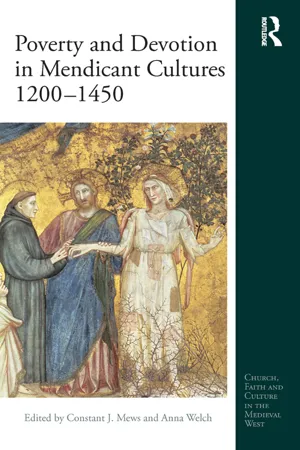
The practice of identifying poverty, chastity and obedience as the three ‘evangelical counsels’ developed only during the course of the thirteenth century, through the influence of the Rule of Francis of Assisi. While they were all traditional concepts, they had never previously been signalled out in this particular way.1 Strictly speaking, the Franciscan Rule insists on a vow not of poverty, but of being without anything of one’s own (sine proprio).2 There is a subtle difference between sine proprio, a legal notion, and paupertas, understood as being a voluntary commitment rather than an involuntary state. The question needs to be asked why it was that in a period of remarkable economic transformation in thirteenth-century Europe, poverty came to assume such a symbolic importance within religious life. How did it happen that a vow of being without anything of one’s own, came to be spoken of as a vow of poverty, a condition considered as shameful when imposed by necessity?
There had been many new movements in the eleventh and twelfth centuries, professing commitment to ‘the apostolic life’ and extending religious renewal to the laity.3 By 1200, however, institutionalisation had led many of these movements to lose steam. A new generation of preachers was emerging in the later twelfth century, like Valdes of Lyons, interested in promoting use of the vernacular. While troubled by the potential influence of dedicated groups like the Cathars (or Albigensians), who rejected the entire sacramental structure of the Church, Valdes failed to persuade the authorities to accept his way of promoting renewal. Even more serious as a threat to episcopal authority were those Cathar boni homines, who were even more radical than Valdes in rejecting not just the institutional authority of the Church, but its core doctrines. This was the context in which mendicant orders emerged, offering renewal of apostolic ideals, but within the framework of orthodoxy.
Not professing stability to a single location, in the fashion of monks, mendicant preachers promoted the cause of penitence within the community. The easiest way of enabling them to establish a legally acceptable status within the Church was for them to establish a recognised ordo. The most successful of these were the Order of Friars Minor, established by Francis of Assisi (1181/82–1226), and the Order of Preachers, founded by Dominic of Osma (1170–1221).4 Francis himself never originally invoked the notion of an ordo, preferring to speak simply of ‘a form of life’.5 By 1221, however, both orders had secured legal recognition within the Church. By the mid thirteenth century, there were many other orders (only gradually identified in canon law as mendicant), such as the Carmelites, the Augustinians, and the Friars of the Sack, suppressed outside England in 1274.6 While all of these new religious movements emphasised living out apostolic ideals in practice, there was no clear agreement about how this should be done. Fearful of excessive multiplicity, the Fourth Lateran Council officially decreed in 1215 that only the three authoritative Rules of the past could be observed, namely those of Benedict, Basil and Augustine.7 This did not impede Francis, a layman who had received spoken approval from Innocent III in 1209 for a primitive form of his own Rule that survives as the Early Rule (from 1221) and in its officially endorsed revision (the Later Ruler) from 1223. By contrast, Dominic, an Augustinian canon from Osma, was more willing to work within established canonical structures. He directed his disciples to follow the Rule of Augustine, interpreted according to a particular set of constitutions. Francis and Dominic thus established very different ways of interpreting a mendicant way of life.8 Nonetheless, both men offered a pattern quite distinct from that of traditional monasticism, defined by its commitment to a vow of stability.
Dominic established that the only vow formally taken should be one of obedience ‘to God, Mary and the Master of the Order, according to the Rule of blessed Augustine and the Institutions of the Order of Preachers’.9 The Rule of Francis by contrast, offers an interpretation of the apostolic life more centred around following the example of Jesus than that of the early Church. It introduces three core vows, namely of obedience, chastity and being without anything of one’s own (sine proprio).10 These are also the three vows defined in the Rule of Clare, in which the sisters are described as pauperes (rather than minores, like the friars).11 Yet alongside this general statement of renunciation of personal property, Francis’s Rule gave specific and more potentially contentious advice that brothers should not receive in any way ‘coin or money, whether for clothing, books, or payment for some work – indeed not for any reason, unless for an evident need of the sick brothers, because we should not think of coin or money having any greater usefulness than stones.’12 There was no precedent in any previous religious legislation for speaking so specifically about coin in this way, as a potential danger to religious life. Francis reinforced the particular way in which he interpreted sine proprio in the Testament that he wrote, shortly before his death in 1226, in which he urged his brothers not to accept any churches or dwellings ‘unless these buildings reflect the holy poverty promised by us in the Rule.’13 The Testament concludes with this firm admonition that no brother should seek to approach Rome with the view of acquiring property, insisting that its text be preserved alongside the Rule. Francis exalted poverty in the dictated version of his Testament: ‘Since, because of weakness and pain, I am unable to speak, I briefly explain in these three words my will for my brothers, that they always love each other as a sign of memory of my blessing and testament, and that they keep our Lady Holy Poverty, and that always remain faithful and loyal to the leaders and all clerics of holy mother Church.’14 This notion of Lady Holy Poverty (domina sancta paupertas), invoked in the 1223 version of the Rule and his Testament, signals a vocabulary that was rhetorically dramatic, for which there was no immediate precedent. Some Franciscan writers (although not all), included poverty as one of the virtues, although this departed from classical convention.15 For thinkers steeped in Aristotle, poverty could not be a virtue in itself. Augustine and Jerome had praised voluntary poverty as a notion, picking up the phrase from Seneca, but spoke only occasionally of holy poverty, not making it a theme of their preaching.16
Certainly, the poverty of Christ became a major theme of the Franciscan movement.17 Yet Francis regularly links poverty to the more familiar virtue of humility, the core virtue of the Rule of Benedict.18 This accentuated focusing on poverty as an internal disposition rather than as an external condition. To s...