eBook - ePub
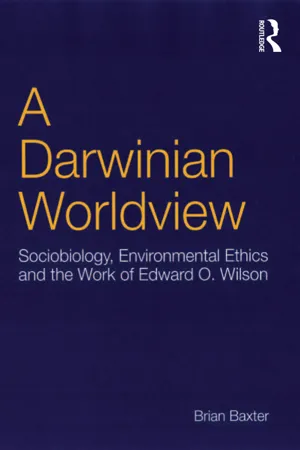
A Darwinian Worldview
Sociobiology, Environmental Ethics and the Work of Edward O. Wilson
- 208 pages
- English
- ePUB (mobile friendly)
- Available on iOS & Android
eBook - ePub
A Darwinian Worldview
Sociobiology, Environmental Ethics and the Work of Edward O. Wilson
About this book
Darwin's theory of evolution by natural selection is considered in its application to human beings in this book. Brian Baxter examines the various sociobiological approaches to the explanation of human behaviour which view the human brain, and so the human mind, as the product of evolution, and considers the main arguments for and against this claim. In so doing he defends the approaches against some common criticisms, such as the charge that they are reductionist and dehumanising. The implications of these arguments for the social sciences and humanities are assessed, as is the naturalistic view of ethics to which they lead. A key issue examined in the book is the connection between this Darwinist perspective on human beings and modern environmental ethics, which also often assume that human beings are part of an evolved living world. The implications of these positions for the meaningfulness of human life are also examined. Throughout the discussion the positions in sociobiology and environmental ethics developed by Edward O. Wilson are taken as an exemplar of the characteristic features of a Darwinian worldview, and the arguments of Wilson and his chief critics are thoroughly examined.
Information
Chapter 1
Introduction
This book aims to explore the implications of what will be referred to as a Darwinian worldview. Charles Darwin did not intend to produce a worldview when he wrote Origin of the Species, aiming solely to tackle the specific intellectual problem referred to in the title of his book. Since he published that work in 1859 his scientific ideas have moved from the realm of the speculative to become received, in their twentieth-century neo-Darwinian form, as part of scientific orthodoxy.
However, many thinkers have developed from his account of the origin of species, especially as applied to our own species, a distinctive perspective on the universe that merits the label ‘worldview’. A worldview embodies a specific understanding of reality, based on presuppositions that are regarded by its exponents as, at least, reasonable, and, more boldly, as firmly established or even indubitable. From these presuppositions a synoptic account is developed of the basic features of reality, encompassing the human and non-human realms, and of how they relate to each other: which are fundamental, which derivative; which are fugitive, which permanent; which have value, which do not. There are various forms of worldview, such as religions and ideologies. But not all worldviews are religious, even though they do all embody metaphysical positions, nor are they all ideologies, at least if we take the latter to involve an orientation of practical action in pursuit of socio-political purposes (Heywood 2003: p. 12). The claim that the Darwinian worldview is a new religion is one that we will have occasion to examine later in this book.
The Darwinian worldview embodies, of course, the two key ideas of Darwin’s theory as applied to human beings. Firstly, it takes as axiomatic the claim that ‘Homo sapiens is an animal species’. Secondly, it accepts the Darwinian claim that this species, like all others on the planet, has arisen by a process of evolution by natural selection from an ancestor common to them all. My own interest in this worldview stems from the fact that these two claims regularly form part of the case made by environmental ethicists for the argument that human beings have moral responsibilities towards, and not simply with respect to, the non-human world of living entities. For such ethicists, in which group I include myself, we are held to be an animal species with a variety of important interconnections with the non-human world, and indeed to share a common descent with all other life-forms on the planet, as the theory of natural selection implies. This fact of our interconnection is held to justify the view that we have the obligations just mentioned (see, for example, Norton 1991). Contrariwise, we are not justified in regarding the rest of the living world as no more than a set of resources to be used for our own purposes as we see fit.
One of the main purposes behind this book is to discover whether there is any important connection between the views that share these presuppositions. Is the Darwinian worldview complementary to the environmental ethicists’ project? Does it support it in any significant ways? Can reasons be found from within the Darwinian worldview for claiming both that an extensive environmental ethic is justifiable, and that we are capable of putting such an ethic into effect? Or, ominously from the point of view of environmental ethics, does the picture which emerges from the Darwinian worldview of the bases of human morality make it very unlikely that human beings are capable of putting into practice any very extensive environmental ethic (Ridley 1996)? Are we ‘by nature’ non-environmentalists, or even anti-environmentalists? For that matter, does the Darwinian worldview have any implications for morality, whether as applied to the environment or anything else?
These questions are basic to the project of this book. But, in seeking to answer them there is inevitably a whole set of other questions that have to be tackled. These are questions that are raised by the attempt to elucidate and defend the Darwinian worldview itself. To see what these are, we have to begin by giving an outline of the worldview, and this involves examining the various important conclusions which defenders of the worldview argue are to be drawn from the claims already mentioned.
The first is that the Darwinian account is capable of explaining how the appearance of design, which is so striking when the intricacies and adaptedness of life-forms is examined, may be satisfactorily explained without the need to suppose that there is a supernatural designer. Since that conception has long underpinned the most important argument of natural theology – arguing from the perceived nature of the world to the conclusion that there is a deity underlying that world – the Darwinian worldview has struck a serious blow to some important forms of religious argument.
Of course, it leaves untouched religious views based on revelation, but such revelations, as is well recognised, are problematic because they are competing. They cannot all be true, and it is highly questionable whether one can determine by rational means which, if any, actually are true. This is the central weakness of the anti-Darwinian position known as ‘creationism’, which seeks to claim that the account of evolution by natural selection is false, not primarily because of its inherent intellectual failings (though creationists have sought to show that it is not adequate to the facts) but because a revealed text, the Book of Genesis, says the origins of species, and of life, are to be accounted for in some completely different way.
This way involves divine creation, of course, but that is really only a detail. The important point is that creationism counters a scientific account with one based on revelation. Once this is allowed, then of course science as a whole becomes problematic, for the whole of modern scientific cosmology contains an account of the origins and age of the universe that cannot be reconciled with a literal understanding of the Book of Genesis. Yet for many people, including many religious believers, science is arguably the only form of intellectual endeavour which can produce something worthy of the term ‘knowledge’, even if it is not guaranteed to do so.
The recent successor to creationism, intelligent design theory, on the face of it does not face this problem, since it does not overtly claim to counter science with revelation, but seeks to remain an alternative scientific theory. It aims to show the empirical inadequacy of Darwinism, and provide empirically-testable reasons for hypothesising a designer of some sort to account for design in life-forms, in at least some instances – those supposedly manifesting ‘irreducible complexity’. The latter is held to be complexity of such a kind that it cannot be derived from earlier, simpler, foundations, by blind causal processes, as Darwin’s theory of evolution requires, for those bases would not have been biologically viable. Only an intelligent designer, on the analogy with human makers, can account for the existence of such phenomena, for only such a designer can effect the transition from simple materials to complex reality without the need for intermediate, simpler stages.
Those arguments appear to fail, partly because the instances of irreducible complexity upon which the theory relies are no such thing, but partly because the postulation of the existence of such designer(s) is scientifically worthless. If the designers are themselves natural phenomena, in principle accessible by normal empirical modes of observation, then we will need a scientific explanation of them in turn, and we will have in effect simply recategorised natural phenomena as artefacts. This will introduce no new principles into science. It will rather be a discovery of a purely historical nature. If the designers are supernatural, then, ex hypothesi, we can have no way of investigating them scientifically.
Hence, the Darwinian worldview appears to make religious belief a more problematic matter than it appeared to be prior to Darwinism. It is possible to be a Darwinian and still hold to a religious belief, but that belief cannot any longer rely for support upon the design argument. And arguably the Darwinian worldview undermines some of the other bases for traditional religious worldviews. Thus, the fact of, and experience of, morality – of a sense of right and wrong, good and bad – has often been held to justify the positing of a supernatural source for such ideas and principles. But Darwinian accounts are available, developed from Darwin’s own theories, on the topic of how morality has emerged as a natural phenomenon within certain kinds of animal species. We must now, many Darwinians claim, think about morality naturalistically, not supernaturally.
In fact the implication of Darwinism, once we encompass the human species within its purview, appears to be that naturalism becomes the required approach towards the understanding of all the phenomena – intellectual, moral, aesthetic, emotional – which have been long held to be distinctive of human beings. For these phenomena are manifestations of one evolved organ – the human brain. Whatever capacities this organ possesses must have been arrived at, if Darwinism is correct, by the process of evolution with natural selection at its core.
It is to be noted right away that it is a matter of dispute among Darwinians just how far all the biological phenomena we observe are to be accounted for exclusively by means of natural selection. But even these points do not detract from the fundamental naturalism just postulated. For, on all accounts, natural selection has been a vitally important mechanism for the evolution of species, even if not the sole one. Also, the alternative explanations proffered by Darwinians who criticise what they believe to be too heavy a reliance on natural selection are themselves naturalistic. They rely on alternative causal mechanisms – biological or cultural – which are to be located firmly within the realm of natural scientific investigation (Gould and Lewontin 1979).
Another key ingredient in the Darwinian worldview concerns the degree to which Darwinian approaches are capable of cementing a unified intellectual approach towards an understanding of human beings. It is important to note that naturalists are not co-extensive with Darwinians. Some forms of naturalism postulate important causal, and empirically accessible, processes that are nevertheless held to be disconnected from the causal processes that pervade the physical world. This is held specifically to apply to the world of human culture. This view has long underpinned the dominant idea that the social sciences and the humanities are in some fundamental way disconnected from the study of the rest of nature, even if the proponents of such views are themselves as strongly supportive of naturalism as most Darwinians appear to be (Dupré 2001). Darwinism is fine for non-human animals, but fails in the attempt to grasp human beings. ‘Darwinism for non-humans, and culturalism for humans’ is the slogan of this group of naturalists.
One might, then, characterise the most radical form of the Darwinian worldview as maintaining the contrary slogan, that Darwinism is appropriate for all life-forms. This is not the same as saying that we can understand human beings in exclusively biological terms. Rather, the version of the view that will command our attention is the more nuanced one that has recently been dubbed by Edward O. Wilson ‘consilience’. This aims to connect up the social sciences and humanities to the biological level of understanding so as to project a unified form of knowledge at all levels. Having seen the challenge which Darwinism poses to traditional versions of religion and moral theory, we can now see the challenge it poses to received views of the appropriate ways to study human beings.
Finally, the Darwinian worldview throws up a series of challenges to our perennial search for meaning, for both our own lives and for the existence of life in general. We may call this the ‘spiritual’ challenge of the Darwinian worldview. In many ways it is the most important, and the most underdeveloped, of all the aspects of the Darwinian perspective. With its emphasis on contingency and chance in the account it offers of the development of life on Earth; with its emphasis on the role of competition, suffering and death in the shaping of species by natural selection; with its denial of any overall point or plan to the process of evolution, and with the blows it has struck to any reason- rather than faith-based belief in a benevolent creator, judge and saviour, Darwinism seems to many to render all life as pointless as it is painful.
Darwin spoke of the evolutionary account of life as having a certain grandeur, and that may well be true also. And if it is true, then the features just outlined which are intrinsic to it will just have to be accepted. The challenge is to find out how much of what many human beings cherish can be shown to be rationally defensible within this worldview. Truth may be there, but truth in itself can be a hard, perhaps impossible, thing to bear. Human beings want to have meaning, love and justice located in the heart of reality. Can a place be found for these within the Darwinian worldview?
In what follows an attempt will be made to investigate these issues to varying degrees. The two main issues that will be taken up will be the explanatory issue, concerning just how far the Darwinian perspective can illuminate much of importance about human life, and the moral issue concerning the Darwinian naturalist approach to the understanding of human morality. Within the latter, the question of what are the implications of the Darwinian worldview for environmental ethics will be given specific attention, for the reasons presented earlier. The issues of religion and meaning will inevitably enter into the investigation of these questions. Let us now take a further preliminary look at these two issues.
The Explanatory Issue
The first, the explanatory issue, concerns how far the phenomenon of evolution by natural selection can be used to explain human nature and human behaviour. In examining this issue the book does not consider the views of those who deny the Darwinian perspective entirely, such as creationists. Rather, it looks at the, often heated, disputes between those who are happy to accept the basic correctness of the Darwinian perspective, but who differ over how far such evolutionary history can be used to explain the nature and behaviour of human beings, as observed both currently and in the historical record.
There is less dispute, amongst those who accept Darwin’s basic thesis, about the usefulness and importance of Darwin’s ideas for an understanding of non-human animals and other forms of life – although some would argue that the understanding of non-human animals also requires an ineliminable non-Darwinian level of explanation. However, hackles begin to arise most vigorously when some Darwinians attempt to explain human beings in terms usefully employed in zoology and ethology.
The specific dispute which has formed the focus of much debate in this first issue area concerns the possibility of human sociobiology. In the final chapter of his 1975 book Sociobiology: The New Synthesis, Wilson began to apply these concepts and theories to the study of human beings, triggering a fierce debate over how far an evolutionary approach to the study of human beings is possible or useful. Philosophers, social scientists, psychologists and biologists have debated whether the human brain, and thus the human mind, is usefully conceived of as an adapted organ – that is, one containing structures selected, largely or exclusively, by the environment of our hunter-gatherer ancestors for their contribution to those ancestors’ reproductive success.
By the mid-1980s there had emerged a now thriving group of researchers calling themselves ‘evolutionary psychologists’ who took their inspiration from Wilson and who have been engaged in the attempt to explain what they believe to be universal patterns of human behaviour on the basis of just such adapted structures. Their critics have dismissed their findings as ‘Just So’ stories and their general approach as misconceived, on the basis that the overwhelming influence on the development of the individual human brain is social and cultural. Hence, it is argued, the study of human beings can only properly be conducted at the level of culture and society – although there remains profound disagreement among the proponents of this general position as to how exactly such a study should be conducted.
Sociobiologists think that it is possible, and increasingly can be shown to be feasible and important, to discover structures within the human brain which in some way govern the important forms of human behaviour. These structures are held to have arisen by means of natural selection, and to have been selected, therefore, because their presence in human brains during the long period of the Pleistocene conferred upon their owners a reproductive advantage. For this explanation to work, the structures in question have to have some genetic basis. Precisely what this is in the case of each putative structure, and what the contributions of non-genetic factors may be to the development and deployment of such structures, are some of the key points under dispute.
In examining this series of debates it will be necessary to reach some view on the defensibility of what might be called the ‘sociobiological’ perspective on human beings. The term ‘sociobiology’ has fallen into disrepute in some quarters, for reasons which will become apparent as we investigate the disputes already alluded to (Midgley 2002: p. x). But it will be used in this book as a useful term to classify a developing family of Darwinian approaches to the study, and explanation, of human beings, of which the approach already noted, called evolutionary psychology, is a prominent member. As will be explained more fully later, however, this family of approaches has developed some internal diversity in recent years, so that evolutionary psychology is not the only, and perhaps not the most promising, version of the sociobiological approach. Reasons will be uncovered later for favouring the line of development favoured by Wilson himself, which has been dubbed gene-culture co-evolution theory.
An important aspect of the dispute here is over the precise character of Darwinism. The most uncompromising, although nevertheless subtle, view is that represented by Daniel Dennett (Dennett 1995). He suggests that Darwin’s achievement lay in showing how the development of all living beings, including humanity, could result from an algorithmic process – a blind but orderly sifting out of actualities from the huge design space of possibilities available within the structures of physical reality.
For an algorithmic process to provide the explanation of the origins of all design features observable in actual species it is necessary to reject explanations that posit sources of design outside the processes embodied in the algorithm(s). All design features must be shown to develop from already-existing features produced algorithmically. We must, as good Darwinians, only employ ‘cranes’ – mechanisms resting upon, and constructed out of, earlier phases of material development, not appeal to ‘sky hooks’ (or a deus ex machina), to account for design features of organisms, including human beings. In this way, Darwinism is reductionist (all new features derive by intelligible processes from existing features) though not, Dennett argues, ‘greedily reductionist’ – that is, seeking to show that the proper explanation of any behaviour has to appeal solely to the first elements in the sequence of design features. A proper Darwinian explanation, therefore, of structures essential to the workings of any organism will eschew the idea of prior design. Structures emerge by the working of natural selection – an undeniably ‘brute’ and wasteful process involving death and destruction and, when sentience has evolved, much pain and suffering.
On this view, to be a Darwinian is to espouse algorithmic processes as one’s sole explanatory tool, and to be a reductionist (though not a greedy reductionist) in one’s explanations. Other Darwinians (for example, Gould and Lewontin 1979) reject the idea that one is committed to such an all-encompassing view by acceptance of Darwin’s theory. For them, evolution by natural selection may explain a great deal of the observable properties of organisms, but one has to appeal to features beyond natural selection in many cases. Not all of the features present in organisms can plausibly be said to have arrived there as the result of natural selection. For example, some are side effects of other changes that were adaptations. Some have resulted from the random series of genetic changes known as ‘genetic drift’, the full extent of which has become apparent since we have acquired detailed knowledge of the molecular composition of the human genome (see the Appendix of this book). They claim that when one comes to the human case a whole new phenomenon – language, and the culture which that makes possible, become of vital importance in explaining human nature and behaviour (Dupré 2001).
This first issue, then, concerns a heated dispute within Darwinism. Must we reject any form of sociobiology, at least as applied to human beings, even if we are Darwinians? Or are we committed to some (subtle and sophisticated) form of sociobiology by our Darwinism? At stake in this...
Table of contents
- Cover Page
- Dedication
- Title Page
- Copyright Page
- Contents
- Acknowledgements
- 1 Introduction
- PART 1 THE EXPLANATORY ISSUE
- PART 2 THE MORAL ISSUE
- Appendix
- Bibliography
- Index
Trusted by 375,005 students
Access to over 1.5 million titles for a fair monthly price.
Study more efficiently using our study tools.
Frequently asked questions
Yes, you can cancel anytime from the Subscription tab in your account settings on the Perlego website. Your subscription will stay active until the end of your current billing period. Learn how to cancel your subscription
No, books cannot be downloaded as external files, such as PDFs, for use outside of Perlego. However, you can download books within the Perlego app for offline reading on mobile or tablet. Learn how to download books offline
Perlego offers two plans: Essential and Complete
- Essential is ideal for learners and professionals who enjoy exploring a wide range of subjects. Access the Essential Library with 800,000+ trusted titles and best-sellers across business, personal growth, and the humanities. Includes unlimited reading time and Standard Read Aloud voice.
- Complete: Perfect for advanced learners and researchers needing full, unrestricted access. Unlock 1.5M+ books across hundreds of subjects, including academic and specialized titles. The Complete Plan also includes advanced features like Premium Read Aloud and Research Assistant.
We are an online textbook subscription service, where you can get access to an entire online library for less than the price of a single book per month. With over 1.5 million books across 990+ topics, we’ve got you covered! Learn about our mission
Look out for the read-aloud symbol on your next book to see if you can listen to it. The read-aloud tool reads text aloud for you, highlighting the text as it is being read. You can pause it, speed it up and slow it down. Learn more about Read Aloud
Yes! You can use the Perlego app on both iOS and Android devices to read anytime, anywhere — even offline. Perfect for commutes or when you’re on the go.
Please note we cannot support devices running on iOS 13 and Android 7 or earlier. Learn more about using the app
Please note we cannot support devices running on iOS 13 and Android 7 or earlier. Learn more about using the app
Yes, you can access A Darwinian Worldview by Brian Baxter in PDF and/or ePUB format, as well as other popular books in Philosophy & Philosophy History & Theory. We have over 1.5 million books available in our catalogue for you to explore.