eBook - ePub
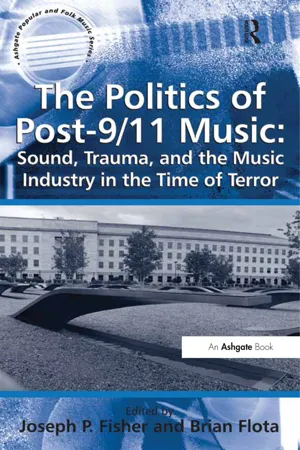
The Politics of Post-9/11 Music: Sound, Trauma, and the Music Industry in the Time of Terror
- 232 pages
- English
- ePUB (mobile friendly)
- Available on iOS & Android
eBook - ePub
The Politics of Post-9/11 Music: Sound, Trauma, and the Music Industry in the Time of Terror
About this book
Seeking to extend discussions of 9/11 music beyond the acts typically associated with the September 11th attacks"U2, Toby Keith, The Dixie Chicks, Bruce Springsteen"this collection interrogates the politics of a variety of post-9/11 music scenes. Contributors add an aural dimension to what has been a visual conceptualization of this important moment in US history by articulating the role that lesser-known contemporary musicians have played"or have refused to play"in constructing a politics of protest in direct response to the trauma inflicted that day. Encouraging new conceptualizations of what constitutes 'political music,' The Politics of Post-9/11 Music covers topics as diverse as the rise of Internet music distribution, Christian punk rock, rap music in the Obama era, and nostalgia for 1960s political activism.
Information
Electric Dreams: The Medium and the Message
Chapter 1
Rock, Enroll: Music and Militarization since 9/111
Samuel Dwinell
What role will we assume in the historical relay of violence, who will we become in the response, and will we be furthering or impeding violence by virtue of the response we make?
Introduction
There has been a curious lack of attention to forms of popular music that advance politicized interventions in US contexts since September 11, 2001. It has become commonplace to decry the apparent lack of American “protest music” in comparison with the enthusiasm with which an earlier generation of artists took up issues such as the Vietnam War or “Third World” poverty.2 Carefully sutured into the newly turbo-charged machine of “post-9/11” US nationalism, it would seem, popular music artists now all sing from the same jingoistic hymn sheet that political scriptwriters quickly provided to the Bush administration in the immediate aftermath of the 9/11 tragedy. Voices from below either failed to penetrate the hegemonic grasp of censored, corporate media networks, or never sound in the first place. Such was the extent of popular support for the newly named “war on terror.” This chapter does not seek to deny the power of the new politics of security to disallow or, as David Palumbo-Liu writes, make appear “treasonous,” positions of “skepticism, doubt, and critical thinking” with respect to the “war on terror” (124). Rather, I attempt to demonstrate how the new state of (being at) “war on terror” includes spaces for, and even encourages, certain forms of protest music. How has the “post-9/11 world,” theorized so powerfully by Slavoj Žižek as an example of what Giorgio Agamben refers to as a bio-political “state of exception,” been achieved over the last ten years? (140–1). I discuss related examples of post-9/11 popular music that advocate on behalf of both “pro-” and “anti-war” causes, arguing that North American protest music of different political stripes in fact contributes to the maintenance of what Bülent Diken calls the new, everyday “normality” of the post-9/11 “war on terror” (82). In other words, popular culture in the “digital age” becomes inseparable from everyday life, and, in turn, inscribes the militarized into the commonplace. We must understand these connections between global violence and daily life in order to imagine alternatives to militarized cultural production.
This chapter is thus concerned with ascertaining how, since September 11, 2001, the media technologies that we use every day become complicit with the discourse of the “war on terror,” not least by stripping meaningful dissent of validity. With respect to popular music since 9/11, I ask how militarized networks of different media work both to represent and to constitute the conditions of everyday life. In the first section, I summarize how others have theorized significant changes to culture and society brought about by the tragedy of 9/11. Next, I discuss two important case studies of militarized cultural production in the years immediately following 9/11: the video game America’s Army, released by the US Army as a recruitment tool in 2002, and the song “(America’s Army) Die Jugend Marschiert” (2005), an “anti-war” response to the game from the Canadian punk-rock band Propagandhi. I argue that both these texts function as important precursors to the type of “militarization of everyday life” enacted through the text that I discuss in the final, largest section of this chapter: “Citizen/Soldier,” a recent music video and song that was produced through an ostensible act of collaboration between the US Army National Guard and the popular American rock act 3 Doors Down. Here, rock music and military recruitment converge in perhaps surprisingly direct ways. As the first example of the hybridization of music video and military recruitment commercial, “Citizen/Soldier” (2007) not only represents the confluence of these two distinct and historically important genres of audio-visual cultural production, but also must be understood, I argue, within its contemporary, multimedia environment.3 This seemingly ubiquitous distribution relies on established patterns of media interactivity, thereby allowing connections to be forged between what Judith Butler refers to as the post-9/11 “relay of violence” and the practices of everyday life (187).
Militarization since 9/11
The common theoretical distinction between military and police force, whereby the latter exert power within the nation-state and the former outside it, has of course often been breached in recent US and world history by various iterations of military power in civilian life. Since the birth of the studio system, Hollywood films, for example, have not only routinely defined visual pleasure through the use of military themes, but also regularly entered into financial and artistic collaborations with sections of the US military.4 By 2000, moreover, media studies scholar Tim Lenoir could speak productively of what he called the “military-entertainment complex” in the US (238). Yet, as many commentators have argued, 9/11 precipitated a period of redoubled discourses of US nationalism—one during which militarized cultural production in the US became less the exception than the rule. Many commentators have pointed perspicuously to the ways in which, partly as a result of the Bush administration’s prompt delivery of mediatized, rhetorical effusions, the razing to the ground of the World Trade Center (and the concomitant, indefensible loss of life) became emblematic of a US “national” tragedy. That is, discursive operations in the immediate aftermath of 9/11 successfully produced the “Twin Towers” as a synecdoche for, specifically, the US nation-state. Such post-9/11 US nationalism thus worked performatively to (re)produce what Benedict Anderson famously referred to as a national “imagined community.”5 This renewed US nationalism, one that cohered around feelings of fear and retribution, soon provided a nodal point through which support could quickly be garnered for the US-led invasion of Afghanistan in October 2001 and the ensuing military offensive, “Operation Enduring Freedom.” Furthermore, alongside the Afghan theater of war, the new “war on terror” later came to include the 2003 invasion of Iraq, as well as sweeping changes to US policy, such that, in addition to the military operations in the Middle East, a new part of both the discourses and force of US defense became “homeland security”—a “state of exception,” perhaps, characterized by a redoubled, militarized focus on both the borders of the US nation-state and many of those within them.6 As James Thompson, Jenny Hughes, and Michael Balfour explain, “[A] war declared on an abstract noun [‘terror’] has permitted global powers to construct a shifting series of objects as targets of offensive operations” (276). This “relay of violence” expanded and increased to fever pitch.
The redoubling of US nationalism after 9/11, it seems, has provided commentators with urgent occasions to theorize new complicities between our daily consumption of mass media in the US and the violence enacted globally under the aegis of the “war on terror.” One of Butler’s key insights regarding this global aftermath of 9/11, which also refers to a “cycle of revenge,” is the way in which she connects large-scale “retributive” projects, such as the US-led military operations in the Arab Middle East, and the seemingly more mundane aspects of the “war on terror,” such as the kinds of discursive violence relayed, broadcast, and transmitted via mass media, particularly newspapers and cable television news (188). Since 2001, other prominent scholars, such as Slavoj Žižek, Douglas Kellner, and Patricia Mellencamp, have provided more extensive accounts of the processes by which the mass media in the US has worked to forge connections between military offensives in the Middle East and everyday life at “home,” such that not only do scenes and sounds of global violence now seem commonplace, but also, and more importantly, a broad consensus of public opinion is formed in support of the “war on terror” (Žižek 54). As we have come to realize, the “‘war on terror’ is a war that has indeterminate and shifting borders as well as an unprecedented global reach and is being fought in the spaces of language, mainstream media and alternative digital mediascapes as much as on the frontiers of Afghanistan and Iraq” (Thompson, Hughes, and Balfour 276–7). Thus, today, the politics of security, Diken writes, has become the “most important factor of sociality”: not something that can be extracted from contemporary social relations, but that which forms them (81).
As we will see with the music video and US National Guard recruitment film “Citizen/Soldier,” cultural production in the years since 9/11 has played an important role in constituting and maintaining the imbrication of the “war on terror” in the everyday. Aggregating an array of public and private mediatized sites to the extent that it becomes ubiquitous in popular culture at a particular historical moment, “Citizen/Soldier,” and other examples of militarized multimedia cultural production, partake in that which commentators such as Henry Giroux, Marita Sturken, and Zillah Eisenstein have persuasively referred to as the post-9/11 “militarization of everyday life.” In this chapter, I employ this term to name the processes by which the post-9/11 politics of security become naturalized through our variously everyday activities, such as the types of practices associated with consuming popular music in the “digital age.”
A significant body of scholarship now attests to the significance of American popular music within post-9/11 discourses of US nationalism. The overall picture presented by scholars such as Martin Cloonan, Suzanne Cusick, J. Martin Daughtry, Reebee Garofalo, Jonathan R. Pieslak, Kip Pegley, Susan Fast, and Martin Scherzinger is one, perhaps, in which the cultural context of the post-9/11 world powerfully, and almost without exception, demands that contemporary, American popular music be expressive of, and largely complicit with, militaristic US nationalism. For example, Cusick’s recent work on music and torture reveals both that forms of “no touch torture,” such as the types of sensory deprivation that results from the use of music as torture, has formed part of the US military’s “oral tradition” since at least the Cold War, and, more significantly, that the post-9/11 “war on terror” has witnessed a profound change in how such torture is received in contemporary US culture (“Music as Torture”). Today, a range of mediatized sites—from online public chat forums, to the portable media players of US soldiers, to the high-decibel speakers of the Guantánamo Bay interrogation rooms—delineates a global network of music as torture that is specific to the post-9/11 “war on terror,” one which spans military and civilian cites globally (“Music as Torture”). “Provok[ing] no public outcry” (“You are in a place” 4), Cusick describes how this bespeaks a new habituation on the part of the US public for aspects of post-9/11 militarization (“You are in a place” 17–18). These studies of music since 9/11 represent an invaluable intervention in the field of musicology. Popular music studies of the last few decades of the twentieth century were perhaps too preoccupied with refuting the Frankfurt School’s claims regarding the capacity of the “culture industry” to create, maintain, and deceive a passive consuming public. A return in the years following 9/11 to scholarly engagement with what Gage Averill uncompromisingly refers to as the “nefarious uses to which the power of music is put [in the context of the ‘war on terror’]” works powerfully to revise this institutional privileging of popular music’s anti-establishment potential. This scholarship provides a vital context for understanding new, post-9/11 developments in popular culture, such as the militarization of everyday entertainment enacted by the US Army National Guard’s “Citizen/Soldier” recruitment campaign.
The “War on Terror” and the Bedroom
“Citizen/Soldier” was in fact not the first example of the US military’s production of innovative, hybridized forms of popular entertainment and recruitment in the years following 9/11. Although there has been a long history of the collaboration between software technology industries and military agencies, the video game America’s Army represents the first instance of US state-sponsored production and distribution of a video game for the purposes of military recruitment (Nichols 39–40). Free to play online, America’s Army was released by the US Army as a recruitment tool on July 4, 2002—not by coincidence, one assumes, the date of the first US Independence Day after 9/11—and remained popular for several years, before being superceded by later versions of the game. The game includes hyperlinks that guide players to the US Army’s primary recruitment tool, the Go Army website. In turn, the site makes it easy for its visitors to chat online with recruitment officials and to leave personal contact information. In other words, while playing America’s Army—a game not unlike many other popular “First-Person Shooter” video games—players are encouraged to connect with state power in perhaps surprisingly direct ways. America’s Army channels the diversionary energy of video gaming toward US military recruitment.
America’s Army represents an important, innovative, post-9/11 example of the US military’s committed appropriation of established forms of entertainment, but its spaces of distribution, and the audiences it reached, nevertheless remained limited. To be sure, players of the game range from active duty servicemen and women across the world to civilian teenagers and young adults. Yet, as we will see with the 2007 “Citizen/Soldier” recruitment campaign for the National Guard, examples of the militarization of entertainment in the US in subsequent years attained a far greater purchase on the terrain of everyday life than America’s Army. The 2002 video game was only playable on personal computers, and thus remained largely confined to private, domestic locations, such as the bedroom or living room; players of the game consisted mainly of the particular demographics mentioned in Palumbo-Li’s account: those already playing video games. Although the game occasionally encourages players to return to the US Army’s recruitment website, it functioned relatively straightforwardly as a vehicle with which the US Army could connect with young people—and do so in predominantly domestic, private spaces.
Significantly, the seeming simplicity of the US Army’s approach to recruitment with America’s Army also provided an opportunity for opposition to the game within the realm of popular culture. The song “(America’s Army) Die Jugend Marschiert” by the Canadian, activist punk-rock band Propagandhi, responds directly to the video game. It begins with twenty seconds of a grainy, Third Reich-era recording of the Hitler Youth song “Die Jugend Marschiert” (The Youth Are Marching) before abruptly launching into a thrashing, punk-rock invective about the supposed indoctrination of children brought about by America’s Army. The game is referred to in the song—albeit in exuberantly riotous screams that render most of the lyrics unintelligible—as a “Trojan Horse that you living idiots paid for and actually rolled into your own kids’ rooms.” This edited collage of sound, by which the seemingly distant strains of an unaccompanied children’s chorus are juxtaposed uncompromisingly with punk-rock “noise,” remains the most significant sonic aspect of the song. Since it depends upon previously recorded material, it renders the song impossible to perform live. In other ways, too, the form of the song, as well as its subject matter of the video game-cum-recruitment campaign America’s Army, seems to play with its own mediatization. As well as its inclusion on Propagandhi’s album Potemkin City Limits (2005), the song appears on www.americasarmy.ca, one of the band’s websites. This URL is of course a reference to www.americasarmy.com, the official website of the US Army’s video game, and represents an aggressive form of “digital activism” on the part of Propagandhi. This URL helps to expand the circulation of the song to users who mistype the much more widely known official website of the America’s Army video game. Whereas the US Army used America’s Army to appropriate video gaming as a tool in military recruitment, Propagandhi responded by reversing this tactic. Through the innovative use of the URL, the band attempts, on behalf of an “anti-militarization” politics, to take over the same area of cyberspace in order to advance the outlandish analogy between contemporary American society and Hitler’s Third Reich.
Given the band’s wholehearted involvement since the mid-1990s with a number of progressive political issues, we should take seriously the extent to which the satirical elements of “(America’s Army) Die Jugend Marschiert” make a politicized appeal to parents in the form of advocating on behalf of removing militarized culture and entertainment from the private space of “kids’ [bed]rooms.” The relatively limited distribution of America’s Army to precisely these spaces perhaps justifies, and inspires, such an approach. Indeed, the song represents a response to the video game, one that, in Judith Butler’s terminology, attempts to “impede,” rather than “further,” the post-9/11 relay of violence. Like much North American protest music since the 1960s, such as that associated with the Vietnam War, “(America’s Army) Die Jugend Marschiert” adopts an oppositional stance toward the perceived wrongs of a specific, current development. The song’s political message, despite its willfully childish invocation of the Third Reich, seeks to restore the sanctity of young people’s domestic spaces and to return the military or the militarized to its “proper” place—outside the borders of the nation-state, or at least the boundaries of the private home.
However, such an attempt to “undo” the incursion into the everyday of the militarized fails to recognize the extent to which, in the years since 9/11, practices of everyday life have in fact become constitutive of the “war on terror.” From 2005, for example, the US Army released many different versions of America’s Army, including those for arcade machines, mobile phones and other portable devices and game consoles. Ma...
Table of contents
- Cover
- Half Title
- Title Page
- Copyright Page
- Table of Contents
- General Editor’s Preface
- Notes on Contributors
- Foreword
- Acknowledgments
- Introduction—Greet Death: Post-9/11 Music and the Sound of Decay
- PART I ELECTRIC DREAMS: THE MEDIUM AND THE MESSAGE
- PART II HAIL TO THE THIEF: POST-9/11 EXPERIMENTAL MUSIC
- PART III WHAT’S GOING ON, AGAIN?: PROTEST AND NOSTALGIA
- PART IV IDLE AMERICAN, AMERICAN IDOL: MAINSTREAM MEDIA AND IDEOLOGY
- Index
Trusted by 375,005 students
Access to over 1.5 million titles for a fair monthly price.
Study more efficiently using our study tools.
Frequently asked questions
Yes, you can cancel anytime from the Subscription tab in your account settings on the Perlego website. Your subscription will stay active until the end of your current billing period. Learn how to cancel your subscription
No, books cannot be downloaded as external files, such as PDFs, for use outside of Perlego. However, you can download books within the Perlego app for offline reading on mobile or tablet. Learn how to download books offline
Perlego offers two plans: Essential and Complete
- Essential is ideal for learners and professionals who enjoy exploring a wide range of subjects. Access the Essential Library with 800,000+ trusted titles and best-sellers across business, personal growth, and the humanities. Includes unlimited reading time and Standard Read Aloud voice.
- Complete: Perfect for advanced learners and researchers needing full, unrestricted access. Unlock 1.5M+ books across hundreds of subjects, including academic and specialized titles. The Complete Plan also includes advanced features like Premium Read Aloud and Research Assistant.
We are an online textbook subscription service, where you can get access to an entire online library for less than the price of a single book per month. With over 1.5 million books across 990+ topics, we’ve got you covered! Learn about our mission
Look out for the read-aloud symbol on your next book to see if you can listen to it. The read-aloud tool reads text aloud for you, highlighting the text as it is being read. You can pause it, speed it up and slow it down. Learn more about Read Aloud
Yes! You can use the Perlego app on both iOS and Android devices to read anytime, anywhere — even offline. Perfect for commutes or when you’re on the go.
Please note we cannot support devices running on iOS 13 and Android 7 or earlier. Learn more about using the app
Please note we cannot support devices running on iOS 13 and Android 7 or earlier. Learn more about using the app
Yes, you can access The Politics of Post-9/11 Music: Sound, Trauma, and the Music Industry in the Time of Terror by Brian Flota, Joseph P. Fisher in PDF and/or ePUB format, as well as other popular books in Social Sciences & Music. We have over 1.5 million books available in our catalogue for you to explore.