Autoethnography is an ideal method to study the 'feminist I'. Through personal stories, the author reflects on how feminists negotiate agency and the effect this has on one's political sensibilities. Speaking about oneself transforms into stories of political responsibility - a key issue for feminists who function as cultural mediators.
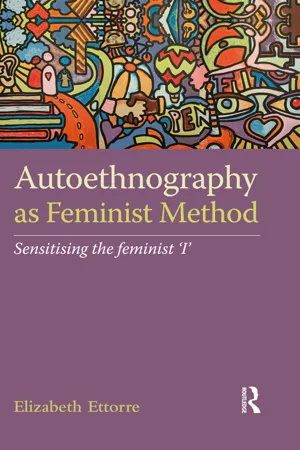
- 124 pages
- English
- ePUB (mobile friendly)
- Available on iOS & Android
eBook - ePub
About this book
Information
1
Being a ‘sexual pervert’ in academia
I wanted to move out of the flat world of most sociological accounts of relationships … incorporate the kinds of emotional and relational dimensions that are meaningful in everyday life … it was no longer appropriate to reflect upon ‘other people’ as if being a sociologist entitled one to be apart from these cultural shifts, emotional tides and personal feelings.
(Smart, 2007: 3–4)
Introduction
This chapter is a good example of how as a lesbian feminist scholar, I tackled the structural constraints and career diversions that many LGBTQI scholars confronted over the past four decades. Using autoethnography as a feminist method, I begin this chapter by recounting my journey as a Catholic nun (and closeted lesbian) through social and community activism of the late 1960s to early 1970s in East Coast, US. I also provide a glimpse of what it was like to be involved in feminist sociology at the London School of Economics (LSE), University of London in the 1970s and the influence of British and American feminism on my postgraduate research on lesbians. I then turn my attention to the impact of drugs and alcohol research on my lesbian feminist sociological imagination and vice versa. Lastly, I reflect upon my contributions to the sociology of the body and the construction of deviant bodies’ within a genetics moral order. All of what I say is framed by my being a feminist sociologist in academia since the 1970s. I hope to show how being in this situation feels and how as a result of my life changing, precarious experiences, I was propelled into political life. This chapter emerges from the growing body of work by LGBTQI scholars (Adams, 2011; Adams and Holman Jones, 2011; Berry, 2006; Crawley, 2002, 2008; Eguchi, 2015; Gust, 2007; Joshi, 2007; Macdonald, 2013; Munoz, 1995; Philareatou and Allen, 2006; Trotter et al., 2006; Vannini, 2008) who reflect autoethnographically upon their positions vis-à-vis heteronormativity, albeit this work may be viewed as marginal in relation to conventional academic canons (Plummer, 2009). Nevertheless, I introduce autoethnography as a methodological tool for speaking and writing reflexively about being out in academia and developing a ‘critical sexology’ (Barker, 2006). Similar to other academics, whether sociologists (Glassner and Hertz, 2003), women (Krieger, 1996), lesbian couples (Gibson and Meem, 2006) or lesbian and gay scholars (McNaron, 1996), I want my story to resonate.
My story begins …
18 June 1966
It is a beautiful sunny day in Bridgeport, Connecticut and I can smell the cherry blossoms in the clear air as I sit in our back yard and ponder my future life. I feel so happy to graduate from high school. I do well in my studies but unlike most, if not all of my friends, I am not going to a large college or university. I look forward in August to entering the convent of the Sisters of Mercy in my home state, Connecticut, where I will be studying at a very small Catholic girls’ college, St Joseph’s College. My college training includes university-level courses (much to the relief of my dad), but in my first three years of training, these course will be focused mainly on theology and philosophy. I will soon be a postulant and start my preparation to be a fully fledged nun with final vows of poverty, chastity and obedience in six years.
20 June 1966
Unbeknown to me, my friends are giving me a surprise party at my house. My parents are complicit. I park the car in the driveway as I arrive home from the grocery store. I open the back door, ‘Surprise!’ I hear my friends and parents yell. I am astonished and almost drop my bag of groceries as I go into the living room. My mother hurries to take the bag away from me, looks at me with a big smile and squeezes my hand as she relieves me of the grocery bag. I am still astonished. Immediately, my friend Betsy says, ‘It’s about time, Sister Betsy. We’ve been waiting a long time’. I laugh and say, ‘How did you plan this? I never knew’. Maureen chirps in, ‘You weren’t meant to. We just wanted a get together before you are locked in the nunnery forever’. Everyone laughs.
25 August 1966
It is my entrance day to the Sisters of Mercy. My family drive me to the Sisters of Mercy novitiate in Madison, Connecticut. It is a beautiful August day and the novitiate is by the sea. As we enter the grounds, I can already smell the salty sea air. I look out the car window and see that a few of my high school friends have come to say goodbye to me. I am excited to enter the convent. It feels like I have waited many years to fulfil my promise to God. I wear my postulant habit with pride and my trunk with all of my other personal things have been delivered to the novitiate the week before. For the past two years, I have had a deep sense that I have a vocation – that God is calling me to serve him in this world. But still, I am anxious because I have had, for many years, secret attractions to women. I have not acted on these attractions but they have been strong, especially in my Senior year in high school. I think, ‘At least, I don’t have to date men anymore. No, I will be surrounded by women who I desire’. Deep in my heart, I know I won’t dare to act on my desires or lesbian feelings. ‘Or won’t I?’, I ask myself fearful of my answer. My father stops the car and I open the door and step out. I am excited and afraid at the same time.
3 May 1970
I am in West Hartford, Connecticut at the Motherhouse, the main centre where Mother Superior, the head of my religious order, lives. I asked to leave the convent two months ago. I have already been in the convent for nearly four years. I took temporary vows of poverty, chastity and obedience last summer but it has been hard going for me. I feel that I do not belong and I am full of fear for my future. So I tell my sisters that I want to leave the novitiate. I do not feel like I have a vocation. At that time, I write to the Pope to ask if I can live outside the convent until my temporary vows expire, so to speak. If he agrees, then soon I will be exclaustrated.1 I learn from my Mother Superior that the response from the Pope has been received this week and I am free to leave the convent, but I am required to report to the Motherhouse in West Hartford, Connecticut. There my Mother will be waiting for me to take me home. I sit in the waiting room next to Mother Superior’s office. I hear my mother’s voice. She is talking to Mother Superior. I hear her say, ‘We must go now, where is Betsy?’. Her voice is loud. She sounds irritated. I could tell she is upset. The door opens and my mother appears. She looks somewhat shaken and without hugging me, she grabs my hand and says immediately, ‘Betsy, let’s go and get out of here’. No one is around as we leave. This feels strange to me. My mother walks quickly, still holding my hand and I have a hard time keeping up with her. As we leave the building, she says with an exasperated voice, ‘I have never been so insulted in my life’. I ask, ‘Why? What happened?’. My mother says, ‘Keep walking, Betsy. I’ll tell you in the car’. When we get in the car, she scurries in, starts up and waits for me to fasten my seat belt. She is silent and looks cross. She drives off quickly from the parking lot, turns right on the main road and begins with a huge sigh of relief, ‘I am so happy you left that place. You don’t belong there, Betsy. I know you still have two years of your temporary vows left. But, you are too good for them’. Astonished, I ask, ‘Why? Why would you say that, Mom?’. ‘Can you imagine’, she continues now with a raised voice, ‘That Mother Superior whatever her name is tried to suggest that you are mentally ill and that is the reason you are leaving the convent. Well, I won’t have any of that nonsense. They are the sick ones, as far as I am concerned’. I feel as if I am betrayed deeply. ‘What’, I think ‘How can she say that? I was only unhappy’. I am speechless for a few seconds and say to my mother, ‘Why would Mother Superior say that about me? I just felt recently that I don’t have a vocation, God hasn’t called me and I was not happy to have my life always dictated by others – obedience was the killer, Mom’. Quickly, Mom responds, ‘Well, I am glad to hear that and you’re not mentally ill and her comments are ridiculous. Maybe, they say that about all the girls who leave or become exclaustrated. By the way, there’s a packet of cigarettes in the glove compartment. Help yourself’. ‘Thanks, Mom, you’re an angel and thanks for coming to pick me up’. I open the window, light up the cigarette, inhale and look out at the Connecticut countryside. ‘What a relief’, I think, ‘I am out of that place’, but I still feel hurt at what Mother Superior said to my mother. As I look out, I wonder, ‘What will the future hold?’.
12 August 1970
A letter addressed to me arrives home from Fordham University, a Catholic Jesuit University in the Bronx Borough of New York City. I open it and read it. It says, ‘We are writing to inform you that you are accepted as a transfer student to Fordham University, Thomas More College. We have accepted all of your credits from St Joseph’s College. You will be enrolled as a Junior year undergraduate’. I think, Fantastic! Immediately, feeling elated, I put down the letter and run to tell my mother.
Catholic elitism creates a political sociologist
4 February 1971
The sun is shining, but it is freezing. I am standing outside Dealy Hall at Fordham University. I love being here and am an extremely ebullient student. I ponder, ‘No one knows that I am a Catholic nun who completed a two-year novitiate, including a year of silence … I dedicated my life to vows of poverty, chastity and obedience … I am having my first lesbian affair with sweet Sharon, another nun. I am rather anxious and have no habit on. I am in ‘civis’ as we nuns call our ‘lay clothes’. I am a transfer student from St Joseph’s College but no one knows why. As a nun who left my community, the Sisters of Mercy, I have a visceral sense of relief that I don’t need to worry about my vows. I study sociology, a new subject to me. My heart races as I think about Sharon. I am in love but uncomfortable in the knowledge that she is in Connecticut being a real nun. I ask myself, ‘Am I a lesbian?’. Without answering, I push this guilty secret deep inside me and carry on with my student life. I feel so guilt ridden that a week later I develop non-specific uticaria (i.e. hives all over my body) which my doctor announces as ‘stress related’.
Before I left the convent, I was active in the anti-war movement. I knew Fordham would be a good place to continue my political activity. In Catholic terms, Fordham, as a Jesuit institution, was a hotbed of social protest with an active branch of Students for a Democratic Society (SDS). Much to the dismay of the FBI, Fordham provided political sanctuary for the peace activist and poet Daniel Berrigan, a Jesuit priest and member of Catonsville nine who doused military draft files with napalm and set them ablaze. Also, I knew in terms of my intellectual development, I would be able to build upon my scholastic training which I had during my convent years. ‘Maybe I’d even fantasize less about Sharon and feel less guilty’, I contemplate.
I’m at Dealy Hall because I’m dropping off a book from one of my lecturers. Dealy is a large brick building that houses the Department of Sociology and Anthropology. I’ve become accustomed to it during the past five months. I see Professor Fitzpatrick exit Dealy. ‘Fitz’, as he is known, is a Jesuit priest, the chair and founder of the Department of Sociology and Anthropology the first such department created in a Catholic college in the US. Last semester, I took his Introduction to Sociology course. I really enjoyed it, and the examples drawn from his experience as a political activist and scholar. As Fitz sees me, he says, ‘Hi Betsy, I liked your Intro essay last semester; it was excellent’. He smiled, turned away and rushed on. Feeling overwhelmed by excitement, I shout after to him, ‘Thanks, Fitz’. I almost burst into tears and muse elatedly to myself, ‘Gosh … Fitz has a reputation of being a hard marker. How did I do it?’ Two weeks later, I learn that I get an A on Fitz’s course. This knowledge spurns me on to take his other undergraduate courses, SOC 193 Community and SOC 177 Social Change in Latin America. I sense Fordham is a breath of fresh air and I am happy here.
Social justice: becoming a political sociologist
In his article, ‘Catholic and Evangelical elites in dialogue and alliance’, Rutan (1995) discusses Catholic elites. Fitz is mentioned as one who endorsed Rutan’s paper. Whether or not Fitz would have seen himself as a ‘Catholic elite’ is an interesting question. Fitz studied with Talcott Parsons at Har...
Table of contents
- Cover
- Title
- Copyright
- Dedication
- Contents
- About the author
- Preface
- Acknowledgements
- Introduction: autoethnography as feminist method
- 1 Being a ‘sexual pervert’ in academia
- 2 Finding my feminist voice through an illness story: ‘An old female body confronts a thyroid problem’
- 3 Doing feminist autoethnography with drug-using women
- 4 ‘She wrote it but look what she wrote’
- 5 Sensitizing the feminist ‘I’
- Index
Trusted by 375,005 students
Access to over 1.5 million titles for a fair monthly price.
Study more efficiently using our study tools.
Frequently asked questions
Yes, you can cancel anytime from the Subscription tab in your account settings on the Perlego website. Your subscription will stay active until the end of your current billing period. Learn how to cancel your subscription
No, books cannot be downloaded as external files, such as PDFs, for use outside of Perlego. However, you can download books within the Perlego app for offline reading on mobile or tablet. Learn how to download books offline
Perlego offers two plans: Essential and Complete
- Essential is ideal for learners and professionals who enjoy exploring a wide range of subjects. Access the Essential Library with 800,000+ trusted titles and best-sellers across business, personal growth, and the humanities. Includes unlimited reading time and Standard Read Aloud voice.
- Complete: Perfect for advanced learners and researchers needing full, unrestricted access. Unlock 1.5M+ books across hundreds of subjects, including academic and specialized titles. The Complete Plan also includes advanced features like Premium Read Aloud and Research Assistant.
We are an online textbook subscription service, where you can get access to an entire online library for less than the price of a single book per month. With over 1.5 million books across 990+ topics, we’ve got you covered! Learn about our mission
Look out for the read-aloud symbol on your next book to see if you can listen to it. The read-aloud tool reads text aloud for you, highlighting the text as it is being read. You can pause it, speed it up and slow it down. Learn more about Read Aloud
Yes! You can use the Perlego app on both iOS and Android devices to read anytime, anywhere — even offline. Perfect for commutes or when you’re on the go.
Please note we cannot support devices running on iOS 13 and Android 7 or earlier. Learn more about using the app
Please note we cannot support devices running on iOS 13 and Android 7 or earlier. Learn more about using the app
Yes, you can access Autoethnography as Feminist Method by Elizabeth Ettorre in PDF and/or ePUB format, as well as other popular books in Social Sciences & Sociology. We have over 1.5 million books available in our catalogue for you to explore.