- 238 pages
- English
- ePUB (mobile friendly)
- Available on iOS & Android
eBook - ePub
Gender, Age and Musical Creativity
About this book
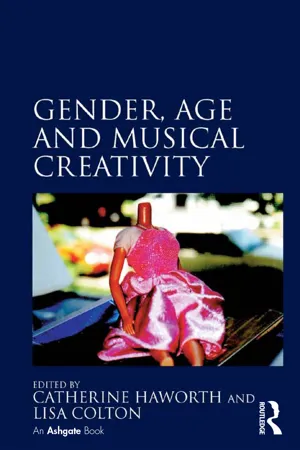
From the perennially young, precocious figure of 'little orphan Annie' to the physical and vocal ageing of the eighteenth-century castrato, interlinked cultural constructions of age and gender are central to the historical and contemporary depiction of creative activity and its audiences. Gender, Age and Musical Creativity takes an interdisciplinary approach to issues of identity and its representation, examining intersections of age and gender in relation to music and musicians across a wide range of periods, places, and genres, including female patronage in Renaissance Italy, the working-class brass band tradition of northern England, twentieth-century jazz and popular music cultures, and the contemporary 'New Music' scene. Drawing together the work of musicologists and practitioners, the collection offers new ways in which to conceptualise the complex links between age and gender in both individual and collective practice and their reception: essays explore juvenilia and 'late' style in composition and performance, the role of public and private institutions in fostering and sustaining creative activity throughout the course of musical careers, and the ways in which genres and scenes themselves age over time.
Information
Chapter 1
‘Something revolting’: Women, Creativity and Music after 50
In February 2012 a record-breaking 114 million viewers watched 53-year-old Madonna give the half-time performance at the Super Bowl, the annual championship game of the National Football League in the United States, in a jaw-dropping spectacle involving dancers, choirs, marching bands and younger singers (notably Nicki Minaj, M.I.A. and Cee Lo Green). A timely promotion for her forthcoming MDNA album, the show attracted the kind of mixed media attention, concentrating mainly on her age, that Madonna has come to expect. In the Daily Telegraph, Neil McCormick wrote that ‘The past decade has seen a host of challengers arrive, young women like Beyoncé, Lady Gaga, Rihanna who are ready to take her crown but Madonna’s pre-eminent status as the reigning Queen of Pop was emphasised by her majestic arrival, to the roar of the big guns of her mega hits’,1 while Jon Parales reported in the New York Times that although Madonna was ‘still lithe, she measured her moves, letting her supporting cast offer distractions’.2 MSN Entertainment headlined their report ‘Super Bowl performance: has Madonna lost it?’3 49-year-old Sharon Osbourne tweeted: ‘Madonna is back. She’s the queen. Just sensational!’ while 46-year-old Piers Morgan’s reaction was to tweet: ‘Yuk. Just put it away, Madonna. Seriously.’4 Among the multitude of media reports after this performance was an insightful response from feminist commentator Naomi Wolf, writing for The Guardian under the title ‘Madonna Acts Just Like a Serious Male Artist Would – and People Hate Her for It’.5 I will return to the Material Girl (or should that now be Material Woman?) later.
In September of the same year, the UK Labour Party launched a Commission on Older Women, ‘to ensure public policy properly considers the lives of women in their fifties and onwards, many of whom are balancing work with caring responsibilities across the generations within their families’.6 At the launch the shadow home secretary, 43-year-old Yvette Cooper, drew attention to the generation of women born in the 1940s, 1950s and early 1960s, and the battles they had fought for many different kinds of equality – equal pay, improvements in childcare and maternity leave. But as she went on to explain: ‘A toxic combination of sexism and ageism is causing problems for this generation.’7
The toxic combination of sexism and ageism is of course nothing new. It affects older women throughout the world in almost every aspect of their lives and has been explored and dissected by feminist thinkers and writers from Simone de Beauvoir to Germaine Greer and beyond. Any study of the older woman inevitably needs to take on board attitudes towards the menopause – the physical change that marks ageing so distinctly for most women. For both men and women, ageing is accompanied by numerous physical changes but society’s negative view of menopause is key to understanding attitudes towards the ageing woman. Still something all too rarely discussed as anything other than a problem, a burden or source of humour, the menopause is more than just a physical reality – it is also a social construct.
Feminist scholars in the West have investigated factors such as the invisibility of the post-menopausal woman and highlighted the attitudes of a society that regards the older female body as inevitably diseased and deteriorating, in need of medical treatment, particularly in the form of hormone replacement therapy (HRT). In gynaecologist Robert Wilson’s bestselling 1966 book promoting HRT, Feminine Forever, for example, he wrote of the menopause that ‘no woman can be sure of escaping the horror of this living decay … even the most valiant woman can no longer hide the fact that she is, in effect, no longer a woman’.8 For men like Wilson, once a woman can no longer reproduce, she fails to fulfil her only truly valuable function in life and so is discarded and fades into invisibility. More recently, in a 1992 article entitled ‘Hormone Replacement Therapy: Protection against the Consequences of Menopause’, P. B. Marshburn and P. R. Carr declared categorically: ‘Anxiety, depression, irritability and fatigue increase after menopause.’9
Needless to say, many women, perhaps especially as we ourselves age, have raged against this view of the menopause and what it says about our place and value in society. While acknowledging the physical changes that can occur in our bodies, for many women the menopause can in fact be a time of freedom, renewed energy and exciting potential. In the 1990s a survey carried out in the United States found that only three per cent of the women questioned were regretful at the onset of menopause, while thirty-nine per cent were relieved.10 Linda R. Gannon even argues that the menopausal woman can be regarded as in a state of wellness in comparison to the menstruating woman who is ‘at heightened risk for disease, injury, and death’.11
Women who refuse to allow themselves to be medicalised or marginalised find not just a peaceful serenity and acceptance of ageing but often a new dynamic and power as they reach the pivotal age of 50. As feminist scholar Jacqueline Zita has written:
To deconstruct the meanings of menopause in a male gerontocracy is to construct a social and cultural space for the empowerment of crones … My hope is that more powerful and unruly women will emerge from this conceiving – old, wise, and furiously heretical.12
Germaine Greer, in her monograph The Change, has explained:
There are positive aspects to being a frightening old woman. Though the old woman is both feared and reviled, she need not take the intolerance of others to heart, for women over fifty already form one of the largest groups in the population structure of the Western world. As long as they like themselves, they will not be an oppressed minority. In order to like themselves they must reject trivialisation by others of who and what they are.13
Elsewhere Greer has written:
Let the Masters in Menopause congregate in luxury hotels all over the world to deliver and to hearken to papers on the latest astonishing discoveries about the decline of grip strength in menopause or the number of stromal cells in the fifty-year-old ovary, the woman herself is too busy to listen. She is climbing her own mountain, in search of her own horizon, after years of being absorbed in the struggle of others. The way is hard, and she stumbles many times, but for once no one is scrambling after her, begging her to turn back … The climacteric marks the end of apologizing. The chrysalis of conditioning has once and for all to break and the female woman finally to emerge.14
But climbing your own mountain can be difficult. Women are as bound by cultural stereotypes and beliefs as men and it can be hard to break out of the chrysalis, or even to acknowledge there is a chrysalis to be broken out of. The title of this chapter comes from a somewhat startling letter written by the Welsh composer Grace Williams (1906–77) to her friend Gerald Cockshutt in 1949, when she was in her early forties:
Ten years ago I thought that no one could ever possibly want to hear music written by a woman in her forties. Well, the two Elizabeths [Maconchy and Lutyens] have proved me wrong. But I still feel the same way about women of 50+. There does seem something revolting – and perhaps a bit pathetic – in the thought of a symphony by a woman of 50.15
At this stage in her life, Williams was a successful freelance composer, writing music in a variety of genres, including several well-received orchestral works such as her Fantasia on Welsh Nursery Themes (1940) or her Sea Sketches for string orchestra (1944). What is particularly poignant about her remark is that she went on to complete her dynamic second symphony, a work still available on CD, in 1956, at the age of 50.16 Was she merely expressing what she felt she was somehow expected to feel? ‘Revolting’ is such a strong word to use. Was she really so unsure of her own value that she felt there was something repellent about the public expression of complex musical creativity from an older woman? And why was the symphony singled out as a genre? Would a song or piano piece – traditionally women’s genres – be more acceptable?
Williams certainly continued to express such feelings about herself as an older woman creating music. In 1966, she wrote to her friend and fellow composer Elizabeth Maconchy (1907–94) about a possible production of her opera The Parlour which she had completed five years earlier: ‘A first opera by a woman of 60 - - - how would we react to it? – let alone the young!’17 Williams is often distressingly self-deprecating and self-effacing, but these declarations of disgust at her age are particularly painful.
Ultimately, however, Williams does not seem to have listened to herself. She certainly did not feel enough revulsion at approaching old age to stop composing, as the catalogue of powerful, dynamic and beautiful music that she produced after the age of 50 bears witness. Indeed her biographer Malcolm Boyd, without drawing attention to her age, has noted that ‘it is possible to recognise in the music she wrote after about 1954 a new sense of direction and an individuality not often apparent in the large-scale works she had written before that date’, going on to talk of ‘a new self-confidence and sense of identity’.18
Grace Williams was one of a number of British female composers – along with Elisabeth Lutyens (1906–83), Elizabeth Maconchy and others – whose music was first heard in the late 1920s and early 1930s, when it frequently confounded critics who were confused by music that was more modernist and challenging than anything they were expecting from young women.19 In 1935, the critic for the Evening News reviewed a concert with new music by Lutyens (a song-cycle for tenor, four horns and strings), Maconchy (a ballet) and Williams (an orchestral suite) describing it as:
an interesting study of the young female mind of today. This organ, when it takes up musical composition, works in mysterious ways. No lip-stick, silk stocking, or saucily tilted hat adorns the music evolved from its recesses.20
By the time these composers reached their fifties, their distinctive music – which they continued to write despite the struggle to get it heard – had been eclipsed as their male contemporaries – Benjamin Britten and Michael Tippett – became the grand old men of British music and a new generation of younger men – Harrison Birtwistle and Peter Maxwell Davies – took over the avant-garde. Nevertheless Lutyens, Maconchy and Williams, along with female contemporaries such as Priaulx Rainier (1903–86) or...
Table of contents
- Cover Page
- Half Title Page
- Title Page
- Copyright Page
- Contents
- List of Figures and Tables
- List of Musical Examples
- Notes on Contributors
- Introduction Gender, Age and Musical Creativity
- 1 ‘Something revolting’ Women, Creativity and Music after 50
- I Performing Identity in Early European Musical Culture
- II Gendered Musical Communities
- III Contemporary Creative Practices and Identities
- Bibliography
- Index
Trusted by 375,005 students
Access to over 1.5 million titles for a fair monthly price.
Study more efficiently using our study tools.
Frequently asked questions
Yes, you can cancel anytime from the Subscription tab in your account settings on the Perlego website. Your subscription will stay active until the end of your current billing period. Learn how to cancel your subscription
No, books cannot be downloaded as external files, such as PDFs, for use outside of Perlego. However, you can download books within the Perlego app for offline reading on mobile or tablet. Learn how to download books offline
Perlego offers two plans: Essential and Complete
- Essential is ideal for learners and professionals who enjoy exploring a wide range of subjects. Access the Essential Library with 800,000+ trusted titles and best-sellers across business, personal growth, and the humanities. Includes unlimited reading time and Standard Read Aloud voice.
- Complete: Perfect for advanced learners and researchers needing full, unrestricted access. Unlock 1.5M+ books across hundreds of subjects, including academic and specialized titles. The Complete Plan also includes advanced features like Premium Read Aloud and Research Assistant.
We are an online textbook subscription service, where you can get access to an entire online library for less than the price of a single book per month. With over 1.5 million books across 990+ topics, we’ve got you covered! Learn about our mission
Look out for the read-aloud symbol on your next book to see if you can listen to it. The read-aloud tool reads text aloud for you, highlighting the text as it is being read. You can pause it, speed it up and slow it down. Learn more about Read Aloud
Yes! You can use the Perlego app on both iOS and Android devices to read anytime, anywhere — even offline. Perfect for commutes or when you’re on the go.
Please note we cannot support devices running on iOS 13 and Android 7 or earlier. Learn more about using the app
Please note we cannot support devices running on iOS 13 and Android 7 or earlier. Learn more about using the app
Yes, you can access Gender, Age and Musical Creativity by Catherine Haworth,Lisa Colton in PDF and/or ePUB format, as well as other popular books in Mezzi di comunicazione e arti performative & Etnomusicologia. We have over 1.5 million books available in our catalogue for you to explore.