eBook - ePub
The Meaning of Modern Architecture
Its Inner Necessity and an Empathetic Reading
- 168 pages
- English
- ePUB (mobile friendly)
- Available on iOS & Android
eBook - ePub
The Meaning of Modern Architecture
Its Inner Necessity and an Empathetic Reading
About this book
Using empathy, as established by the Vienna School of Art History, complemented by insights on how the mind processes visual stimuli, as demonstrated by late 19th-century psychologists and art theorists, this book puts forward an innovative interpretative method of decoding the forms and spaces of Modern buildings. This method was first developed as scholars realized that the new abstract art appearing needed to be analysed differently than the previous figurative works. Since architecture experienced a similar development in the 1920s and 30s, this book argues that the empathetic method can also be used in architectural interpretation. While most existing scholarship tends to focus on formal and functional analysis, this book proposes that Modern architecture is too diverse to be reduced to a few common formal or ornamental features. Instead, by relying on the viewer's innate psycho-physiological perceptive abilities, sensual and intuitive understandings of composition, form, and space are emphasized. These aspects are especially significant because Modern Architecture lacks the traditional stylistic signs. Including building analyses, it shows how, by visually reducing cubical forms and spaces to linear configurations, the exteriors and interiors of Modern buildings can be interpreted via human perceptive abilities as dynamic movement systems commensurate with the new industrial transportation age. This reveals an inner necessity these buildings express about themselves and their culture, rather than just an explanation of how they are assembled and how they should be used. The case studies highlight the contrasts between buildings designed by different architects, rather than concentrating on the few features that relate them to the zeitgeist. It analyses the buildings directly as the objects of study, not indirectly, as designs filtered through a philosophical or theoretical discourse. The book demonstrates that, with technology and science affecting culture
Information
1
Wittgenstein House: The Perfect Mechanism
How do architectural historians describe, analyze, and interpret typical Modernist designs? In 1926 Viennese socialite Margarethe Stonborough-Wittgenstein asked her brother, the philosopher Ludwig Wittgenstein, to assist architect Paul Engelmann in the design of her new house. The resulting building is one of the most perfect examples of Modernist architecture. That is because we are presented with a set of undecorated building blocks assembled into an irregular configuration. It is a composition of “super- and subordinated cubic volumes, … of lines, planes and volumes.”1 These forms look precisely executed and lack traditional façade decorations. Upon ascending to the elevated site from the street, one immediately notices a tall cubical mass flanked by additional prisms on the left and right. A small rectangular volume with a door protrudes from the main cube (Figure 1.1). On the left side, a short and narrow box is attached to the tall central shape slightly behind its front; farther back still is a slightly taller and wide cube that is set behind a terrace reached over a few steps and partly cut into the narrow volume immediately adjacent (Figure 1.2). This initial assessment already reveals the overall composition of this building, as it consists of a tall central cube, to which are added two wings.
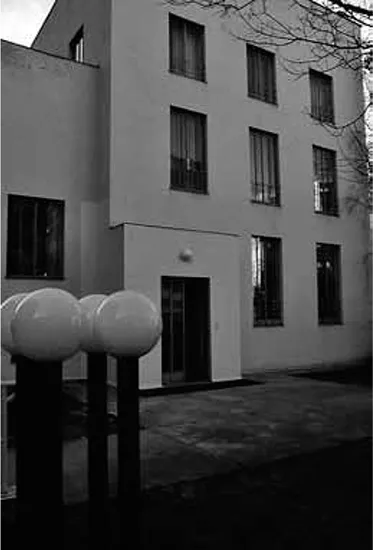
1.1 Wittgenstein House, Entrance façade (Author’s collection)
The vertical surfaces of the volumes are divided by regular rows of tall windows, which form dark rectangles on white ground. All windows are vertically and horizontally aligned. On the right side of the main prism, a wide volume, also preceded by a terrace, is set back from the central form. At the back of the house, there is a long flat wall revealing again the tall central cube flanked by lower ones (Figure 1.3). A shallow shape with a sloping roof terminates the rear of the building. This sloping roof makes this part unique and different from the cubical forms of the rest of the house. All exterior walls are flat and reveal their building block assembly, except on the left side, where the terrace cuts a negative volume out of one of the blocks.
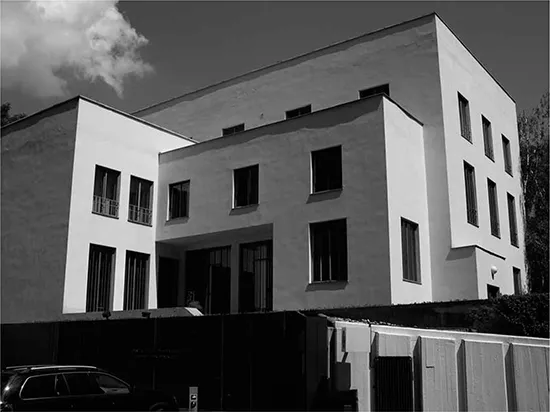
1.2 Wittgenstein House, Southern corner with entrance block on right side (Author’s collection)
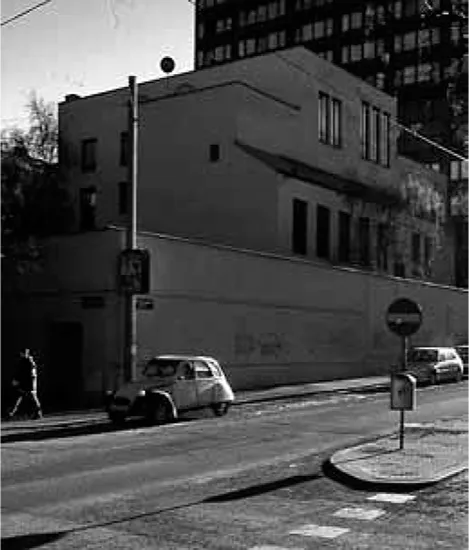
1.3 Wittgenstein House, Rear façade (Author’s collection)
What is one to make of such a building? What does it mean? Such questions are important to us. When architectural historians study a building, they usually begin with a stylistic evaluation, which helps in attempting to extract the symbolic message of the building. This is achieved by comparing the building in question with characteristic styles and their meanings, which have been established through historical research. In this case, that proves to be difficult, since the exterior of the Wittgenstein House lacks any familiar stylistic features such as columns, arches, cornices, or pediments. There are just geometric forms and white surfaces with window openings cut into them. This suffices only to identify it as a building. Thus, one needs to distill the expressive qualities of this building through a different approach. The most promising method—and the one used in most of the existing scholarly evaluations of this building—is to identify the characteristic formal, compositional, and surface features. This identification should go beyond a simple description, which is almost impossible here. The most one can ascertain about the Wittgenstein House is that it looks identical to most other buildings grouped together as part of the Modernist architectural movement. This falls well short of the claim that buildings should reveal to us the social and cultural beliefs and conventions of their time.
When a building is as plain as the Wittgenstein House, architectural historians usually resort to other data and information to find clues for interpretation. First, these are written sources, either primary ones related to the design and construction phase of the building, or secondary ones that allow the researcher to gain insight from the social, cultural, and theoretical context of the building’s history. There are various scholarly methods and perspectives that allow one to analyze a building. In this particular case, one of the most promising areas of study is the life of the architect, because Ludwig Wittgenstein himself left many clues that help explain his design. One of the most interesting sources for the Wittgenstein House is found in this philosopher’s texts, especially his early publications, in which he tried to establish a system of language that would exclude the world of feelings from concept formulation. Wittgenstein stated that language can express concepts only through metaphorical descriptions. Abstract, metaphysical concepts cannot be reified into words. Therefore, language propositions can only be about positive things and facts, not about values. To remedy this shortcoming, he came up with his picture theory of language that emphasized deliberately constructed images as logical conceptions that were not derived from sensory experience. In this scenario, pictures are projections of language propositions.2 These pictures would be assembled into a scaffolding of model propositions. Meaning would then emerge by comparing things in the real world to the propositions contained in this structuring scaffolding. This framework made his system a purely metaphorical one, without however creating a viable relationship between language and the real world. Nevertheless, it constituted a model of how things are in the real world. His philosophy of the world had derived from the paradigm of the efficiently functioning mechanical system.3 Esthetics was intimately bound to logic for Wittgenstein.4 With mathematics, it enhanced one’s esthetic judgment.5 This judgment would then originate from a cosmic, transcendental order.6
One senses immediately that the Wittgenstein House looks a lot like this language system sounds. Thus, it can easily be accepted as a transposition of this language system into architecture. The building is thus an object that functions as a projection of a proposition.7 In this ultimate example of a building without any connection to its social environment, Wittgenstein applied his earlier “mechanical” system of language to architecture. He “practised architecture with … independence of purpose and … relentless perfectionism.”8 This design produced a perfect, balanced, clear, rigorous, absolute, and non-subjective result. Its beauty came from “the purity and clarity of architecture.”9 Architectural reality has receded behind a metaphorical, esthetic, or scientific fiction. The building and its parts do not immediately communicate what they are. As August Endell had formulated earlier, “this is an art with forms which signify nothing, represent nothing, and remind us of nothing, but arouse our souls deeply.”10 One could say that this building is one of the language games mentioned in Wittgenstein’s Tractatus Logico-philosophicus (1919), which described the above mentioned language system. However, this investigation only confirms what the viewer receives from the initial scan of the exterior. It provides a grammar, not a meaning.
There are additional clues from cultural history that suggests such a straightforward, almost mechanical manner of design as characteristic for Vienna. Such a logical focus on practical meaning and the subsequent elimination of the traditional opulent expressivity of architecture connotes exactly the artistic personality Karl Kraus had promoted: working only with the materials and tools of one’s medium.11 Just like Adolf Loos, Wittgenstein saw architecture as “a craft bound to its characteristic methods and techniques.” There are no familiar stylistic features in Wittgenstein’s architectural design. The house is composed from within and emphasizes its spatiality, since one can really only see it as a container. Exterior and interior follow the same language. The house is indifferent to its materials, meaning that it would look this way even if it were constructed of different building materials. The building is simply present. Its architecture was reduced to the absolute minimum: adjoining and intersecting cubes, planes, lines, light, symmetry, and proportion.12 Consequently, we no longer have to be concerned about stylistic classification, but must try to understand this work on its own terms.
In addition, architectural historians can also find clues by placing a building into its architectural locality and period culture. This scholarly approach actually opens a gold mine of clues for the Wittgenstein House. It definitely reflects the culture of its time and place: fin-de-siècle Vienna. First, the Wittgenstein House fits into the typology of the urban palace in Vienna. The plan of the house is influenced by the traditional Baroque urban palais, as was the entrance block, which was just reduced in size from the earlier portals.13 Moreover, the entrance hallway also shows this derivation. It is formal and impressive, and surrounded by a sequence of rooms.14 It restored tradition and was determined by the appearance that such houses and interiors should have.15
Second, the Wittgenstein House continues a distinct compositional method found in historic Viennese buildings. Comparing this building with a Baroque church brings out an interesting particularity of the architectural style of this town. Wittgenstein had high regard for the 18th-century architect J.B. Fischer von Erlach, and, although this sounds absurd, there are a number of classicist aspects in the house for his sister.16 Throughout its treatment in architectural history, Fischer von Erlach’s architecture has been seen as abundantly meaningful. His Karlskirche (1715–37) (Figure 1.4) can function as a precursor to how meaning is generated through formal and decorative façade treatments. Each building part of this church is isolated from the other: the flanking towers from the central portico, the spiral columns from the front façade, and the main nave from the frontispiece façade. In recent years, historians have described the Viennese Late Baroque style as synthetic, characterizing it as a combination of Roman Baroque, Mannerism, and French Classicism. In the Karlskirche the isolated parts are not unified formally. The decorative articulation of the individual parts is similarly diverse because they were designed in different styles. There is a Classical temple portico, a Renaissance cupola, Baroque spires, and two monumental Ancient Roman spiral columns. This treatment suggests that Fischer wanted to emphasize narrative features of this building, as opposed to producing a stylistically coherent design. He worked with the language character of architecture, namely that it is a form of representation. Meaning is provided by using fragments from historical buildings, which communicate their own historical circumstances. The above listed historical fragments are appropriated to compose a representational façade. Its complex formal and symbolic structure attempts to satisfy the two functions of this commission: as a votive church and as a monument to the greatness of the Hapsburg dynasty. The spiral reliefs on the two columns represent scenes from St. Charles Borromeo’s life, to whom the church was dedicated. In between the two columns, on top of the entrance pediment with sculptures of victims of the plague of 1713 are statues symbolizing the virtues of this Saint. On the apex of the pediment is Charity, on the two flanking towers Faith and Hope. Additional allegories of the virtues of the saint are on the attic behind the pediment. The dome symbolizes the apotheosis of the saint through its soaring outline. It is guarded outside by statues of angels, whereas inside a fresco depicts the glory of the saint. Sharing the same name with the saint, the Emperor Charles VI was also glorified in this church. He is symbolized through the two triumphal columns, which formed his coat of arms and also allude to the Pillars of Hercules. And, of course, the references to a number of precedents in the history...
Table of contents
- Cover Page
- Title Page
- Copyright Page
- Contents
- List of Illustrations
- Preface
- Introduction: The Meaning of Modern Architecture
- 1 Wittgenstein House: The Perfect Mechanism
- 2 An Empathic Description and Interpretation of Le Corbusier’s Villa Savoye: The Machine Design
- 3 Spatial Esthetics and Einfühlung (Empathy): Theodor Lipps’s Aesthetik
- 4 The Inner Construction of Objects and Space: Hildebrand’s Problem der Form
- 5 Visual Perception and Artistic Judgment: Conrad Fiedler’s Visibility
- 6 The Scientific Treatment of Perception and the Human Nature of the Viewer: Alois Riegl’s Kunstwollen
- 7 The Word on the Street: Architectural Criticism
- 8 House Schminke: The Anti-esthetic Design
- 9 Casa del Fascio: The Eclectic Puzzle
- 10 Haus Lange: The Elegant Analyst
- Bibliography
- Index
Trusted by 375,005 students
Access to over 1.5 million titles for a fair monthly price.
Study more efficiently using our study tools.
Frequently asked questions
Yes, you can cancel anytime from the Subscription tab in your account settings on the Perlego website. Your subscription will stay active until the end of your current billing period. Learn how to cancel your subscription
No, books cannot be downloaded as external files, such as PDFs, for use outside of Perlego. However, you can download books within the Perlego app for offline reading on mobile or tablet. Learn how to download books offline
Perlego offers two plans: Essential and Complete
- Essential is ideal for learners and professionals who enjoy exploring a wide range of subjects. Access the Essential Library with 800,000+ trusted titles and best-sellers across business, personal growth, and the humanities. Includes unlimited reading time and Standard Read Aloud voice.
- Complete: Perfect for advanced learners and researchers needing full, unrestricted access. Unlock 1.5M+ books across hundreds of subjects, including academic and specialized titles. The Complete Plan also includes advanced features like Premium Read Aloud and Research Assistant.
We are an online textbook subscription service, where you can get access to an entire online library for less than the price of a single book per month. With over 1.5 million books across 990+ topics, we’ve got you covered! Learn about our mission
Look out for the read-aloud symbol on your next book to see if you can listen to it. The read-aloud tool reads text aloud for you, highlighting the text as it is being read. You can pause it, speed it up and slow it down. Learn more about Read Aloud
Yes! You can use the Perlego app on both iOS and Android devices to read anytime, anywhere — even offline. Perfect for commutes or when you’re on the go.
Please note we cannot support devices running on iOS 13 and Android 7 or earlier. Learn more about using the app
Please note we cannot support devices running on iOS 13 and Android 7 or earlier. Learn more about using the app
Yes, you can access The Meaning of Modern Architecture by Hans Rudolf Morgenthaler in PDF and/or ePUB format, as well as other popular books in Architecture & Architecture General. We have over 1.5 million books available in our catalogue for you to explore.