- 336 pages
- English
- ePUB (mobile friendly)
- Available on iOS & Android
eBook - ePub
The Fate of Anatomical Collections
About this book
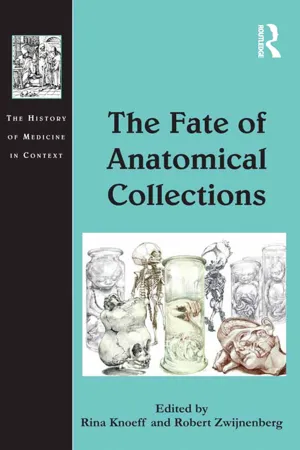
Almost every medical faculty possesses anatomical and/or pathological collections: human and animal preparations, wax- and other models, as well as drawings, photographs, documents and archives relating to them. In many institutions these collections are well-preserved, but in others they are poorly maintained and rendered inaccessible to medical and other audiences. This volume explores the changing status of anatomical collections from the early modern period to date. It is argued that anatomical and pathological collections are medically relevant not only for future generations of medical faculty and future research, but they are also important in the history of medicine, the history of the institutions to which they belong, and to the wider understanding of the cultural history of the body. Moreover, anatomical collections are crucial to new scholarly inter-disciplinary studies that investigate the interaction between arts and sciences, especially medicine, and offer a venue for the study of interactions between anatomists, scientists, anatomical artists and other groups, as well as the display and presentation of natural history and medical cabinets. In considering the fate of anatomical collections - and the importance of the keeper's decisions with respect to collections - this volume will make an important methodological contribution to the study of collections and to discussions on how to preserve universities' academic heritage.
Introduction
Chapter 1
Setting the Stage
Imagine this: a miniature orchestra of mice skeletons playing a ‘rhapsody in death’. Tiny claws hold minute instruments in front of minuscule music stands while a petite conductor waves an exquisite little baton (see Plate 1). This composition was created in 1860 by the Dutch doctor E.J. van der Mijle.
This extraordinary piece is part of Leiden University Medical Center’s anatomical collection. Yet, only a decade ago it came close to being discarded as a kind of curiosity from which serious medicine wanted to dissociate itself. The mouse orchestra suffered the same fate as so many anatomical preparations and collections worldwide. Newer teaching methods in medicine – and particularly a decline in practical anatomy – have caused many collections to become obsolete and underappreciated. Moreover, financial constraints and crises have easily led to a deprioritization of funding for the conservation, storage and sometimes even the preservation of anatomical collections. As a result, collections have often been dumped in damp cellars and stuffy attics where temperatures sometimes exceed 50 degrees Celsius. Preparations are insecurely stored, jars not topped up, provenances lost.
Luckily, staff at Leiden University Medical Center see it as their task to care for the ‘anatomical past’. In the new Anatomical Museum the old collections (including preparations over 300 years old) have been cleverly integrated into the medical curriculum. Preparations have been reallocated, restored and redefined in terms of new teaching courses, while at the same time an entire floor has been reserved for the exhibition of rare historical preparations and rarities. Thus, bottles containing babies decorated with beads, eighteenth-century sailors’ tattoos, an infant’s head decorated with lace, bladder stones cut out of bodies and ‘monstrous births’ also ride the wave of ‘relevant’ teaching material.
The mouse orchestra was also relocated: it now takes pride of place in the Medical Faculty Room at the Academy building. Its new role is to point out the rich history of the Leiden faculty and the continued excellence of its medical curriculum. Leiden University Medical Center has found a way to revalue its anatomical past, yet it still faces the difficult realization that the collections must be preserved at a time when museums and universities have difficulty finding money to preserve their academic/cultural heritage.1
The example of the mouse orchestra shows how much the fate of anatomical and pathological collections is in the hands of their keepers – which today are almost always medical faculties and related institutions. They possess great numbers of human and animal preparations, wax and other models, as well as drawings, photographs and documents, and the archives relating to them. In many institutions they are well cared for, the focus often shifting from using preparations as medical material to displaying them as historical objects. In less fortunate places anatomical collections are sadly neglected: badly stored, poorly maintained, and rendered inaccessible to medical staff and students and other audiences.
Yet, anatomical and pathological collections are medically relevant. Not only for future generations of medical students and faculty, and for future medical research, but also to the history of medicine generally, for the history of the institutions to which they belong, and for a wider understanding of the cultural history of the body. Anatomical collections hold rare and extraordinary material, records of unique medical practices. They document diseases and medical conditions that are now rare or simply no longer exist. They reflect teaching methods and preoccupations currently unfashionable or apparently superseded, as well as techniques of manufacture and display that are no longer practised. In some cases, these materials are the only documents that enable us to understand key changes and developments in Western medicine, and how they spread.
Moreover, anatomical collections are crucial to new scholarly interdisciplinary studies that investigate the interaction between arts and sciences, especially but not exclusively medicine. Such collections allow the study of interaction between anatomists, scholars and anatomical artists, and other occupational groups involved in anatomical and pathological displays. They embody the rich histories related to the display of natural history and medical cabinets; they reveal how new artistic and documentary techniques and materials were adopted by physicians and scientists in other historical periods; they demonstrate how new knowledge about the body and the natural world was presented by and for medical, scientific and sometimes lay audiences. Ultimately, anatomical collections are important for our understanding of ourselves and of the bodies we inhabit. In this sense they are no less important than world-famous artworks like the ‘Mona Lisa’, the ‘Venus de Milo’ or Michelangelo’s ‘David’.2
This book starts from the premise that anatomical collections (preparations as well as wax and papier-mâché models) are fluid – their purpose, appearance and meaning continuously change according to the cultural and scientific ideas of their keepers. This means that rather than viewing anatomical preparations as finished objects – as immutable museum pieces – standing on the shelves to be admired from a safe distance, the authors look at preparations and collections as the outcome of scientific and cultural practices. In so doing, they explore how the keepers and users of collections determined their fate. All the chapters therefore examine how curators and conservators have continuously rearranged collections according to the wishes and expectations of visitors; how researchers have actively handled, touched and redissected preparations when new research questions needed answering; how collections have been made redundant and been abandoned in basements and attics; and in a few instances how they have been cherished as important remains from the past, and as representations of lost diseases and medical cultures.
With its focus on the fate of anatomical collections, this books moves away from existing research. In recent years the history of anatomy has been a popular topic in the history of medicine. The histories of dissection and anatomical illustrations, in particular, have attracted a lot of interest. Yet the history of its material remains has so far lagged behind. Museum curators are mainly concerned with locating, cataloguing and digitizing objects, and most books on anatomical collections are on the creation (rather than the fate) of the collections. In his Morbid Curiosities, Samuel Alberti wrote about the making of nineteenth-century medical museums.3 Michael Sappol and Tatjana Buklijas have discussed anatomical preparations in relation to social and political identity.4 Historians of anatomical models increasingly focus on the user history of medical models.5 The same is true of recent research and museum initiatives designed to investigate the relationship between medical collections and public audiences. For instance, the 2014 conference of the European Association of Museums of the History of Medical Sciences (EAMHMS) was entirely devoted to the topic of medical collections and their audiences. With the exception of the recently published Medical Museums: Past, Present, Future none of these books and initiatives has so far addressed the fluidity of anatomical collections and the changing identities of the preparations in them.6 In this book, the authors explore the historical importance of keepers’ decisions with respect to collections.
Structure of this Book
The book is structured more or less chronologically, starting with the fate of early modern collections and ending with some issues that modern anatomical museums face today. The chapters are divided into five parts, each highlighting a particular aspect of the fate of anatomical collections.
In addition to this introductory chapter, Part I also includes a poetic prologue by Ruth Richardson, in which she lets the preparations speak for themselves. In a symphony of organ music we hear them tell stories of diseases and lost lives. The piece, originally written for publication in a British Medical Journal issue on narrative-based medicine, is fictional, but it conveys better than any scholarly article how the fate of preparations is inextricably bound up with the fate of the people whose parts ended up on the shelves of anatomical cabinets as well as with the people who put them there. Moreover, in giving preparations a voice, Richardson gives them identity and so helps us understand how preparations are more than mere medical objects.
Part II, ‘Fated Collections’, analyses some important factors that determine the fate of collections. Using the example of how Richard Owen curated John Hunter’s famous collections, now kept at the Royal College of Surgeons in London, Andrew Cunningham shows that what keepers do with collections can affect everything about them, right down to transforming the identity of the individual objects. Cindy Stelmackowich similarly shows how the fate of the collections at McGill University was inextricably bound up with the tragic marginal position of its female curator, Maud Abbot, who cared passionately about her collections. They flourished and were famous until she died, after which they became as unimportant as she had been throughout her professional life.
As well as curators, specific features of the collections also determined their fate. Tim Huisman considers why the old collections of the Leiden anatomical theatre, which included more curiosities than hard-core anatomical stuff, remained important even when they were no longer considered anatomically relevant. He highlights their capacity to change from anatomical material to tourist attraction. Anita Guerrini similarly shows how, in the case of skeletons, symbolic meanings were played out – materialized – in preparations, alongside their medical or scientific relevance. Both determined how they were used and displayed.
In Part III, ‘Preparations, Models and Users’, the authors tackle the fate of anatomical collections in the hands of their users. Hieke Huistra begins this part with a discussion of how preparations have the ability to adapt to different needs. She argues that preparations can be reinterpreted and reused many times according to different circumstances. In her chapter Huistra sharply distinguishes between flexible preparations, which can easily be reused, and static models, made for the purpose of answering a specific research question. Yet Anna Maerker shows how models adapt to different circumstances too. In following the fate of the famous Auzoux models from France to Egypt, India and the United States, she argues that user agency – their active contribution to model development and distribution – was crucial for the successful adoption of the models all over the world.
Tatjana Buklijas’s chapter also concerns the user history of collections. She writes about the anatomical collections of Joseph Hyrtl, as they moved around the nineteenth-century city of Vienna, while arguing that, as the city changed, so did the audiences for and locations of its anatomical collections. The final chapter in this part is on the Roca Museum of anatomical wax models. Alfons Zarzoso and José Pardo-Tomás follow the fate of this particular collection from the sordid streets of Barcelona in the 1920s, via a Catalan antiquary in the 1980s, to the modern-day trendy and slightly sensational Wunderkammern of an Antwerp collector. The story is one of disappearance and resurfacing, whereby the collections continuously adapted to new times and circumstances.
The following three chapters, in Part IV, discuss the importance of provenance for the fate of collections. They consider the problematic collections of a racial past as well as the long-felt need to carefully catalogue preparations. Marieke Hendriksen introduces the issue of how the fate of collections is intertwined with provenance with a chapter on the ‘beaded babies’, anonymous preparations of indigenous infants decorated with beads that can be found in almost all Dutch collections. These preparations are uncomfortable reminders of a colonial past. Present keepers often struggle with the problem of how to deal with these preparations, precisely because of questions about their origin. Fenneke Sysling also argues that provenance is of the utmost importance for preparations collected overseas in the former colonies. She looks at nineteenth-century Dutch physical anthropologists who considered their preparations from the Dutch East Indies of no value if not accompanied by detailed information on the region of origin. But it is not only the origin of anthropological preparations that is deemed important. Tricia Close-Koenig argues a similar point in her chapter on the paper records of the Strasbourg Medical School. She maintains that careful recordkeeping – of patients and diseases at the root of anatomical material – allows for preparations to change meanings and uses, a point that Karin Tybjerg also makes, with respect to collections of tissues and cells kept in today’s biobanks.
Anatomical collections still matter. The authors of Part V show not only that old preparations are still in use today, but also that new collections are created on a much wider scale than we might perhaps think. Samuel Alberti, curator of the anatomical collections at the Hunterian Museum, works with preparations on a daily basis, and he argues that we need to look beyond the display of objects to the actual practices and materials of museum work today. Flavio Häner, working with anatomical collections in Basel, confronts us with the consequences of museum restoration work – something that historians of anatomy find shocking. He shows that the practice of curating collections is about making controversial and ‘fate-changing’ decisions concerning the historical relevance of preparations and the need to make sense of collections in today’s museums. Finally, Karin Tybjerg, curator at the Medical Museion in Copenhagen, compares ‘old-fashioned’ nineteenth-century ‘babes in bottles’ with modern biobanks and she argues that collection practices still lie at the heart of medical research.
As an epilogue, Rina Knoeff discusses why public audiences have always been attracted to anatomical collections. Her chapter enlarges on the theme of Richardson’s ‘Organ Music’ by suggesting that the emotions and reactions evoked by anatomical preparations are strikingly similar to responses to relics and icons that figure prominently in cultural history. Thus the two chapters form a narrative framework, highlighting the cultural meaning and understanding of anatomical preparations.
In addition, the book contains the Leiden Declaration on Human Anatomy/Anatomical Collections (see the Appendix). This Declaration was an outcome of the international conference on ‘Cultures of Anatomical Collections’ held at Leiden University in February 2012, which also lies at the basis of this volume. The Leiden Declaration, in addition to stressing the need to take proper care of anatomical collections, highlights the need for multidisciplinary engagement with these collections.
Since anatomical collections are pivotal for a fuller understanding of cultural history they should not be abandoned to a closet existence for a small group of medical students and professionals. The fact that anatomical collections have figured prominently in heated debates, often focused on a sense of wrongdoing in the past, as in the case of preparations from the colonial period, goes to show that anatomical collections raise questions that go far beyond the remit of medicine alone. One might say that the need to involve the humanities is unwittingly demonstrated by the often hesitant and defensive responses of medical professionals to public questions touching on the fate of anatomical remains. New and constructive positions on the relationship between anatomical collections and a public interest in the body must be developed, based above all in the humanities. The present volume showcases the type of new approaches from the humanities that we hope will help inform the debate.
1 The story of the mouse orchestra was previously published as Rina Knoeff, ‘From Where I Sit: Remembrance of Medicine Past’, Times Higher Education, 5 June 2012, accessed 9 April 2014, http://www.timeshighereducation.co.uk/comment/from-where-i-sit/from-where-i-sit-remembrance-of-medicine-past/420434.article. For the history of the Leiden collections see also Marieke Hendriksen, Hieke Huistra and Rina Knoeff, ‘Recycling Anatomical Preparations: Leiden’s Anatomical Collections’, in Medical Museums: Past, Present, Future, ed. Samuel J.M.M. Alberti and Elizabeth Hallam, London: Royal College of Surgeons of England, 2013, pp. 74–87.
2 The relevance of medical collections was also pointed out in the Leiden Declaration on Human Anatomy / Anatomical Collections, drafted by Rina Knoeff, Ruth Richardson, Cindy Stelmackowich and Robert Zwijnenberg and widely signed by scholars, artists, medical institutions and others. The Declaration circulated online and is published at the end of this book.
3 Samuel J.M.M. Alberti, Morbid Curiosities: Medical Museums in Nineteenth-Century Britain, Oxford: Oxford University Press, 2011.
4 Michael Sappol, A Traffic of Dead Bodies: Anatomy and Embodied Social Identity in Nineteenth-Century America, Princeton: Princeton University Press, 2004; Tatjana Buklijas, ‘Cultures of Death and Politics of Corpse Supply: Anatomy in Vienna, 1848–1914’, Bulletin of the History of Medicine, 82, pp. 570–607; Tatjana Buklijas and Emese Lafferton, ‘Science, Medicine and Nationalism in the Habsburg Empire from the 1840s to 1918’, Studies in History and Philosophy of Biological and Biomedical Sciences, 38, 2007, pp. 679–86.
5 See Anna Maerker, Model Experts: Wax Anatomies and Enlightenment in Florence and...
Table of contents
- Cover Page
- Title Page
- Copyright Page
- Contents
- List of Figures
- List of Plates
- Notes on Contributors
- A Museum of My Own: Notes on the Cover Image
- Acknowledgements
- PART I INTRODUCTION
- PART II FATED COLLECTIONS
- PART III PREPARATIONS, MODELS AND USERS
- PART IV PROVENANCE AND FATE
- PART V MUSEUM AND COLLECTION PRACTICES TODAY
- Appendix: The Leiden Declaration
- Index
Trusted by 375,005 students
Access to over 1.5 million titles for a fair monthly price.
Study more efficiently using our study tools.
Frequently asked questions
Yes, you can cancel anytime from the Subscription tab in your account settings on the Perlego website. Your subscription will stay active until the end of your current billing period. Learn how to cancel your subscription
No, books cannot be downloaded as external files, such as PDFs, for use outside of Perlego. However, you can download books within the Perlego app for offline reading on mobile or tablet. Learn how to download books offline
Perlego offers two plans: Essential and Complete
- Essential is ideal for learners and professionals who enjoy exploring a wide range of subjects. Access the Essential Library with 800,000+ trusted titles and best-sellers across business, personal growth, and the humanities. Includes unlimited reading time and Standard Read Aloud voice.
- Complete: Perfect for advanced learners and researchers needing full, unrestricted access. Unlock 1.5M+ books across hundreds of subjects, including academic and specialized titles. The Complete Plan also includes advanced features like Premium Read Aloud and Research Assistant.
We are an online textbook subscription service, where you can get access to an entire online library for less than the price of a single book per month. With over 1.5 million books across 990+ topics, we’ve got you covered! Learn about our mission
Look out for the read-aloud symbol on your next book to see if you can listen to it. The read-aloud tool reads text aloud for you, highlighting the text as it is being read. You can pause it, speed it up and slow it down. Learn more about Read Aloud
Yes! You can use the Perlego app on both iOS and Android devices to read anytime, anywhere — even offline. Perfect for commutes or when you’re on the go.
Please note we cannot support devices running on iOS 13 and Android 7 or earlier. Learn more about using the app
Please note we cannot support devices running on iOS 13 and Android 7 or earlier. Learn more about using the app
Yes, you can access The Fate of Anatomical Collections by Rina Knoeff,Robert Zwijnenberg in PDF and/or ePUB format, as well as other popular books in History & 19th Century History. We have over 1.5 million books available in our catalogue for you to explore.