- 176 pages
- English
- ePUB (mobile friendly)
- Available on iOS & Android
eBook - ePub
About this book
Crossing disciplinary and chronological boundaries, Volunteer Tourism: Popular Humanitarianism in Neoliberal Times is the first full-length treatment of volunteer tourism from a longitudinal ethnographic perspective. Volunteer tourism, one of the fastest growing niche tourism markets in the world, is a type of tourism in which tourists pay to participate in conservation, humanitarian or development oriented projects. Volunteer Tourism is a comprehensive and comparative study of the perspectives of Thai host community members, NGO practitioners and international volunteer tourists. The book thus shines an ethnographic lens onto the complexities and contradictions of the volunteer tourism experience in northern Thailand. Drawing on cross-disciplinary perspectives in geography and anthropology as well as development, tourism and cultural studies, Volunteer Tourism illustrates how a focus on sentimentality in the volunteer tourism encounter obscures the structural inequalities on which the experience is based. Such a focus situates volunteer tourism within the commodification and sentimentalization of development and global justice agendas, which hail the new moral consumer and reframe questions of structural inequality as questions of individual morality. As a result, albeit inadvertently, the practice of volunteer tourism serves the continued expansion of the cultural logics and economic practices of neoliberalism.
Chapter 1 Introduction: Sentimental Sojourns in Northern Thailand
DOI: 10.4324/9781315547886-1
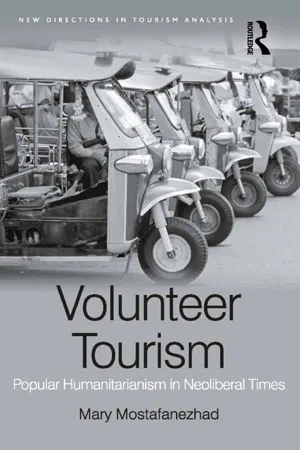
With a burning cigarette in one hand and freshly printed color brochures in the other, Tom, a tuk-tuk 1 driver, elaborates on his newfound business plan. We are at a home for single mothers in crisis about 20km outside of Chiang Mai. Tom is showing me the brochures he made with the help of some of his English friends who stay at the hostel below his sister’s apartment. A hand drawn map printed on the back and brief descriptions of six volunteer sites on the front, Tom keeps these brochures in the backseat pocket of his tuk-tuk so that they are easily noticed by his passengers. Tom is a former Thai soldier who recently acquired a tuk-tuk from his cousin. Since he began driving the tuk-tuk two years ago, Tom has noticed an increasing number of Farang 2 volunteers in Thailand. I ask Tom what he thinks about the increase in Western volunteers.3 He pauses for a moment, takes a drag of his cigarette and explains: “Thailand can’t help everyone.” He continues, “[Volunteer tourism] is good because it helps Thailand to improve. It’s better to have international NGOs and foundations than have no one to help solve the problems. So there are people to help. It helps improve the situation.”
I surmise that most people would agree with Tom: “It is better to have international NGOs and foundations than have no one to help solve the problems.” After all, it is the core ideology “of all western-based development—that the Global South is inevitably better off with ongoing interventions (in the name of development) than it would be without them” (Manzo, 2008, p. 652). Echoing this ideology, Sally Brown, founder of Ambassadors for Children, explains how, “If a kid can be held for a couple of days, you’re able to make a small difference” (Fitzpatrick, 2007). It is around these small differences that volunteer tourism—travel for the purpose of volunteering time, energy and financial support to benefit environmental conservation and development oriented projects—is positioned. Volunteer tourism is now at the forefront of tourism development agendas and is the fastest growing niche tourism market in the world (Vrasti, 2012). The expansion of volunteer tourism is more than the latest trend in alternative travel; it is a cultural commentary on the appropriate response to global economic inequality. Volunteer Tourism examines this commentary through the lives of ordinary individuals who like their celebrity counterparts or the colonial explorers that came before them, have become key signifiers in the reorganization of international humanitarianism in the Global South.
The volunteer tourism experience complicates postcolonial readings of the tourism encounter. Existing stereotypes about the superficial sociality of tourism experiences is seemingly vindicated through intimate interaction with “host community members”4 —often the foremost attraction in volunteer tourism. Ted, the founder of Chiang Mai Friends—one of the NGOs on which this research is based—explains on his website how meaningful cross-cultural experiences are and how volunteer tourism departs from mainstream tourism experiences (Ted, 2010, Founder of Chiang Mai Friends). In this way, volunteer tourists are able to escape the “tourist bubble” through intimate encounters with local people. Thus, the sentimentality of the volunteer tourism experience is at least in part what authenticates and differentiates volunteer tourism from mass tourism experiences.
Sentimentality intersects with humanitarianism and development discourse in volunteer tourism in ways that reflect an emerging transnational cultural logic. As Tester points out, “[T]he linkage between humanitarianism and culture is intrinsic and actually essential because humanitarianism means paying moral attention to others who are beyond one’s immediate sphere of existence, and therefore it requires, and involves an imagination about the world, about the relationships between the near and the far, ‘us’ and ‘them’” (Tester, 2010, p. vii). This cultural logic engages with neoliberalism as both a cultural ideology and economic practice that takes shape in distinctive ways in diverse geopolitical contexts. Rather than a monolithic force with undifferentiated characterizations, neoliberalism is manifest and is co-constituted within existing political and economic circumstances (Springer, 2010, Ferguson, 2010). Daley points out how “humanitarianism has become corporatised and professionalised at the same time that neoliberal economic restructuring has reduced state-provisioned social welfare” and that “Western humanitarian actors have become increasingly diversified, ranging from government agencies, Western militaries, multilateral organisations, international non-governmental organisations (INGOs), wealthy philanthropic individuals, ordinary citizens, and celebrities” (Daley, 2013, p. 375–6). Along with these actors is the increasingly conspicuous volunteer tourist who now makes regular appearances along the banana pancake trail in Southeast Asia.
In Volunteer Tourism, I consider the ways that neoliberalism mediates the volunteer tourism experience including 1) how neoliberalism is resisted as well as how this resistance is co-opted through the privatization of social justice agendas; 2) how individuals take on neoliberal subjectivities and identity formations; and 3) the ways neoliberalism is appropriated as a coping strategy in local struggles for economic survival. Despite its protean nature, I argue that there is a tie which binds these practices into a recognizable neoliberal project of humanitarian ilk. This project takes place within the contemporary moment “in which realms of culture and society once considered ‘outside’ the official economy are harnessed, reshaped and made legible in economic terms” (Mukherjee and Banet-Weiser, 2012, p. 1). Through ethnographic and theoretical mappings of these configurations in the context of volunteer tourism in northern Thailand, I offer a nuanced geography of neoliberalism as a cultural, political and economic ideology and practice that takes place, shifts and reconfigures within the transnational volunteer tourism encounter.
The “voluntary turn” which has progressively expanded since the mid-1980s and the corollary rapid expansion of NGOs—now key players in international development and the expansion of global civil society are illustrative of how the cultural articulates with the economic and political in neoliberalism (Milligan and Conradson, 2006b, Milligan and Conradson, 2006a, Hailey, 1999). The intensified focus on the individual as a moral consumer is one link in the broader chain of expansion of “moral economies”—most notably exemplified by fair, ethical and alternative consumer products—as well as global justice movements. In this way, volunteer tourism represents a growing consumer consciousness of global economic, social and political inequality. Today, “instead of the rational, calculating and cold-blooded American Psycho, the good neoliberal subject of the twenty-first century is the rather schizophrenic figure of the compassionate entrepreneur, the happy workaholic, the charitable CEO, the creative worker, the frugal consumer and, last but not least, the volunteer tourist” (Vrasti, 2012, p. 21). Ironically, within this commodity driven context, both supporters and critics of neoliberalism facilitate its expansion through their mutual commodification and privatization of development as well as their appropriation of sentimentality as the flag under which they compete for legitimacy.
A central question in contemporary scholarship on the Third World5 “is how the linked processes of globalization, modernization, and transnational capitalism affect people’s everyday lives” (Wilson, 2004, p. 8). This question is regularly debated in the public arena where audiences around the world are becoming increasingly mindful of the negative implications of neoliberal global capitalism. While local governments have been debilitated by the wake of neoliberalism’s onslaught of structural adjustment programs, state pullbacks and privatization schemes—middle and upper class Western consumers have decided to take action into their own hands. Volunteer tourism has become an increasingly popular approach for people to participate in humanitarianism: as TIME Magazine reports, “[G]etting in touch with your inner Angelina Jolie is easier than it used to be!” (Fitzpatrick, 2007, also cited in 207">Mostafanezhad, 2013). In myriad ways, celebrities like Angelina Jolie, Madonna and George Clooney have made international volunteering sexy! While most people cannot commit their lives or bank accounts to long-term volunteer projects, there has been a recent explosion of the range of humanitarian organizations and projects that are suited for first-timers.
The primary argument that threads through the pages that follow is that the volunteer tourism encounter is mediated by the cultural logic of neoliberalism which reframes questions of structural inequality as questions of individual morality. As a result, volunteer tourism—albeit inadvertently—contributes to the continued expansion of the cultural logic and economic practices of neoliberalism as well as contributes to the ongoing redefinition of humanitarianism and social activism. Additionally, I argue that the focus on sentimentality in the encounter obscures the structural inequality on which the volunteer tourism experience is based. Thus, while the small, and indeed sentimental changes that Brown notes above are meaningful in their own right, in Volunteer Tourism I illustrate how and why the sustainability of the accomplishments of volunteer tourism remain tenuous. This is, I argue, because the problems that volunteer tourism seeks to address are the outcome, rather than the cause of underdevelopment. The work of Volunteer Tourism traverses between anthropology of tourism and tourism geographies and extends into the interdisciplinary terrain of cultural, tourism and humanitarian studies. It engages with crucial questions regarding how the contemporary generation has transformed activism and social resistance in ways that articulate with the market. This widespread reorientation forces us to consider resistance in relation to, among others, the consumer-cum-volunteer tourist (Sturken, 2012, p. x).
The Media(ted) Humanitarian Gaze
The voluntary impulse in Thailand reached new heights in the aftermath of the 2004 Indian Ocean tsunami where more than 150,000 people were killed including more than 7,000 people in Thailand (Rigg et al., 2005, Jankaew et al., 2008). Ricky Martin and other high profile artists such as Madonna, George Clooney and Christina Aguilera took part in campaigns to raise funds for tsunami victims (Jeckell and MacNeil, 2004). In his week-long tour of the tsunami affected area of southern Thailand, Ricky Martin met with the Thai prime minister at the time, Thaksin Shinawatra and Foreign Minister Surakiart Sathirathai to discuss the extent of the devastation. He also toured Patong and Kamala beaches and several orphanages, where photographs of him holding and kissing children attracted international media attention. Media representations of the humanitarian and environmental devastation caused by the tsunami were inescapable. Coupled with widespread attention to celebrity humanitarians calling out for the help of their fellow global citizens, thousands of international volunteers rallied to Thailand and other affected regions in Asia. Notably, “the immediacy of the suffering and the extensive news coverage helped mobilize people in the countries that supply Southeast Asia with most of their tourists: Europe, Japan and Australia” (Hitchcock et al., 2009, p. 6). While many volunteers knew victims, “others had first-hand experience of the places and people struck by the tsunami, and had a feeling of solidarity as a result of visiting the region” (Hitchcock et al., 2009, p. 6). A consequence of the successful recruitment of Western volunteers was the growing identification among the public as potential humanitarian actors. Like the phenomena of volunteer tourism itself, the increasing visibility of celebrities in humanitarianism should not be taken for granted. Daley notes how “[S]ince the mid-1980s, celebrity advocacy has become more widespread; through its association with the technological developments in the social media, it is helping to reshape public engagement with politics in Western societies” (Daley, 2013, p. 376). Celebrity humanitarianism and volunteer tourism embody a different, yet related cultural politics that merge as mutual forms of popular humanitarianism which require a “moral sensibility demanding action on the part of the safe and secure toward the suffering and endangered” (Tester, 2010, p. vii). This sensibility was reinforced in the aftermath of the 2010 earthquake in Haiti where more than three million people were affected and at least 150,000 people were killed.
Sean Penn spearheaded celebrity contributions to the reconstruction in response to the humanitarian crisis. Penn told the press: “There’s something that takes over and it’s really an obligation because you see the strength of the people who have never experienced comfort, and the gifts that that can give to people like myself and to our country and culture. You see the enormous gaps” (Huffington Post, 2011). Celebrity rapper P. Diddy joined the effort on Twitter, where he wrote, “God Bless Haiti!!!! God please!!!,” while Lindsay Lohan tweeted, “[A]nyone that may be listening’s attention [sic]. Call 1884074747 State Dept for Haitian Relief Please help them … I know I will as much as I can … Please do all that you can.” (Bull, 2010). Celebrities who responded to the event also encouraged citizens to contribute to the effort: “I hope I see you there,” Penn commented to reporters (Bull, 2010).
More recently, a People Magazine article, “Christina Aguilera Takes Emotional Trip to Rwanda,” quotes Aguilera, pop singer, global spokesperson for Yum! Brands World Hunger Relief effort and an Ambassador Against Hunger for the UN World Food Programme, as stating, “This trip came at a time when I really needed to step away and connect with bigger issues in the world, [and] this trip really touched me in a way I never felt before … The people of Rwanda touched me in a way I cannot express or put into words” (Leonard, 2013). Sentimental celebrity commentary such as Aguilera’s is echoed throughout the industry that almost invariably obscures the broader structural causes of the issues that celebrities speak to. Yet, this is not to say that these events are without critique. For example, on the popular blog, Africa is a Country, an author sums up the People Magazine article with the comment: “Africa: helping white people who’re a wee bit down-in-the-dumps feel better about themselves since 1884” (Nsabimana, 2013). Thus, as one link in this broader chain of events, celebrities have become interlocutors and spokespeople for myriad causes and as such, are reconfiguring the political economy of international humanitarian interventions. Tester asks why it is that we listen when celebrities “speak with the voice of humanitarian concern even though they have as much—and as little—knowledge as anyone else” (Tester, 2010, p. ix). I ask, how is it that the celebrity industrial complex has become such a powerful force in Western society? And in what ways is it linked to the growth of volunteer tourism and its corollaries? Commenting on the link between commodities, celebrities and activism, Sturken observes how:
[C]ontradictions are inevitable here. Activism is consumerism. Celebrity humanitarianism. Commodity-driven social resistance. Neoliberal activism. Yet … seeing it all as contradiction does not help us anymore, that a sense of contradiction is derived from reining in an outdated mode of thinking. We canno...
Table of contents
- Cover Page
- Half-Title Page
- Title Page
- Copyright Page
- Table of Contents
- 1 Introduction: Sentimental Sojourns in Northern Thailand
- 2 “Making a Difference One Village at a Time”: Volunteer Tourism and the Peace Corps Effect
- 3 The Seduction of Development: NGOs and Alternative Tourism in Northern Thailand
- 4 Cosmopolitan Empathy, New Social Movements and the Moral Economy of Volunteer Tourism
- 5 The Cultural Politics of Sentimentality in Volunteer Tourism
- 6 Converging Interests? Cross-Cultural Authenticity in Volunteer Tourism
- 7 Conclusion—Re-mapping the Movement: Popular Humanitarianism and the Geopolitics of Hope in Volunteer Tourism
- Bibliography
- Index
Trusted by 375,005 students
Access to over 1.5 million titles for a fair monthly price.
Study more efficiently using our study tools.
Frequently asked questions
Yes, you can cancel anytime from the Subscription tab in your account settings on the Perlego website. Your subscription will stay active until the end of your current billing period. Learn how to cancel your subscription
No, books cannot be downloaded as external files, such as PDFs, for use outside of Perlego. However, you can download books within the Perlego app for offline reading on mobile or tablet. Learn how to download books offline
Perlego offers two plans: Essential and Complete
- Essential is ideal for learners and professionals who enjoy exploring a wide range of subjects. Access the Essential Library with 800,000+ trusted titles and best-sellers across business, personal growth, and the humanities. Includes unlimited reading time and Standard Read Aloud voice.
- Complete: Perfect for advanced learners and researchers needing full, unrestricted access. Unlock 1.5M+ books across hundreds of subjects, including academic and specialized titles. The Complete Plan also includes advanced features like Premium Read Aloud and Research Assistant.
We are an online textbook subscription service, where you can get access to an entire online library for less than the price of a single book per month. With over 1.5 million books across 990+ topics, we’ve got you covered! Learn about our mission
Look out for the read-aloud symbol on your next book to see if you can listen to it. The read-aloud tool reads text aloud for you, highlighting the text as it is being read. You can pause it, speed it up and slow it down. Learn more about Read Aloud
Yes! You can use the Perlego app on both iOS and Android devices to read anytime, anywhere — even offline. Perfect for commutes or when you’re on the go.
Please note we cannot support devices running on iOS 13 and Android 7 or earlier. Learn more about using the app
Please note we cannot support devices running on iOS 13 and Android 7 or earlier. Learn more about using the app
Yes, you can access Volunteer Tourism by Mary Mostafanezhad in PDF and/or ePUB format, as well as other popular books in Business & Hospitality, Travel & Tourism Industry. We have over 1.5 million books available in our catalogue for you to explore.