eBook - ePub
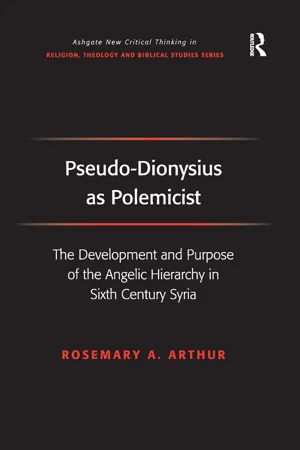
Pseudo-Dionysius as Polemicist
The Development and Purpose of the Angelic Hierarchy in Sixth Century Syria
- 226 pages
- English
- ePUB (mobile friendly)
- Available on iOS & Android
eBook - ePub
Pseudo-Dionysius as Polemicist
The Development and Purpose of the Angelic Hierarchy in Sixth Century Syria
About this book
The anonymous theologian known as Pseudo-Dionysius, who was responsible for arranging the angelic hierarchy into nine orders, had a significant influence on mediaeval European mysticism. This book places him in his religious and political context in sixth century Syria, and uncovers the hidden agenda which lies behind his writings. New evidence is presented to establish the dating of the corpus more accurately than has been done before. Rather than analysing the minutiae of Dionysius' thought, Rosemary Arthur focuses on his sources for, and treatment of, the Angelic Hierarchy and the Dazzling Darkness, with a view to ascertaining his motive for writing, his relationship with his opponents and his need to hide his identity.
Trusted by 375,005 students
Access to over 1.5 million titles for a fair monthly price.
Study more efficiently using our study tools.
Information
Topic
Theology & ReligionSubtopic
Ancient HistoryChapter 1
Christian and Non-Christian Sources
1.1 Introduction
Dionysius the Areopagite, whose conversion to Christianity is described in Acts 17.16–34, was an Athenian philosopher who was reputed to have become the first bishop of Athens. Apart from Acts 17, the only other information that we have of him comes from Eusebius of Caesarea’s Ecclesiastical History:
… that member of the Areopagus, Dionysius by name, whom Luke records in the Acts as having received the faith for the first time after Paul’s public address to the Athenians in the Areopagus, is described by one of the ancients, another Dionysius, shepherd of the diocese of Corinth, as having been the first Bishop of Athens.1
This second Dionysius, bishop of Corinth in about 180AD, appears to have been a man of some influence who, like Paul before him, wrote letters to various churches.2 Since we have no information about the epistular habits (if any) of Dionysius the Areopagite, Ps-Dionysius may have modelled himself partly on Dionysius of Corinth. Although the biblical account mentions only Epicurean and Stoic philosophers,3 our author is a Neoplatonist.
His attitude to the human body is rather more positive than that of the Middle Platonists who would have been contemporary with his namesake. He does not, for example, see the body as a tomb for the soul:
Why then do we hesitate and doubt to put off the corruptible body that hinders us and weighs down the soul …?4
On the contrary, the body is inseparable from the soul and therefore shares with it after death the appropriate reward which both have earned.5 The human body, in spite of its many ailments and weaknesses, is not evil, but ‘a lesser beauty’, which certainly cannot be said to be a cause of evil in the soul.6 The influence of Proclus can be seen here; matter is necessary for the good that happens in the world.7
Because they denied divine judgement, Epicureans argued8 that death was not to be feared:
By this means the objections of the Epicureans against providence are dissolved; for, say they, that which is divine is neither the cause of molestation to itself nor to others.9
Neither does Dionysius see death as something to be feared by those who have led pure lives.10 The only people who need to worry are those Christians who have rejected the moral teachings which they have received, in order to embark on a life of pleasure.11 Stoics gave divine providence a central place in their teachings and shared with the later Neoplatonists a belief in the inter-relationship (sympatheia) of all parts of the cosmos.12 Ps-Dionysius appears to have taken care not to contradict these teachings. For example, he nowhere mentions hell, while Providence (pronoia) occurs frequently, particularly in Divine Names.
In order to convey that he has a sound knowledge of Greek philosophy (although now a Christian bishop and disciple of St Paul), Dionysius makes extensive use of Greek philosophical terminology. In Epistle 10 he informs the reader that he is writing in old age, at the end of the first century.
As a Christian, Dionysius needs to be very careful about referring to the Fathers, since his readers are likely to be acquainted with much more of the history of Christian doctrine than of Greek philosophy, and will quickly detect his fraud if he takes a false step. As it is, there are some breath-stopping moments when he quotes Ignatius of Antioch13 and draws on the writings of Clement of Alexandria, Gregory of Nyssa and others, not forgetting the use of the Nicene Creed in the liturgy, only introduced in 475–7AD by Peter the Fuller.14 His main Christian influence ought to be that of Paul. But although Dionysius quotes the Pauline and Ps-Pauline epistles a large number of times, his much vaunted discipleship is simply not convincing. Firstly, Paul was the last person to encourage hero-worship. Dionysius’ extravagant use of epithets such as ‘the divine Paul’, ‘the great Paul’,15 belong far more to the milieu of the Greek schools, where the personality of the master was central in the learning process, and where there was often an ‘almost hysterical devotion of pupil to teacher’.16 1 Cor. 3.4–9 illustrates the Pauline attitude of teacher as servant, using the analogy of a gardener who nurtures his plants, recognizing that their growth comes from God alone.
Secondly, Dionysius claims to have known Paul personally, yet the Damascus Road conversion is not referred to anywhere in the Dionysian Corpus. Neither is Paul’s ascent to the third heaven in 2 Cor. 12.1–4 mentioned, in spite of Dionysius’ apparent interest in visionary and mystical experiences. These two omissions are particularly suspicious. St Ephrem’s Homily on our Lord deals with the Damascus Road experience in sections 26–40, where he compares the effect of the light on Moses and Paul:
Why did the eyes of Moses radiate with the glory he saw, [while the eyes] of Paul rather than radiating, were utterly blinded by that light? We should know that the eyes of Moses were not stronger than Paul’s; they shared the same relationship to flesh and blood. Another power graciously sustained the eyes of Moses, but no power lovingly reinforced [the eyes] of Paul … We should realise this: whenever anything is revealed to us that is greater than and beyond our nature, the strength of our nature is unable to endure in its presence. But if another power beyond our nature reinforces us, we are able to endure the presence of something extraordinary which we do not experience in nature because of what we receive above and beyond nature.17
Could it be that the power which protected Moses, but not Paul, the Shekinah who transfigures all those on whom it rests,18 did so precisely because Moses was humble enough to work in the strength of the Lord rather than in his own? Whereas Paul, in his pride, had been fighting against God, certainly at the time of his conversion. Even thereafter, although he professed humility, yet was he still fighting – against the very ‘pillars of the Church’ whose teaching he ought presumably to have been handing on unchanged.19 In this connection it may be significant that Dionysius refers to Peter as ‘that summit, that chief of all those who speak of God’,20 but does not mention Paul’s presence on this important occasion. Dionysius picks up this theme of Moses’ humility in the letter to Demophilus.21
Even though Dionysius professed admiration of Paul, there is a remoteness which suggests that he was unwilling to engage with the person behind the words of the Pauline epistles. His relationships with Hierotheus and Carpus seem much more realistic. Thirdly, Paul discouraged Christians from treating angels as intermediaries between God and humanity. They should not have too high a place in the attainment of salvation,22 lest they usurp the place which is rightfully that of Christ alone.23 This is quite the opposite of Dionysius, for whom angels virtually take the place of Christ.24 So Dionysius finds Paul very useful as a source of quotes (although only, be it noted, in Divine Names and the Letters!). But he only quotes him when it suits his purposes. His own theology owes very little indeed to Paul, 1 Tim. 6.16 excepted. Worse still, Ps-Dionysius’ Christology ‘totally ignores … the central affirmation of Pauline faith’,25 which is that we are justified by faith in the crucified Christ. In fact Dionysius...
Table of contents
- Cover
- Half Title
- Title Page
- Copyright Page
- Table of Contents
- List of Abbreviations
- Preface
- 1 Christian and Non-Christian Sources
- 2 The Angelic Hierarchy
- 3 The Unknowability of God
- 4 The Monophysite Connection
- 5 Summa or Polemic?
- 6 Conclusion
- Bibliography
- Index
Frequently asked questions
Yes, you can cancel anytime from the Subscription tab in your account settings on the Perlego website. Your subscription will stay active until the end of your current billing period. Learn how to cancel your subscription
No, books cannot be downloaded as external files, such as PDFs, for use outside of Perlego. However, you can download books within the Perlego app for offline reading on mobile or tablet. Learn how to download books offline
We are an online textbook subscription service, where you can get access to an entire online library for less than the price of a single book per month. With over 1.5 million books across 990+ topics, we’ve got you covered! Learn about our mission
Look out for the read-aloud symbol on your next book to see if you can listen to it. The read-aloud tool reads text aloud for you, highlighting the text as it is being read. You can pause it, speed it up and slow it down. Learn more about Read Aloud
Yes! You can use the Perlego app on both iOS and Android devices to read anytime, anywhere — even offline. Perfect for commutes or when you’re on the go.
Please note we cannot support devices running on iOS 13 and Android 7 or earlier. Learn more about using the app
Please note we cannot support devices running on iOS 13 and Android 7 or earlier. Learn more about using the app
Yes, you can access Pseudo-Dionysius as Polemicist by Rosemary A. Arthur in PDF and/or ePUB format, as well as other popular books in Theology & Religion & Ancient History. We have over 1.5 million books available in our catalogue for you to explore.