- 224 pages
- English
- ePUB (mobile friendly)
- Available on iOS & Android
eBook - ePub
About this book
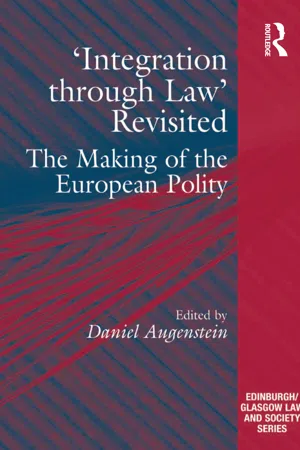
Over the last twenty years, processes of pluralization, differentiation and trans-nationalization in the European Union have arguably challenged the centrality of law to European integration. Yet these developments also present opportunities to investigate new understandings of law triggered by European integration. The contributors to this book revisit one of the first academic projects to conceptualise and study European legal integration - the early 'Integration through Law' School. On this basis, they consider continuities and discontinuities in the underlying social and political landscape which the law is to integrate (the 'object' of integration), the forms and capacities of the law itself (the 'agent' of integration), and the way these two dimensions reflect on each other. Displaying different normative concerns and varied theoretical starting points, all contributors maintain that 'integration through law' remains of enduring significance to the European integration process. The volume provides a valuable reference for scholars in the field of European integration studies and European legal and political theory.
PART I The Constitutional Frame of EU Legal Integration
DOI: 10.4324/9781315589046-2
Chapter 1 European Integration and European Constitutionalism: Consonances and Dissonances
DOI: 10.4324/9781315589046-3
Introduction
The two terms, European integration and European constitutionalism, are widely used as labelling and organizing concepts in this not-easily-described project-process of possible/putative-polity-formation on the continent of Europe since the end of the Second World War. On the one hand, both concepts seem not to be incapable of broadly corresponding to the sentiment of the ever-vague and oft-repeated mission phrase of the European treaties: ‘ever closer union among the peoples of Europe’, and certainly both are frequently employed in its support. On the other hand, it is not clear, first, that these concepts have a whole lot in common with each other, and second, that either of these concepts, for different reasons, is capable of providing the normative foundations that the European project so badly needs if it is ever to be able to provide good answers to the questions of how to ensure respect for the principles of representation, democracy, self-determination and what kind of polity it is supposed (eventually) to be. This chapter purports to examine the consonances and dissonances between European integration and European constitutionalism with the hope of clarifying their usefulness to us as we search for these answers. 1
Turning first, and briefly, to the documentary usages of the terms integration and constitutionalism, it can be noted that in the beginning, while the Schumann Declaration (1950) clearly envisages that European nations will become more integrated with each other through a slow step-by-step process of successive ‘concrete achievements’, there is no reference in the text to a need for a European constitution, or even to a process of constitutionalism or constitutionalization. The absence of such a reference in the Declaration is more significant when set against the fact that the document does, as we know, make specific reference to the fact that the end-point of this process of iterative functional integration is the establishment of a ‘federation of Europe’. Ironically, then, the document, which does accept that the continent of Europe can be integrated to the fullest extent conceivable, does not contemplate that that integration will take place on a specifically constitutional basis. Indeed, the document repeatedly makes reference to the continuing existence of the states and nations (of France, Germany, etc). The various treaties that mark the various stages of European integration (and constitutionalization?) are also noteworthy more often for the concepts that they do not invoke. Neither the words ‘integration’ or ‘constitution’ nor any of their derivatives find their way into the Treaty of Paris (establishing the European Coal and Steel Community in 1951) or the Treaty of Rome (establishing the European Economic Community in 1957) so as to describe the putative European project. The famous one-line reference to the projected greater unity (‘ever closer union’) between the peoples of Europe stands unsubstantiated in all its preambular glory. The Maastricht Treaty (1992) is the first Treaty to actually mention ‘the process of European integration’ as a process currently underway and one which is to be advanced through the provisions of the Treaty (Preamble of the Treaty on the European Union). The only constitutional reference here though is to ‘constitutional traditions of the Member States’, which reference is in fact used by the Treaties to bolster and legitimize European integration. 2 It was Joschka Fischer’s ‘Quo Vadis Europa?’ speech in 2000 that for the first time publicly promoted the finalization of the project of European integration, i.e. the establishment of a European federation by the means of a European constitution. In Fischer’s speech we have one of the very few documentary examples of the close association between European integration and European constitutionalism; the following passage from which is particularly striking:
These three reforms – the solution of the democracy problem and the need for fundamental reordering of competences both horizontally, i.e., among the European institutions, and vertically, i.e., between Europe, the nation-state and the regions – will only be able to succeed if Europe is established anew with a constitution. In other words, through the realisation of the project of a European constitution centred around basic, human and civil rights, an equal division of powers between the European institutions and a precise delineation between European and nation-state level (Fischer 2000).
Although the subsequently-established Constitutional Convention was likened by its Chairman, Valéry Giscard d'Estaing, to the Philadelphia Convention that prepared the US Constitution, the Chairman also claimed in 2002 that the text produced by the European Convention would not give or become a final answer on the question of whether the European Union was a federation or a confederation, but would instead ‘borrow from both models’ (Giscard d'Estaing 2002). 3 This conscientious dodging of the most important question itself became the most notable characteristic of the aptly colloquially renamed ‘Constitutional Treaty’ – properly known as the Treaty establishing a Constitution for Europe and signed in 2004 – and was perfectly expressed in the opening Article I-1.1:
Reflecting the will of the citizens and States of Europe to build a common future, this Constitution establishes the European Union, on which the Member States confer competences to attain objectives they have in common. The Union shall coordinate the policies by which the Member States aim to achieve these objectives, and shall exercise on a Community basis the competences they confer on it. 4
In the Constitutional Treaty, then, we have not so much a consonance between constitutionalism and integration as a deliberate ambiguity in that the document was specifically designed to be capable of being defended as a (non-constitutional) treaty to those who wanted a treaty, and conversely as a constitution to those who wanted a constitution. Upon rejection of the Constitutional Treaty, the process of integration was to continue in an explicit constitutional vacuum although the vast majority of the provisions of the Constitutional Treaty exist now and have been given legal effect under the Treaty of Lisbon which came into effect in 2009. The Treaty of Lisbon itself reverts to the Preamble used in the Maastricht Treaty and so it does specifically mention ‘the process of European integration’.
After this cursory glance at documentary usages of the terms integration and constitutionalism, this chapter concentrates in the four sections which follow on both judicial and conceptual consonances between European integration and European constitutionalism and on judicial and conceptual dissonances between European integration and European constitutionalism. It would also have been possible, of course, to examine the consonances and dissonances between integration and constitutionalism as they occur in political discourse, for example, in the usage of those terms in the Presidency Conclusions released after IGC conferences, or in documents prepared by the Commission, or in statements by Heads of Government to their national audience, and so on. The particular focus of this chapter on judicial and conceptual consonances and dissonances has been chosen to complement the other chapters of the book, and to revisit the original premise and direction of the Integration through Law project.
Judicial Consonances
The first intimations of the position that there might be consonances between European integration and constitutionalism come in the context of the two most famous cases of the European Court of Justice. Nowadays we accept almost unthinkingly that the principles declared by the European Court of Justice in the cases of Van Gend en Loos ([1963] ECR 1) and Costa ([1964] ERC 585) are constitutional principles. Actually, neither of the judgments makes any reference whatever to ‘constitution’ (or any of its derivatives), nor were these ‘constitutional’ principles founded in a constitutional text. How did it happen, though, that the jargon of constitutionalism came to be used and accepted as an accurate descriptor of principles laid down in a couple of cases decided by a court established under an international treaty, adjudicating in specific cases on the official meaning of the substantive laws established under that same international treaty (although not on their application to a concrete fact-scenario, because that was not a power that was given to the court by the treaty)?
The first, and most commonly proffered part of the answer to that question is that the ECJ, when it declared the two principles of direct effect and supremacy, was declaring that (from the point of view of the Court, at least) European law would have a doctrinal authority that would be more consonant with the authority of constitutional law than that of international law in terms of its validity and applicability. However, the establishment of the principle of direct effect in Van Gend en Loos, and the establishment of the principle of supremacy in Costa (Case 6/64) are both in fact supported by arguments relating to European integration, rather than arguments grounded in European constitutionalism. In Van Gend en Loos, the establishment of the (constitutional) principle of direct effect is linked to the viability of the internal market: ‘The objective of the EEC Treaty, which is to establish a common market, the functioning of which is of direct concern to interested parties in the Community, implies that this Treaty is more than an agreement which merely creates mutual obligations between the Contracting States’ (Van Gend en Loos, Case 26/62: 12). In the Costa judgment, the (constitutional) principle of supremacy was even more explicitly justified by reference not only to the viability of the common market but to the integration project as a whole:
The integration into the laws of each Member State of provisions which derive from the Community, and more generally the terms and spirit of the Treaty, make it impossible for the States, as a corollary, to accord precedence to a unilateral and subsequent measure over a legal system accepted by them on the basis of reciprocity (Costa, Case 6/64: 594).
It has been noted how poor and/or how baseless the legal reasoning in these aspects of the judgments is (de Witte 1999: 177, Craig and de Búrca 2007: 273–4, 345–6). These criticisms are not of direct concern here – except insofar as they confirm that these constitutional principles were declared in a constitutional vacuum – because the focus is instead on the fact that the judgments very specifically justify direct effect and supremacy in terms of European integration rather than European constitutionalism. That is, although the Van Gend en Loos and Costa cases claimed doctrinal authority for European law which was consonant with the doctrinal authority that constitutional law usually has, these doctrinal authority claims were actually grounded in the concept and project of European integration, and not in the concept and project of European constitutionalism. Any consonance at this point is therefore only apparent and superficial, rather than authentic and profound.
In these cases, however, the European Court of Justice not only declared the two principles of direct effect and supremacy, but it also asserted that it had the authority to make such a declaration. That is, the Court announced its own constitutional authority, and it did so, as already alluded to, under the same conditions where there was a lack of constitutional infrastructure and where the relevant sources of law expressly did not confer constitutional authority on the Court. As Weiler says: ‘If nothing else, this jurisprudence was as clear an indication as any of the audacious self-perception of the European Court. The measure of the creative interpretation of the Treaty was so great as to be consonant with a self-image of a constitutional court in a “constitutional” polity’ (Weiler 1999: 24). If, to think counter-factually for a moment, instead of signing the Treaty of Rome, the six founding Member States of the European Union had ratified a constitution (of Rome?), and if the European Court of Justice had been established under that constitution as the constitutional court for the European Community, then the constitutional authority of the ECJ would have been legally incontestable, and the Court would not have had to announce that authority in the absence of a constitutional mandate. Furthermore, if the ECJ had been established as a constitutional court, then, irrespective of whether the treaties required that European law should be applied in the legal orders of the Member States according to the principles of direct effect and supremacy, the Court could certainly have articulated those principles in the Van Gend en Loos and Costa decisions, in the exercise of its constitutional authority. Precisely because no constitutional mandate was given to the ECJ by a constituent power capable of conferring that authority, the only option the Court had was to try to claim that authority for itself, simply by asserting and exercising it.
So how was the claim to constitutional authority made? The parts of the judgments in the cases of Van Gend en Loos and Costa that established the constitutional authority claim are even more insufficiently grounded than were those that established the doctrinal authority claim, but this time the paucity of reasoning is more relevant to our dis...
Table of contents
- Cover Page
- Half-Title Page
- Title Page
- Copyright Page
- Table of Contents
- List of Contributors
- Preface
- Introduction: What Law for What Polity? ‘Integration through Law' in the European Union Revisited
- Part I: The Constitutional Frame of EU Legal Integration
- Part II: Conceptions and Roles of Law in European Integration
- Part III: Beyond ‘Integration Through Law’?
- Epilogue
- Bibliography
- Index
Trusted by 375,005 students
Access to over 1.5 million titles for a fair monthly price.
Study more efficiently using our study tools.
Frequently asked questions
Yes, you can cancel anytime from the Subscription tab in your account settings on the Perlego website. Your subscription will stay active until the end of your current billing period. Learn how to cancel your subscription
No, books cannot be downloaded as external files, such as PDFs, for use outside of Perlego. However, you can download books within the Perlego app for offline reading on mobile or tablet. Learn how to download books offline
Perlego offers two plans: Essential and Complete
- Essential is ideal for learners and professionals who enjoy exploring a wide range of subjects. Access the Essential Library with 800,000+ trusted titles and best-sellers across business, personal growth, and the humanities. Includes unlimited reading time and Standard Read Aloud voice.
- Complete: Perfect for advanced learners and researchers needing full, unrestricted access. Unlock 1.5M+ books across hundreds of subjects, including academic and specialized titles. The Complete Plan also includes advanced features like Premium Read Aloud and Research Assistant.
We are an online textbook subscription service, where you can get access to an entire online library for less than the price of a single book per month. With over 1.5 million books across 990+ topics, we’ve got you covered! Learn about our mission
Look out for the read-aloud symbol on your next book to see if you can listen to it. The read-aloud tool reads text aloud for you, highlighting the text as it is being read. You can pause it, speed it up and slow it down. Learn more about Read Aloud
Yes! You can use the Perlego app on both iOS and Android devices to read anytime, anywhere — even offline. Perfect for commutes or when you’re on the go.
Please note we cannot support devices running on iOS 13 and Android 7 or earlier. Learn more about using the app
Please note we cannot support devices running on iOS 13 and Android 7 or earlier. Learn more about using the app
Yes, you can access 'Integration through Law' Revisited by Daniel Augenstein in PDF and/or ePUB format, as well as other popular books in Law & Jurisprudence. We have over 1.5 million books available in our catalogue for you to explore.