- 232 pages
- English
- ePUB (mobile friendly)
- Available on iOS & Android
eBook - ePub
About this book
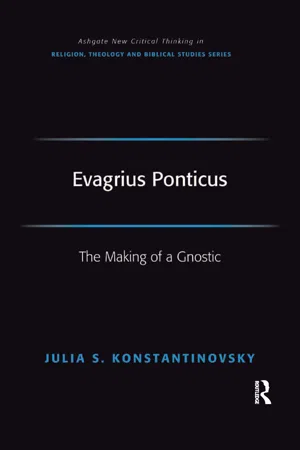
A revered instructor of the eremitic monks of Nitria, Sketis and Kellia, Evagrius Ponticus is a fascinating yet enigmatic figure in the history of fourth-century mystical thought. This historical and theological re-evaluation of the teaching of Evagrius brings to bear evidence from the Greek and Syriac Evagriana. Focusing on Evagrius' concept of perfection as the acquisition of spiritual knowledge, this book revisits current perceptions of Evagrius's thought and character by comparing and contrasting him with his contemporaries and predecessors, both Christian and pagan. Ideas of the three 'Cappadocians' and the author of the Macariana, as well as Stoic, Neo-Platonic and earlier Christian writers such as Alcinoos, Plotinus, Clement and Origen, are all explored. Konstantinovsky draws attention to a lack of uniformity in the fourth-century views on the origin of the soul, the body-soul relation, and the eschatological destiny of humankind.
Information
Chapter 1
Evagrius in situ: the making of a gnostic
Evagrius Ponticus believed that his was a life of true spiritual knowledge, or gnosis. It is his identity as a Christian gnostic or wise man that his works reveal. An evaluation of Evagrius’s conception of perfection as spiritual knowledge, therefore, cannot be disengaged from an account of his own choices in life that set him on the road to the gnostic proficiency he exhorts his audience to achieve.
Do not one’s life choices enable one to instruct others how to become what one instructs them to be? In antiquity, one was only qualified to pronounce upon the life of eudemonia if one had trodden the eudemonic path first. Evagrius abides by this rule. What then were his choices and situation in life that initiated his progression towards the making of the gnostic that he became? How do these contrast with the choices he could have made but did not? Answering these questions will provide a prolegomenon that will prepare the ground for evaluating Evagrius as Evagrius and as a fourth-century figure on the basis of his writings. Since, however, commentators frequently assess Evagrius according to different criteria, such as the doctrinal traditions and the orthodoxy and heterodoxy criterion of the sixth century, the chapter will also set the scene for an understanding of how Evagrius came to be assessed in this manner, that is, in terms of the sixth-century Origenistic condemnations, rather than being evaluated in terms of himself and his fourth-century Sitz-im-Leben.
(i) The sources
The principal sources of information on Evagrius are the following. First, the biographical account in Chapter 38 of The Lausiac History of bishop Palladius of Helenopolis (ca. 420) is fundamental.1 The Galatian Palladius, Evagrius’s friend, disciple and biographer, spent about nine years of his life sharing his teacher’s desert life.2 Second, antedating Palladius’s account, is a chapter on Evagrius contained in the anonymous Enquiry About the Monks of Egypt.3 The latter is a first-hand account of a voyage undertaken by seven monks from Palestine in the winter of 394–395 to the principal monastic sites in Egypt. Third, Evagrius features in some of the Apophthegmata literature, as well as in the Church Histories of Socrates and Sozomen. Of the latter three sources, the Apophthegmata Patrum, as anti-Origenist in flavour, is scathing regarding Evagrius, whilst the accounts of both ancient historians are eulogistic.
(ii) The early years
Whilst the name ‘Evagrius’ is fairly common in the Eastern Empire in the third to fourth centuries,4 the subject of this study is the Evagrius whom Palladius calls ‘Ponticus’.5
Born around 345 in the town of Ibora in the diocese of Pont in Asia Minor,6 Evagrius was a son of the local χωρεπίσκοπος,7 who was also ‘a nobleman, of a noble birth, and among the first in the city’.8 In virtue of his nobility, his father’s ecclesiastical position of importance, and the proximity of Ibora to Basil’s family estate in Annisa,9 Anatolia, Evagrius10 came into contact with Basil of Caesarea and the two Gregories early on.
(iii) The Cappadocian link – a formative connection?
In attempting to explain Evagrius as a theological and cultural phenomenon, scholars11 have made much of Evagrius’s close biographical ties with the so-called ‘Cappadocian’12 theologians, especially Basil of Caesarea and Gregory of Nazianzus. The question, however, is to what extent Evagrius’s governing idea of ‘gnosis’ that characterises his mature work derived from them.
There can be little doubt that Basil and Gregory of Nazianzus played a significant role in Evagrius’s early formation. Evagrius undoubtedly also encountered Gregory of Nyssa, both in Basil’s Cappadocian estate and in Constantinople, although no reliable record exists of their contacts. Although he never went to study at Athens, Evagrius was an educated man.13 He probably received some instruction from Gregory of Nazianzus. Commenting on the latter’s pedagogic role in the life of the young Evagrius, Sozomen avers that the latter ‘was formed as a philosopher (ἐφιλοσό φησε) and was taught the holy Scripture by Gregory, bishop of Nazianzus.’14 Basil and Gregory gave a start to what promised to be Evagrius’s position of importance in the Church. Whether Basil ordained Evagrius a reader and Gregory, a deacon, is a moot point, though it is probable.15 It was in accompanying Gregory that early in 37916 Evagrius travelled to Constantinople, whose bishop Gregory had become earlier that year.17 A letter by a certain Evagrius entrusting his young son of the same name to Gregory’s care, with the request to teach him ‘the fear of God and to despise the good things of this world’,18 is probably an avowal of a thriving mentor-pupil relationship between the two theologians around the time of their journey to the metropolis. While in Constantinople their friendship apparently flourished. That Gregory remembered in his will19 a certain Evagrius for the latter’s ‘kindness’ and ‘friendship’20 may be indicative of this. From early 379 until July 381 then, Evagrius was closely associated with Gregory, assisting him in his duties as the bishop of Constantinople. Later on, Evagrius was eager to emphasise the importance of Gregory’s influence upon his formative years. Thus, in the Epilogue to Practicus, composed after Gregory’s death,21 Evagrius entrusts himself ‘to the prayers and intercessions of the righteous Gregory who has planted me and of the holy fathers who now water me.’22
In the light of this evidence of friendliness it is, to all appearances, unexpected that as Gregory was leaving Constantinople in July 381, rather than following his mentor into exile, Evagrius stayed on in the metropolis in the service of its new bishop Nectarius.23 Yet evidence suggests that by the summer of 381 the relationship had come to an end. This evidences from the fact that practically no record of contact between the two men exists that postdates the 381 parting of the ways. The sole testimony of some connection is Evagrius’s Letter 46,24 possibly addressed to Gregory of Nazianzus and containing an apology precisely for lack of contact and a promise to fare better in the future. Nonetheless no evidence of further correspondence between them is available.25 Given that a substantial collection of Evagrius’s letters is extant,26 it is unlikely that the absence of any further written (or other) communication between him and Gregory is to be explained by the disappearance of relevant sources. It seems more probable that, for reasons of which one can only speculate, no other contact actually existed.
The lack of personal connection with Gregory of Nazianzus in Evagrius’s later life is matched by a divergence between Evagrius’s mature thought and what is traditionally considered to be the views of the Cappadocian Fathers.27 The degree of agreement between the mature Evagrius and the Cappadocians is unremarkable and is restricted to the general area of agreement within the late fourth-century Nicene consensus. One need not have been the Cappadocians’ life-long friend and pupil to assert the equality of Persons within the Trinity, the presence of a human nous in Christ, and the unknowability of God – the tenets that, like all the theologians of the Nicene camp, Evagrius embraced throughout his life. In fact, it better grasps the nature of evidence to present the relationship between the Evagrian and the Cappadocian systems in terms of contrasts of context, genre and purposes, rather than in terms of a dependence between the offspring and parent system.
(iv) A metropolitan theologian: Evagrius’s doctrinal stance prior to departure from Constantinople
What were Evagrius’s doctrinal views prior to his departure from Constantinople in 382? Evagrius the theologian was initially formed as part of the late fourth-century Nicene party. He was therefore an heir to crucial fourth-century Triadological and Christological developments as expressed in the Nicene Creed, the anti-Arian and anti-Apollinarian writings of Athanasius and the anti-Eunomian and anti-Apollinarian works of Basil and Gregory the Theologian. As Gregory’s deacon, at Constantinople Evagrius assisted his bishop in the latter’s polemic against the anti-Nicenes at the city’s sole Catholic church.28 Evagrius knew especially well Gregory’s Orations 36 and 38, delivered in Constantinople, respectively, at Christmas 379 and in November 380,29 as well as his Theological Orations (27–31), delivered in the summer and autumn of 380. Evagrius was at Constantinople during the 381 general Synod and its aftermath.30 He thus was fully familiar with the 381 Nicene-Constantinopolitan Creed and the 382 Synodical Letter to the Western ...
Table of contents
- Cover
- Title Page
- Copyright Page
- Table of Contents
- Abbreviations
- Preface
- Map – 4th-century Lower Egypt
- Introduction
- 1 Evagrius in situ: the making of a gnostic
- 2 Knowledge through mental faculties in relation to spiritual knowledge
- 3 Natural contemplation versus knowledge of God’s essence
- 4 The intellect’s vision of light
- 5 Christology
- 6 The last things
- Conclusion
- Bibliography
- Index
Trusted by 375,005 students
Access to over 1.5 million titles for a fair monthly price.
Study more efficiently using our study tools.
Frequently asked questions
Yes, you can cancel anytime from the Subscription tab in your account settings on the Perlego website. Your subscription will stay active until the end of your current billing period. Learn how to cancel your subscription
No, books cannot be downloaded as external files, such as PDFs, for use outside of Perlego. However, you can download books within the Perlego app for offline reading on mobile or tablet. Learn how to download books offline
Perlego offers two plans: Essential and Complete
- Essential is ideal for learners and professionals who enjoy exploring a wide range of subjects. Access the Essential Library with 800,000+ trusted titles and best-sellers across business, personal growth, and the humanities. Includes unlimited reading time and Standard Read Aloud voice.
- Complete: Perfect for advanced learners and researchers needing full, unrestricted access. Unlock 1.5M+ books across hundreds of subjects, including academic and specialized titles. The Complete Plan also includes advanced features like Premium Read Aloud and Research Assistant.
We are an online textbook subscription service, where you can get access to an entire online library for less than the price of a single book per month. With over 1.5 million books across 990+ topics, we’ve got you covered! Learn about our mission
Look out for the read-aloud symbol on your next book to see if you can listen to it. The read-aloud tool reads text aloud for you, highlighting the text as it is being read. You can pause it, speed it up and slow it down. Learn more about Read Aloud
Yes! You can use the Perlego app on both iOS and Android devices to read anytime, anywhere — even offline. Perfect for commutes or when you’re on the go.
Please note we cannot support devices running on iOS 13 and Android 7 or earlier. Learn more about using the app
Please note we cannot support devices running on iOS 13 and Android 7 or earlier. Learn more about using the app
Yes, you can access Evagrius Ponticus by Julia Konstantinovsky in PDF and/or ePUB format, as well as other popular books in Theology & Religion & Religion. We have over 1.5 million books available in our catalogue for you to explore.