eBook - ePub
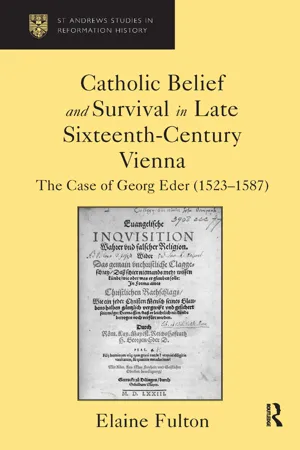
Catholic Belief and Survival in Late Sixteenth-Century Vienna
The Case of Georg Eder (1523–87)
- 216 pages
- English
- ePUB (mobile friendly)
- Available on iOS & Android
eBook - ePub
Catholic Belief and Survival in Late Sixteenth-Century Vienna
The Case of Georg Eder (1523–87)
About this book
Dr Georg Eder was an extraordinary figure who rose from humble origins to hold a number of high positions at Vienna University and the city's Habsburg court between 1552 and 1584. His increasingly uncompromising Catholicism eventually placed him at odds, however, with many influential figures around him, not least the confessionally moderate Habsburg Emperor, Maximillian II. Pivoting around a dramatic incident in 1573, when Eder's ferocious anti-Lutheran polemic, the Evangelical Inquisition, fell under sharp Imperial condemnation, this book investigates three key aspects of his career. It examines Eder's position as a Catholic in the predominantly Protestant Vienna of his day; the public expression of Eder's Catholicism and the strong Jesuit influence on the same; and Eder's rescue and subsequent survival as a lay advocate of Catholic reform, largely through the alternative protection of the Habsburgs' rivals, the Wittelsbach Dukes of Bavaria. Based on a wide variety of printed and manuscript material, this study contributes to existing historiography by reconstructing the career of one of late sixteenth-century Vienna's most prominent figures. In a broader sense it also adds significantly to the wider canon of Reformation history by re-examining the nature and extent of Catholicism at the Viennese court in the latter half of the sixteenth century. It concludes by emphasising the importance of influential laity such as Eder in advancing the cause of Catholic reform, and challenges the prevalent portrayal of the sixteenth-century Catholic laity as an anonymous and largely passive group who merely responded to the ministries of others.
CHAPTER 1
Eder’s Vienna
The Vienna in which Georg Eder lived and worked was a far cry from the city that would later be known for the physical splendour and Catholic vigour of its Baroque period.1 By the time of his arrival at the mid-point of the sixteenth century, the city was still suffering from the after-effects of a Turkish siege, a series of epidemics and a major fire which had destroyed one-third of the 1250 buildings estimated to have stood within the city walls.2 Together, these disasters led to a drop in the city’s population, a decline in trade and a subsequent rise in the cost of living for those who remained.3 At the university, these circumstances resulted in a drastic downturn in student matriculation rates which, despite the gradual return of notable and attractive humanist figures, were by the mid-point of the century, still nowhere near pre-siege numbers.4
One of the few draws left was the Habsburg court, which had, since the Archduke Ferdinand’s arrival in 1522, acted not only as something of a military high command but as a growing administrative centre for the dynasty’s hereditary lands.5 Ferdinand’s eventual accession as Holy Roman Emperor in 1556 gave Vienna an important share in his reflected glory, and the city remained the primary base for the emperor during the reign of Ferdinand’s eldest son, Maximilian II, 1564–76.6 Though Rudolf II, Maximilian’s son and successor as Holy Roman Emperor, chose to spend much of his reign in Prague, Rudolf’s younger brother Archduke Ernst, who administered Lower Austria between 1576 and his death in 1596, remained in Vienna and maintained the Habsburg presence.7 The Habsburg court became, as John Spielmann has put it, ‘the most important resident of the city’, and played a central role in defining the political and religious culture of Vienna in the second half of the sixteenth century.8
This was not, however, always to the taste of all the city’s inhabitants. For those as devoutly Catholic as Georg Eder, Habsburg policy often seemed to be at best ambivalent toward the Catholic cause, and at worst actively hostile.9 This impression came in large part from the religious concessions wrung from the Habsburgs during a period of severe political and military vulnerability. The extent of the Ottoman threat to Europe in the sixteenth century has been reasonably well-documented, at least from the perspective of the Christian powers.10 Its impact on Habsburg policy at imperial level is also well-known: it had been Ferdinand I who, desperate for military aid against the Turks from the Protestant princes of the empire, had first accepted the temporary principle of the ‘cuius regio, eius religio’ formula at the Diet of Speyer in 1526. Less than thirty years later it was the same ruler who was forced to accept the formula as permanent in the Peace of Augsburg, thereby permitting Lutheran freedom of worship within the empire.11 What has received much less attention, though, is how the even greater geographical proximity of the Ottoman threat impacted on Habsburg policy in their own archduchy of Lower Austria and its most vulnerable city of Vienna.
Lutheranism had infiltrated Vienna in the early 1520s, and despite frequent efforts by Ferdinand I, was never fully suppressed.12 Whether this form of Protestantism was accepted by the Lower Austrian nobility for doctrinal reasons or political ones is hard and perhaps unnecessary to fathom, but whatever their reasons, by 1568, the Lower Austrian Herrenstand or upper nobility was overwhelmingly dominated by nobles describing themselves as Lutheran.13 By then too, Maximilian II was struggling to contain the Turkish threat that seemed continually on the verge of enveloping Vienna. The year 1566 had seen humiliation for the Habsburg forces in Hungary, which only increased fears of a further Ottoman attack on the city. This was to be avoided at all costs. Maximilian’s father Ferdinand had stated in a letter of 1546 that ‘our city of Vienna is almost a frontier town against them [the Turks] … Vienna is important and precious not only for the hereditary dominions, but for all Christendom and the German nation … ‘, and his son clearly appreciated the same.14 Attempts were duly made to negotiate terms between ruler and estates, but with a state debt standing at 2.5 million gulden, the result was inevitable.15 In return for the financial and military aid of the Lower Austrian estates, Maximilian II was not only forced to grant the Lower Austrian ‘Religions-Konzession’ in 1568, but to confirm the same three years later with the so-called ‘Religions-Assekuration’ of 1571. Maximilian had permitted the seemingly unthinkable on his own doorstep. Although Lutheran worship was not formally permitted in Vienna, both Konzession and Assekuration granted members of the noble estates the right to worship according to the confession of Augsburg ‘in all their castles, houses and possessions’. In the countryside, this also included the provision of churches for their Lutheran subjects.16
Maximilian II’s provision, however, contained a rapidly exploited legal loophole that made regular worship according to Lutheran rites just as possible for those living within Vienna’s walls as for those living without. Lower Austrian nobles installed Lutheran Schloßprediger, or ‘castle preachers’, at their own properties, as permitted under the terms of the Konzession. Indeed, a Lutheran visitation of Lower Austria in 1580 uncovered a total of 138 such preachers in what is a relatively small area.17 What Maximilian had perhaps not anticipated, was that such was the Viennese hunger for Lutheranism, every Sunday several thousand people would flock from the city, technically excluded from the terms of the Konzession, to hear the Protestant preachers on the nobles’ own land. Eder himself observed bitterly in 1585, almost two decades after the issue of the Konzession, that as many as 3000 people were still participating in the so-called ‘Auslaufen’ to hear a Lutheran preacher at just one such location, Inzersdorf.18 In a fruitless bid to stop such embarrassing infringements of Habsburg authority, Maximilian bowed even further to Protestant demands and granted a room for worship in the Viennese Landhaus, right in the heart of the city, and close to the Hofburg itself. With their own preachers, and soon a school and even a bookshop all under noble protection, Habsburg religious policy had done nothing less than permit the exercise of Protestantism in Vienna as well as Lower Austria.19
No less damaging to the reputation of the Austrian Habsburgs as defenders of Catholicism was the enthusiasm of Ferdinand I and particularly Maximilian II to turn the Viennese court into a centre of humanist scholarship.20 There was, of course, nothing inherently damaging to Catholicism in this. The men they invited to Vienna were famed primarily for their scholarship, and between them they turned what was an unglamorous Habsburg court into a base of patronage and production for humanist intellectuals working in a wide range of fields.21 As a result, by the middle decades of the sixteenth century the court of Vienna could boast the presence of many of the leading scholars of the day, including Wolfgang Lazius, physician, court historian and author of the first history of Vienna; Jacopo Strada, court antiquary and artist; Hugo Blotius, keeper of the imperial library; Augerius Busbequius, Ottoman ambassador, botanist and collector; Johannes Sambucus, historian and philologist, and Johannes Crato and Carolus Clusius, botanists.22
This wish to act as patrons of humanism was in large part due to the two emperors’ own deep personal interest in scholarship and learning. Maximilian II in particular was well known for his interest in natural science and antiquities. Humanist writer Andreas Camutius recorded how the emperor liked to participate in debates on literature and inscriptions, while the correspondence of his ambassadors in Spain contains many references to the supply of Maximilian’s requests for rarities from the new world, especially exotic plants and animals.23 These interests may, it seems, have been passed down by his father: Ferdinand too had once been described by a Venetian ambassador as ‘a most curious investigator of nature, of foreign countries, plants and animals’.24
There was, however, another reason why the Emperors Ferdinand and Maximilian were so keen to espouse this late, central European manifestation of humanism, and that was for its emphasis on religious moderation and compromise in the interests of political peace, social harmony and the salvaging of Christian unity.25 As politicians, both rulers already had had to compromise in the name of the higher goals of peace and unity: the Peace of Ausgburg which Ferdinand I had accepted and Maximilian II sought to maintain was one case in point. Robert Evans has also seen Ferdinand I’s efforts to press Rome for the authorisation of clerical marriage and the use of the lay chalice as ‘not simply a gesture from weakness, but a real movement towards conciliation within the area of adiaphora’, while the correspondence of the future Maximilian II with none other than Philip Melanchthon points to a similar desire.26 Maximilian first approached Melanchthon in 1555 for his views on the key areas of doctrinal debate between Lutherans and Catholics, in itself a bold move towards inter-confessional understanding. Melanchthon’s replies challenged the then 28-year-old Maximilian to work as ‘God’s tool for his universal church’, and offered advice on the rebuilding of Christian unity.27
Humanism therefore provided an ideology and an impetus to the tricky politics of compromise being exercised on a daily basis at the Habsburg court of sixteenth-century Vienna. For those less open to the paths of moderation, however, such humanist impulses not only looked like a sign of weakness, but seemed to provide yet another dangerous ‘back-door’ through which Protestant heresies could continue to creep. Indeed, to a hostile observer, the composition of the Habsburg court itself provided a perfect example of the dangers of overlooking Catholic purity in the interests of confessional unity and temporal gain. Of the humanist scholars named above, for example, every one except Lazius and Strada would have described themselves as Protestant, while Hugo Blotius even came from a Reformed background.
In part through a need to appear even-handed, and in part through the urgent need for competent functionaries to carry out policy, the administrative branches of the Viennese court of the late sixteenth century also housed a significant number of Protestants or at least non-Catholics in high places.28 A key figure in this regard was Johann Baptist Weber, Reichsvizekanzler between November 1563 and April 1577. In spite of the Emperor Maximilian II’s personal dislike for Weber, he did espouse the political virtues of religious tolerance and confessional moderation that were the Habsburgs’ political watchwords in these years.29 Another significant court office-holder who claimed no particular confessional allegiance was doctor of law, Andreas Gail.30 Gail not only served in the Reichshofrat from 1569 until 1582, but was sent on numerous missions to Italy, France and Belgium.31 Two other members of the Reichshofrat were,...
Table of contents
- Cover
- Half Title
- Title Page
- Copyright Page
- Dedication
- Table of Contents
- Acknowledgements
- List of Figures
- Abbreviations
- Glossary
- Editorial Conventions
- Introduction
- 1 Eder’s Vienna
- 2 Promotion and prominence, 1550–73
- 3 Service to the Church, 1550–73
- 4 1573: Imperial Condemnation
- 5 Wittelsbach Patronage, 1573–87
- 6 ‘Whoever is not like a Jesuit, is not a Catholic’
- Conclusion
- Select Bibliography
- Index
Trusted by 375,005 students
Access to over 1.5 million titles for a fair monthly price.
Study more efficiently using our study tools.
Frequently asked questions
Yes, you can cancel anytime from the Subscription tab in your account settings on the Perlego website. Your subscription will stay active until the end of your current billing period. Learn how to cancel your subscription
No, books cannot be downloaded as external files, such as PDFs, for use outside of Perlego. However, you can download books within the Perlego app for offline reading on mobile or tablet. Learn how to download books offline
Perlego offers two plans: Essential and Complete
- Essential is ideal for learners and professionals who enjoy exploring a wide range of subjects. Access the Essential Library with 800,000+ trusted titles and best-sellers across business, personal growth, and the humanities. Includes unlimited reading time and Standard Read Aloud voice.
- Complete: Perfect for advanced learners and researchers needing full, unrestricted access. Unlock 1.5M+ books across hundreds of subjects, including academic and specialized titles. The Complete Plan also includes advanced features like Premium Read Aloud and Research Assistant.
We are an online textbook subscription service, where you can get access to an entire online library for less than the price of a single book per month. With over 1.5 million books across 990+ topics, we’ve got you covered! Learn about our mission
Look out for the read-aloud symbol on your next book to see if you can listen to it. The read-aloud tool reads text aloud for you, highlighting the text as it is being read. You can pause it, speed it up and slow it down. Learn more about Read Aloud
Yes! You can use the Perlego app on both iOS and Android devices to read anytime, anywhere — even offline. Perfect for commutes or when you’re on the go.
Please note we cannot support devices running on iOS 13 and Android 7 or earlier. Learn more about using the app
Please note we cannot support devices running on iOS 13 and Android 7 or earlier. Learn more about using the app
Yes, you can access Catholic Belief and Survival in Late Sixteenth-Century Vienna by Elaine Fulton in PDF and/or ePUB format, as well as other popular books in History & World History. We have over 1.5 million books available in our catalogue for you to explore.