- 220 pages
- English
- ePUB (mobile friendly)
- Available on iOS & Android
eBook - ePub
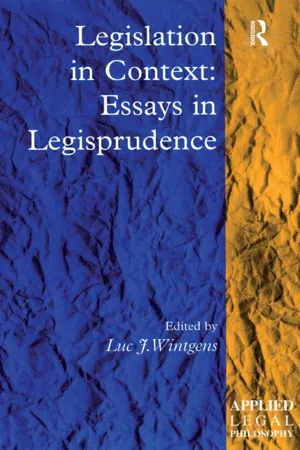
Legislation in Context: Essays in Legisprudence
About this book
The essays in this volume set out to provide a rational framework for legislation. Whilst legislation and regulation is the result of a political process, this volume considers whether they can also be the object of theoretical study. It examines the problems that are common to most European legal systems by applying the tools of legal theory to legislative problems ('legisprudence'). While traditional legal theory deals predominantly with the question of the application of law by a judge, legisprudence enlarges the scope of study to include the creation of law by the legislator. The essays published in the volume develop a new range of insights into the relationship between legislative problems and legal theory in a way that will interest legal scholars throughout the world. Specifically the work will attract the attention of those involved with constitutional law, EU law, human rights law and legal theory.
THEORY OF LEGISLATION
Chapter 1
Legitimacy and Legitimation from the Legisprudential Perspective
Introduction
In earlier work1 I have proposed a distinction between strong legalism and weak legalism as a starting point for the elaboration of a theory of rational legislation. After the diagnosis of the absence of a theory of legislation, resulting from strong legalism, some alternative, weaker version of legalism was proposed. This weaker version primarily aims at taking the subject qua subject seriously, in that the subject’s freedom proposed as the principium of law.
In addition to that I have proposed an interpretation of freedom that better fits with its reflexive characteristics. Freedom that is, requires freedom to be realised. Freedom, that is, cannot, and even less than any other thing, be fully represented without destroying itself. Insofar as freedom is represented, it exists as the realisation on conceptions about freedom. In proportion to this representation, freedom in the moral sense is reduced in favour of freedom in the political sense.
I have further argued that the substitution of acting on conceptions about freedom for acting on conceptions of freedom seems unproblematic in the Modern philosophical project. The main argument that justifies it is of an epistemological character. In doing so, freedom in the moral sense is reduced in favour of freedom in the political sense. Consequential on this reduction, moral freedom can be outweighed without further justification.
In this chapter, I will focus on the problems of legitimacy on the one hand and legitimation on the other that come with this conclusion.
Strong legalism, in relying on representationalism, excels in its impossibility to provide a theory of freedom. A theory of freedom is crucial for freedom to make any moral sense at all. Instead of a theory of freedom, in which the subject qua subject occupies the places he deserves, the Modern philosophical project has supplied variants of a theory about freedom. Within a theory about freedom the subject shows up as a legal subject, that is, a subject defined through the rules that he is supposed to edict himself.
Self-legislation as the political celebration of the autonomous subject, it must be conceded, is held one of the major products of this project. Self-legislation has all there needs to be in order to get a full theory of freedom. At least, that is what it seems to be.
That is what this chapter is about. Self-legislation as the core of most Western institutional designs is not well served, as I will argue, if it is taken from the mere perspective of an institutionalisation of truth as strong legalism does. Representationalism entails the institutionalisation of truth. In doing so, the institutional design we call ‘democracy’, leads its life as a representation of reality, although democracy is not a natural fact. Democracy is a matter of public justification resulting in valid norms; it is not a matter of truth.
From the very ‘moment’ the social contract enters into force, so to speak, the subject qua subject fades into the background. The suggestion could be made that, as a matter of course, he is still a subject qua subject at the moment of elections, moment supreme of democracy. But even there, he can only act on political rights, defined in and by the political space he is called to sustain, in some variants even under the threat of punishment.
The main claims I will argue for in this chapter include the irreversible character of democratic legitimation in the rationalistic version. As a consequence, so I will further argue, the question can be raised as to whether other patterns of legitimation can be thought of, in which the subject qua subject gets more weight, while avoiding the trappings of a de(con)struction of legalism altogether.
It is not however because strong legalism turns out to be defective that any form of legalism is to be criticized. The claims argued for in the pages to come are projected on the framework provided by weak legalism. This will assist us in the construction of a rational theory of legislation or legisprudence.
From the very beginning, a distinction must be made between deliberation on the one hand and justification on the other. Deliberation as a process of legitimation is considered to be political in nature. Justification for its part consists of a process of argumentative support for decisions, judicial or otherwise. The distinction does not claim to be a grand dividing line of opposition. As a matter of course, deliberation has justifying effects, while justification in turn may refer to deliberation in support of a decision. Both are processes contributing to some similar effects when it comes to decision-making.
Without denying the merits of deliberation in decision-making, I will mainly focus on justification as a distinct process. Deliberation, roughly speaking, has to do with the making of decisions, i.e. legal rules. Justification, in my view, comes after that. In the process of justification, the rules that come out of a deliberative process are to be connected to the social environment in which they will operate. This is what justification in my view comes to.
I will begin with a clarification of another distinction, that is, between legitimation and legitimacy. A familiar starting point is the distinction between positivism and jusnaturalism that for reasons of clarity I label ‘non-jusnaturalistic’ and ‘jusnaturalistic’ respectively.
Jusnaturalistic and Non-jusnaturalistic Models of Legitimation
In this chapter I will focus on the differentiation of the organisation of the social bond from its jusnaturalistic and theological roots, thus giving rise to a political space that has grown to be independent of these sources. The proper aspect of independence suggests that the organisation of political space has no relation whatsoever with these sources of legitimation; any dealings with them are only of historical value, and do not have a legitimating effect.
I will briefly dwell on the negation of this proposition, without however denying the independence of the organisation of political space. There is, so I will argue, a structural similarity between the jusnaturalistic (that includes the classical, theological and Modern version of natural law) and the non-jusnaturalistic organisation of society. Only the latter, as I will show, can be qualified a democratic organisation.
Political space in the Modern philosophical project, or civil society as it is labelled nowadays, as different from the ancient polis, belongs to the realm of construction, not to the order of what exists naturally. At its very foundation, it relies on the will of those who live in and by it. Both its existence and the order that it brings about are the outcome of human construction. This, broadly speaking, can be considered the essence of ‘democracy’.
On this approach, democracy is the organisation of political space that comes into being, historically speaking, after the classical jusnaturalistic and theological forms of social organisation respectively. Despite the qualitative differences between jusnaturalistic and theological models on the one hand and the new, democratic models on the other, these models share a similar dynamics.
The core of the democratic organisation of political space is that the rules – that is, the limitations of freedom that are considered normative – can be related to the will of those submitted to them. The relation between limitation of freedom and will is the kernel of democracy, that is, it is impossible to call ‘democratic’ any organisation of social space where no variant of this relation can be spelled out. This is what follows from a conceptual analysis of the concept of democracy.
At its maximum, this relation will be direct in that all the members contribute immediately in the ruling activity in the so-called popular democracy that Rousseau advocates. In its minimal variant, this contribution crystallises as the designation by all of one person who will be vested with the power to limit all the others’ freedom.
Within these two extreme poles, we find a variety of conceptions that can be ranged within the concept of democracy or self-legislation. Most commonly, any form of representation – upon which all designate a limited group to which they will submit, while taking these rules as imputations to themselves – will be considered democratic.
Sieyes, who turns out to have won the competition of democratic theory in the 18th century, is a fervent advocate of representative democracy, most criticised by Rousseau.2 Whether the organisation of political space is or is not mediated by a group of representatives is not of great importance, at least from the perspective of the dynamics of the model of legitimation. The dynamics of the process of legitimation in both the popular and the representative variant of democracy starts with all the subjects. The mediation of the legitimation of the subsequent legislation by a group of representatives makes the process maybe longer than, though not essentially different from, the process established under popular democracy.
What is more important than the difference between the Rousseau and Sieyes conceptions of democracy is the dynamics of the model of legitimation that is labelled ‘democratic’. A democratic legitimation model in its radical form is non-jusnaturalistic. The dynamics of the latter, though, are similar to jusnaturalistic legitimation models. What the latter models – commonly specified as classical, theological, and rational or Modern natural law – share is some form of substantive legitimation. They legitimate social order and law from the perspective of its content.
Rational natural law does so in that it legitimates the content of human ordering upon principles the content of which is discovered by Reason alone. Classical natural law is substantively legitimating in that observation of Nature provides the proper content of human ruling. In theological natural law, finally, human law’s validity flows from its correspondence as regards its content, to the will of God.
These three legitimation models have, and that is their essence, a transcendent origin. They transcend, that is, human will and, consequentially, the transcendent content is not available for the latter. Their normativity consists of both their transcendence and unavailability. They will be referred to as substantive models of legitimation.
Over against this, non-jusnaturalistic or democratic legitimation models can be considered a liberation from these substantive models, just like Modern natural science can be taken to be a liberation from its medieval ecclesiastical shackles. The organisation of political space according to the Modern philosophical project is both a critique and a differentiation thereof.
According to a substantive model of legitimation, legal rules cannot contradict the transcendent norms they rely on. If they do, they lose their status of legal rules altogether. That is at least the logic inherent to this type of theories. Correspondence to the substantive transcendent content is a necessary and a sufficient condition for their validity.
According to non-substantive models this correspondence is as a matter of course, neither a necessary nor a sufficient condition for a rule’s validity. There simply is no content to which a legal rule can or must correspond. This is the core of non-jusnaturalistic or democratic models of legitimation. While rules are legitimate according to substantive legitimation models, according to non-substantive models of legitimation they have to be legitimated.
The crucial difference, that is, between substantive or jusnaturalistic and non-jusnaturalistic models of legitimation, lies in the need for an active legitimation of the rules under the latter. According to the former, legitimacy as correspondence with substantive norms makes part of their very validity. Put differently, substantive legitimation models provide legitimate rules, while on non-substantive models rules must legitimated. I propose to call the non-jusnaturalistic, non-substantive or democratic models procedural models of legitimation. This difference between substantive and procedural models of legitimation is that the latter produce legitimate rules while the former calls for a legitimation of rules.
From the perspective just set out both models are prima facie opposed to each other. This opposition is what Hobbes and Rousseau were so eager to erase or to make it only apparent. Their theories were qualified as a representation-construction since, as we have seen, they spared no effort to show that they also – or better: simply – a reproduction of reality.
The erasing of the distinction between legitimacy and legitimation makes the construction look like a reproduction. This comes to what was called the process of naturalisation of hypostatisation proper to strong legalism. Under strong legalism, that is of nominalistic brand, law as a construction is moulded as a representation of reality of which it is argued to be a reproduction. Strong legalism, then, is nominalism in a realistic dress.
Apart from the opposition between substantive and procedural models, as it follows from the above articulation, and apart from the strong legalistic assimilation of both models, I suggest that there is neither complete opposition nor full assimilation. If the latter are differentiated from the former, this means that they are not necessarily opposed to it, but rather only different. According to this idea of differentiation, there must be some trace of similarity. There is at least one crucial similarity between the substantive and procedural models as described above. This similarity has to do with the direction of legitimation, that is, the dynamics of legitimation, in both models.
In a substantive model, the normative content is pre-existent to concrete legislative action. In the theological model, this normative content is given and so it precedes action.3 Legislative action then is dependent on the accessibility of this normative content, consequential upon revelation and metaphysical reflection. Legislative action is rational insofar as the normative content is adopted as a norm. The dynamics of the legitimation chain according to a substantive model starts from the substantive content to the derived rule.
Accessibility to and knowledge of any normative content is, by very definition, not relevant in procedural legitimation models. They do no rely on any substantive content, so their resemblance to substantive legitimation models must lie elsewhere. Their specificity lies in the fact that the first step of legitimation, the identification of a specific content, revealed, or rationally discovered, is pushed out of side. Any transcendent content, natural, rational or theological, stops producing legitimacy. This content may, accidentally, show up though in the rules issued in political space. It is, though, not necessarily related to concrete rules.
Procedural models of legitimation can be said to produce legitimacy as a result of some form of active l...
Table of contents
- Cover Page
- Series Preface
- Title Page
- Copyright Page
- Contents
- List of Contributors
- Introduction
- Part I Theory of Legislation
- Part II Legislation, Rules and Norms
- Part III Legislation and the Disciplines
Trusted by 375,005 students
Access to over 1.5 million titles for a fair monthly price.
Study more efficiently using our study tools.
Frequently asked questions
Yes, you can cancel anytime from the Subscription tab in your account settings on the Perlego website. Your subscription will stay active until the end of your current billing period. Learn how to cancel your subscription
No, books cannot be downloaded as external files, such as PDFs, for use outside of Perlego. However, you can download books within the Perlego app for offline reading on mobile or tablet. Learn how to download books offline
Perlego offers two plans: Essential and Complete
- Essential is ideal for learners and professionals who enjoy exploring a wide range of subjects. Access the Essential Library with 800,000+ trusted titles and best-sellers across business, personal growth, and the humanities. Includes unlimited reading time and Standard Read Aloud voice.
- Complete: Perfect for advanced learners and researchers needing full, unrestricted access. Unlock 1.5M+ books across hundreds of subjects, including academic and specialized titles. The Complete Plan also includes advanced features like Premium Read Aloud and Research Assistant.
We are an online textbook subscription service, where you can get access to an entire online library for less than the price of a single book per month. With over 1.5 million books across 990+ topics, we’ve got you covered! Learn about our mission
Look out for the read-aloud symbol on your next book to see if you can listen to it. The read-aloud tool reads text aloud for you, highlighting the text as it is being read. You can pause it, speed it up and slow it down. Learn more about Read Aloud
Yes! You can use the Perlego app on both iOS and Android devices to read anytime, anywhere — even offline. Perfect for commutes or when you’re on the go.
Please note we cannot support devices running on iOS 13 and Android 7 or earlier. Learn more about using the app
Please note we cannot support devices running on iOS 13 and Android 7 or earlier. Learn more about using the app
Yes, you can access Legislation in Context: Essays in Legisprudence by Luc J. Wintgens in PDF and/or ePUB format, as well as other popular books in Law & Law Theory & Practice. We have over 1.5 million books available in our catalogue for you to explore.