eBook - ePub
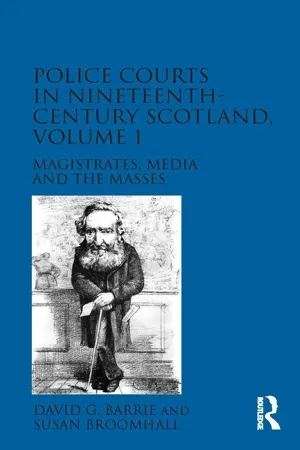
Police Courts in Nineteenth-Century Scotland, Volume 1
Magistrates, Media and the Masses
- 534 pages
- English
- ePUB (mobile friendly)
- Available on iOS & Android
eBook - ePub
Police Courts in Nineteenth-Century Scotland, Volume 1
Magistrates, Media and the Masses
About this book
Taking the form of two companion volumes, Police Courts in Nineteenth-Century Scotland represents the first major investigation into the administration, experience, impact and representation of summary justice in Scottish towns, c.1800 to 1892. Each volume explores diverse, but complementary, themes relating to judicial practices, relationships, experiences and discourses through the lens of the same subject matter: the police court. Volume 1, with the subtitle Magistrates, Media and the Masses, provides an institutional, social and cultural history of the establishment, development and practice of police courts. It explores their rise, purpose and internal workings, and how justice was administered and experienced by those who attended them in a variety of roles. Special attention is given to examining how courtroom discourse was represented in print culture, the role of the media in providing a discursive commentary on summary justice, and the ways in which magistrates and the police engaged in a law and order dialogue with the press. Throughout, consideration is given to uncovering the relationship between magistrates, the courts, the police and the wider community, and to charting the implications of the rise of summary justice and the 'police-man' state for the urban masses (as evidenced through prosecution, conviction and punishment patterns). Volume 2, with the subtitle Boundaries, Behaviours and Bodies, explores, through themed case studies, how police courts shaped conceptual, spatial, temporal and commercial boundaries by regulating every-day activities, pastimes and cultures.
Chapter 1
Evolution and Expansion
I. Introduction
Every public outrage, every theft, robbery or depredation, every obstruction, nuisance, or breach of cleanliness, and every imposition or overcharge in articles under the cognizance of the police act, are deemed public offences, and are prosecuted by the inspectors of the wards [under the authority of the police judge]. The examination of the offender and witnesses are in this [Edinburgh police] court taken instanter, and viva voce; and the sentence pronounced is immediately executed.1
Writing in Picture of Edinburgh (1806), local author John Stark paid homage to the efficiency and scope of the city’s recently established police court. Edinburgh’s example was quickly followed by other major urban centres, which, like Scotland’s capital, established police courts under local police legislation.2 These courts came to be integral to the smooth running of towns, the maintenance of magisterial concepts of urban order, and the development of the Scottish criminal justice system. From their inception, police courts dealt with more business, prosecuted more cases, and punished more offenders than any other centre of justice in the country. They were the principal local courts before which people were likely to be summonsed and to interact with the law, and were instrumental in bringing about a massive increase in the number and type of crimes, offences and misdemeanours that were dealt with and punished in a summary manner. It was in this era that summary legal procedure emerged as the cornerstone of the criminal justice system and police courts were at the forefront of this transition.3 They helped change how Scots criminal law was administered over the course of the nineteenth century, as proportionately fewer cases were prosecuted in higher courts in favour of local centres of justice that could process cases in a fairly quick, cheap and, on occasions, informal manner.4
Scholars of criminal justice history in England have in recent years given greater attention to chronicling the summary courts’ rise to prominence in administering the criminal law. Explanations for this phenomenon in the eighteenth century have identified the important role played by Sir John Fielding in the Bow Street Magistrates’ Court, mounting concerns with crime held by men of property, and the perception that lay magistrates were corrupt and ‘trading in justice’.5 Historians have also identified the impact of the 1792 Middlesex Justices Act, which authorised the appointment of stipendiary justices and the establishment of seven police offices in the metropolis, and the growing challenges of securing convictions in higher courts following the introduction of defence counsel, in making summary justice more attractive.6 Although often not examining police courts per se, studies have also connected the expansion in summary jurisdiction in the nineteenth century to wider developments within the criminal justice system following major judicial reforms from the 1840s onwards.7 Scholars have pointed to legal and administrative changes to improve the efficiency of court procedure, the re-classification of what constituted indictable crime, and the removal of juveniles from the higher courts.8 The evolution and expansion of summary justice has also been viewed as a product of the emergence of the ‘police state’, changes in middle-class perceptions of violence and appropriate masculine conduct, and the judicial system’s growing preoccupation with ‘civilising’ the lower orders and safeguarding urban order.9
Unfortunately, the expansion of Scottish summary justice has not received the same level of attention as the English model. As Clive Emsley points out, Scots legal history has traditionally been backward rather than forward looking, ‘glorifying a mythical past in which Scots Law is said to have originated and established its defining characteristics’ during the Enlightenment rather than seeking to chart its modern development in the nineteenth century.10 In most histories of Scots Law, the 1747 Heritable Jurisdiction Act – which abolished heritable jurisdiction following the failed Jacobite rising in 1745–1746 – is held up as having laid the foundations for the modern criminal justice system by sweeping away local feudal courts in favour of a more structured, uniform and centralised system.11 Only recently have scholars explored the important role that fiscal concerns, legal technicalities associated with common law, and the rise to prominence of a new class of businessmen played in the development of summary procedure in the first few decades of the nineteenth century.12 But much more needs to be done.
This chapter aims to address this by examining not just legal and legislative changes, but also the economic, social and intellectual influences that underpinned them. In doing so, it reveals how men of property reconceptualised urban order and intertwined civic imperatives in line with their own moral and economic interests in order to effect reform and defend their own position, status and influence. Nineteenth-century police legislation, it contends, was at the forefront in extending the local state’s influence over the urban population through new police laws and in facilitating major reform within the criminal justice system through the expansion in summary procedure. Although parliament in London exerted influence in passing statutory police legislation, it is shown here that it was local elites who were central to shaping police laws, regulations and legislation with central government playing a less important role in the development of criminal justice history than was once believed. Mirroring recent work in England and, indeed on Scottish policing, this chapter demonstrates that it was urban elites, not politicians in London, who laid the foundations for the reform of what was to become the busiest and, arguably, the most important branch of the criminal justice system.13
II. The Local Courts and Magisterial Justice in the Late Eighteenth and Early Nineteenth Centuries
In the early 1700s, the Scottish criminal justice system was characterised by multiple jurisdictions and a lack of centralised legal and national control.14 The High Court of Justiciary and the Court of Session were the country’s most senior central criminal and civil courts, but the majority of courts were in the hands of individuals unconnected with the state. Scottish society was supervised and controlled by an elaborate and extensive system of private, local courts – royal, seigneurial and ecclesiastical – with wide-ranging variations between them in terms of judicial authority, day-to-day business and legal procedure.15 In the Highlands and counties, judicial power was either purchased or inherited and was firmly under the authority of landowners and clan chiefs in seigneurial and sheriff courts.16 In urban centres, it was predominantly in the hands of magistrates in burgh and guildry courts. There were also justice of the peace courts scattered throughout the country, although these were much less common and important than was the case in England. The lines of judicial authority were often determined by perceived spatial boundaries, specific local needs and interests, and the economic and social status of parishes, whilst judicial powers were based on local statutes and charters rather than a uniform principle of application.17 Similarly, Scots Law was largely a collection of local practices, usages and conventions.18 There was little consistency in decision-making or sentencing, and little regulation of procedure in a system ‘founded on custom and convention rather than precise statutory codification’.19 Justice was often administered informally to suit private and religious interests, and criminal prosecutions – especially in the inferior courts – were rare.
The second half of the eighteenth century, however, brought significant change to the local criminal courts throughout Scotland. The 1747 Heritable Jurisdiction Act streamlined the Scottish court structure. The statute aimed to extend central control over Scottish jurisdiction: firstly, by weakening, and in some cases, breaking the feudal structure of authority that tied local courts to landowners and clan chiefs; secondly, by laying down regulations regarding court sittings, duties and justice qualifications; and, thirdly, by extending the influence and jurisdiction of the High Court of Justiciary in Edinburgh.20 Although there was no desire to break completely with the old feudal structure, especially in towns where some ancient powers survived well into the nineteenth century, the statute limited feudal jurisdiction when it challenged sovereign power.21 Widely regarded as laying the foundations for the modern Scottish criminal justice system,22 the abolition of heritable jurisdiction ‘brought about the demise of a complex and distinctive legal system’ in favour of a more structured and uniform one.23 It signified a move towards greater centralised control by abolishing many old feudal courts and the jurisdiction of others.24
By the late eighteenth century, the number of Scottish criminal courts had been significantly reduced and their roles and powers clarified. More serious criminal cases – which included serious assault, rape, grand larceny and murder – were tried under solemn procedure25 before juries in either sheriff courts or the High Court in Edinburgh (or one of its circuit courts). Less serious offences – which included petty theft, assault and breach of the peace – were brought primarily before either justices in sheriff courts or magistrates in burgh courts, both of which had become the principal local courts for dealing with statutory and common law crimes. Barony courts and admiralty courts also dealt with criminal matters, but their jurisdictions were limited to a narrow category of offences and their roles within the criminal justice system were fairly minor.26 Similarly, justice of the peace courts dealt with petty offences committed within the jurisdiction of the county shire and generally performed the same role that police courts would fulfil for urban centres, but the number of cases with which they dealt was relatively small.27 Whether a case was brought before burgh courts or sheriff courts was determined by judicial boundaries and the seriousness of the charge. Burgh courts traditionally had wide-ranging powers, including capital ones until the seventeenth century, but by the late eighteenth century their judicial scope had been reduced to dealing with quite mundane crimes. By this point, magistrates in many towns were more than content to let sheriffs with concurrent jurisdiction deal with more serious crimes (although not serious enough to warrant jury trial in a justiciary court).28
In addition to these criminal courts, church courts held an extremely important position in Scottish parishes. Indeed, the Church of Scotland had an integral role to play in the everyday lives of Scots and was a vital mechanism for maintaining urban order and social stability in the eighteenth century.29 Elders – who along with the minister made up the kirk sessions – performed important religious and public duties that were akin to a parish state.30 As Anne-Marie Kilday has argued, church figures worked with legal authorities to curb bad behaviour.31 Although elders had no judicial powers to deal with serious crimes,32 they were expected to police the morals of parish congregations and were responsible, as Leah Leneman and Rosalind Mitchison have pointed out, for prosecuting and punishing a wide array of misdemeanours and minor offences.33 Most related to moral crimes and included fornication, adultery and Sabbath breaches, but they also extended to assault, theft, domestic violence, d...
Table of contents
- Cover
- Title Page
- Copyright Page
- Contents
- List of Figures and Illustrations
- List of Tables
- List of Abbreviations
- Acknowledgements
- INTRODUCTION
- 1 EVOLUTION AND EXPANSION
- 2 DIGNITY AND DISCRETION
- 3 PEOPLE’S COURTS?
- 4 PUBLIC THEATRES?
- 5 PRACTICES, PATTERNS AND PERCEPTIONS
- 6 LEGAL, SOCIAL AND CULTURAL CONVICTIONS
- 7 PUNISHMENT AND PROTECTION
- CONCLUSION
- Selected Secondary Reading
- Glossary
- Index
Trusted by 375,005 students
Access to over 1.5 million titles for a fair monthly price.
Study more efficiently using our study tools.
Frequently asked questions
Yes, you can cancel anytime from the Subscription tab in your account settings on the Perlego website. Your subscription will stay active until the end of your current billing period. Learn how to cancel your subscription
No, books cannot be downloaded as external files, such as PDFs, for use outside of Perlego. However, you can download books within the Perlego app for offline reading on mobile or tablet. Learn how to download books offline
Perlego offers two plans: Essential and Complete
- Essential is ideal for learners and professionals who enjoy exploring a wide range of subjects. Access the Essential Library with 800,000+ trusted titles and best-sellers across business, personal growth, and the humanities. Includes unlimited reading time and Standard Read Aloud voice.
- Complete: Perfect for advanced learners and researchers needing full, unrestricted access. Unlock 1.5M+ books across hundreds of subjects, including academic and specialized titles. The Complete Plan also includes advanced features like Premium Read Aloud and Research Assistant.
We are an online textbook subscription service, where you can get access to an entire online library for less than the price of a single book per month. With over 1.5 million books across 990+ topics, we’ve got you covered! Learn about our mission
Look out for the read-aloud symbol on your next book to see if you can listen to it. The read-aloud tool reads text aloud for you, highlighting the text as it is being read. You can pause it, speed it up and slow it down. Learn more about Read Aloud
Yes! You can use the Perlego app on both iOS and Android devices to read anytime, anywhere — even offline. Perfect for commutes or when you’re on the go.
Please note we cannot support devices running on iOS 13 and Android 7 or earlier. Learn more about using the app
Please note we cannot support devices running on iOS 13 and Android 7 or earlier. Learn more about using the app
Yes, you can access Police Courts in Nineteenth-Century Scotland, Volume 1 by David G. Barrie,Susan Broomhall in PDF and/or ePUB format, as well as other popular books in History & 19th Century History. We have over 1.5 million books available in our catalogue for you to explore.