- 214 pages
- English
- ePUB (mobile friendly)
- Available on iOS & Android
eBook - ePub
About this book
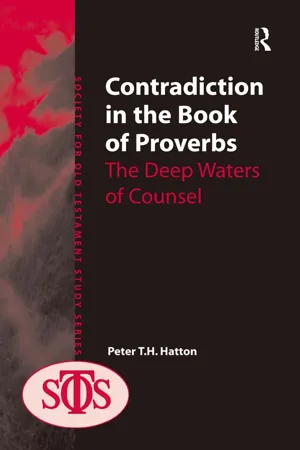
Despite the welcome revival of scholarly interest in Biblical Wisdom, the Book of Proverbs remains neglected. It continues to be seen as a disorganised repository of traditional banalities, while Job and Qohelet are viewed as more exciting texts, in revolt against Proverbs' conventional wisdom. Contradiction in the Book of Proverbs argues that this misleading consensus owes more to scholarly presuppositions than to the content of Proverbs; it sees Proverbs as a challenging work, one that aims to provoke a critical appropriation of wisdom and in which diverse sources have been skilfully brought together by a creative final editor to form a complex unity. Many divergences from the Hebrew in the Greek witness to the translator's discomfort with his spikey, provocative original. Peter Hatton challenges many existing scholarly assumptions and calls for a re-evaluation of the role and significance of Proverbs in relation to the other biblical wisdom books and the whole canon.
Information
Chapter 1
Proverbs, an Undervalued Text
Summary of introduction
In spite of the hermeneutical developments of the recent decades, scholars, with some notable recent exceptions, have neglected the book of Proverbs. This is surprising in view of some of the book’s striking features, particularly its wit and the delight in paradoxes and incongruities evident in many of its sayings. Another characteristic – the fact that some of its sayings appear to contradict others – is sometimes seen as an indication of the flawed, random nature of this text’s construction. This chapter begins the investigation of another possibility, that these contradictions are not imperfections but part of a subtle and profound didactic strategy to awaken the critical faculties of the reader. The methodological insights of the Russian Formalists, Shklovsky and Bakhtin suggest that the contradictions in Proverbs could be important elements in an ‘heteroglossalic’, dialogical text. Hinds’s view of the book offers an important insight into the way such contradictions might function in ‘teaching for responsibility’.
Introductory background
When I studied the wisdom books of the Old Testament1 as an undergraduate in the mid 1980s, the book of Proverbs, in spite of the large amount of wisdom material it contains, was not highly regarded. It was held to be a sort of waystation to what were seen as the more significant books, Job and Qohelet; of interest, not for itself, but for what might be deduced about the sources of its teachings. Our focus on Proverbs was restricted to two rather narrow topics; the origins of the ‘hypostatization’ of Wisdom in Proverbs 8, and the significance of the parallels with other ancient wisdom literature – particularly the close parallels claimed between the Egyptian Wisdom of Amenemope (around 1300 BC2) and Proverbs 22.17–24.22. In our consideration of these topics Proverbs was chiefly valued for what it might reveal of the religious and social conditions that had led to its production. In particular, two questions were thoroughly addressed. Firstly, did the personification of Wisdom in Proverbs 8 hint at the worship of a female deity in Israel? Secondly, did the links with Egypt, and elsewhere, suggest that there had been a ‘Solomonic renaissance’? That is, had a broadly ‘secular’ international wisdom been introduced into ancient Israel along with the technical expertise and bureaucratic structures required to run Solomon’s more complex kingdom?
With our focus on what lay behind the text of Proverbs, its actual teaching, particularly the concise one-line sayings that make up the bulk of the book, was, as it were, ‘blurred’. These sayings were routinely dismissed as conventional and banal, brought together in a more or less random fashion. Furthermore, we were told that the salient feature of their teaching was a simple moral calculus that held that prudent actions had positive consequences – material prosperity and divine approval – while imprudent actions were attended with negative consequences – poverty and divine disapproval. Job and Qohelet, it was held, had taken issue with this platitudinous traditional teaching and revealed its shortcomings.
The most influential commentary on Proverbs of the period was that of William McKane (1970). Although this did focus on the individual sayings of the sayings material – McKane often offered highly insightful readings of them – our attention was directed to the grand sweep of his thesis, particularly to his contention that the book revealed a tradition in transition. McKane argued that, in Proverbs, ‘secular’ sayings from an older international wisdom tradition were found alongside others that bore traces of a revision motivated by Yahwistic piety, a trend that would continue until Ben Sira and beyond. Once again, little in this analysis seemed to endorse the intrinsic value of Proverbs.
An undervalued text
In the late 1990s an interest in paradoxes and riddles in the Scriptures3 led me to revisit Proverbs. I recalled the claim in the book’s prologue that its purpose was, at least in part, to help the reader ‘to understand a proverb and a figure, the words of the wise and their riddles’ (Proverbs 1.7, NRSV). Did this mean that the book actually contained riddles? With this question in mind I looked again at the book, particularly the sayings material.
It seemed, at first sight, that there was little evidence that any riddles were to be found in Proverbs. However, the attention I paid to the Hebrew text of the individual sayings during this enquiry stimulated other interesting thoughts. I began, for instance, to suspect that they were not arranged quite so haphazardly as was usually assumed. Was it possible that Proverbs was of intrinsic interest in itself and not just for what it might reveal about underlying social developments in Ancient Israel or the significance of the personification of Wisdom?
I turned to the more recent critical literature to see if today’s scholars had engaged with Proverbs in ways that might answer some of the questions that were now beginning to frame themselves. Since the 1980s there had been remarkable methodological and hermeneutical developments in academic approaches to the Scriptures, innovations that complemented – and sometimes challenged – the historical-critical methodologies that had previously dominated the field. However, as far as Proverbs was concerned, the consensus view did not appear to have substantially changed in response to these developments.
Scholars, who might differ considerably in the methodologies they employed, were in agreement that Proverbs represented an inferior form of wisdom. They continued to hold the book of value chiefly in relation to other texts, or for what it might reveal about the social and historical situations that had led to its writing and publication. It was still the dominant view that Proverbs articulated a platitudinous and banal wisdom, consisting chiefly of the counter-factual doctrine that both the good and bad would always be appropriately requited for their deeds. Indeed, in the work of Walter Brueggemann (1990) and Philip Davies (2002), this assertion now had a sharper edge. They argued that Proverbs reflected the views of establishment supporting scribes concerned to uphold an unjust religious and economic settlement. Such scholars might agree with Friedrich Wolf’s dictum ‘Selbst die Sprichwörter entlarven die Ideologie der jeweils herrschenden Klasse’; [Even proverbs unmask the ideology of the class ruling at the time] (1963, 86). Proverbs continued to be compared unfavourably with Job and Qohelet, often regarded as texts that dared to question establishment certainties. In chapter two a more detailed survey will show that, in spite of several more positive scholarly evaluations of the book recently, the general scholarly attitude to the book remains dismissive.
However, as I continued to wrestle with the Hebrew text of Proverbs, a working hypothesis that it could be read as a work composed with a subtle didactic purpose began to suggest itself. The more I read Proverbs, the more this was confirmed. I became increasingly convinced that, far from being a complacent mouthpiece for conservative establishment stooges, Proverbs is carefully composed and crafted to encourage readers to question traditional wisdom and to develop their critical faculties.
Are words like ‘composed’ and ‘crafted’ appropriate in relation to Proverbs? Is not the book self-evidently a collection of collections, to whose original independence the titles affixed to several of its sections – for instance at Proverbs 10.1 and 25.1 – bear witness? If this is granted, surely the final act of assembly that gave us Proverbs in its canonical form could not have been anything very creative or skilful? Michael Fox – whose erudite commentary on Proverbs 1–9 bespoke an exceptional sympathy with the book – described it as something that had been filtered through a ‘membrane’ of ‘learned clerks’ over a long period of formation (2000, 11). However, as I became increasingly intrigued by Proverbs’ complexity, I began to suspect that its arrangement might have been more careful and more creative than Fox’s metaphor of filtration suggests. Could Proverbs have been shaped carefully by a final editor in order to make complex interplays between the individual sayings possible? I shall argue in chapter two that the final shaping of the book was indeed more purposeful than the general scholarly model allows for. However, let us first address the question of Proverb’s supposed banality at the level of the individual sayings.
Versified banality or bomplex poetry? Paradoxes and wit in Proverbs
Proverbs provides us with one of the most extensive collections of Hebrew verse. It is, of course, together with the Song of Songs and the Psalter, one of the three books traditionally recognized as poetic by Jewish tradition. Accordingly, it is no surprise that Luis Alonso Schökel’s work on Hebrew poetics (1988) draws many of its examples from the one-line sayings in Proverbs. Though the precise form of the ‘metre’ of Hebrew verse remains a matter of scholarly dispute, the similarities with the verse forms seen in the Psalms and the prophetic books are unmistakable in the parallelism of the meshalim, the brief one–line sayings that dominate the book from Proverbs 10.1. Extended versification is found in the discourses of Proverbs 1–9 and the acrostic poem in praise of the ishet-hayil, the ‘valiant woman’, with which the book concludes. So Proverbs is in the form of poetry – but is this simply an adherence to convention, a plodding versification of banalities? Clearly, not every saying in Proverbs is, in itself, a masterpiece of gnomic complexity. However, as we shall see, several of its sayings have the capacity to surprise the reader. Others, it is true, appear to be simply trite expressions of conventional thought. For example, the major collection of meshalim in Proverbs, the ‘Proverbs of Solomon’ (10.1–22.16), begins with a verse that marries a conventional thought to a simple form. ‘A wise child makes a glad father, but a foolish child is a mother’s grief’ (Proverbs 10.1, NRSV). In chapter three, a reading of this verse, and the other verses that open the ‘Proverbs of Solomon’, will be offered to suggest that this apparent simplicity serves a complex purpose. It will be argued that sometimes the overall complexity of the book actually requires some sayings to possess a high degree of simplicity and straightforwardness.
Furthermore, even if the majority of the book’s individual sayings seem platitudinous, scattered through the book are some sayings that offer a striking contrast. They are marked by the expression of paradox and an awareness of the counterintuitive aspects of reality. The consensus view that the book is a more or less random collection would lead to a dismissal of the inclusion of such sayings as of no consequence. It might be said that a few nuggets of gold were bound to have been dug up with the dross. However, if we entertain the suspicion that the inclusion of these more complex sayings was part of the book’s didactic strategy, then some exciting possibilities are opened up. Might they be consciously subverting the apparent platitudes? Might they flag up a knowing awareness of the limitations of what is so often confidently asserted elsewhere in the book? I noted that troubling sayings, ones that contradicted some of the most apparently cherished teachings of Proverbs, were frequently placed within the flow of the other verses in a way which, as one read the book, might be calculated to cause most disturbance.
Later in the book we shall focus on the effect of individual sayings in the context of the whole book and attempt to chart some of these ‘eddies in the flow’ of Proverbs. It is worth noting at this point in the argument however, that some individual sayings are troubling and disturbing enough to gainsay any notion that Proverbs is simply a collection of platitudes. Indeed, even McKane – who denied any context to the sentence literature in Proverbs and argued that ‘each sentence is an entity in itself’ (1970, 413) – was often struck by the powers of observation and poetic expression manifest in some of these, supposedly atomistic, individual sayings.4
Paradox and incongruity in Proverbs
Many of Proverbs’ meshalim indicate an awareness of paradox and incongruity; for example, Proverbs 11.22,
...
Table of contents
- Cover
- Half Title
- Title Page
- Copyright Page
- Dedication
- Table of Contents
- Acknowledgements
- Permissions
- Abbreviations
- 1 Proverbs, an Undervalued Text
- 2 How Proverbs was Marginalized
- 3 Unity and Diversity in Proverbs
- 4 Provocative Contradiction: The Acts–Consequence ‘Construct’
- 5 Provocative Contradiction: The Powerful in Qohelet and Proverbs
- 6 Provocative Contradiction: Gifts and Bribes in Proverbs
- 7 The Deep Waters of Counsel
- Recent Articles Dealing with Wisdom Literature in JSOT, VT and ZAW
- Bibliography
- Index of Authors
- Index of References
- Index of Selected Subjects
Trusted by 375,005 students
Access to over 1.5 million titles for a fair monthly price.
Study more efficiently using our study tools.
Frequently asked questions
Yes, you can cancel anytime from the Subscription tab in your account settings on the Perlego website. Your subscription will stay active until the end of your current billing period. Learn how to cancel your subscription
No, books cannot be downloaded as external files, such as PDFs, for use outside of Perlego. However, you can download books within the Perlego app for offline reading on mobile or tablet. Learn how to download books offline
Perlego offers two plans: Essential and Complete
- Essential is ideal for learners and professionals who enjoy exploring a wide range of subjects. Access the Essential Library with 800,000+ trusted titles and best-sellers across business, personal growth, and the humanities. Includes unlimited reading time and Standard Read Aloud voice.
- Complete: Perfect for advanced learners and researchers needing full, unrestricted access. Unlock 1.5M+ books across hundreds of subjects, including academic and specialized titles. The Complete Plan also includes advanced features like Premium Read Aloud and Research Assistant.
We are an online textbook subscription service, where you can get access to an entire online library for less than the price of a single book per month. With over 1.5 million books across 990+ topics, we’ve got you covered! Learn about our mission
Look out for the read-aloud symbol on your next book to see if you can listen to it. The read-aloud tool reads text aloud for you, highlighting the text as it is being read. You can pause it, speed it up and slow it down. Learn more about Read Aloud
Yes! You can use the Perlego app on both iOS and Android devices to read anytime, anywhere — even offline. Perfect for commutes or when you’re on the go.
Please note we cannot support devices running on iOS 13 and Android 7 or earlier. Learn more about using the app
Please note we cannot support devices running on iOS 13 and Android 7 or earlier. Learn more about using the app
Yes, you can access Contradiction in the Book of Proverbs by Peter Hatton in PDF and/or ePUB format, as well as other popular books in Theology & Religion & Religion. We have over 1.5 million books available in our catalogue for you to explore.