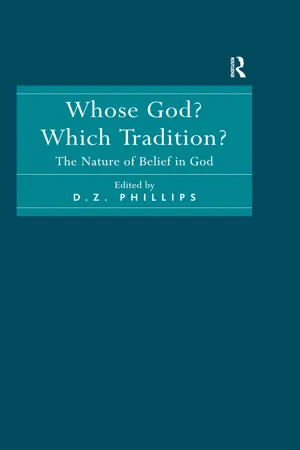
- 184 pages
- English
- ePUB (mobile friendly)
- Available on iOS & Android
eBook - ePub
About this book
Philosophy of Religion is marked by controversy over which philosophical accounts do justice to core religious beliefs. Many Wittgenstinian philosophers are accused by analytic philosophers of religion of distorting these beliefs. In Whose God? Which Tradition?, the accusers stand accused of the same by leading philosophers in the Thomist and Reformed traditions. Their criticisms alert us to the dangers of uncritical acceptance of dominant philosophical traditions, and to the need to do justice to the conceptual uniqueness of the reality of God. The dissenting voices breathe new life into the central issues concerning the nature of belief in God.
Information
Chapter 1
'God' and Grammar: An Introductory Invitation
D.Z. Phillips
It is obvious, or should be, that in any theistic context, everything depends on what is meant by ‘God’. My own work, in the philosophy of religion, is well known for its view that dominant trends in the subject today distort and confuse the grammar of ‘God’.1 It is equally well known that the counter-charges against me state, with great confidence, that I am the one who is guilty of misunderstanding or revising the essential nature of religious belief. Indeed, an appeal to orthodoxy and tradition has been made part of the philosophical arguments of my accusers, as though there were nothing that needed even a cursory argument with respect to the legitimacy of their appeal. My long-standing suspicion of this confidence was, no doubt, the background against which the idea for the 2005 Claremont Conference on Philosophy of Religion came to fruition. It took the July/August 2003 issue of New Blackfriars, however, to turn that standing suspicion into a positive intention to address it in an historical/philosophical way.
The issue of New Blackfriars consists of essays in memory of Gareth Moore OP, who, in 2001, returned to Blackfriars, Oxford, to teach philosophy. In June 2002, however, he was diagnosed with kidney cancer, and died less than six months later. He had participated in the Claremont conference on four occasions, the last being in 2000.
During his time as Prior of the Belgian Dominican house at Rixensart, near Brussels, Moore had asked Brian Davies OP, by that time teaching at Fordham University, about the state of philosophy of religion in america. After Moore’s death it struck Davies that he had never answered this question in any detail. Davies’s contribution to the memorial issue of New Blackfriars takes the form of a ‘Letter from America’, in which he draws sharp contrasts between dominant trends in philosophy of religion, and what he takes to be orthodox Christian belief down the centuries. It was this recurring contrast that caught my eye, since ‘the modern trend’, regarded by Davies as wayward, consisted precisely in those philosophers who accuse me, and other Wittgensteinian philosophers of religion, of distorting Christian belief! But the accusers were now being accused, not by recent Wittgensteinians, but, according to Davies, from the context of classical theistic writing, patristic texts and the works of the giants of the Middle Ages. It is these accusations, from traditions very different from my own, that I wanted to explore further in the present conference by asking, Whose God? Which tradition?
Most of this introduction was written before anyone was invited to participate in the conference. This is because it consists of a series of questions I wanted the participants to address. My questions come from a Wittgensteinian context, as does my depiction of how they arise for me. But it is not that context I want to discuss, but the questions themselves. Some of the contributors may have been influenced by Wittgenstein more than others, but, in the main, they come from philosophical traditions very different from my own. I certainly do not expect there to be agreement on all issues. My questions should make that clear. Nevertheless, if what Davies claims can be sustained, a parallel will emerge between Wittgensteinian accounts of religious concepts of belief and the work of Christian thinkers down the centuries. Such a parallel, I confess, would give me personal and philosophical satisfaction, since Wittgensteinians are not reformers of religious belief, but philosophers who seek to give perspicuous representations of what is there already to be seen.
I. The Accusers Accused
Davies refers to philosophers in America whom he regards as talking ‘excellent sense about God, or, at least, [as having] a sound grasp of what we cannot say about God’.2 He refers to the work of David Burrell, Michael Dodds, Germain Guirez, Mark Jordan, Brian Leftow (now at Oxford), Norman Malcolm, Ralph Mclnerney and James Ross. ‘In their different ways,’ Davies tells us, ‘all these people keep clearly in mind the difference there must be between creature and Creator.’3 These American authors, Davies writes, ‘all have colleagues with the same sensitivity (though of different opinions) working in the context of Europe’.4 He says that he is thinking ‘especially of such authors as Cyril Barrett, David Braine, Ian Crombie, Peter Geach, Herbert Mccabe, and D.Z. Phillips’.5 He also mentions Moore himself.6
The importance of all these philosophers, for Davies, is that they do justice to the grammar of ‘God’. Ten important features of that grammar must be protected in any philosophical account of ‘God’. First, God cannot be said to be part of the world of space or time. Second, God cannot be said to be subject to the limitations which affect spatial and temporal things. Third, it is nonsense to speak of God as an individual, locatable in one place rather than another. Fourth, God cannot be said to be an individual ‘in the familiar sense of “individual” where to call something an individual is to think of it as a member of a class of which there could be more than one member, as something with a nature shared by others but different from that of things sharing natures of another kind.’7 Fifth, there is no distinction between God’s identity and God’s nature. Sixth, it makes no sense to speak of God changing, as though he passes through successive states. Seventh, God cannot be informed of things, as though he were ignorant of them, and he cannot be caused to have pain. Eighth, God cannot be said to be the source of some things, but not others. Ninth, as Aquinas says, God ‘is at work without intermediary in everything that is relative’.8 Tenth, everything depends on God for its existence, whereas one cannot say that God’s existence depends on anything outside itself.
Davies claims that in contrast to these important grammatical features of ‘God’, which mark essential differences between ‘God’ and ‘creature’, much modern American philosophy of religion claims that these features are false when ascribed to God.
It is false, so we are told, that God is incomprehensible. He is, in fact, something very familiar. He is a person. And he has properties in common with other persons. He changes, learns, and is acted on. He also has beliefs, which alter with the changes in the objects of his beliefs. And he is by no means the source of all that is real in the universe. He is not, for example, the cause of my free actions. These come from me, not from God. He permits them, but they stand to him as an observed item stands to its observer. He is not their maker. He is only their enabler.9
In recent American Philosophy of religion, Davies mentions Richard Creel, Stephen T. Davis, William Hasker, Nelson Pike, Alvin Plantinga and Nicholas Wolterstorff as holding some or all of these views, but he could have added many others. Had he mentioned European parallels, the name of Richard Swinburne would have to have loomed large.
It would be hard to imagine a greater grammatical contrast than that to which Davies calls our attention. What interested me, as I have said, is the fact that the philosophers he criticizes often use, as part of their philosophical arguments, an appeal to the Christian tradition which they claim to be upholding, in contrast to philosophers whom they claim are distorting or, at least, revising that tradition.
For example, Davies writes, ‘Plantinga is a particularly interesting example of the trend to which I am now referring. For he writes in a polemical manner, and he presents himself as a philosophical spokesperson for the Christian community.’10 Yet, as I know only too well, Plantinga is not alone in that respect. Here is Wolterstorff embracing the same role:
Phillips understands himself, in his writings, as speaking not religiously but philosophically; and over and over he says that his aim, as philosopher, is not to revise but describe. His description does not hold, however, for how Reformed epistemologists use theistic language; nor, I contend, for how most people use such language. His description holds only for a rather select group of Wittgensteinians and their allies. Yet his words regularly carry the suggestion that he is describing all serious religious use of theistic language. Accordingly, his description is, for most people, a misdescription. And should his discussion succeed in getting some people to think they are using theistic language in his way, when in fact they have been using it in my way, then his discussion threatens to do what he says he wants at all cost to avoid doing; namely, it threatens to function not as description but as revision.11
Wittgensteinian philosophy of religion, perhaps more than any other aspect of contemporary philosophy of religion, has been subjected to criticisms such as those of Wolterstorff. in the same vein, Swinburne writes, ‘Much of the time Phillips writes as if he were merely analysing religious talk, but he is not; he is recommending a new way of understanding that talk, and he needs to realize this much more fully.’12 What is more, Swinburne proceeds to suggest how an improved education can help me towards such a realization: ‘It's no good reading only Simone Weil – you need to read St. Paul, Irenaeus, and Gregory of Nyssa and Luther and Francis de Sales and so on, and so on. Wittgensteinian Philosphy of religion suffers from a very one-sided diet of examples.’13 Given such confident criticism, Wolterstorff’s, Swinburne’s and Plantinga’s claim to be spokespersons for the Christian community, what are we to make of Davies’s criticisms of such critics? Surveying the American scene, he concludes, ‘If there is anything characteristic of modern American philosophy of religion it is the view that God is temporal.’14 It can be said more generally of such views that they suffer from a distorting anthropomorphism. Swinburne has been aptly called the Cleanthes of twentieth-century p...
Table of contents
- Cover
- Half Title
- Title
- Copyright
- Contents
- Notes on Contributors
- Preface
- 1 'God' and Grammar: An Introductory Invitation
- Voices in Discussion
- 2 Beyond Subject and Object: Neo Thomist Reflections
- 3 Speaking of the Unknowable God: Dilemmas of the Christian Discourse about God
- Voices in Discussion
- 4 The'Grammar'of'God' and 'Being': Making Sense of Talking about the One True God in Different Metaphysical Traditions
- Voices in Discussion
- 5 Simplicity and the Talk About God
- Voices in Discussion
- 6 Is God a Moral Agent?
- Voices in Discussion
- 7 Anthropomorphism in Catholic Contexts
- 8 Anthropomorphism Protestant Style
- Voices in Discussion
- 9 Is God Timeless, Immutable, Simple and Impassible? Some Brief Comments
- Index
Trusted by 375,005 students
Access to over 1.5 million titles for a fair monthly price.
Study more efficiently using our study tools.
Frequently asked questions
Yes, you can cancel anytime from the Subscription tab in your account settings on the Perlego website. Your subscription will stay active until the end of your current billing period. Learn how to cancel your subscription
No, books cannot be downloaded as external files, such as PDFs, for use outside of Perlego. However, you can download books within the Perlego app for offline reading on mobile or tablet. Learn how to download books offline
We are an online textbook subscription service, where you can get access to an entire online library for less than the price of a single book per month. With over 1.5 million books across 990+ topics, we’ve got you covered! Learn about our mission
Look out for the read-aloud symbol on your next book to see if you can listen to it. The read-aloud tool reads text aloud for you, highlighting the text as it is being read. You can pause it, speed it up and slow it down. Learn more about Read Aloud
Yes! You can use the Perlego app on both iOS and Android devices to read anytime, anywhere — even offline. Perfect for commutes or when you’re on the go.
Please note we cannot support devices running on iOS 13 and Android 7 or earlier. Learn more about using the app
Please note we cannot support devices running on iOS 13 and Android 7 or earlier. Learn more about using the app
Yes, you can access Whose God? Which Tradition? by D.Z. Phillips in PDF and/or ePUB format, as well as other popular books in Theology & Religion & Religion. We have over 1.5 million books available in our catalogue for you to explore.