eBook - ePub
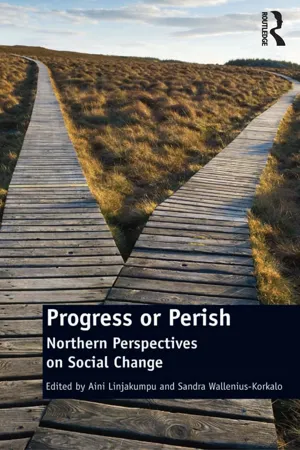
Progress or Perish
Northern Perspectives on Social Change
- 200 pages
- English
- ePUB (mobile friendly)
- Available on iOS & Android
eBook - ePub
About this book
Drawing on contemporary and historical case studies from Finland, Sweden and Norway, Progress or Perish highlights the roles that art, culture and academic research play alongside technology and economics as bearers of change, approaching the study of progress from the human level. By turning attention towards communities and the everyday social activities of individuals in their socio-cultural and microhistorical contexts, this volume links the idea of progress to the emancipation and empowerment of collectives. Multidisciplinary in nature, Progress or Perish brings together the work of leading scholars to explore the changes that individual and social agency can effect. It engages with the wider theoretical and methodological debates to be of key interest to sociologists, geographers and anthropologists, as well as those with interests in gender studies, cultural and environmental history, literary studies and political science.
Information
Chapter 1
Introduction
Northern societies are experiencing a period of change. The increasingly globalized world of late modernity is having a remarkable impact on living conditions in the European North. Until recently, the societal development of the northern areas followed the logic of modernity, concentrating on promoting the advancement of economics and technology. In commercial and political rhetoric, the changes in development policies are often justified in the name of irreversible progress and the ‘common good’. In remote northern areas especially, the choice has often been either to progress or to perish.
In spite of the popularized political and administrative use of the concept, in the field of social studies the notion of progress is considered an outdated concept that should be avoided. In the last few decades, academic literature featuring the word ‘progress’ has been scarce. This once crucial ideology of Western civilization is now considered obsolete. However, the notion of progress is still a powerful idea which affects the conditions of everyday life, and therefore it should not be ignored. Instead, a critical examination and redefinition of progress is called for.
This volume seizes that challenge, and examines the idea of progress in the context of northern Europe: Finnish Lapland,1 northern Sweden, and northern Norway. Most of the chapters concentrate on Finnish Lapland, but in many cases, the themes and arguments raised could be generalized to other parts of northern Scandinavia and other remote areas. In this way, northernness is an essential part of the empirical material analysed, but the theoretical bases of the study – and the results – transcend local particularity. There is no one type of northern community; on the contrary, the various strata and mosaic-like structures of northern communities change in time and space. It is their constant reconstruction that allows us to shatter the notion of a homogeneous northern community. Instead of a homogenizing representation, we should consider northern communities as plural. Their formation seems to follow national and international developments, while some of their features arise specifically from the northern context.
Historically, since ancient times, indigenous peoples occupied the northern regions until new populations, people or nations moved into or conquered the area. This has meant that a series of different empires and nation states have defined the very existence of the northern parts of Scandinavia. Progress in the region has been largely dependent on formulations of governance, and the rulers’ consequent intentions. Even though the northern parts of Scandinavia have always been rich in fauna and other natural riches, these areas have not achieved such a prosperous and favourable situation as their counterparts in southern Scandinavia and Finland.
Finnish Lapland experienced rapid change after the Second World War. The Finnish state showed a remarkable interest in the North, and was ‘a promoter in the reconstruction of the area’ after the war (Aho et al. 2004: 169). Effective economic and social development was guaranteed by the industrial achievements of the state and state-owned companies. The North was seen as useful for the whole nation because the area’s natural resources, especially forestry, provided a considerable amount of export income (Aho et al. 2004: 169, Benediktsson and Suopajärvi 2007: 29). The modernization and development of the North were based on the utilization of natural resources (mines, hydroelectric power, forestry), mass tourism and industrial enterprise. The North was seen as a resource in the national imagination, and, economically, post-war Finnish Lapland has ultimately been a notable success (see Linjakumpu and Suopajärvi 2003: 8).
The situation in northern Sweden and Norway is somewhat similar, although there are differences, as for example, in the state subsidies for different municipalities. However, in all three countries – Finland, Sweden and Norway – the regional policies have had a remarkable impact on the socio-economic development of the northern areas. The European Union (EU) has also played a prominent role. As the historian Peter Stadius argues, ‘[t]he EU-policy of a northern dimension is an example of political intentions to make the region and its population count within the Union’ (Stadius 2005: 24). Norway is not a member of the EU, but its influence is nonetheless also considerable there.
Even though development in northern Scandinavia has been relatively successful, it is crucial to reconsider the idea of progress; how we understand progress may also direct the course of the future, and it no doubt also encompasses the question of power. Therefore, it is important to ask who defines progress, and to whom progress is directed. Traditionally, progress in the North has been detached from ‘ordinary people’; instead, it has been the domain of authority, enterprise and politicians. However, no one can own progress, even though it is implicitly wielded by those in power. Progress should also be seen as a normative issue: progress is a political concept, and the process of defining progress is a political act. It is not a neutral, value-free dimension of society, but an issue relevant to all people.
Progress is related to several other concepts, such as those of development, transition and social change. According to the sociologist Piotr Sztompka (1990: 247–251), progress is valid only together with a certain image of social change: social changes need to be seen as fundamental transformations of society. It is the directional sequence of changes in society that constitutes progress. However, this does not necessarily lead to determinism. Progress is not a linear, or an inevitable course of history, but it lies in the potentiality of becoming. All historical processes and changing social structures are outcomes of human actions, the practices of individuals and collectives who react and reform their realities in a given time and place. So the moving force behind progress is fundamentally the agency of people. The potential and capacity for progress is inherent in human agency, and everyday social activities need to be seen as the active force of social change. The focus, therefore, should be turned to ‘real socialized individuals in their actual social and historical contexts’ (Sztompka 1990: 250).
The main aim of this volume is to seek alternative ways of understanding progress in the European North. The contributors point out that technology and economics are not the only relevant topics when studying the processes of progress in society – art, culture and academic research are also carriers of change and equally relevant subjects of study. Unlike modern social sciences that have often applied a macro-perspective to the notion of progress, this volume approaches the concept from a human and micro-level. In this book, attention is turned to communities and the everyday social activities of individuals in their socio-cultural contexts. The book demonstrates how they, too, can be seen as agents of progress. In this way, progress is understood as a ‘plural phenomenon’; there are always several interpretations of what progress is or how it should be approached. Alongside large-scale social transformations, small steps of potential progress can also be identified.
This book focuses on the opportunities available to people – individuals and communities – living in a geographical and mental borderland, where cultures, systems of norms, and life practices collide, intersect and merge. It seeks to deconstruct the homogenizing and totalizing definitions, identities and subject positions associated with the North. Rather than dwelling on the ‘marginality’ of the North, the chapters regard northernness as a cultural and social resource that provides the foundations on which individual and community activities are constructed. The North is not seen as a passive target of macro-historical actions or structures, but rather as a space where wilful, feeling and free-thinking people have acted and continue to act.
Research on the North has a long tradition. The most common issues studied have included ethnicity and different cultures, as well as nature and economic survival in the region.2 This book, however, addresses the thematic, theoretical and methodological gaps that persist in social scientific and humanistic research dealing with the North. The wars, economic difficulties and demographic development in the region all feature in a constructed history of misery and marginality. Furthermore, certain attitudes of colonialism or, at best, exoticism, have been applied to the North, and they, in turn, create their own meta-narratives of what northernness is assumed to be. The North as a lived and experienced space – as a location of subjectivity, individuality, community, creativity, agency and emancipation – has, until recently, remained unstudied. This book aims to address this imbalance.
The chapters presented here are multi-disciplinary in nature. They combine the disciplines of historical sociology, cultural and environmental history, art education, and gender and literary studies as well as political science. The volume illustrates the themes of progress and the North by examining historical and contemporary empirical examples, as well as intertwining arts and social science perspectives. As the chapters draw on very different bodies of material, it has not been feasible to use a single methodological tool to examine the data. Nevertheless, the chapters share common methodological strategies and approaches. For example, many of the studies are linked through their use of micro-history and community perspectives. This convergence of the methodological strategies, in conjunction with the common thematic and theoretical dimensions of the research, reveals a mutual coherence and dialogue between the authors’ works.
The foundation of a micro-historical approach is the notion that individual experience can play a vital role in understanding collective history. It provides the researcher with an opportunity to study the communal through the individual (e.g. Ginzburg 1996, Levi 2001), drawing the researcher’s attention to the fractures in history, and the ‘marginal’ in society. It is not the size of what is studied that is essential, but the perspective from which the focal phenomenon is examined (Levi 2001: 97). The micro-historical standpoint makes it possible to focus and fine-tune the researcher’s gaze, but it is far more than writing a ‘mini-history’ of an individual; it enables one to discover a new perspective in the study of broader, socially significant phenomena.
By using micro-history to zoom in on certain individuals and communities, the researcher is able to examine the prevailing norms in society, and study the conflicts and interrelationships between the two on a manageable scale. It is also possible to study power systems and social hierarchies and the ways in which they are connected (e.g. Suoninen 2001). This approach allows results that might usually remain abstract to become expressed in more concrete terms that can be analysed through research. In the chapters, micro-history can be seen in the research practices as both an epistemological and methodological choice. What kind of information is desired? Whose knowledge is important? Who or what constitutes a suitable research subject? Micro-history is not a method, but methodological choices are affected by the kind of information sought, and the types of sources and materials selected as research material. The method then influences the data that are obtained (on micro-history, see Rantala 2009: 40–42).
As this kind of research often studies exceptional people or phenomena, it has been criticized for studying ‘distortions’ – what can such deviations tell us about normality? In the view of micro-historians, it is precisely through such exceptions that one can reveal how people thought in the past, for the deviant makes visible the boundary with the normal and abnormal. An exception sheds light on that which is considered normal; it makes the invisible visible, enabling us to ‘wonder’ and question (Elomaa 2001: 63–72). Yet, the approach also reveals the mobility and flexibility of borders. For example, in her much cited study Le Retour de Martin Guerre, Natalie Zemon Davis (2001) has proven that women’s mobility in the village community of sixteenth-century France was far greater than had been assumed. In turn, the chapters in this book reveal how a community can – despite the imposition of borders and the apparent inflexibility of norms – provide atypical or special individuals with an opportunity to actualize their existence and their own particularity.
The first chapters in the book form an introduction to the theme of progress by taking a longue-durée perspective on this contentious concept. In their contributions, Marja Tuominen, Pälvi Rantala and Aini Linjakumpu attempt to deconstruct the historical determinism of progress, and open opportunities to reinterpret the concept. Their chapters emphasize the political dimensions of progress which are dependent on a social context of a specific period of time: there is no essential meaning of progress, but it is clearly a socially constructed concept.
Chapter 2 by Marja Tuominen applies a cultural history approach to progress. It begins by taking a look at different notions of time in various periods of European history, and by questioning progress as a trans-historic concept. According to Tuominen, the concept of progress is always bound up with the historical and cultural context of its user, and to the user’s power to define the meaning of the concept. Tuominen examines how images of the North and its progress have been constructed, what kinds of alternatives might have been available, and how these given concepts might be deconstructed. Finally, she asks what kind of challenges the deconstruction of these concepts might pose to northern research.
While Marja Tuominen conveys the theme of progress through the centuries and through central and southern European representations and discourses, Pälvi Rantala, in Chapter 3, also takes a ‘retrospective’ approach, although her study focuses more on national discourses of progress in Finland. In her chapter, the concept of progress is understood as a historical and cultural issue; a changing way of thinking. Like Marja Tuominen, Rantala refers to the political dimensions of progress; she illustrates how the uses of the concept reveal power relations in certain socio-historical situations. Her chapter describes one possible way to see the concept of progress through an empirical case – the historical period and changes taking place between the 1880s and the first decade of the twenty-first century. The theme of progress is explicitly present in the literary and verbal traditions concerning a village idiot known as ‘the Preacher of Limeland’. The writer looks at material from different eras in which this idiot is discussed, and asks what kinds of ideas and events are identified as progress in each period. Rantala demonstrates that the subjects and objects of progress vary remarkably in different times and contexts.
In Chapter 4 by Aini Linjakumpu, the voices of ordinary people are examined in terms of progress. Progress is often understood as a structural and macro-level phenomenon, but in this chapter it is analysed as a human-based activity. Linjakumpu argues that progress should be located ‘closer’ to people; it is attached to the emotions, experiences, capabilities and competencies of ordinary people, and therefore it cannot be seen as a non-human or abstract aspect of society. She asks how progress in the North can be understood through emotions, examining how certain progress-related issues generate different emotions, and how specific emotions affect progress. Her study presents autobiographies written by Laplanders, covering a period from the post-war years to the present.
It is quite clear that the Second World War had a profound impact on the history of northern Europe and on people’s minds, and Chapter 5 by Sandra Wallenius-Korkalo examines how the war has been remembered. Much like Linjakumpu, Wallenius-Korkalo interprets progress through ordinary people. Her contribution studies how the Second World War in Finland is remembered in contemporary Internet discussions. She asks whether it is possible for future conceptualizations of progress to exist simultaneously with an acknowledgement of the past, and argues that they should. She traces the ways in which different narratives of progress are constructed and tied to a potentially political memory of the war in the discussions. Through the analysis of themes of remembrance and forgetting, her chapter reflects on how memory might promote or inhibit the processes of progress.
While Wallenius-Korkalo touches on the realm of political representations by analysing war memory in terms of progress, Petri Koikkalainen, in Chapter 6, focuses on official Finnish narratives of progress in relation to President Urho Kekkonen. Kekkonen (1900–1986) remains one of the most prominent Finnish politicians of the twentieth century, both nationally and internationally. The chapter examines Kekkonen’s relationship with the narratives of progress, which is understood in this context as social and political improvement. Three narratives are identified and analysed with respect to Kekkonen’s politics: the ‘agrarian republican’ narrative, the ‘modernization’ narrative, and the ‘between East and West’ narrative. Koikkalainen’s analysis of Kekkonen provides a way of demonstrating how different and even conflicting ideals related to progress can be present in a single politician’s vocabulary. The narratives are also relevant to studying Kekkonen’s particular personal relationship with the northern regions of Finland. Paradoxically, Kekkonen was at the same time an active supporter of the modernization of northern Finland, and an admirer of traditional livelihoods.
Universities and education have been major proponents of progress in Western societies, including the northern countries. They represent the presence of state authorities in remote areas, but they have also provided a platform of progress for those who would have been otherwise excluded from dominant discourses and practices. In Chapter 7, Lars Elenius focuses on the relations between ethnicity, power and the institutionalization of knowledge in the context of ethnic groups in northern Fenno-Scandinavia. In today’s society, existing at the stage of ‘second modernization’, universities play an important role as the ultimate legitimization of knowledge. In his chapter, Elenius makes problematic the notion of progress and modernity in this context, and describes ho...
Table of contents
- Cover Page
- Title Page
- Copyright Page
- Contents
- List of Figures
- Notes on Contributors
- Preface and Acknowledgements
- 1 Introduction
- 2 History as a Project of Progress? The North as a Focus of Attention
- 3 ‘Chapters’ of Progress – The Case of a Village Idiot
- 4 Progress and Emotions in Lapland
- 5 Remembering and Forgetting the Second World War in Finland: The Politics of Memory in Online Discussions
- 6 Narratives of Progress in the Politics of Urho Kekkonen and the Agrarian League
- 7 Northern Universities and the Changing Status of Minorities
- 8 Slow Activism: Art in Progress in the North
- 9 From Emotional Memory to Active Awareness: Counter-Memory and Resistance in Torne Valley Finnish Literature
- 10 Women Behind the Camera in the Early Twentieth Century at the Arctic Circle: A Step Towards Independence
- 11 Concluding Remarks
- Index
Trusted by 375,005 students
Access to over 1.5 million titles for a fair monthly price.
Study more efficiently using our study tools.
Frequently asked questions
Yes, you can cancel anytime from the Subscription tab in your account settings on the Perlego website. Your subscription will stay active until the end of your current billing period. Learn how to cancel your subscription
No, books cannot be downloaded as external files, such as PDFs, for use outside of Perlego. However, you can download books within the Perlego app for offline reading on mobile or tablet. Learn how to download books offline
Perlego offers two plans: Essential and Complete
- Essential is ideal for learners and professionals who enjoy exploring a wide range of subjects. Access the Essential Library with 800,000+ trusted titles and best-sellers across business, personal growth, and the humanities. Includes unlimited reading time and Standard Read Aloud voice.
- Complete: Perfect for advanced learners and researchers needing full, unrestricted access. Unlock 1.5M+ books across hundreds of subjects, including academic and specialized titles. The Complete Plan also includes advanced features like Premium Read Aloud and Research Assistant.
We are an online textbook subscription service, where you can get access to an entire online library for less than the price of a single book per month. With over 1.5 million books across 990+ topics, we’ve got you covered! Learn about our mission
Look out for the read-aloud symbol on your next book to see if you can listen to it. The read-aloud tool reads text aloud for you, highlighting the text as it is being read. You can pause it, speed it up and slow it down. Learn more about Read Aloud
Yes! You can use the Perlego app on both iOS and Android devices to read anytime, anywhere — even offline. Perfect for commutes or when you’re on the go.
Please note we cannot support devices running on iOS 13 and Android 7 or earlier. Learn more about using the app
Please note we cannot support devices running on iOS 13 and Android 7 or earlier. Learn more about using the app
Yes, you can access Progress or Perish by Sandra Wallenius-Korkalo, Aini Linjakumpu in PDF and/or ePUB format, as well as other popular books in Social Sciences & Anthropology. We have over 1.5 million books available in our catalogue for you to explore.