eBook - ePub
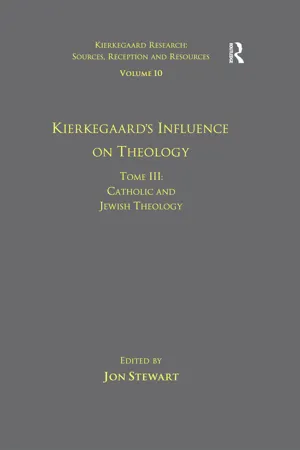
Volume 10, Tome III: Kierkegaard's Influence on Theology
Catholic and Jewish Theology
- 234 pages
- English
- ePUB (mobile friendly)
- Available on iOS & Android
eBook - ePub
About this book
Kierkegaard has always enjoyed a rich reception in the fields of theology and religious studies. This reception might seem obvious given that he is one of the most important Christian writers of the nineteenth century, but Kierkegaard was by no means a straightforward theologian in any traditional sense. He had no enduring interest in some of the main fields of theology such as church history or biblical studies, and he was strikingly silent on many key Christian dogmas. Moreover, he harbored a degree of animosity towards the university theologians and churchmen of his own day. Despite this, he has been a source of inspiration for numerous religious writers from different denominations and traditions. Tome III explores the reception of Kierkegaard's thought in the Catholic and Jewish theological traditions. In the 1920s Kierkegaard's intellectual and spiritual legacy became widely discussed in the Catholic Hochland Circle, whose members included Theodor Haecker, Romano Guardini, Alois Dempf and Peter Wust. Another key figure of the mid-war years was the prolific Jesuit author Erich Przywara. During and especially after World War II Kierkegaard's ideas found an echo in the works of several trend-setting Catholic theologians of the day such as Hans Urs von Balthasar, Henri de Lubac and the popular spiritual author Thomas Merton. The second part of Tome III focuses on the reception of Kierkegaard's thought in the Jewish theological tradition, introducing the reader to authors who significantly shaped Jewish religious thought both in the United States and in Israel. These theologians represent a variety of religious and political backgrounds: the spiritual world of Hasidism, Modern Orthodox Judaism of Mithnaggedic origin, and Modern Religious Zionism.
Information
Part I
Catholic Theology
Hans Urs von Balthasar:
Persuasive Forms or Offensive Signs? Kierkegaard and the Problems of Theological Aesthetics
Joseph Ballan
It has become practically de rigeur to begin discussing the life and work of Hans Urs von Balthasar (1905–88) by making reference to his almost impossibly extensive, eclectic corpus and astonishing erudition. Reflecting on the life and work of his friend, Henri de Lubac (1896–1991) exclaimed, "this man is perhaps the most cultivated of his time. If there is a Christian culture, here it is!"1 Born into a Swiss family which saw that he received a thorough cultural education, Balthasar wrote his first book, on music, at the age of 20. He studied Germanistik at the Universities of Berlin, Vienna, and Zürich. His 1930 dissertation, Geschichte des eschatologischen Problems in der modernen deutschen Literatur, submitted to the Germanistik faculty at Zürich, eventually became the three-volume Apokalypse der deutschen Seele (1937–39).2 A friend reports that Balthasar insisted upon the fact that he remained primarily a scholar of German literature and culture, rather than a theologian, throughout his life.3 Indeed, the references to Mozart (1756–91), Goethe (1749–1832), Nietzsche (1844–1900), and Hegel (1770–1831) do not end with the publication of the Apokalypse, though veritably theological concerns also animate even this early work of Germanistik, as the title indicates.4 As he neared completion of these studies, he began to study philosophy and theology in preparation for entering the Society of Jesus. He became a Jesuit in 1929 and would eventually align himself with the French ressourcement theologians, for example, de Lubac, Yves Congar (1904–95), and Jean Daniélou (1905–74), who can be said to have inspired some of the reforms of Vatican II. As Kevin Mongrain explains, his own contribution to this movement cannot be separated from his reaction against the regnant neo-scholasticism, along with its late medieval criteria for theological rationality. Balthasar’s desire to reorient theology and, with it, rationality more generally, manifested itself in a series of studies of Patristic writers, including Gregory of Nyssa (ca. 335–94), Origen (ca. 185–254), and Maximus Confessor (ca. 580–662).5
After leaving the Jesuits in 1940 to join Adrienne von Speyr’s (1902–67) Johannesgemeinschaft, Balthasar published a seminal work on the theology of his friend Karl Barth (1886–1968),6 whom he first wrote about in the final volume of his Apokalypse. Peter van Erp characterizes Karl Barth as “the first serious Catholic answer to the Protestant discussion of natural theology.”7 In the 1950s Balthasar continued to publish some shorter theological works which anticipate and sometimes lay the groundwork for the larger scale projects to come. During the decades of the 1960s, 1970s and 1980s Balthasar produced what scholars regard as his magnum opus and one of the most important contributions to theology in the twentieth century. Balthasar is perhaps most well-known for the first panel of this triptych, the theological aesthetics (Herrlichkeit), and for the more general project that pervades all three portions of this trilogy in 14 volumes, namely, the recovery of the significance of beauty, the “forgotten transcendental,” for Christian theology. As D.C. Schindler has it, referring to a claim made in the book that concludes the trilogy (Epilog), since “all worldly being is epiphanous...the fundamental phenomenon of reality, than which nothing more basic can be found, is Gestalt.”8 Indeed, the trilogy begins with beauty (pulchrum), and more specifically with a prolegomena on “seeing the Gestalt” before moving on to volumes dealing with the good (bonum) and the true (verum). Balthasar takes up these last two subjects under the rubrics of Theo-Drama and Theo-Logic, respectively. The former, whose subject is the “action” both of God and of humanity, aims to explicate “the meaning of the theater of the world ultimately as a play within God’s (trinitarian) play,”9 while the latter constitutes Balthasar’s attempt to write an ontology, in three volumes, of Father, Son, and Holy Spirit. In all three sections of this massive undertaking, the full scope of Balthasar’s erudition is on display as he shows himself equally at ease conversing with patristic as with modern sources, with philosophy and theology as with literature and drama. In the face of this often breathtaking variety of textual interlocutors, Oliver Davies issues a helpful warning that those interested in the question of Balthasar’s interpretation of Kierkegaard, for instance, would do well to heed: “much of what is included [in the trilogy] is intended to exemplify the key ideas and does not need to be scrutinized with the same attentiveness as those passages or sections which set out the governing ideas of the entire project.”10 In the early 1970s Balthasar founded the Communio journal with Joseph Cardinal Ratzinger (b. 1927) who was later elected Pope Benedict XVI. John Paul II (1920–2005) made him cardinal in 1988; Balthasar died in the same year.
I. Kierkegaard, Nietzsche, and a New Apocalyptic
Regarding Balthasar’s early contribution to German literary history, in three tomes that Balthasar did not republish after 1947, Aidan Nichols writes that
what we have [in this work] is a large number of miniature monographs on a variety of philosophers and poets in which Balthasar runs through their work for the light they can throw on ideas of ultimate reality or final destiny—on what he terms “eschatology,” a word he uses in a very broad sense that is unconfined to discussion of “the Four Last Things,” death, judgment, Heaven, Hell, though these are not excluded.11
In many ways, this study, though a massive undertaking in itself, merely lays the ground for what will be clarified in a more overtly theological discourse later in Balthazar's career. That Balthasar did not have the work republished after 1949 suggests that, from his more mature theological perspective, he did not take a very high view of the work, which Kierkegaard scholar Theodor Haecker (1879–1945) lambasted as “even more embarrassing than [Karl] Söhle’s manure pit” and full of “blasphemy.”12 Balthasar will return with great frequency to many of the figures discussed in these pages, including Kierkegaard. Before opening the second volume “under the sign of Nietzsche,” he concludes the first volume with a discussion of Kierkegaard and Nietzsche, who are brought together in a section entitled, “The Duel of the Idea.”13 In bringing these two thinkers together, attempting to come to terms with the “meaning of the dialogic between Christian and non-Christian world views,”14 Balthasar is preceded by Gottlieb Sodeur’s Kierkegaard und Nietzsche,15 a work with which Balthasar was familiar, among other sources, for his reflection on Kierkegaard that he reports having read throughout his student career, including works by August Vetter,16 Romano Guardini,17 Martin Thust,18 and Friedrich Adolf voigt.19 It should be borne in mind that this work is a study in German literary history; Kierkegaard, along with Fyodor Dostoevsky (1821–81), who receives a lengthy treatment in comparison with Nietzsche in volume two,20 is one of very few non-German writers to make an appearance in its pages. Balthasar quotes, often at length and without commentary, from German translations of The Sickness unto Death, Philosophical Fragments, Stages on Life’s Way, The Concept of Anxiety, “Purity of Heart,” Concluding Unscientific Postscript, and from the journals, but the citation of these secondary works should remind us that Balthasar is as interested in the effect of Kierkegaard’s writings on “the German soul” as he is in their content. This will become clearer as we discuss Balthasar’s later writings.
The chapter in question begins by emphasizing the similarities between the two men, for example their opposition to the inte...
Table of contents
- Cover
- Half Title
- Title
- Copyright
- Contents
- List of Contributors
- List of Abbreviations
- PART I CATHOLIC THEOLOGY
- PART II JEWISH THEOLOGY
- Index of Persons
- Index of Subjects
Trusted by 375,005 students
Access to over 1.5 million titles for a fair monthly price.
Study more efficiently using our study tools.
Frequently asked questions
Yes, you can cancel anytime from the Subscription tab in your account settings on the Perlego website. Your subscription will stay active until the end of your current billing period. Learn how to cancel your subscription
No, books cannot be downloaded as external files, such as PDFs, for use outside of Perlego. However, you can download books within the Perlego app for offline reading on mobile or tablet. Learn how to download books offline
Perlego offers two plans: Essential and Complete
- Essential is ideal for learners and professionals who enjoy exploring a wide range of subjects. Access the Essential Library with 800,000+ trusted titles and best-sellers across business, personal growth, and the humanities. Includes unlimited reading time and Standard Read Aloud voice.
- Complete: Perfect for advanced learners and researchers needing full, unrestricted access. Unlock 1.5M+ books across hundreds of subjects, including academic and specialized titles. The Complete Plan also includes advanced features like Premium Read Aloud and Research Assistant.
We are an online textbook subscription service, where you can get access to an entire online library for less than the price of a single book per month. With over 1.5 million books across 990+ topics, we’ve got you covered! Learn about our mission
Look out for the read-aloud symbol on your next book to see if you can listen to it. The read-aloud tool reads text aloud for you, highlighting the text as it is being read. You can pause it, speed it up and slow it down. Learn more about Read Aloud
Yes! You can use the Perlego app on both iOS and Android devices to read anytime, anywhere — even offline. Perfect for commutes or when you’re on the go.
Please note we cannot support devices running on iOS 13 and Android 7 or earlier. Learn more about using the app
Please note we cannot support devices running on iOS 13 and Android 7 or earlier. Learn more about using the app
Yes, you can access Volume 10, Tome III: Kierkegaard's Influence on Theology by Jon Stewart in PDF and/or ePUB format, as well as other popular books in Theology & Religion & Philosophy History & Theory. We have over 1.5 million books available in our catalogue for you to explore.