eBook - ePub
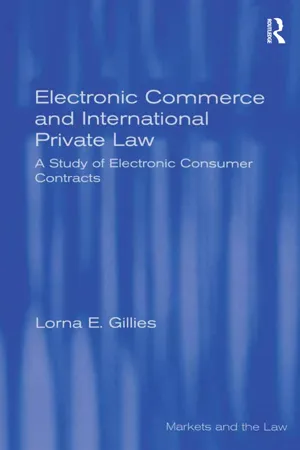
Electronic Commerce and International Private Law
A Study of Electronic Consumer Contracts
- 286 pages
- English
- ePUB (mobile friendly)
- Available on iOS & Android
eBook - ePub
Electronic Commerce and International Private Law
A Study of Electronic Consumer Contracts
About this book
Electronic Commerce and International Private Law examines the maximization of consumer protection via the consumer's jurisdiction and law. It discusses the proposition that a new connecting factor be used to improve the efficiency of juridical protection for consumers who contract with foreign sellers by electronic means and offers recommendations as to how to amend existing jurisdiction and choice of law rules to provide a basis for the consumer to sue in his own jurisdiction and for the law of the consumer's domicile to apply. The book will be a valuable resource for academics, students and practitioners working in the areas of international private law, electronic commerce law and consumer law.
Chapter 1
Electronic Consumer Contracts and International Private Law
The Aim and Scope of International Private Law
In a democracy, the law may be deemed to reflect the values and beliefs of the society that lives by it. This explains some of the differences between national laws … (O)ther differences can be traced to the geographical, demographic, economic or social conditions prevailing in each state.1
International private law provides rules of jurisdiction, choice of law and recognition and enforcement of foreign judgments for cases where the existence of a foreign element is present in the facts of the dispute.2 The importance of choice of law rules to the regulation of cross-border disputes is undoubted. According to Jaffey ‘… the aim of the choice of law rule must be to select the appropriate governing law on criteria of justice and convenience for the parties.’3 The purpose of Article 5 of the Rome Convention on the Law Applicable to Contractual Obligations is to ensure certainty and predictability of result by applying the mandatory rules of the consumer’s habitual residence. The reason for this approach, as Jaffey confirms, is that the consumer has the ‘convenience in consulting [his] law,’ rather than being entitled to rely on whatever law is more favourable to him, whether the law of his domicile or a foreign law.4 Jurisdiction rules are a ‘manifestation of state sovereignty,’5 since their purpose is to determine whether the state and its courts can adjudicate over cases with a foreign element.6 Once the jurisdiction of a cross-border dispute has been determined, the lex fori’s choice of law rules will be applied. The effective operation of ‘judicial’7 or ‘juridical’8 jurisdiction rules relies upon locating the parties or their activities in a particular jurisdiction.9 Byassee has succinctly commented on the significance of physical presence in determining jurisdiction as follows,
(T)he fundamental jurisdictional premise of the common law is physical presence, either actual or constructive within the jurisdiction attempting to assert authority over an individual. The body of the individual action may be located in the jurisdiction, the individual may perform an action that has physical effects within the jurisdiction or the individual boundaries of the jurisdiction itself are defined in physical geographical terms.10
The operation of international private law rules are premised on connecting factors which are used to determine whether parties are physically present or their activities are associated with certain jurisdictions and laws in a material way. Domicile is an important connecting factor most often used to determine whether parties are physically located in a jurisdiction. For example, a party is domiciled in England if he can demonstrate both residence and an intention to remain in England.11 The place where the parties’ commercial activities occur also connects the parties to a particular jurisdiction and applicable law. Once the parties know where each other is geographically located, or where their activities have taken place, they will be able to determine which jurisdiction will hear their dispute and what law(s) will apply. Connecting factors are a means of ensuring that the closest,12 and thereby the most appropriate, jurisdiction of a dispute can be foreseen13 or determined with a degree of certainty and predictability.14 Once the parties know or have anticipated what jurisdiction will hear any dispute between them, they will then be able to determine whether the lex fori will apply its own laws, the law that the parties have agreed in their contract or another law to govern the dispute. As international private law rules are to provide justice for the parties – and moreover justice for a particular class of claimants such as consumers – determining the jurisdiction with the closest geographical connection or interest to a dispute with a foreign element is of crucial significance.15 Since international private law rules seek to ensure justice to the parties in a cross-border dispute, an important consideration is the meaning of ‘justice’ in this context and in the context of disputes between consumers and foreign sellers who have contracted by electronic means.
International Private Law Rules and the Pursuit of ‘Conflicts Justice’
Clarkson and Hill identify a number of aspects that underpin conflicts justice, namely ‘giving effect to the parties’ intentions … giving effect to the parties’ legitimate expectations … certainty and predictability … balancing public interests and principles of conflicts justice.’16 The two aspects of justice that interplay in cross-border electronic consumer contract disputes are conflicts justice and the material justice enshrined in substantive consumer protection laws. The Oxford English Dictionary defines justice, inter alia, as ‘the administration of law in a fair and reasonable way.’17 The Collins English Dictionary defines justice, inter alia, as ‘the moral principle that determines the fairness of actions.’ It also defines justice more specifically as ‘the administration of law according to prescribed and accepted principles.’18 In international private law cases the pursuit of conflicts justice is sought as the parties are from different jurisdictions with different expectations of their legal rights and remedies. International private law rules seek to provide certainty and predictability of result19 to facilitate ‘conflicts justice.’20 In particular, the aim of jurisdiction rules is two-fold. The first aim is to provide the parties with legal certainty by providing rules that direct their dispute to the most appropriate jurisdiction21 whether a choice of forum has been agreed or not. Vonken has described this as the ‘parties’ conflicts interests.’22 Each party may reasonably expect the dispute to be heard in the jurisdiction where they are located, where their activities take place or the jurisdiction specified in the contract.23 Furthermore each party may reasonably expect the substantive laws of those jurisdictions to apply.24 The aim of contractual choice of law rules is to give effect to the parties’ choice of applicable law(s), determine the applicable law in the absence of choice and where necessary or appropriate restrict or limit their choice of law in favour of the operation of mandatory rules or laws to protect public policy. Choice of forum and applicable law clauses are prima facie evidence that the parties have agreed what jurisdiction will hear any dispute between them and what law will apply to their contractual obligations. Nevertheless, international private law rules must provide a clear basis to determine whether or not the parties can agree a choice of forum or applicable law clause and what effect such choices have on the resolution of their dispute. International private law rules must also determine whether a purported choice of forum or law clause, for example in a standard form or a click-wrap agreement25 on a web site, enables one or either parties to override the forum or law specified in the contract.
The purpose of international private law rules is not therefore to determine the final outcome of a dispute between the parties. There is the potential for more than one jurisdiction and law to apply in a cross-border dispute. The second aim of international private law rules is to facilitate predictability of result.26 The content and scope of both jurisdiction and applicable law rules must be clear for a jurisdiction to be established and a particular law to be applied. By determining the place where a consumer can sue a business, both parties can foresee what procedural rules and substantive law(s) will apply to their cross-border dispute.27 As Jaffey affirms,
… a party in an international dispute cannot complain of injustice if the justice given to him or her is that of his or her own country. The difficulty, of course, is that the parties will often belong to different countries, whose standards of justice differ.28
In addition the use of connecting factors, the ‘litigational convenience of […] the parties [and their] witnesses’29 and the legal regulation of cross-border activities are significant ‘wider considerations’30 in establishing jurisdiction in the consumer’s domicile. There are legal, practical and economic benefits to the consumer when a dispute is heard in his jurisdiction. As Vonken confirms, ‘(T)he parties cannot be expected to have a detailed knowledge of substantive law provisions. Rather it must be assumed that they have a general perception of the essential principles of justice embodied in ‘their’ law.’31 A consumer is more likely to know the procedural or substantive consumer protection rules of his jurisdiction and will want to take advantage of the protection provided by those rules. Jurisdiction rules therefore provide the ‘means [for] observance of [consumer’s] rights.’32 Establishing jurisdiction is therefore a crucial ‘first’ step in determining where the dispute will be heard to enable the applicable law to be applied to that dispute. The inextricable purpose and link between jurisdiction and choice of law rules for consumer contracts is evident since both seek to facilitate conflicts’ justice for consumers in one jurisdiction who contract with sellers in foreign jurisdictions. As Fawcett has explained, whilst questions of choice of law often arise when jurisdiction is being determined,33 the function (i.e. purpose) of jurisdiction and choice of law rules is different34 and therefore requires separate treatment.35 As stated earlier, it is the purpose of jurisdiction rules to establish the most appropriate jurisdiction...
Table of contents
- Cover Page
- Half-Title Page
- Title Page
- Copyright Page
- Table of Contents
- Table of Cases
- Table of Statutes
- Acknowledgements
- Dedication
- List of Abbreviations
- Introduction: International Private Law and the Dematerialisation of Electronic Consumer Contracts
- 1 Electronic Consumer Contracts and International Private Law
- 2 The Internet, Electronic Commerce and Electronic Consumer Contracts
- 3 International Private Law Rules for Electronic Consumer Contracts: Theoretical Approaches
- 4 The Development of European International Private Law Rules for Electronic Consumer Contracts
- 5 Jurisdiction Rules for Electronic Consumer Contracts in the Brussels 1 Regulation
- 6 Application of United Kingdom Jurisdiction Rules to Electronic Consumer Contracts
- 7 Choice of Law Rules for Electronic Consumer Contracts in the Rome 1 Regulation
- 8 Rules of Personal Jurisdiction for Electronic Consumer Contracts in the United States
- 9 Adaptation of Personal Jurisdiction Rules for Electronic Consumer Contracts in the United States
- 10 Towards Harmonised International Private Law Rules for Electronic Consumer Contracts
- Appendix (i)
- Appendix (ii)
- Appendix (iii)
- Appendix (iv)
- Bibliography
- Index
Trusted by 375,005 students
Access to over 1.5 million titles for a fair monthly price.
Study more efficiently using our study tools.
Frequently asked questions
Yes, you can cancel anytime from the Subscription tab in your account settings on the Perlego website. Your subscription will stay active until the end of your current billing period. Learn how to cancel your subscription
No, books cannot be downloaded as external files, such as PDFs, for use outside of Perlego. However, you can download books within the Perlego app for offline reading on mobile or tablet. Learn how to download books offline
Perlego offers two plans: Essential and Complete
- Essential is ideal for learners and professionals who enjoy exploring a wide range of subjects. Access the Essential Library with 800,000+ trusted titles and best-sellers across business, personal growth, and the humanities. Includes unlimited reading time and Standard Read Aloud voice.
- Complete: Perfect for advanced learners and researchers needing full, unrestricted access. Unlock 1.5M+ books across hundreds of subjects, including academic and specialized titles. The Complete Plan also includes advanced features like Premium Read Aloud and Research Assistant.
We are an online textbook subscription service, where you can get access to an entire online library for less than the price of a single book per month. With over 1.5 million books across 990+ topics, we’ve got you covered! Learn about our mission
Look out for the read-aloud symbol on your next book to see if you can listen to it. The read-aloud tool reads text aloud for you, highlighting the text as it is being read. You can pause it, speed it up and slow it down. Learn more about Read Aloud
Yes! You can use the Perlego app on both iOS and Android devices to read anytime, anywhere — even offline. Perfect for commutes or when you’re on the go.
Please note we cannot support devices running on iOS 13 and Android 7 or earlier. Learn more about using the app
Please note we cannot support devices running on iOS 13 and Android 7 or earlier. Learn more about using the app
Yes, you can access Electronic Commerce and International Private Law by Lorna E. Gillies in PDF and/or ePUB format, as well as other popular books in Business & Business Law. We have over 1.5 million books available in our catalogue for you to explore.