- 354 pages
- English
- ePUB (mobile friendly)
- Available on iOS & Android
eBook - ePub
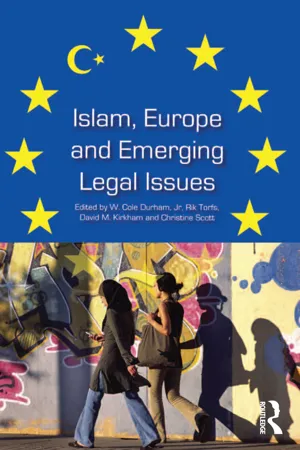
Islam, Europe and Emerging Legal Issues
About this book
Islam, Europe and Emerging Legal Issues brings together vital analysis of the challenges that Europe poses for an expanding Islam and that Islam poses for Europe, within their ever-evolving religious, legal, and social environments. This book gathers some of the best thinking on Islam and the law affecting current and contested issues that can no longer be ignored, particularly as they have found their way before the European Court of Human Rights. Contributors include leading authorities who are working at the heart of this generation's law and religion questions in Europe and across the world. This book outlines implications for all those who look to Europe-from both within and without-for models of human rights implementation and multi-cultural accommodation.
Information
ISLAM, HUMAN RIGHTS, AND SECULARISM IN EUROPE: AN OVERVIEW
Chapter 1
Islam in Strasbourg: Can Politics Substitute for Law?1
Introduction
It is no secret that in Europe—as in other parts of the West—there is an increasing concern about how to deal with Islam from legal, political, and cultural perspectives. Two factors seem to be the main cause of this concern. On the one hand, the ever-growing presence of Muslim immigrants in Europe, especially in the richest European Union (EU) countries, raises difficult questions about how to promote integration of immigrants and about how to respond to the visibility of Islamic personal religious symbols within a public sphere dominated either by a “secularity” or by a predominantly Christian religious atmosphere.2 And on the other hand, raising equally complex questions is the gradual emergence of Turkey as an important actor in European politics and economy. Turkey is a country with more than 70 million people, the vast majority of whom are Muslims (mostly Sunni and Alevi), but its legal system and religious policies are allegedly based upon the constitutional principle of secularism (laïcité), presented as an essential safeguard to prevent religious extremism from undermining democracy.
Some characteristics of European history and culture may help explain the difficulties involved in integrating Muslims into modern European society. First, to a large degree the core values embedded in the European legal, moral, and political culture come from a Judeo-Christian heritage submitted to a secularization process over the last two and a half centuries. In this context, the historical presence of Islam in Europe has been traditionally perceived by Europeans as marked by continuous tension and wars with the Christian kingdoms (from the Muslim conquest of the Iberian Peninsula to the Eastern invasions of Europe).3 This historical diffidence about Islam has been reinforced in the present day by a widespread fear of Islamist terrorism and violence. These perceptions, together with the frequent lack of a real democracy in many Muslim countries, have contributed to suspicion that it is not easy—and perhaps impossible—to reconcile Islam and democratic freedoms; or, in other words, the Muslim religion might not be fully acceptable in light of the standards that secular democracies must require from all religions.
The foregoing factors may be analyzed from very different perspectives, but no doubt they form part of the social backdrop against which the European Court of Human Rights (ECtHR or the Court) must operate when interpreting the European Convention on Human Rights (ECHR). In the last decade, the Court has decided a relatively significant number of cases regarding Islam, and some of these decisions have raised heated debates in the academic milieu and even in the media. The purpose of this chapter is to examine whether the Court, when facing “Islamic” issues, has followed a specific policy or adopted a different approach in comparison with its approach to other religions. In other words, whether the usual legal reasoning used by the Court when dealing with religious freedom issues has experienced some alteration in the particular case of Islam because of political or cultural—or, in general, extra-juridical—considerations.
When trying to identify the ECtHR’s trends, it is important to bear in mind that the dynamics of the European Court are very different from the dynamics of national constitutional courts. It is true that the Court fulfills a sort of constitutional function at the European—supranational—level with respect to the standards of protection of fundamental freedoms, and that it tends to follow the stare decisis rule, abiding by its own precedents. But, at the same time, we must not lose sight that the ECtHR is much more complex than European constitutional courts. First, we must consider a patent quantitative factor: there is a judge for each member state of the Council of Europe; this amounts to 47 judges, distributed into five sections of a court that sits in a single-judge formation, in committees of three judges, in chambers of seven judges, or in a Grand Chamber of 17 judges.4 And there is also a qualitative factor: the diverse professional, political, and cultural background of the judges as well as, frankly speaking, their diverse standing and prestige from a purely legal perspective. In addition, we have to take into account both that their term of office is nine years5 and the fact that there is a political component in their appointment. The latter also occurs in constitutional courts throughout the world, but of course the combined politics of 47 countries in a continuously changing European panorama creates an environment that is, by far, much more intricate than purely national politics. As a consequence, it is not always easy to find logical patterns and stable trends or policies in the case law of the ECtHR, especially because the Court often declares formally and solemnly its attachment to certain general principles, deemed immovable, but then it assesses the factual evidence with extreme concision and lack of detail (to the extent that sometimes those same principles could have been used to decide the case the opposite way).
This chapter endeavors to provide an overview of the “Islamic cases” decided by the ECtHR in order to draw some general conclusions. I will not describe at length the particular profiles of each case, above all considering that the most controversial cases are already analyzed in detail in other contributions to this volume.6
The Autonomy of Muslim Religious Communities
In recent years, the ECtHR has decided several cases directly related to the autonomy of Muslim religious communities. It seems natural that Article 9 of the ECHR should be construed to include the rights of religious groups to be recognized and to have internal autonomy and control of their own affairs,7 both as a consequence of the individual’s right to religious freedom and also of freedom of association. Problems arise, however, when the state provides a specific support or recognition for religious communities—which implies normally a certain degree of control of religious affairs—and those communities become divided.
The analysis of these cases reveals that the ECtHR did not curtail or provide any restrictive interpretation of the rights of Muslim communities to their own autonomy and self-government. On the contrary, the Court emphasized that the autonomy of religious groups is protected both by Article 9 and 11 of the ECHR, and must be guaranteed even when it leads to a certain degree of social tension. It is worth describing briefly the circumstances of these cases.
The first one, Serif v. Greece,8 regarded the appointment of a religious Islamic leader (Mufti) in a region of Greece (Thrace) with a significant Muslim population of Turkish origin. The applicant had been elected Mufti of the prefecture of Rodopi by the Muslim community without the intervention of the state authorities prescribed by the Greek law governing the election and appointment of Muftis. It should be noted that the law had been changed a few days before the election took place. The government did not recognize the election of the applicant, who was subsequently convicted under Greek law of having usurped the functions of a minister of a “known religion” and for having publicly dressed as such without the right to do so. The Greek government justified the state’s intervention in the elections on account of the administrative and judicial functions that Muftis exercise, and argued that the criminal proceedings against the applicant were necessary for the protection of public order. Given that there was another person claiming the leadership of the Muslim community, Greece asserted that the courts had to convict the spurious one to keep the religious peace. The election and subsequent events sharpened the division within the Islamic community as well as the confrontation between civil and religious authorities.9
The ECtHR accepted that the protection of public order was a legitimate aim when social peace was at stake as a result of a strong religious division. However, the Court held that, unless there is a “pressing social need,” the state is not legitimated to interfere in a purely religious question decided by a religious community, even when that community is sharply divided over the issue.10 In this case the Court did not find any evidence of a pressing social need that justified the government’s intervention. The government claimed that the restrictive measures adopted were necessary in a democratic society because the applicant’s actions undermined the system established by the state for the organization of the religious life of the Muslim community in the region. However, the Court observed that the applicant’s conviction had been based upon the exercise of merely religious functions and that there was no indication that he had attempted to exercise the judicial and administrative functions that Greek legislation recognized to the Muftis.11 Therefore, the Court found unanimously that Article 9 ECHR had been violated.
In addition, the ECtHR made another very important remark with regard to the self-government of religious groups: “the Court does not consider that, in democratic societies, the State needs to take measures to ensure that religious communities remain or are brought under a unified leadership.”12 The ECtHR acknowledged that divisions within religious communities may produce a certain degree of “social tension,” but made clear that this fact does not entitle the public authorities to interfere in such a sensitive issue as the appointment of religious leaders. Internal religious disputes—the Court added—is one of the unavoidable effects of pluralism, which is in turn inseparable from democracy. “The role of the authorities in such circumstances is not to remove the cause of tension by eliminating pluralism, but to ensure that the competing groups tolerate each other.”13 In other words, the role of the state with regard to religion is not to impose uniformity but to guarantee the actual exercise of freedom by individuals and collectivities.
The ECtHR reiterated this doctrine in Agga v. Greece,14 a case almost identical to Serif that related also to the election of a Mufti in the region of Thrace, this time in the prefecture of Xanthi. The facts were analogous and almost contemporary to those in Serif. The local Islamic community had elected the applicant as Mufti but the government refused to recognize him and appointed a different person one year later, after changing the law that regulated the election and appointment of Muftis. The applicant was repeatedly prosecuted in the Greek courts for having usurped the functions of a minister of a “known religion.”15 The dicta of the ECtHR were almost a transcription of the Serif decision, which was continuously quoted in Agga.
Another interest...
Table of contents
- Cover Page
- Title Page
- Copyright Page
- Contents
- List of Figures
- List of Contributors
- List of Abbreviations
- Acknowledgements
- Introduction
- PART I ISLAM, HUMAN RIGHTS, AND SECULARISM IN EUROPE: AN OVERVIEW
- PART II EUROPEAN APPROACHES TO THE ISLAMIC HEADSCARF CONTROVERSY
- PART III THE EUROPEAN COURT AND THE LIMITS OF PLURALISM: THE WELFARE PARTY CASE
- Bibliography
- Index
Trusted by 375,005 students
Access to over 1.5 million titles for a fair monthly price.
Study more efficiently using our study tools.
Frequently asked questions
Yes, you can cancel anytime from the Subscription tab in your account settings on the Perlego website. Your subscription will stay active until the end of your current billing period. Learn how to cancel your subscription
No, books cannot be downloaded as external files, such as PDFs, for use outside of Perlego. However, you can download books within the Perlego app for offline reading on mobile or tablet. Learn how to download books offline
Perlego offers two plans: Essential and Complete
- Essential is ideal for learners and professionals who enjoy exploring a wide range of subjects. Access the Essential Library with 800,000+ trusted titles and best-sellers across business, personal growth, and the humanities. Includes unlimited reading time and Standard Read Aloud voice.
- Complete: Perfect for advanced learners and researchers needing full, unrestricted access. Unlock 1.5M+ books across hundreds of subjects, including academic and specialized titles. The Complete Plan also includes advanced features like Premium Read Aloud and Research Assistant.
We are an online textbook subscription service, where you can get access to an entire online library for less than the price of a single book per month. With over 1.5 million books across 990+ topics, we’ve got you covered! Learn about our mission
Look out for the read-aloud symbol on your next book to see if you can listen to it. The read-aloud tool reads text aloud for you, highlighting the text as it is being read. You can pause it, speed it up and slow it down. Learn more about Read Aloud
Yes! You can use the Perlego app on both iOS and Android devices to read anytime, anywhere — even offline. Perfect for commutes or when you’re on the go.
Please note we cannot support devices running on iOS 13 and Android 7 or earlier. Learn more about using the app
Please note we cannot support devices running on iOS 13 and Android 7 or earlier. Learn more about using the app
Yes, you can access Islam, Europe and Emerging Legal Issues by W. Cole Durham,Rik Torfs, David M. Kirkham in PDF and/or ePUB format, as well as other popular books in Teologia e religione & Teologia islamica. We have over 1.5 million books available in our catalogue for you to explore.