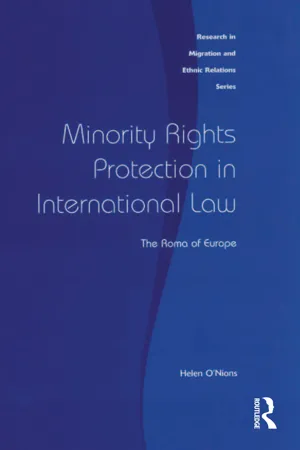
- 344 pages
- English
- ePUB (mobile friendly)
- Available on iOS & Android
eBook - ePub
About this book
There are approximately ten million Roma in Europe, making them the continent's largest non-territorial minority. Despite this fact, the Roma continue to experience routine discrimination and marginalization in European countries. As a result they are seldom engaged in national political activism and are frequently at the bottom of the economic and social ladder. The severity of exclusion experienced by the Roma in societies which have long paid heed to the notion of individual, universal human rights - combined with their geographical dispersal and heterogeneous nature - makes the study of the Roma highly informative. This book examines the theoretical debate concerning the most appropriate way of protecting the fundamental human rights of the Roma, which also illuminates ways in which the rights of minority groups can be protected more generally. As a result, this work will be a valuable resource for social scientists and practitioners in the field of human rights.
Information
Chapter 1
The Treatment of Roma in Europe: A ‘Litmus Test for Civil Society’1
Introduction
While the statement above is concerned predominately with the former Communist states of Europe, it also reflects the difficulties in accommodating this diverse diaspora of people within the new European order that prides itself on showing respect for human rights and democratic values in a secular, individualist paradigm. As a result of the entrenched social, economic and political exclusion, Anna Meijknecht describes the Roma as a people without a future.2 Prejudice is exhibited by the non-Roma (Gadjo3) citizens, media, government officials and law enforcers alike. The Roma activist, Rudko Kawczynski, makes reference to President Havel’s statement in these terms:
We Roma have in the last few years become the measure for the newly created democracies in Europe: so long as those countries are not ready to let go of their anti-Roma policies, they are as far from democratic development as they ever were under their communist regimes. So long as in those countries human rights violations against Roma are a normal occurrence, the resistance to their policies will remain a duty. Without respect for Roma, there can be no democracy in those countries and certainly no open society.4
The problem of anti-Roma prejudice and discrimination while more acutely felt in Central and Eastern Europe, is by no means confined to this region. Indeed, recent inflammatory reports in the British press demonstrate the deep-seated hostility towards Gypsies, particularly those who continue to adopt a nomadic way of life in the face of great adversity. A MORI poll examining patterns of prejudice found that dislike of Gypsies was more common than for any other ethnic group.5 A survey of 1521 eight and nine-year-old Italian children found that of the 60% who expressed fear of crossing open spaces, 32% attributed that to ‘Gypsies, drug addicts and Moroccans’.6
Recent estimates place the Romany/Gypsy population of Europe at around ten million people, making them Europe’s largest minority group.7 Due to their comparatively high birth rate the proportion of Roma in Europe is likely to increase.8 These figures are only estimates and the difficulties of collecting reliable data are immense: particular factors include a reluctance to admit to Roma identity, the disparate nature of Roma communities, fears of discrimination and ghettoisation and the absence of reliable census data in some countries.9 The result is that reliable statistics on the number of Rom and other travelling peoples in Europe are notoriously illusive. In the 1991 Czechoslovak census only 80,000 Slovak people declared themselves to be of Roma origin, the true figure being estimated at 500,000.10 Kertzer and Arel have noted that while census data is seldom reliable it does play a key role in the construction of reality, reflecting minority-majority relations and providing a context for policy.11 In a country with a population of over one million Roma, former President Ceausescu was able to comment: ‘Don’t talk to me about Gypsies, there are no Gypsies in Romania’12 What is clear is that most Roma are living in conditions of poverty and deprivation in some of the richest countries in the world. Ironically, these are countries with multi-ethnic societies that have embraced the principles of democracy and the fundamental importance of human rights for all.
This book aims to examine this level of exclusion in the light of the principal human rights standards and their implementation. Considering TH Marshall’s three concepts of modern citizenship and applying it to three specific situations it becomes apparent that the Roma are denied active ‘citizenship’ at all levels.13 Marshall’s civil dimension focuses on individual freedoms, which are examined in the context of the Czech Republic in Chapter 4. The social dimension is examined in Chapter 5 looking at education policies across Europe and the political dimension of public participation and representation is examined in Chapter 7 with reference to the Hungarian self-government experiment.
The individualistic focus of these standards will be shown as limited in addressing the level of exclusion. An alternative focus recognising group rights of the Roma as a ‘national’ or ‘ethnic’ minority will be critically addressed, as will demands for recognition as a transnational minority group.
Following on from increased international awareness at the plight of the Roma, in 2005 the governments of eight CEE countries launched the ‘Decade for Roma Inclusion’, a 10-year initiative to redress some of these deep-seated problems.14 This development is to be welcomed and it is sincerely hoped that pilot projects will be established, monitored and, where desirable, expanded to real effect. An essential part of the decade is the Roma Education Fund which will provide additional funding for positive education programmes.15
However, this will not mark the end of marginalisation, exclusion and discrimination. As will become very apparent, international and national policies are one aspect of a complex interaction of relationships. All too often initiatives are not pursued at a local level and a concerted, high-profile effort is needed to demonstrate that discrimination against the Roma is neither legitimate nor tolerable in a democratic, civil society.
Origins of Roma in Europe: What’s in a name?
The Roma are one of the oldest surviving minorities in Europe. Linguists16 have demonstrated that the Rom descended from North Indian castes that left to migrate across Europe between 500 and AD 1000.17 The migration across Europe saw their arrival in small groups in Turkey in the eleventh century and by the fifteenth century in Sweden, Germany and Belgium. The first record of their arrival in England is dated 1514, with further movements into Scandinavia in the sixteenth century.18
The name ‘Gypsy’ is derived from the term ‘Egyptian’.19 When Gypsies began to arrive in England from Egypt they were identified as different by the colour of their skin and dress and these were attributed to their Egyptian origins. The term ‘Gypsy’ and associated labels such as ‘Cygani’ and the Spanish ‘Gitano’ can thus be seen as inaccurate and pejorative descriptions.20 The term ‘Rom’ or ‘Roma’ (in the plural) is generally preferred,21 although in British travelling communities ‘Gypsy’ and ‘traveller’ is still the most common form of self-identification.
The European Roma are today a heterogeneous community with many different cultural values as well as linguistic and religious diversity.22 Nevertheless, the common ancestry of the Rom can be used to provide evidence of an underlying core of values and traditions, some of which have since been eroded or altered on account of the need to adapt to the conditions of the host state. Europe’s High Commissioner on National Minorities noted:
… there are significant commonalities perceived as binding the Roma together: commonalities in origin, language, culture, historical experience and present-day problems in the region. In addition to a Romani cultural heritage, including a strongly itinerant tradition that is both the cause and effect of their history, the Roma also share the use (or remembrance) of a common, though highly variant language, also known as Romani or Romanes.23
Furthermore, as Bancroft notes, there is one experience common to almost all Roma and travellers in Europe, namely the degree of discrimination and hostility they face from the rest of society.24 This is possibly the biggest factor in the identification of Roma as a ‘transnational minority’.
Finding an appropriate terminology
Overshadowing much of the debate about the rights of Roma and travelling people is the issue of appropriate terminology. If one is to consider extending human rights protection to those designated Roma or travellers as a minority, a suitable label must be identified. However, it is difficult to find a label which neither depends on the exclusion of certain sub-units nor encompasses a variety of geographically dispersed groups with no common ancestry or traditions. Even amongst English Gypsies, as Thomas Acton has shown, there is considerable ethnic diversity attributed to different historical experiences.25
The ideal situation would be of course to ask each individual whether they would prefer the label Gypsy/Rom/traveller or ‘traditional traveller’ and this would be likely to yield every combination of response. Each of the terms may be seen as problematic for different reasons and the absence of a core group in a geographically defined territory means that such responses will vary depending on the particular host state. Furt...
Table of contents
- Cover Page
- Title Page
- Copyright Page
- Contents
- Acknowledgements
- Chapter 1 The Treatment of Roma in Europe: A ‘Litmus Test for Civil Society’
- Chapter 2 The Protection of Groups in International Human Rights Discourse
- Chapter 3 The Protection of Minorities through Individual Rights
- Chapter 4 Citizenship in the Czech Republic
- Chapter 5 The Education of Roma and Traveller Children: The Development of an Intercultural Pedagogy
- Chapter 6 The Protection of Minorities in International Human Rights Law
- Chapter 7 Extending Collective Rights: The Roma Nation, Self-Determination and Minority Autonomy
- Chapter 8 Conclusion: A Complimentary Approach to Human Rights for Minorities
- Bibliography
- Index
Trusted by 375,005 students
Access to over 1.5 million titles for a fair monthly price.
Study more efficiently using our study tools.
Frequently asked questions
Yes, you can cancel anytime from the Subscription tab in your account settings on the Perlego website. Your subscription will stay active until the end of your current billing period. Learn how to cancel your subscription
No, books cannot be downloaded as external files, such as PDFs, for use outside of Perlego. However, you can download books within the Perlego app for offline reading on mobile or tablet. Learn how to download books offline
Perlego offers two plans: Essential and Complete
- Essential is ideal for learners and professionals who enjoy exploring a wide range of subjects. Access the Essential Library with 800,000+ trusted titles and best-sellers across business, personal growth, and the humanities. Includes unlimited reading time and Standard Read Aloud voice.
- Complete: Perfect for advanced learners and researchers needing full, unrestricted access. Unlock 1.5M+ books across hundreds of subjects, including academic and specialized titles. The Complete Plan also includes advanced features like Premium Read Aloud and Research Assistant.
We are an online textbook subscription service, where you can get access to an entire online library for less than the price of a single book per month. With over 1.5 million books across 990+ topics, we’ve got you covered! Learn about our mission
Look out for the read-aloud symbol on your next book to see if you can listen to it. The read-aloud tool reads text aloud for you, highlighting the text as it is being read. You can pause it, speed it up and slow it down. Learn more about Read Aloud
Yes! You can use the Perlego app on both iOS and Android devices to read anytime, anywhere — even offline. Perfect for commutes or when you’re on the go.
Please note we cannot support devices running on iOS 13 and Android 7 or earlier. Learn more about using the app
Please note we cannot support devices running on iOS 13 and Android 7 or earlier. Learn more about using the app
Yes, you can access Minority Rights Protection in International Law by Helen O'Nions in PDF and/or ePUB format, as well as other popular books in Social Sciences & Sociology. We have over 1.5 million books available in our catalogue for you to explore.