The capacity of human beings to invent, construct and use technical artifacts is a hugely consequential factor in the evolution of society, and in the entangled relations between humans, other creatures and their natural environments. Moving from a critical consideration of theories, to narratives about technology, and then to particular and specific practices, Technofutures, Nature and the Sacred seeks to arrive at a genuinely transdisciplinary perspective focusing attention on the intersection between technology, religion and society and using insights from the environmental humanities. It works from both theoretical and practical contexts by using newly emerging case studies, including geo-engineering and soil carbon technologies, and breaks open new ground by engaging theological, scientific, philosophical and cultural aspects of the technology/religion/nature nexus. Encouraging us to reflect on the significance and place of religious beliefs in dealing with new technologies, and engaging critical theory common in sociological, political and literary discourses, the authors explore the implicit religious claims embedded in technology.
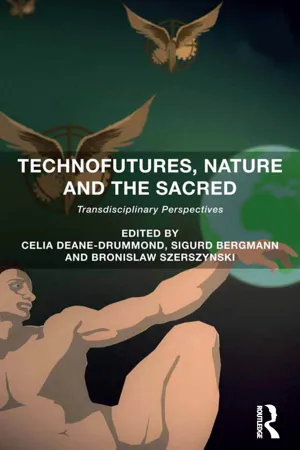
eBook - ePub
Technofutures, Nature and the Sacred
Transdisciplinary Perspectives
- 306 pages
- English
- ePUB (mobile friendly)
- Available on iOS & Android
eBook - ePub
Technofutures, Nature and the Sacred
Transdisciplinary Perspectives
About this book
Information
Theories
Chapter 1
Human Responsibility for Extra-Human Nature: An Ethical Approach to Technofutures
According to a common opinion we human beings, even in the not (yet) industrialised world, live in a technological civilisation and the influence of science and technology is still increasing. Our future, therefore, will be even more permeated by science and technology, and it looks as if there is no alternative. On the other hand, there is a conviction as widespread as the opinion just mentioned that we as human beings have to live and act responsibly, especially in a world increasingly shaped by technology. As the task of philosophy since its very beginnings in ancient Greece has been (and still is) to question opinions and convictions taken for granted, the objective of the following deliberations is to critically scrutinise the development and meaning of both technology and responsibility with respect to their temporal characteristics. In order to do this, I will in a first step reflect on time in general and especially on the future (1). The second step will consist of an ideal-typical reconstruction of the development of technology (2), while the third step will analyse the theoretical framework of the notion of responsibility (3). This then will provide the necessary conceptual background for looking into the pragmatic turn from principle-oriented to applied ethics and thus to human responsibility for extra-human nature which will turn out to be one of the meanings of ‘technofutures’ in the plural tense (4).
Time – A Both Anthropological and Technological Approach
From the point of view of philosophical anthropology, we Western philosophers take for granted that human beings are essentially being defined by time, and we know that time is both happening to and ‘at the same time’ constituted by us in many different respects: we are finite beings, we are mortal, we measure time by constructing all kinds of clocks, and we talk and interact in temporal terms. We also know that within the phenomenological ‘fundamental ontology’ we are nothing but being in time as well as time in being (Heidegger1). In addition, we know that we are always living in the permanent present (‘nunc stans’2), although we also know from a hermeneutical point of view that we are nothing but the result of our past and that this past, in terms of a consciousness of reception history (‘wirkungsgeschichtliches Bewusstsein’3), is always with us, thus defining our humaneness.
There is, however, a certain asymmetry in our existence as temporal beings. Theoretically, we know that there must be something like a direction in time, the ‘arrow of time’, in physics defined by the second principle of thermodynamics, the one-directedness of entropy. As every historian of science and technology knows, this principle is an abstraction and generalisation of a technical insight, that is, an insight into the fundamental principles of a steam engine as first developed by Sadi Carnot and William Thomson, better known as Lord Kelvin.4 So even the very fundamentals of the temporal aspects of physics have been (and still are) technological by nature. The fact that our history of science and technology as a rule is (or at least has been) written from a history of ideas rather than from a history of artefacts point of view has somewhat obscured the strong connection between concepts of time and the development of technology.
This becomes even more obvious when we take into account still another aspect of the asymmetry of time. We usually distinguish between three different extensions (or as the existentialists call them: ‘ekstasies’) of time: the past, the present and the future. At first glance the past, present and future seem to be just different extensions of ever-flowing linear time. But it has been noticed as early as the fourth century B.C. (by Aristotle in his famous sea-battle argument5) that there is a decisive difference between the past and the present, on the one hand, and the future, on the other hand, if we focus on the way we speak about them, that is, according to temporal logic. Strictly speaking only sentences in the past and the present tense do express a truth-value. Sentences in the future tense are neither true nor false unless they have become sentences in the present and the past tense.
If we take an even closer look we then see that this decisive difference corresponds to another difference in terms of modality and quantity: whereas in the present and past tense we speak about present and past reality, sentences in the future tense refer to possibility; consequentially, as far as quantity is concerned, sentences in the future tense, although grammatically pretending to speak about the one future, in fact are speaking about different futures because otherwise they would not speak about possibilities. Or to put it differently, when we intend to speak about the future we in fact speak about different possible futures. In order to congeal the different possible futures into one present (and later on: past) reality, we have to make decisions thus realizing that we are observers, and not just passive, but influential observers, and thus players in the game of time which consists in transforming different possible futures into the one present and later on: past.
Linguistically speaking there are – at least – two different ways of expressing ourselves when we try to talk about this game of time which is both a game of chance and a language game, the rules of which we are shaping ‘as we go along’. We can either use the notions of ‘before – (at the same time) – after’ or the notions of ‘past – present – future’, and John Ellis McTaggart has called the latter sequence ‘A-sequence’ as opposed to the ‘B-sequence’ somehow presupposing that the ‘A-sequence’ is ontologically speaking prior to the B-sequence6 as it is not pretending to be ‘objective’ in the way the B-sequence is.
But what exactly is the difference between the two sequences? Obviously the very notion of ‘present’ is the key which is capable of unlocking the so far still mysterious and secret fabric of time: whereas the B-series ‘before – (at the same time ) – after’ refers to the relation between events only, the A-series (‘past – present – future’) expresses the relation of events to an observer, that is to the presupposed I or We. Only with respect to a given I or We in a given spatio-temporal order does it make sense to call a given event ‘past’, ‘present’ or ‘future’.
But this now is implying something else: if transforming future into present and past by reducing the many possibilities into the one reality requires decisions and if decisions amongst other aspects are characterised by including normative features in our reasoning, it becomes unavoidable to talk about values. By ‘values’ I do not mean substantial entities but preference relations that make decisions possible, regardless of whether or not these are decisions of individuals or of communities. And if we take into account that preference relations are basically governed by what we hope and what we fear, it becomes quite obvious that future as the intentionally fundamental temporal structure at the end of the day is not just dependent on values but also on emotions. By ‘future’ we understand the description of a present that one would like to have or avoid.7 Here, however, we can see the link to both technology and responsibility: ethically speaking, one cannot but be held responsible for the consequences of one’s own actions. Therefore, it is not our knowledge about human and extra-human nature one is responsible for, but the consequences of how one has interfered with human and extra-human nature and thus preserving or changing it, in brief, for the consequences of technology.
Development of Technology
In order to understand such consequences, we have to take a look at technology not only in an affirmative but also in a critical perspective.8 And that requires from a temporal point of view, first of all, an analysis of the development of technology. Contrary to our deeply rooted Platonic prejudices, the idea of a substantialist interpretation of the leading concepts of our tradition is in most cases misleading, most concepts having undergone quite remarkable changes over the centuries. In most cases it is not just one concept, but a whole set or pattern of contextual concepts that has been varying and thus changing. In our case, we have to take a closer look at the conceptual quadruple ‘technology’, ‘human being’, ‘nature’ and ‘culture’. If all of them are still approached in a rather traditional way by considering them to refer to something internally immutable (‘substantia’) with just some changing external characteristics (‘accidentia’), we miss the decisive distinctions in their mutual evolution beginning a next turn of the old pointless ‘quarrel about technology’.9 Therefore, the concepts ‘technology’, ‘human being’, ‘nature’ and ‘culture’ are to be considered as nodes in a network, being defined by its interrelation and interaction with the others: using more or less advanced tools (‘technology’) human beings are changing the human and extra-human nature in order to gain tangible and intangible values; the social and historical aspects of this process is called ‘culture’, which is why technology in actual fact is and always has been identical with or at least closely related to culture.10
In an ideal-typical (Max Weber) reconstruction, four different stages can be distinguished. The first pattern of these four nodal concepts could be called the Judo Type. In struggling with extra-human nature, human beings do not fight the forces of nature by confronting them but by obediently using these forces in a similar way as a judo fighter wins over his opponent by vectorially adding the forces behind the movement of his adversary’s body to his own. Francis Bacon can be called upon as the chief witness for this idea: ‘Natura (…) non nisi parendo vincitur’11 – you cannot win over nature but by obeying its laws. Thus, the early modern human being using technology is homo faber, but homo faber mensura naturae, that is, the human being exploiting nature by following the measure of nature.
With the industrial revolution a new pattern arises which I call the Reproducibility/Profit Type. Due to a (at least partial) mechanisation in manufacturing, technology has become characterised by the commercial exploitation of its products. Thus, identical reproduction of goods results in a new type of production: mass production and hence economy of scale. This again leads to an interchangeability of individual workers and a general ‘de-skilling’.12 This then does have implications concerning the social structure, the culture and of course the self-understanding of human beings: the human being still is homo faber but becomes primarily economically interested: homo faber oeconomicus enters the stage.
As the industrial revolution is being transformed into the scientific technological revolution a new type is emerging which I like to call the White-Coat Type. Science itself becomes a productive power and therefore the image of technology itself is changing: oil-stained fitters with spanners and wrenches in hands are being replaced by ladies and gentlemen in white coats reading off and interpreting highly complex instruments. One of the side effects of this development is the increasing power of the experts: only in very limited areas the technical layperson is capable of fixing broken gadgets. Both scientific technology and the mechanisation of science have progressed to such an extent that the human being as homo faber scientificus at the same time turns out to be homo faber ignorans with respect to the cognitive, technological and social consequences of his/her technical behaviour.
And now, at the wake of the Digital Era, we have reached a pattern that I like to name the Technological Wake-up Call Type. Today the borders between science and technology have been blurred and permeated by the omni-present Information and Communication Technology (ICT) on the one hand; on the other, the technocratic dream of an ongoing improvement and domination of the world by technology is being questioned as the most recent examples of Social Media and of lacking data security are strikingly demonstrating. A reflexive turn is taking place in science and technology as well as in society. A movement which seemed to be dying is suddenly reanimated: the reflection on unintended negative side effects of the development and application of new technologies, we are witnessing a renaissance of Technology Asses...
Table of contents
- Cover Page
- Title Page
- Copyright Page
- Contents
- List of Figures and Tables
- Notes on Contributors
- Acknowledgements
- Introduction
- PART I THEORIES
- PART II RELIGIOUS NARRATIVES
- PART III PRACTICES
- PART IV SYNTHESIS
- Bibliography
- Index
Trusted by 375,005 students
Access to over 1.5 million titles for a fair monthly price.
Study more efficiently using our study tools.
Frequently asked questions
Yes, you can cancel anytime from the Subscription tab in your account settings on the Perlego website. Your subscription will stay active until the end of your current billing period. Learn how to cancel your subscription
No, books cannot be downloaded as external files, such as PDFs, for use outside of Perlego. However, you can download books within the Perlego app for offline reading on mobile or tablet. Learn how to download books offline
Perlego offers two plans: Essential and Complete
- Essential is ideal for learners and professionals who enjoy exploring a wide range of subjects. Access the Essential Library with 800,000+ trusted titles and best-sellers across business, personal growth, and the humanities. Includes unlimited reading time and Standard Read Aloud voice.
- Complete: Perfect for advanced learners and researchers needing full, unrestricted access. Unlock 1.5M+ books across hundreds of subjects, including academic and specialized titles. The Complete Plan also includes advanced features like Premium Read Aloud and Research Assistant.
We are an online textbook subscription service, where you can get access to an entire online library for less than the price of a single book per month. With over 1.5 million books across 990+ topics, we’ve got you covered! Learn about our mission
Look out for the read-aloud symbol on your next book to see if you can listen to it. The read-aloud tool reads text aloud for you, highlighting the text as it is being read. You can pause it, speed it up and slow it down. Learn more about Read Aloud
Yes! You can use the Perlego app on both iOS and Android devices to read anytime, anywhere — even offline. Perfect for commutes or when you’re on the go.
Please note we cannot support devices running on iOS 13 and Android 7 or earlier. Learn more about using the app
Please note we cannot support devices running on iOS 13 and Android 7 or earlier. Learn more about using the app
Yes, you can access Technofutures, Nature and the Sacred by Celia Deane-Drummond,Sigurd Bergmann,Bronislaw Szerszynski in PDF and/or ePUB format, as well as other popular books in Theology & Religion & Religion. We have over 1.5 million books available in our catalogue for you to explore.