eBook - ePub
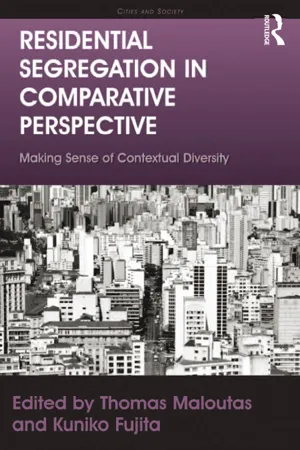
Residential Segregation in Comparative Perspective
Making Sense of Contextual Diversity
- 346 pages
- English
- ePUB (mobile friendly)
- Available on iOS & Android
eBook - ePub
Residential Segregation in Comparative Perspective
Making Sense of Contextual Diversity
About this book
We know very little about variations in urban class and ethnic segregation among nations and even less about differences among cities in different regions of the world. Spatial organization (places and neighbourhoods) matters significantly in some cities in reproducing class relations and ethno-racial hierarchies, but may be much less important in others. The degree and the impact of segregation depend upon contextual diversity. By emphasizing the importance of contextual diversity in the study of urban residential segregation, the book questions currently popular urban theories such as global city, neoliberal urbanism, and gentrification. These theories tend to dissociate cities from their national and regional context and thus ignore their history, culture, politics and institutions. The aim of this book is to introduce the significantly different urban experiences in social and spatial segregation patterns and rationales which exist among the world's regions and to demonstrate that urban theory needs to draw systematically upon this wide range of experiences. The cities selected (Athens, Beijing, Budapest, Copenhagen, Hong Kong, Madrid, Paris, São Paulo, Taipei, and Tokyo) were chosen in order to achieve geographical spread, to maximise the diversity of types of socioeconomic regulation.This volume is thus able to avoid the interpretative limitations and misconstructions resulting from universalizing the Anglo-American experience.
Information
Chapter 1
Introduction: Residential Segregation in Context
Introduction
This book is about the great variety of patterns and trends of social and ethnic segregation in cities nested in different regions of the world. It is also about the limited impact this contextual variety has had on the dominant explanatory schemes in urban theory and about the shortcomings of the latter in making sense of contextually diverse forms of segregation. Its chapters challenge primarily the vision of the dual and polarized city as a fitting description of current socio-spatial divisions in large metropolitan areas around the world and its projection as their unavoidable future under the pressure of capitalist globalization. They challenge, in fact, the depictions and predictions about increasing segregation and spatial polarization founded on essentially mono-causal explanations, such as the social polarization thesis (Sassen 1991), by drawing attention to outcomes and processes that are not in line with, and often contradict, theoretical expectations. By doing so this book brings to the fore the double contextual blindness of such theoretical approaches: blindness in terms of the contradicting empirical evidence from diverse contexts; and blindness due to their implicit attachment to specific contexts. Contextual blindness in the latter sense is not new. It is an issue with early approaches and tools of segregation research as well. Since, the major theoretical assumptions—old and new—about segregation were formulated in the US and, to a much lesser extent, in the UK, the focus of this book lies outside the Anglophone world, seeking to avoid the interpretative limitations and misconstructions resulting especially from universalizing the American experience.
Residential segregation no longer attracts interest as an independent issue, but mainly as part of urban social changes related to the post-industrial metropolis and the globalization era. According to Hamnett (2001: 163–4) interest in segregation declined with David Harvey and radical geography and reappeared with William Julius Wilson and the underclass debate and, further, it shifted from segregation patterns to conceptions of duality in world/global cities. The strongest theoretical assumptions involving segregation are certainly related to the world/global city model (Friedman and Wolff 1982, Sassen 1991, Knox and Taylor 1995, and in more nuanced terms Mollenkoprf and Castells 1991, Fainstein et al. 1992) produced by global forces unleashed by neoliberal deregulation. The social polarization thesis (Sassen 1991) is probably the most direct claim about the relation between social and spatial trends: Social polarization is the assumed outcome of economic restructuring for global cities, which become the strategic spaces for global capitalist management; this role entails the rapid development of high-end producer services that generate high profile and highly paid jobs and attract a highly skilled workforce from all over the world. The growth of the upper occupational pole is complemented by the simultaneous growth of menial jobs related to the low level tasks in the expanding sector of producer services, but also in the service of the expanding occupational elite, while the loss of secure and averagely paid jobs in industry completes the polarization trend by depleting the middle of the social hierarchy. According to Sassen (1991: 251) social polarization leads also to spatial polarization: gentrification, supported by the housing demand for the new occupational elite, and the appropriation of prime space for corporate use, both lead to increased segregation for the lower social strata.
The social polarization thesis endorses the perception of cities as increasingly socio-spatially divided under the changes brought about by globalization that pull away all stops and leave no margin for political intervention. It treats segregation as a simple and homogeneous negative social outcome deriving almost automatically from changes in the socioeconomic structure and does not adequately corroborate its theoretical claims by empirical evidence. I claim that both of these shortcomings are, partly at least, related to the contextual blindness of the polarization thesis, which assumes general validity in spite of the contextual attachments to the Anglophone world—and to US global cities in particular—it implicitly carries.
The social polarization thesis has been criticized on many grounds: The lack of corroborating evidence for social polarization in par excellence global cities like London, Paris or Tokyo (Hamnett 1994, Préteceille 1995, Hill and Kim 2000, Fujita 2003, Hill and Fujita 2003); the inadequacy of duality as the essence of socio-spatial division that should be replaced by the more nuanced descriptions and assumption of the quartered or layered city (Marcuse 1989, 2002, Marcuse and van Kempen 2002a: 265–6); the neglected importance of politics and the state, with particular reference to the welfare state (Hamnett 1996, Musterd and Ostendorf 1998, Marcuse and van Kempen 2002, Musterd et al. 2006); its explanatory inadequacy for regional metropolises around the world etc. (Baum 1997, 1999, Wessel 2000, Walks 2001, Vaattovaara and Kortteinen 2003, Maloutas 2007a, Borel-Saladin and Crankshaw 2009).
Other approaches to urban socio-spatial processes and outcomes under conditions of capitalist globalization put much more emphasis on contextual causality. Brenner and Theodore (2002: 353) stress the different pathways that lead to different forms of “actually existing neoliberalism” related to the contextual embeddedness of neoliberal restructuring projects within “a historically specific, ongoing, and internally contradictory process of market-driven sociospatial transformation (...).” Hill and Fujita (2003) insist on the nested structure of urban, national and regional systems that reduce the influence of global forces and contribute significantly in shaping socio-spatial outcomes. Following an institutional approach, adapted to his focus on European cities, Kazepov (2005: 6) stresses the open-ended and path-dependent character of socio-spatial outcomes within different contexts, stemming from processes configured as “a set of alternatives made of constraints and enablements within which individual (or collective) actors can or have to choose.” Swyngedouw et al. (2003) emphasize the local crafting of emblematic urban development projects producing a kind of unexpected expectedness in the outcome of the interaction between global forces and local factors.
Without denying the existence and the importance of global forces that push toward increasing inequality and segregation, the contributions of this book try to illustrate that in cities around the world there are often alternative outcomes. These outcomes are significantly affected by targeted national and local policies in the North and West-European welfare states or the East Asian developmental states; they follow the dynamic of market forces in the transition economies of Eastern and central Europe; they appear as the unintended outcome of policies related to other issues in the clientelist and family-centered regimes in Southern Europe. They also appear related to private housing production structures, which in some cases are too weak to enhance division and sometimes so powerful and centralized that they tend to mitigate the dividing impact of their product in their own business interest. In most cases, these alternative outcomes are largely influenced by processes and structures originating long before the emergence of new global forces, like the local long-lasting social division patterns and the spatially uneven distribution of quality in the housing stock. Contextually varied situations offer different possibilities for policy intervention, and empirical findings show that policy impact in tandem with unintended consequences from policy and business decisions, and inertia in the reproduction of urban structures can seriously impede global forces from leading to “a new spatial order” of increasingly clear socio-spatial division that Marcuse and van Kempen (2002) have not identified across several cities either.
Segregation is a context-bound concept. For this book, context is important in two ways: first, in the form of varied urban settings around the world involving multiple versions of segregation that are not amenable to simple and universal explanations regarding their formative processes, their patterns and their impact; second, as the context-bound, and therefore limited, “shared understanding of reality” (Kazepov 2005: 6) which derives from the binding of the concept of segregation to the context of the US metropolis of the first half of the twentieth century that has to be considered when the concept travels worldwide.
“Context” is used here in a more mundane manner than in Wittgenstein’s or Frege’s philosophical elaborations concerning the (im)possibility of meaning or truth/falsity claims outside the (contextual) frames of propositions. It is mainly used to remind us that expected outcomes deriving from theoretical claims are often contradicted by outcomes whose understanding entails taking into account contingencies not included in theoretical models. Concepts and theories are always context-dependent and the degree of this dependency varies in relation to their specific object. Urban segregation is context-dependent in the sense that its patterns and social impact are determined by the combined effect of mechanisms and institutions involving the market, the state, civil society and the specific and durable shape of local socio-spatial realities. Theoretical models usually take into account part of this interrelation and, to a large extent, disregard the rest. The market is usually privileged as the focus of theoretical constructions with a particular focus on economic restructuring during the last decades.
By “context” this book refers to the specific intertwining of four major spheres: (1) the economic sphere (exchange) that mainly focuses on labor market conditions and on market access to housing; (2) the state sphere (redistribution) that covers housing and public services allocation, and local regulation regimes; (3) the social sphere (reciprocity) that includes social and family networks, churches and other local voluntary organizations. “Context” also extends to (4) the specific and durable shape of local socio-spatial realities, i.e. built environments, social relations inscribed in property patterns, urban histories and ideologies. The three first derive from Polanyi’s (1944) modes of economic integration1 while the fourth involves the physical support of segregation processes and the social relations directly inscribed in it. This understanding of contextual elements is not fundamentally different from the ‘contingencies’ identified by Marcuse and van Kempen (2000a: 266) affecting the impact of global forces on socio-spatial urban forms, and from Hill and Fujita’s (2003) or Kazepov’s (2005: 6–7) elaboration of urban systems’ embeddedness in wider contexts of social, institutional and economic relations.
There should be no question by now whether residential segregation can be adequately de-contextualized and assumptions about it formulated in market—or state-related mono-causal terms or if a less de-contextualized plural causality should rather be adopted. There are two different, but interconnected, ways to proceed with the construction of such a causal plurality. The first is to elaborate on causal mechanisms and processes using a hypothetico-deductive approach; the second is inductive and could rely on building a large database relating contextual features to specific segregation processes and outcomes on the basis of a number of initial theoretical assumptions. This introduction, as well as the city chapters, are steps in both directions.
Definition and Etymology
Segregation indicates the spatial separation of two (or more) population groups; here this separation is understood as residential, but it may also refer to separation in schools, in the workplace, in transportation or in leisure activities. Segregation can vary from complete separation to completely even distribution of population groups in the spatial units of study areas. Highly segregated areas are those where the distribution of population groups is particularly uneven. Although in the recent literature there are attempts to re-focus segregation studies either in terms of effective life experiences (Schnell 2002) or in terms of a simultaneous layering of different activities and functions (Marcuse and van Kempen 2002a: 266) the focus remains on traditional understanding of residential segregation.
The term originates from nineteenth-century genetics and refers to the separation of allelic genes that occurs during meiosis (Mendel’s 1st law). In the early twentieth century the Chicago School drew explanatory inspiration from analogies with the vegetable kingdom and segregation was adopted by human ecology as a metaphor for the residential separation of ethno-racial groups (Park 1936 [1957]). This metaphor subsequently became segregation’s dominant meaning.
The definition of segregation in The Dictionary of Human Geography is very brief—“The residential separation of subgroups within a wider population” (Johnston et al. 1986: 424)—and is followed by references to the degree of segregation and to its measurement techniques using various segregation indices. However, as I will subsequently stress, despite its apparently simple definition, the social and political content of segregation becomes relatively ambiguous; and this is mainly due to the understanding of segregation as exclusively related to the lower social strata and as an unequivocally negative social condition disregarding the complex relations between spatial and social distance, especially across different contexts. Segregation is imbued with connotations—acquired through its long history as a social and political issue and a research object and practice—that continually add new meaning and make this concept rather imprecise.2 It is therefore imperative to start by elucidating how the definition of segregation is operationalized within the practice of segregation research.
The Practice of Segregation Research: Choosing Population Groups and Measurement Techniques
The simple definition of segregation leaves a number of important issues to be resolved through practical decisions, sometimes in ad hoc ways. Such decisions involve the choice of population groups who come under scrutiny or the methods that will be used to quantify the level of segregation and reveal its shape.3 The choices made in terms of these issues add further meaning and reshape the definition of segregation in ways that are not always explicit. In this book we consider mainly segregation research that deals with city-wide patterns and trends; therefore, we focus on quantitative and broad urban area research rather than on localized neighborhood studies that may be appropriate to dissect segregation processes, but often project out of proportion the extreme social condition of particular neighborhoods onto the cities they belong to.4
Population Groups and Spatial Units
Theoretically, all kinds of population groups (ethnic, racial, social, age, …) can be the object of segregation. However, segregation research and literature have focused on groups whose spatial separation created a social and political problem, i.e. on those identified by race or ethnic origin and on social groups, mainly identified by occupational status or income. Racial and ethnic groups have been the primary object for the pioneering segregation studies in the United States, where they continue to constitute the main concern. This focus is related to the context of American cities in the early twentieth century, in which the legacy of the slavery regime and the very important immigrant inflow were regulated through institutionalized discrimination against specific racial and ethnic groups that involved, among other things, their residential segregation. Even though this situation has gradually changed after the Second World War with the high social mobility and desegregation of most immigrant groups, and the progressive abolition of discriminatory legislation, the long established segregation patterns along ethno-racial lines have not been fundamentally reshaped. This is especially striking for hypersegregated5 metropolises, like Chicago or New York, where the index of segregation for African-Americans remained extremely high (over 0.806) until 2000, even though it had slightly decreased after 1980 (Logan et al. 2004).
European cities, on the other hand, are much more homogeneous in terms of ethnic and racial composition (Kazepov 2005, Musterd 2005, van Kempen 2005, Musterd and van Kempen 2009) and have been so during most of the twentieth century; and those that were traditionally varied in terms of ethnicity—especially in Central and Eastern Europe—have usually become homogeneous as a result of wars and ethnic cleansing. Segregation studies in continental European cities, that started developing in the early post-war decades as an export product from the Anglophone world,7 focused on social class as the prime identifier for residential segregation. The UK and the continental European industrial core encouraged immigration toward their Fordist labor markets from former colonies and Southern Europe since the early post-war period. Outside these regions, ethnic and racial minority groups have substantially developed as an important component of cities’ populations during the last decades of the twentieth cent...
Table of contents
- Cover Page
- Title Page
- Copyright Page
- Contents
- List of Figures and Maps
- List of Tables
- Notes on Contributors
- 1 Introduction: Residential Segregation in Context
- 2 Residential Income Inequality in Tokyo and Why it Does Not Translate into Class-based Segregation
- 3 The Impact of Housing Tenure on Residential Segregation in Beijing, China
- 4 Residential Segregation in an Unequal City: Why are There No Urban Ghettos in Hong Kong?
- 5 A Portrait of Residential Differentiation in Taipei City (1980–2010)
- 6 Residential Segregation and Social Structure in São Paulo: Continuity and Change since the 1990s
- 7 Segregation, Social Mix and Public Policies in Paris
- 8 The Solidity of Urban Socio-spatial Structures in Copenhagen
- 9 Residential Segregation in Budapest before and after Transition
- 10 The Limits of Segregation as an Expression of Socioeconomic Inequality: The Madrid Case
- 11 Changing Dynamics of Residential Segregation in Istanbul
- 12 Social Polarization and De-segregation in Athens
- 13 Conclusion: Residential Segregation and Urban Theory
- Index
Trusted by 375,005 students
Access to over 1.5 million titles for a fair monthly price.
Study more efficiently using our study tools.
Frequently asked questions
Yes, you can cancel anytime from the Subscription tab in your account settings on the Perlego website. Your subscription will stay active until the end of your current billing period. Learn how to cancel your subscription
No, books cannot be downloaded as external files, such as PDFs, for use outside of Perlego. However, you can download books within the Perlego app for offline reading on mobile or tablet. Learn how to download books offline
Perlego offers two plans: Essential and Complete
- Essential is ideal for learners and professionals who enjoy exploring a wide range of subjects. Access the Essential Library with 800,000+ trusted titles and best-sellers across business, personal growth, and the humanities. Includes unlimited reading time and Standard Read Aloud voice.
- Complete: Perfect for advanced learners and researchers needing full, unrestricted access. Unlock 1.5M+ books across hundreds of subjects, including academic and specialized titles. The Complete Plan also includes advanced features like Premium Read Aloud and Research Assistant.
We are an online textbook subscription service, where you can get access to an entire online library for less than the price of a single book per month. With over 1.5 million books across 990+ topics, we’ve got you covered! Learn about our mission
Look out for the read-aloud symbol on your next book to see if you can listen to it. The read-aloud tool reads text aloud for you, highlighting the text as it is being read. You can pause it, speed it up and slow it down. Learn more about Read Aloud
Yes! You can use the Perlego app on both iOS and Android devices to read anytime, anywhere — even offline. Perfect for commutes or when you’re on the go.
Please note we cannot support devices running on iOS 13 and Android 7 or earlier. Learn more about using the app
Please note we cannot support devices running on iOS 13 and Android 7 or earlier. Learn more about using the app
Yes, you can access Residential Segregation in Comparative Perspective by Kuniko Fujita, Thomas Maloutas in PDF and/or ePUB format, as well as other popular books in Sozialwissenschaften & Minderheitenstudien. We have over 1.5 million books available in our catalogue for you to explore.