North America's Indigenous population is a vulnerable group, with specific psychological and healing needs that are not widely met in the mental health care system. Indigenous peoples face certain historical, cultural-linguistic and socioeconomic barriers to mental health care access that government, health care organizations and social agencies must work to overcome. This volume examines ways Indigenous healing practices can complement Western psychological service to meet the needs of Indigenous peoples through traditional cultural concepts. Bringing together leading experts in the fields of Aboriginal mental health and psychology, it provides data and models of Indigenous cultural practices in psychology that are successful with Indigenous peoples. It considers Indigenous epistemologies in applied psychology and research methodology, and informs government policy on mental health service for these populations.
eBook - ePub
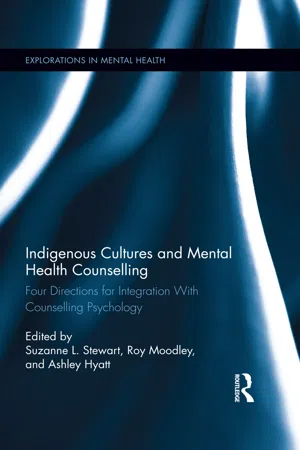
Indigenous Cultures and Mental Health Counselling
Four Directions for Integration with Counselling Psychology
- 238 pages
- English
- ePUB (mobile friendly)
- Available on iOS & Android
eBook - ePub
Indigenous Cultures and Mental Health Counselling
Four Directions for Integration with Counselling Psychology
About this book
Information
Part 1
East
Indigenous Spirituality in Western Psychology
1
Reclaiming Grassroots Traditional Indigenous Healing Ways and Practices Within Urban Indigenous Community Contexts
Prior to our colonization, traditional Indigenous healing practices were carried out organically through grassroots kinship systems of relationship. We can contextualize these systems of relationship as the kinship mutual-aid approach to helping (Waterfall, 2008). Indigenous peoples historically possessed profound knowledges, acquired over countless generations, about living in harmony and balance, counselling, holistic health, medicine, and healing (Baikie, 2009; Coyhis & White, 2006). The training of Indigenous healers and the practices of Indigenous healing modalities were organized through extended family ties. In spite of colonizing impositions, Indigenous healing ways and practices, nonetheless, remain resilient today and can be clearly observed through current grassroots healing practices.
This chapter will speak to two Indigenous healing initiatives that exist within Indigenous grassroots community contexts. 1 Given that we currently reside in Urban centres, these case studies reflect our work within Indigenous urban community contexts. The two case examples refer to Dan and Mary Lou Smoke’s involvement as organizers and members of an Indigenous grass-roots addictions recovery healing circle, and Barbara Waterfall’s and Mary Lou Smoke’s work with the organization of Indigenous women’s drumming and singing circles.
The framework that informs our discussion about traditional urban healing ways and practices employs Indigenous cultural resiliency and postcolonial psychology theories, within an overarching feminist anticolonial prism (cf. Waterfall, 2008). This chapter begins with a brief explication of this dis-cursive framework for practice. We follow this discourse with a discussion of salient Indigenous cosmological understandings about the context and basic premises of Indigenous healing practices. In so doing, the traditional organization of the grassroots approach for helping and healing will be clarified. The chapter will then give a brief portrayal of the social context that we currently work in within our healing practices. Finally, we will speak to two case examples of Indigenous approaches to healing and wellness that are located within grassroots urban Indigenous community contexts. These two case examples speak to the cultural resiliency of the Indigenous kinship approach to healing and helping and to the affirmation that Indigenous grassroots cultural practices are legitimate forms of Indigenous intervention, treatment, and therapy.
Discursive Framework
Dei (2000) contends that the employment of a “discursive” rather than a “theoretical” approach opens up space for the inclusion of ever-changing social realities and questions, as well as for the infusion of multiple Indigenous theoretical practices and perspectives. Influenced by Dei’s work, the framework that informs this discussion is an overarching feminist anticolonial discursive prism (Dei & Asgharzadeh, 2001; Waterfall, 2008) with infused salient Indigenous cultural resiliency (Dumont, Hopkins, Dell, & Menzies, 2014; Heavy Runner & Morris, 1997) and postcolonial psychology perspectives (Archibald, 2006; Wesley-Esquimaux & Smolewski, 2004). A detailed delineation of this framework appears in Waterfall (2008).
A feminist anticolonial stance has been previously defined as the absence of colonial imposition, as the agency to govern our own lives, and as the practice of such agency based upon our ancestors’, women-centred principles of life-giving and nurturance (Wane & Waterfall, 2005). Informed by feminist anticolonial discourse, our entry point for work within Indigenous communities begins by centering the traditional mutual-aid paradigm and traditional healing ways and practices, particularly those that are grassroots initiatives. While it is recognized that there are many understandings about what the term “grassroots” refers to, we define the domain of grassroots activity as that which stems from outside of and independent from the government funding sector.
For purposes of further augmenting the role and importance of the traditional grassroots paradigm, Indigenous cultural resiliency theory is also employed within this discursive framework. Indigenous cultural resiliency theorizing stems from Indigenous grassroots perspectives and presents as a positive and proactive traditionalist stance. Informing practice, this theory presents as a proclamation of the present-day resiliency of traditional Indigenous ways and systems of practice (Heavy Runner & Morris, 1997). Connected to cultural resiliency theorizing is discourse pertaining to the legitimacy of Indigenous cultural practices as intervention, treatment, and therapy. With respect to the addictions recovery literature, this discourse is referred to as culture as treatment (Coyhis & White, 2006; Dumont et al., 2014).
Given that the two grassroots healing initiatives discussed in this chapter have been created in direct response to the Indigenous peoples’ personal and intergenerational responses to colonialism, we infuse within our discursive prism postcolonial psychology theorizing. We acknowledge that the current social problems that exist within Indigenous communities, such as poverty, homelessness, addictions/substance abuse, and violence are the direct consequences of historic and ongoing colonial impositions (Archibald, 2006; Wesley-Esquimaux & Smolewski, 2004). We also conceptualize that the overall impacts of colonialism have created the psychological issues of unresolved historic grief and intergenerational post-traumatic stress and trauma (Wesley-Esquimaux & Smolewski, 2004; Whitebeck, Xiaojin, Hoyt, & Adams, 2004).
The Relationships Between North American Indigenous Cosmologies, the Social Organization of Traditional Indigenous Societies, and Indigenous Healing Practices
Within pre-colonial existences, Indigenous societies were matrifocal and, in some Nations, there was matriarchal governance (Anderson, 2000). In all Nations, women were highly respected, having central and pivotal roles in all aspects of family and community life, inclusive of economic, social, political, and spiritual/cultural activities (Anderson, 2000; Mihesuah, 2003). This understanding is supported by our recorded libraries, or pictographic drawings, as well as by our Elders’ oral teachings (Thunderbird, 2011). Women possessed personal and collective freedoms and powers in these societies, such as the freedom to enter and end intimate relationships of their own choosing, as well as decision-making powers (Anderson, 2000). With respect to the matriarchal, Hau de no sau nee people considered women to be owners of all property (Maracle, 2003). Anderson (2000) contends that women’s centred positioning did not mean that men were excluded, nor were there struggles or competitiveness between genders. Anderson (2000) described that within many Indigenous societies, men’s and women’s positioning was one where each gender had complimentary roles.
Many Nations contextualized human beings’ relationship with the natural ecology as existing within a circular cosmological understanding. This circular cosmology has often been referred to as the Sacred Hoop, or the Medicine Wheel (Nabigon, 2006). Life within the Medicine Wheel understanding is conceptualized as being made up of four distinct areas corresponding to the four cardinal directions of east, south, west, and north; the four seasons of the year of spring, summer, autumn, and winter; the four stages of life from birth, youth, adulthood, and Elder hood, and the four components of self as emotional, mental, physical, and spiritual (White Bison, Inc., 2002).
Traditionally, there is a belief in a Creator of Life, understood to have both female and male traits, as well as a universal creative life force/intelligence within the universe. It is also understood that the Creator of Life exists within all life forms, inclusive of the four elements of the earth, water, air, and fire, as well as rocks, trees, plants, animals, birds, and fish, as examples. Within traditional Indigenous thought, there is a deep respect and reverence for plants and historically, medicinal plants were never used excessively nor abused (Coyhis & White, 2006). As an example, alcohol can be understood to be a medicine derived from plant life. While a few North American Indigenous Nations used alcohol prior to European contact, this substance was never consumed in excessive or abusive ways (Coyhis & White, 2006).
Indigenous peoples commonly understood and understand today that the Creator of Life resides within the heart of every human being. Nabigon, an Oji-Cree Elder’s (2006) depiction of an “inner spiritual fire” supports this standpoint. This fire is deemed the source of our personal power, healing, and renewal, as well as our will or self-determination. From a traditional healing stance, it is understood that the true healer is ultimately the person seeking healing. While overt measures can and are used by traditional healers, such as performing healing ceremonies or directing the person to the use of a healing plant medicine, the underlying objective of any Indigenous healing practice is to assist persons in connecting to and utilizing the majestic power of the Creator, or inner fire, for their own healing (Antone, Miller, & Myers, 1986). As natural conductors of this inner power, human beings are understood to possess innate ways to heal themselves from any form of disharmony or disease, such as talking, crying, or laughing (Nabigon, 2006).
Indigenous methodologies were thus developed to assist people with healing themselves of any form of distress and maintaining harmony, such as employing healing or drumming and singing circles. Pertinent to this discussion is the understanding that the sacred items employed by Indigenous people, such as ceremonial pipes, rattles, and drums are imbued with a specific spirit and possess interconnecting, restorative, and healing qualities. Goudreau, Weber-Pillwax, Cote-Meeks, Madill, & Wilson (2008) assert that the practice of drumming, as an example, was historically an important aspect of Indigenous cultures. Amadahy (2003) argues that Indigenous drum music assisted Indigenous peoples with maintaining an essential peace and unity.
There exists within traditional Indigenous cultures a deep respect for all of life (Nabigon, 2006). It is also believed that human beings’ relationship with all that exists within our universe is one of a “universal system of kinship ties.” Prior to colonialism, our societies were organized along tightly knit extended family lines. Traditional societies were organized to promote peaceful and balanced relations. Traditional ethics, systems, ceremonial practices, and everyday social relations were organized to ensure and maintain a spirit of respectful coexistence with all of creation. For many Indigenous nations, governance and decision making were structured around kinship systems that fostered a consensual paradigm. The purpose of our structures and internal processes were to promote peace and unity among our peoples (Alfred, 2005). From this foundational perspective, it can be understood that all people within a family, community, and nation were responsible for the health and well-being of the people. It is this ethic of being responsible for the people and for future generations that constitutes the axiological foundation from which Indigenous knowledges, systems, and methods of practice originate. Alfred (2005) contends that “reciprocity and mutual obligation were the foundations of (traditional) human interactions and of relationships with other elements in creation” (p. 84). Relating this understanding to Indigenous healing and helping methods, we can contextualize that great Indigenous power can be derived by gathering together and supporting each other collectively. The employment of healing drumming and singing circles were used, and many Nations made use of circular ceremonial practices, such as the sweat lodge, full moon ceremonies, and the sun dance (Anderson, 2000; Hart, 2002; White Bison, Inc., 2002).
Informed by the understanding of “natural law,” 2 traditional life revolved around a preventative medicine. When issues of unrest or unbalance were noticed, it was argued that these issues were immediately attended to (The Truth and Reconciliation Commission of Canada, [TRC], 2015). While it has been noted that in some circumstances abuse of women did exist, there were social structures in place to ensure that this issue was addressed, and there were severe consequences for anyone committing such an offense (Anderson, 2000). Important to this discussion is the understanding that the present-day, government-funded helping systems that are part of Indigenous peoples present-day experiences, did not exist within our pre-colonial history. We did not have soup kitchens, welfare lines, children’s aid societies, battered women’s shelters, addictions treatment centers, or hospitals for psychiatric patients, as examples.
The Current Context of Our Healing Practices
All of the Indigenous people we work with within our healing practices have been impacted in some form by historic and ongoing colonizing forces. It is not within the scope of this chapter to speak to the specifics of how colonialism has been organized or the effects it has had on Indigenous peoples lives. As has been reported by the TRC (2015),
for over a century, the central goals of Canada’s Aboriginal policy were to eliminate Aboriginal governments, ignore Aboriginal rights, terminate the Treaties, and, through a process of assimilation, cause Aboriginal peoples to cease to exist as distinct legal, social, religious, and racial entities in Canada. The establishment and operation of residential schools were a central element in this policy, which can best be described as “cultural genocide.”
(p. 1)
So too have Indigenous feminist scholars portrayed how the combined forces of church and state have actively suppressed Indigenous women’s traditional economic, political, social, and cultural/spiritual powers (Anderson, 2000; Mihesuah, 2003).
It is noteworthy that colonialism is not only that which encompasses our past, but rather is ongoing and reformulating, continuing to impact upon the lives of Indigenous peoples today (Alfred, 2005; Dei & Asgharzadeh, 2001). Alfred (2005) has also argued that the government-funded sector can serve as a force for ongoing reformulating colonizing impositions. A very important understanding about Indigenous peoples relationship to colonization is that in many respects, Indigenous peoples have not been passive victims of oppression. Rather, Indigenous peoples, since early contact, have been actively resisting colonizing impositions and influences, as well as finding creative culturally based responses to combat that oppression 3 (Coyhis & White, 2006).
In our healing practices within our urban communities, we work with women, men, children, and youth from diverse Nations and diverse economic backgrounds. Some of the adults we work with are well educated by Western standards and earn high incomes. Some are teachers, counsellors, administrators, cultural resource people, and/or are serving in leadership roles in our communities. At the other end of the spectrum are people who are newly released from corrections facilities. Also, some are getting away from street life, or are currently living in poverty—subsisting on income assistance. Some are also currently living in, or have recently lived in, abusive conditions. Most of the people we work with have been emotionally, physically, sexually, or spiritually abused at some time in their lives. Many are in recovery from substance abuse, addictions, and/or are dealing with emotional or mental health issues. Some struggle with anger, rage, anxiety, depression, identity confusion, low self-esteem, and post-traumatic stress syndrome. Others have been able to overcome these and other issues, and they offer a breadth of support to our communities through the revitalization of traditional kinship systems of support.
As healers within our communities, we have been most impressed with our people’s will and determination to live balanced, healthy, and productive lives. Many of the people that we serve are able to gain balance and wellness by returning to the trad...
Table of contents
- Cover Page
- Half-Title Page
- Title Page
- Copyright Page
- Table of Contents
- Foreword
- Preface
- Part 1 East: Indigenous Spirituality in Western Psychology
- Part 2 South: Innovative Integration in Psychological Practice
- Part 3 West: Trauma and Contemporary Indigenous Healing
- Part 4 North: Healing Through Western and Indigenous Knowledges
- Biographies
- Index
Trusted by 375,005 students
Access to over 1.5 million titles for a fair monthly price.
Study more efficiently using our study tools.
Frequently asked questions
Yes, you can cancel anytime from the Subscription tab in your account settings on the Perlego website. Your subscription will stay active until the end of your current billing period. Learn how to cancel your subscription
No, books cannot be downloaded as external files, such as PDFs, for use outside of Perlego. However, you can download books within the Perlego app for offline reading on mobile or tablet. Learn how to download books offline
Perlego offers two plans: Essential and Complete
- Essential is ideal for learners and professionals who enjoy exploring a wide range of subjects. Access the Essential Library with 800,000+ trusted titles and best-sellers across business, personal growth, and the humanities. Includes unlimited reading time and Standard Read Aloud voice.
- Complete: Perfect for advanced learners and researchers needing full, unrestricted access. Unlock 1.5M+ books across hundreds of subjects, including academic and specialized titles. The Complete Plan also includes advanced features like Premium Read Aloud and Research Assistant.
We are an online textbook subscription service, where you can get access to an entire online library for less than the price of a single book per month. With over 1.5 million books across 990+ topics, we’ve got you covered! Learn about our mission
Look out for the read-aloud symbol on your next book to see if you can listen to it. The read-aloud tool reads text aloud for you, highlighting the text as it is being read. You can pause it, speed it up and slow it down. Learn more about Read Aloud
Yes! You can use the Perlego app on both iOS and Android devices to read anytime, anywhere — even offline. Perfect for commutes or when you’re on the go.
Please note we cannot support devices running on iOS 13 and Android 7 or earlier. Learn more about using the app
Please note we cannot support devices running on iOS 13 and Android 7 or earlier. Learn more about using the app
Yes, you can access Indigenous Cultures and Mental Health Counselling by Suzanne Stewart, Roy Moodley, Ashley Hyatt, Suzanne Stewart,Roy Moodley,Ashley Hyatt,Suzanne L. Stewart, Suzanne L. Stewart, Roy Moodley, Ashley Hyatt in PDF and/or ePUB format, as well as other popular books in Psychology & Clinical Psychology. We have over 1.5 million books available in our catalogue for you to explore.