eBook - ePub
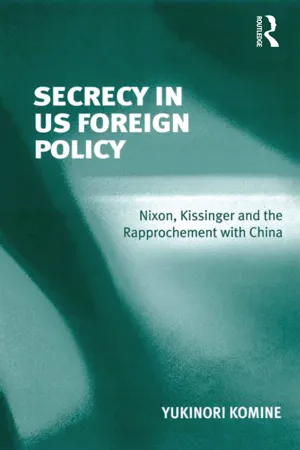
Secrecy in US Foreign Policy
Nixon, Kissinger and the Rapprochement with China
- 300 pages
- English
- ePUB (mobile friendly)
- Available on iOS & Android
eBook - ePub
About this book
Secrecy in US Foreign Policy examines the pursuit of strict secrecy by President Nixon and his National Security Advisor Kissinger in foreign policy decision making in relation to the US rapprochement with China. Moreover it sheds new light on the complexity and dynamism of the evolution of China initiatives and demonstrates the many policy options and perspectives among US officials. Dr Komine focuses on three major elements of the rapprochement: "
Information
The Foundations of Foreign Policy Decision-Making
Chapter 1
The Nixon-Kissinger Leadership for a New China Initiative
The first chapter of Part I begins by investigating both the similarities and differences between Nixon and Kissinger regarding their respective views on US policy toward China. The first half of this chapter examines the development of Nixon’s view on China from the late 1940s to the late 1960s. While maintaining a “cold warrior” public image against the threat of Communist China, Nixon privately spent many years to develop his more pragmatic view to open a new dialogue with the Chinese leaders. The latter half of this chapter analyses the development of Kissinger’s view on the balance of power both in theory and in practice. It also examines how Kissinger developed his view on the China policy. Kissinger sought to exploit the Sino-Soviet rift and enhance US leverage within the US-Soviet-China strategic triangle. Finally, this chapter assesses the Nixon-Kissinger leadership for the opening to China. It was Nixon who set the overall directive for a new China initiative, while Kissinger provided a philosophical framework for the Nixon administration’s foreign policy.
1. Richard M. Nixon as the Architect of US Rapprochement with China
1.1 The development of Nixon’s early view on China
This book perceives Richard Nixon as the architect of the US opening to China. Richard Solomon, a former NSC staff member, and China expert, emphasizes the importance of distinguishing between Nixon as a politician and Kissinger as an academic.1 Nixon had “a lot more exposure to Asia and foreign policy decision-making than Kissinger did.” Solomon argues that because of his life-long involvement in politics, Nixon was an “‘expert’ by virtue of his long-term exposure to China as a political issue.” It is thus important to take into consideration the self-confidence of successful politicians – the ability to understand the political dynamics of the international situation.2
The development of Nixon’s view on China needs to be re-examined within the broader context of change and continuity in the US relations with China. There are three major angles in America’s historical view on China from the mid-19th century to the mid-20th century:
• From an idealistic point of view, to transform China into a friendly nation in Asia,
• From a realist point of view, to re-build China as a central political force to maintain stability in Asia,
• From a commercial point of view, to foresee China as a potentially huge market in Asia.3
The origins of Nixon’s interest in China policy can be traced back to his political career in the late 1940s and the early 1950s.4 During his early career as congressman, Nixon built up his political reputation as a strong anti-Communist cold warrior by criticizing the Truman administration’s “Loss of China” to the Communists.5 It was a result of the establishment of the People’s Republic of China in October 1949, the formulation of the Sino-Soviet alliance in February 1950, the outbreak of the Korean War in June 1950, and Chinese volunteer troops’ entry into the war in October 1950.6 Within the United States, while the pro-Nationalist China Lobby exerted heavy pressure on Congress and influenced public opinion, the State Department was under sharp criticism.7 The United States pursued an open-ended containment policy towards the monolithic threat from Communism without clarifying a distinction between vital and peripheral interests.8 The main elements of US policy toward Beijing during the two decades of mutual hostility were the following:
• Military containment of Chinese Communist expansionism embodied in the renewed support for the Chinese Nationalists on Taiwan, the stationing of the Seventh Fleet in the Taiwan Straits, and the maintenance of a web of military security treaties with non-Communist Asian states.
• Political isolation of the Beijing regime in the international community as reflected in the sustained US effort to keep the People’s Republic of China from membership in the United Nations and associated agencies.
• Economic embargo imposed by the United States on any trade with Communist China.9
During the 1950s, as the Vice President in the Eisenhower administration, Nixon publicly maintained his firm political attitude towards the threat of Communist China. In the late spring of 1953, Nixon took his first official trip to Asia, which became a highly “educational” influence on Nixon’s thinking, establishing the basis of his foreign policy experience.10 In particular, the trip gave him a crucial opportunity to “assess” Asian attitudes toward the “emerging colossus” of Communist China.11 Nixon concluded that Communist China was the “major new and unfathomable factor” in Asia, and that its influence was already “spreading throughout the area.”12 During the NSC meeting on December 23, 1953, Nixon emphasized that there was “very little chance” for the US policy of “containment and economic blockade” of the Beijing regime on the basis of the hope of “overthrowing the government from within instead of from without.”13 Nixon suggested the alternative “to continue the policy of containment and isolation but to allow trade,” which could be a “good cover” without necessarily recognizing Beijing.14 Nixon concluded that although it was important to preserve Formosa [Taiwan] as a “symbol,” the United States should tell Chinese Nationalists that “they can’t go back to the mainland.”15
The US Government publicly maintained its policy of nuclear deterrence against any aggression from Communists.16 On March 17, 1955, Vice President Nixon argued in Chicago that: “tactical atomic weapons are now conventional and will be used against the targets of any aggressive force.”17 During the Taiwan Straits Crises in 1954–1955 and in 1958–1959, Nixon continued to suggest firm response to pressure and contain the expansionism of Chinese Communists. For example, on September 12, 1955, in the National Security Council meeting, Nixon insisted on paying close attention to any sign of miscalculation from Beijing. Nixon suggested that the only practical choice would be to “play poker” in order to “keep the Communists guessing” and to “take a chance on the possible consequences.”18
On the other hand, Vice President Nixon suggested the easing of trade and travel sanctions on Communist China as means of unwinding its political and ideological rigidity. During an NSC meeting on August 18, 1954, Nixon argued that Communist China was “the key problem” for the US policy in Asia.19 Nixon remained cautious, suggesting that any decision to change the policy of containment and isolation towards Communist China “should be postponed for the time being.”20 Nixon presented three specific points to consider: 1) how much the US was willing to trade with Communist China; 2) whether the US would recognize China; and 3) whether and when Communist China would be admitted to the United Nations.21 Nixon claimed that the US would have to face the final decision whether to adopt “a hard or a soft policy” toward Communist China.22 He went on to suggest that the US should explore “an area of action between war and appeasement” because in the long run, the Soviet Union and Communist China “can and must be split apart.”23 Thus, Nixon entered into the policy debate on the possibility of a rift between China and the Soviet Union. Foot argues that Nixon was “less influenced by the ideological tenor” of the Beijing government, and “more concerned about power issues – the balance of power issue – even in those days.”24
During the presidential debate in October 1960, while condemning the Eisenhower-Dulles team for their “brinksmanship” in the Taiwan Strait crises, Democratic candidate John F. Kennedy insisted that the small offshore islands of Quemoy and Matsu were “not strategically defensible” or “essential to the defense of Formosa [Taiwan].”25 Nixon sought to defend the Eisenhower administration’s handling of the offshore island crisis of 1958 by emphasizing that if the United States drew a line at the island of Formosa itself, it would lead to a “chain reaction” of aggression by Chinese Communists.26 On October 13, Nixon emphasized Communist China’s expansionist threat: “Now what do the Chinese Communists want? They don’t want just Quemoy and Matsu. They don’t want just Formosa. They want the world.”27
Importantly, Nixon became “very fascinated with China”: his main concern was the Soviet threat, and his interest in the China issue grew out of the Quemoy-Matsu discussion during the campaign debates.28 Solomon emphasizes the long-term importance of the Nixon-Kennedy debate in 1960 on the Quemoy-Matsu crisis of 1958, which “set off some interesting trends that took over a decade to fully play themselves out.”29
1.2 Changes and developments of the China issue during the 1960s
The development of Nixon’s view on China took place within the context of the gradual development of academic and bureaucratic discussion on relaxation and subsequent reconciliation with Beijing.
From the late 1950s to the early 1960s, a fragmentation emerged in Sino-Soviet relations. One of the major causes of the split was the Soviet attempt to seek détente with the West, which was against China’s anti-capitalist united front strategy.30 Hence, the Chinese were “competing against” the Russians, “making a...
Table of contents
- Cover Page
- Dedication
- Title Page
- Copyright Page
- Contents
- Acknowledgements
- List of Abbreviations
- A Note on Transliteration of Chinese Terms
- Introduction
- PART I THE FOUNDATIONS OF FOREIGN POLICY DECISION-MAKING
- PART II THE EVOLUTION OF THE RAPPROCHEMENT POLICY
- PART III DIRECT TALKS
- Epilogue
- Conclusion
- Appendix
- Bibliography
- Index
Trusted by 375,005 students
Access to over 1.5 million titles for a fair monthly price.
Study more efficiently using our study tools.
Frequently asked questions
Yes, you can cancel anytime from the Subscription tab in your account settings on the Perlego website. Your subscription will stay active until the end of your current billing period. Learn how to cancel your subscription
No, books cannot be downloaded as external files, such as PDFs, for use outside of Perlego. However, you can download books within the Perlego app for offline reading on mobile or tablet. Learn how to download books offline
Perlego offers two plans: Essential and Complete
- Essential is ideal for learners and professionals who enjoy exploring a wide range of subjects. Access the Essential Library with 800,000+ trusted titles and best-sellers across business, personal growth, and the humanities. Includes unlimited reading time and Standard Read Aloud voice.
- Complete: Perfect for advanced learners and researchers needing full, unrestricted access. Unlock 1.5M+ books across hundreds of subjects, including academic and specialized titles. The Complete Plan also includes advanced features like Premium Read Aloud and Research Assistant.
We are an online textbook subscription service, where you can get access to an entire online library for less than the price of a single book per month. With over 1.5 million books across 990+ topics, we’ve got you covered! Learn about our mission
Look out for the read-aloud symbol on your next book to see if you can listen to it. The read-aloud tool reads text aloud for you, highlighting the text as it is being read. You can pause it, speed it up and slow it down. Learn more about Read Aloud
Yes! You can use the Perlego app on both iOS and Android devices to read anytime, anywhere — even offline. Perfect for commutes or when you’re on the go.
Please note we cannot support devices running on iOS 13 and Android 7 or earlier. Learn more about using the app
Please note we cannot support devices running on iOS 13 and Android 7 or earlier. Learn more about using the app
Yes, you can access Secrecy in US Foreign Policy by Yukinori Komine in PDF and/or ePUB format, as well as other popular books in Politics & International Relations & Politics. We have over 1.5 million books available in our catalogue for you to explore.