- 256 pages
- English
- ePUB (mobile friendly)
- Available on iOS & Android
eBook - ePub
About this book
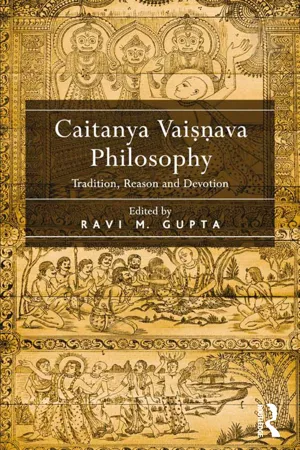
In the sixteenth century, the saint and scholar Sri Caitanya set in motion a wave of devotion to Krishna that began in eastern India and has now found its way around the world. Caitanya taught that the highest aim of life is to develop selfless love for God Krishna, the blue-hued cowherd boy who spoke the Bhagavad Gita. Although only a handful of poetry is attributed to Caitanya, his devotional theology was expounded and systematized by his followers in a vast array of poetical, philosophical, and ritual literature. This book provides a thematic study of Caitanya Vaishnava philosophy, introducing key thinkers and ideas in the early tradition, using Sanskrit and Bengali sources that have seldom been studied in English. The book addresses major areas of the tradition, including epistemology, ontology, aesthetics, ethics, and history, and every chapter includes relevant readings from primary sources.
Information
AESTHETICS
An Ocean of Emotion: Rasa and Religious Experience in Early Caitanya Vaiṣṇava Thought
Though according to established doctrine (siddhānta), there is no difference between the essential nature (svarūpa) of the Lord of Śrī [Nārāyaṇa] and Kṛṣṇa, rasa reveals Kṛṣṇa to be superior. Such is the nature of rasa.1
That Kṛṣṇa, the charming youth who herds cows in Vṛndāvana, is none other than Nārāyaṇa, the omnipotent, majestic Lord of Śrī, the goddess of wealth, is accepted by all Vaiṣṇava schools. That he is superior is one of the central teachings of the Bhāgavata Purāṇa and the cornerstone of Caitanya Vaiṣṇava theology, but is also more contested in Vaiṣṇava circles. What exactly is the basis for such a claim?
In this verse from the Bhakti-rasāmṛta-sindhu (“The ambrosial ocean of devotional rasa”), Rūpa Gosvāmī, the most influential theologian of the school, highlights one of the main characteristics of theological thought in the Caitanya tradition. Though reasoning and theology have their place and are indispensable for spiritual aspirants, it needs to make room for experience and emotions. Rūpa’s theology, while rigorously systematic and vigorously analysed, is attempting to provide the theoretical framework for a very subjective and experiential goal. Devotion (bhakti) is his central concern, and he analyses the dynamics of its emotions in great detail, borrowing extensively from Sanskrit aesthetic theories. But for Rūpa, and indeed for the Caitanya tradition, devotion is more than an emotion. It is a state of being that translates into action, and leads to a state of divine absorption in which God alone can be fully known.
As the above verse highlights, the Caitanya Vaiṣṇavas teach a “polymorphic monotheism,” to borrow a term from Julius Lipner.2 God manifests himself in various forms, “like a thousand rivers flowing from a lake” according to the Bhāgavata.3 He is Brahman, the ground of all being, and interacts with his creation as the inner controller, the Supreme Self (paramātmā). He is Bhagavān, the personal, divinely embodied deity, and assumes various forms as he wills. These are all elaborately described in the tradition’s theological writings and its sacred texts. These texts are the primary source of knowledge (pramāṇa) about the nature of God, as they deliver us its established doctrine (siddhānta). But Rūpa emphasizes that these many forms of God are established not merely through rational deliberation and scriptural study, but above all through the experience generated by spiritual practice. As he writes in the Laghu-bhāgavatāmṛta (“The concise essence of the Bhāgavata”), a work almost entirely devoted to the nature of God:
In the Lord exist numerous forms, which manifest to their worshippers in accordance with their worship (upāsanā). Just as a object like milk always possesses attributes like colour and taste, and this single object is perceived [differently] by the various faculties—it is white to the eyes, sweet to the tongue—so the Supreme Lord, though one, is perceived variously by [different forms of] worship. Just as only the tongue can perceive its sweetness, and no other [faculty], and just as the eyes and the other senses grasp [only] their own object, so do all other forms of worship that depend on the external senses [only perceive part of God’s attributes]. But devotion, which rests in consciousness, can perceive all these objects.4
Though one can catch a glimpse of God’s nature by a variety of ways, only through devotion (bhakti), which, as we will see later, he defines as a total dedication of oneself and all one’s faculties to God, can God be understood in his completeness, as a personal deity with infinite attributes. But even among those who have experienced God through devotion, there are differences of opinion—is Nārāy...
Table of contents
- Cover Page
- Dedication
- Title Page
- Copyright Page
- Contents
- Author Profiles
- Preface
- Introduction Circling in on the Subject: Discourses of Ultimacy in Caitanya Vaiṣṇavism
- Reading Śrī Caitanya Jokes with Veṅkaṭa Bhaṭṭa: Kṛṣṇadāsa Kavirāja’s Caitanya Caritāmṛta
- Bibliography
- Epistemology and Ontology I Where One is Forever Two: God and World in Jīva Gosvāmī’s Bhāgavata-sandarbha
- Reading The Bhāgavata Purāṇa in Four Verses: Jīva Gosvāmī’s Kramasandarbha
- Bibliography
- Epistemology and Ontology II Caitanya Vaiṣṇavism on Trial: Continuity and Transformation in the Eighteenth Century
- Reading A Pearl Necklace of Propositions: Baladeva Vidyābhūṣaṇa’s Prameyaratnāvalī
- Bibliography
- Ethics and Practice Caitanya Vaiṣṇava Ethics in Relation to Devotional Community
- Reading The Upadeśāmṛtam of Rūpa Gosvāmī: A Concise Teaching on Essential Practices of Kṛṣṇa Bhakti
- Bibliography
- Aesthetics An Ocean of Emotion: Rasa and Religious Experience in Early Caitanya Vaiṣṇava Thought
- Reading Two Discourses on Rasa
- Bibliography
- Index
Trusted by 375,005 students
Access to over 1.5 million titles for a fair monthly price.
Study more efficiently using our study tools.
Frequently asked questions
Yes, you can cancel anytime from the Subscription tab in your account settings on the Perlego website. Your subscription will stay active until the end of your current billing period. Learn how to cancel your subscription
No, books cannot be downloaded as external files, such as PDFs, for use outside of Perlego. However, you can download books within the Perlego app for offline reading on mobile or tablet. Learn how to download books offline
Perlego offers two plans: Essential and Complete
- Essential is ideal for learners and professionals who enjoy exploring a wide range of subjects. Access the Essential Library with 800,000+ trusted titles and best-sellers across business, personal growth, and the humanities. Includes unlimited reading time and Standard Read Aloud voice.
- Complete: Perfect for advanced learners and researchers needing full, unrestricted access. Unlock 1.5M+ books across hundreds of subjects, including academic and specialized titles. The Complete Plan also includes advanced features like Premium Read Aloud and Research Assistant.
We are an online textbook subscription service, where you can get access to an entire online library for less than the price of a single book per month. With over 1.5 million books across 990+ topics, we’ve got you covered! Learn about our mission
Look out for the read-aloud symbol on your next book to see if you can listen to it. The read-aloud tool reads text aloud for you, highlighting the text as it is being read. You can pause it, speed it up and slow it down. Learn more about Read Aloud
Yes! You can use the Perlego app on both iOS and Android devices to read anytime, anywhere — even offline. Perfect for commutes or when you’re on the go.
Please note we cannot support devices running on iOS 13 and Android 7 or earlier. Learn more about using the app
Please note we cannot support devices running on iOS 13 and Android 7 or earlier. Learn more about using the app
Yes, you can access Caitanya Vaisnava Philosophy by Ravi M. Gupta in PDF and/or ePUB format, as well as other popular books in Philosophie & Histoire et théorie de la philosophie. We have over 1.5 million books available in our catalogue for you to explore.