Advancing work to effectively study, understand, and serve the fastest growing U.S. ethnic minority population, this volume explicitly emphasizes the racial and ethnic diversity within this heterogeneous cultural group. The focus is on the complex historical roots of contemporary Latino/as, their diversity in skin-color and physiognomy, racial identity, ethnic identity, gender differences, immigration patterns, and acculturation. The work highlights how the complexities inherent in the diverse Latino/a experience, as specified throughout the topics covered in this volume, become critical elements of culturally responsive and racially conscious mental health treatment approaches. By addressing the complexities, within-group differences, and racially heterogeneity characteristic of U.S. Latino/as, this volume makes a significant contribution to the literature related to mental health treatments and interventions.
eBook - ePub
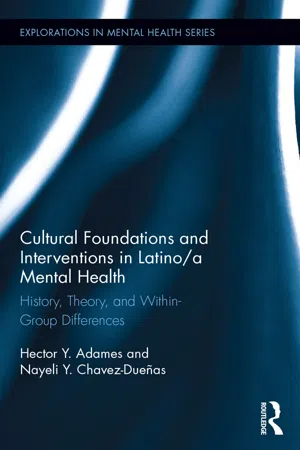
Cultural Foundations and Interventions in Latino/a Mental Health
History, Theory and within Group Differences
- 252 pages
- English
- ePUB (mobile friendly)
- Available on iOS & Android
eBook - ePub
Cultural Foundations and Interventions in Latino/a Mental Health
History, Theory and within Group Differences
About this book
Information
Part I
Sociocultural Foundations
1 The Diverse Historical Roots of Today’s Latinos/as
Learning From Our Past to Move Into the Future
Our people were born dignified and rebellious … Survival, resistance, dignity, and defiance have been the only means of survival.
–Marcos, 2001, p. 33
A fundamental aspect of self-knowledge involves individuals having a strong sense of who they are in two main areas: personal identity and group identity, which undoubtedly shape an individual’s personal history. Personal identity refers to the adoption of idiosyncratic individual attitudes, emotions, feelings, personality characteristics, and behaviors of the self. It involves the process of answering two important questions: “Who am I at the core of my being?” and “What are my personal standards, morals, and values?” (White & Cones, 1999). Alternatively, group identity is defined as the process of learning the collective group history and identifying with a larger social group of people with similar values, characteristics, worldviews, beliefs, and practices.
In the literature, collective group history has been described as having several protective functions for individuals. First, it contributes to the development of a strong sense of group membership, allowing individuals to understand and connect with their ancestral roots and cultural heritage (Parham, Ajamu, & White, 2011). Second, ancestral knowledge, skills, and achievements are transmitted to a new generation and help provide self-affirmation for Youths of Color (Akbar, 1998; White & Parham, 1983; Woodson, 1990). Such knowledge, skills, and achievements also provide Youths of Color with a blueprint with which they can begin to internalize and believe that they have
a legacy of greatness and accomplishment that they are required to continue. It is the images of greatness, which resemble them which serve to inspire young people to become the great scientists, scholars, and artists which continue to fearlessly explore the world and develop new ideas and concepts which advance themselves and the rest of humanity.
(Akbar, 1998, p. 8)
Lastly, collective group history can serve to transmit the acquired immunities or knowledge regarding the successful ways that an individual’s ancestors have used to cope and navigate life’s difficulties, challenges, and transitions (Akbar, 1998).
Overall, knowledge of history is necessary for mental health providers in the therapeutic setting. In fact, mental health practitioners are trained to take a detailed personal history of their clients. The information gathered from the client’s history helps shape how providers understand the impact of past events and experiences on their client’s presenting difficulties and adjustments. This information further provides context regarding the unique ways in which clients discuss and experience problems in daily living, including their mental health symptoms. We argue that in addition to personal history, it is pivotal for mental health practitioners to learn and understand their clients’ collective group histories. Without an integration of both the personal and collective history, clinicians would be left with a fragmented and incomplete view of their clients. Unfortunately, while many providers receive training that helps them to understand their clients’ personal histories, many lack knowledge regarding the collective group histories of the clients they serve.
In an effort to help address the gap in training, this chapter aims to assist mental health providers and researchers studying or working with Latinos/as become familiar with the collective group history of this racially and culturally diverse population. The chapter begins with a brief review of the history of the four main Indigenous groups that flourished in the Americas: the Aztecs, Maya, Inka, and Tainos/Caribs. A description of the legacy of each Indigenous group and their contributions to contemporary Latin American culture is provided. The devastating effects of the historic periods of the conquest and colonization for Indigenous people and their culture is also discussed, followed by a brief summary of the history of Africans in Latin America. The chapter concludes with recommendations for the integration of collective group history into Latino/a mental health.
The Aztecs
One of the most advanced Indigenous civilizations of the central Valley of Mexico was developed by the Aztecs, people also known as the Mexica (Ferguson, 2000; Meier & Ribera, 1993). The group who later formed the Aztec Empire is believed to have originated in a mythical place called Aztlan. This mythical place is believed to be located in what is today known as the southwest region of the United States (Ferguson, 2000; Meier & Ribera, 1993). Interestingly, in contemporary times, the descendants of the Aztecs are the numerical majority in the southwest, the very same lands where ancestors are believed to have originated from.
According to the legend, the Aztecs migrated south of Aztlan looking for their promised land. After hundreds of years of migration, the Mexica settled in the middle of a muddy island surrounded by water where they eventually built the center of their civilization, which they named Tenochtitlan and which served as their capital. Here the Aztecs built one of the most complex and intriguing civilizations that has ever existed. The capital city of Tenochtitlan had approximately 200,000 to 300,000 inhabitants, making it one of the largest cities of that historical time period (Ferguson, 2000; Meier & Ribera, 1993).
The Aztec civilization thrived and prospered in the central Valley of Mexico, and by the time the Spaniards arrived in 1519, their empire had achieved a vast and remarkably advanced knowledge of technology, architecture, farming, and medicine. They had developed a system of public health, public sanitation, and a sewage disposal unparalleled by any other existing city during that historical era (Ferguson, 2000). The Aztec Empire was also economically successful and had a powerful army, which eventually ruled the majority of other Indigenous groups inhabiting the central Valley of Mexico (Meier & Ribera, 1993). This section provides a brief review on the history of this advanced civilization, including their origins, social organization, and spirituality. The section ends with a brief discussion regarding the contributions of the Aztec civilization to contemporary Mexican and Latino/a culture.
Origins
Mystery and ambiguity mark the history and origin of the Aztec civilization. Such lack of clarity regarding this successful civilization stems from the destruction of important Indigenous records by the Spaniards. Specifically, the Spanish conquistadors, who were unable to understand the complexity and level of advancement achieved by the Aztec civilization, considered native records the works of the devil (Davies, 2001). As a result, during the historic period of the conquest, the Spaniards destroyed all existing records, including the Aztec codices, which pictorially documented information pertaining to the origin, culture, and scientific advances of this civilization (Duran, 1967). Thus what is known today about Aztec history and culture has mainly been compiled from a combination of sources, including depictions found in monuments, in pyramids, and in works of art made by the Aztecs themselves that survived colonization. In addition, historical information passed orally by the Aztecs from generation to generation, research gathered by scholars (e.g., historians, anthropologists, archaeologists), as well as data collected from letters and documents written from the perspective of the Spanish conquistadors contribute to knowledge about the Aztecs. Although information regarding the Aztec Empire and its accomplishments can be more readily identified, less is known about the origin, the culture, and the people who developed such a complex civilization.
As previously stated, the Aztec began their migration from Aztlan approximately in 1111 AD. They traveled south for hundreds of years, following the orders of their God, Huitzilopochtli, eventually reaching a place called Coatepec located near the city of Tula, approximately 40 miles away from what would be their final destination (Davies, 2001; Escalante Gonzalbo, 2010). In Coatepec, the Aztecs commemorated the first New Fire of migration, which marked the beginning of the first 52-year cycle in the ritual calendar of ancient Mexico. Here, in the city of Coatepec, the birth of Huitzilopochtli as a God is believed to have taken place (Davies, 2001). Thus Huitzilopochtli is thought to have been a human leader of the Aztecs prior to their migration from Aztlan. He later became a legend after his death and was declared a God in Coatepec. The Aztecs left Coatepec around 1168 AD and proceeded to their final destination guided by dreams and visions from their God Huitzilopochtli (Davies, 2001; Escalante Gonzalbo, 2010).
Despite the short distance between Coatepec and the central Valley of Mexico, it took the Aztecs hundreds of years to arrive there. They eventually reached a place located about a mile away from Tenochtitlan where the God Huitzilopochtli appeared to one of his priests and told him that they should continue until a “place where you find the cactus plant, with the eagle perched upon it, and give it the name Tenochtitlan” (Davies, 2001, p. 13). The following morning, the Aztecs found the cactus plant with an eagle standing on it eating a snake; it was in this precise magical location, an island surrounded by water, where the Aztecs founded their magnificent city, Tenochtitlan. The Aztecs established themselves in the Valley of Mexico on the New Fifth Fire or the year 1345 (Escalante Gonzalbo, 2010). Although the location reportedly chosen by the God Huitzilopochtli did not seem ideal for the establishment of a civilization, the Aztecs quickly learned how to take advantage of every natural resource available. They eventually became masters of the region surrounding Tenochtitlan.
Social Organization
A rich combination of the traditions, culture, and spiritual beliefs of various Indigenous groups (e.g., Toltecs, Teotihuacanos) formed the Aztec culture. Initially, the Aztecs followed a tribal social organization that eventually transformed itself into an empire with a complex system of social stratification, including a powerful army. At the head of the state was the Tlatoani, whom the Spaniards later called the emperor. Under the Tlatoani were the priests, nobles, merchants, free peasants, and slaves. More specifically, the Aztec society was made up of two main social classes that included the pilli (nobility) and the macehualli (commoners). Each group was further subdivided into social groups with different statuses. At the bottom of the system were servants who have been referred to as “slaves.” However, the concept of slavery for the Aztec was different from how it was later conceptualized by the Europeans. For instance, slavery for them was not based on hereditary and children of slaves were born free members of the civilization. Moreover, it was possible for “slaves” to gain their freedom (e.g., by buying it; Davies, 2001; Escalante Gonzalbo, 2010; Ferguson, 2000).
A particular characteristic of Aztec society was its value and emphasis on the education of its citizens. In fact, for the Aztec people, education was mandatory for everyone regardless of gender and social class. Although the education offered was very similar for all children, they were eventually divided into two different tracks. The first track, called the calmecac, was available to the children of nobility. Noble children received the training and education necessary to become the leaders, doctors, teachers, and priests of the empire. The second track, known as the telpochcalli, was provided to children of the commoners. On the telpochcalli track, children were taught skills necessary to become part of a wide variety of trades (e.g., farmers, merchants, artisans) and gender specific skills (e.g., weaving, hunting), as well as the Aztec culture and religious/spiritual beliefs (Davies, 2001; Escalante Gonzalbo, 2010).
An important part of the Aztec civilization and success was its powerful army with strong warriors who eventually conquered a large territory of the central Valley of Mexico. The Aztecs fought several wars, eventually establishing a triple alliance with the neighboring kingdoms of Texcoco and Tlacopan. This alliance helped the Aztecs gain the stability and power necessary to become the most influential empire in the central Valley of Mexico (Escalante Gonzalbo, 2010). In fact, it has been estimated that at its peak, the Aztec Empire had a population of 10 million people, with each group conquered being forced to pay tribute (e.g., taxes). The taxes paid to the empire by all conquered groups were a significant component of the Aztec economic success, allowing this empire to maintain power for many years thereafter (Davies, 2001; Escalante Gonzalbo, 2010).
Spirituality
Aztec religion was a complex and fascinating mixture of the beliefs and Gods of the many Indigenous groups they had conquered. Overall, the Aztecs were polytheistic with a number of deities being worshiped, including three main Gods: Quetzalcoatl (The Creator), Huitzilopochtli (Sun God), and Tezcatlipoca (The Chief God). The Aztecs were deeply religious and superstitious people whose religion permeated every aspect of their society (e.g., celebrations, holidays, rituals, and sacrifices). One of the main objectives of Aztec spirituality centered on the desire to keep nature in balance to prevent its destructive forces from ending the world (Ferguson, 2000).
Creation of the World
According to the Aztec religion, time was divided into five eras or suns, and during the Aztec era, they were living in the fifth sun. Based on their beliefs, it had taken the Gods five attempts to create the world and each previous world had been destroyed due to conflict among the different Gods. For instance, th...
Table of contents
- Cover Page
- Half-Title Page
- Series Title Page
- Title Page
- Copyright Page
- Dedication
- Table of Contents
- Tables
- Figures
- Foreword: Dr. Patricia Arredondo
- Acknowledgments
- Preface
- Part I Sociocultural Foundations
- Part II Understanding Within-Group Latino/a Differences
- Part III Culturally Responsive and Racially Conscious Clinical Practice With Latinos/as
- Part IV The Impact of Latino/a Psychology on Racially and Ethnically Diverse Students and Professionals
- Index
Trusted by 375,005 students
Access to over 1.5 million titles for a fair monthly price.
Study more efficiently using our study tools.
Frequently asked questions
Yes, you can cancel anytime from the Subscription tab in your account settings on the Perlego website. Your subscription will stay active until the end of your current billing period. Learn how to cancel your subscription
No, books cannot be downloaded as external files, such as PDFs, for use outside of Perlego. However, you can download books within the Perlego app for offline reading on mobile or tablet. Learn how to download books offline
Perlego offers two plans: Essential and Complete
- Essential is ideal for learners and professionals who enjoy exploring a wide range of subjects. Access the Essential Library with 800,000+ trusted titles and best-sellers across business, personal growth, and the humanities. Includes unlimited reading time and Standard Read Aloud voice.
- Complete: Perfect for advanced learners and researchers needing full, unrestricted access. Unlock 1.5M+ books across hundreds of subjects, including academic and specialized titles. The Complete Plan also includes advanced features like Premium Read Aloud and Research Assistant.
We are an online textbook subscription service, where you can get access to an entire online library for less than the price of a single book per month. With over 1.5 million books across 990+ topics, we’ve got you covered! Learn about our mission
Look out for the read-aloud symbol on your next book to see if you can listen to it. The read-aloud tool reads text aloud for you, highlighting the text as it is being read. You can pause it, speed it up and slow it down. Learn more about Read Aloud
Yes! You can use the Perlego app on both iOS and Android devices to read anytime, anywhere — even offline. Perfect for commutes or when you’re on the go.
Please note we cannot support devices running on iOS 13 and Android 7 or earlier. Learn more about using the app
Please note we cannot support devices running on iOS 13 and Android 7 or earlier. Learn more about using the app
Yes, you can access Cultural Foundations and Interventions in Latino/a Mental Health by Hector Y. Adames,Nayeli Y. Chavez-Dueñas in PDF and/or ePUB format, as well as other popular books in Psychology & Clinical Psychology. We have over 1.5 million books available in our catalogue for you to explore.