- 248 pages
- English
- ePUB (mobile friendly)
- Available on iOS & Android
eBook - ePub
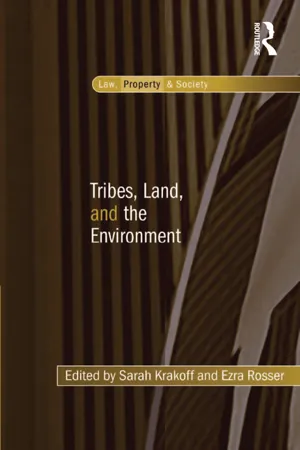
Tribes, Land, and the Environment
About this book
Legal and environmental concerns related to Indian law and tribal lands remain an understudied branch of both indigenous law and environmental law. Native American tribes have a far more complex relationship with the environment than is captured by the stereotype of Indians as environmental stewards. Meaningful tribal sovereignty requires that non-Indians recognize the right of Indians to determine their own relationship to the land and the environment. But tribes do not exist in a vacuum: in fact they are deeply affected by off-reservation activities and, similarly, tribal choices often have effects on nearby communities. This book brings together diverse essays by leading Indian law scholars across the disciplines of indigenous and environmental law. The chapters reveal the difficulties encountered by Native American tribes in attempts to establish their own environmental standards within federal Indian law and environmental law structures. Gleaning new insights from a focus on tribal land and property law, the collection studies the practice of tribal sovereignty as experienced by Indians and non-Indians, with an emphasis on the development and regulatory challenges these tribes face in the wake of climate change. This volume will advance the reader's knowledge and understanding of these challenging issues.
1 Towards a Trust We Can Trust: The Role of the Trust Doctrine in the Management of Tribal Natural Resources
DOI: 10.4324/9781315549668-2
The political relationship between the federal government and the American Indian nations located within the United States is said to be a trust relationship. Under this relationship, also known as the trust responsibility, the Indian nations surrendered some of their sovereignty and acknowledged their political dependence on the United States. In return, the United States undertook a trustee’s duty to protect the tribal land base and guarantee the Indian nations’ right to self-government within this land base.2 Most scholars trace the beginning of the trust doctrine to Chief Justice Marshall’s famous utterance in Cherokee Nation v. Georgia that the relationship between the United States and the tribes resembled that of a guardian to its ward.3 Others, like Mary Wood, have argued that the trust doctrine emerged from the huge land transfers that took place between the United States and the tribes.4 Yet others, like Robert Miller, agree that it originated from land transfers, but trace it to the land transfers that took place as a result of the doctrine of discovery according to which the United States obtained “ultimate title” to all Indian lands.5 Whatever its origins, it seems to have had some pre-constitutional roots, given that the 1787 Northwest Ordinance contained these famous words: “The utmost good faith shall always be observed towards the Indians; their lands and property shall never be taken from them without their consent.”6
The trust doctrine’s uncertain origins have been followed by a long and tortuous path through legal history, which in turn has generated very mixed feelings on behalf of Indian tribes. Thus it is not surprising that recently there have been suggestions from scholars such as Kevin Gover,7 Stacy Leeds,8 and Lincoln Davies,9 among others, that the trust doctrine should be abandoned, or at least seriously modified, especially when it comes to control of Indian natural resources. These scholars take the position that, when it comes to management of the reservations’ environment and control of tribal natural resources, the trust doctrine is anachronistic and a serious impediment to both tribal self-government and economic development. Other scholars, notably Mary Wood, take a much more conciliatory position and advocate the continued use of a vigorous trust doctrine as a means to protect the reservations’ environment from deleterious federal policies and actions by federal officials.10 Finally, others, like Reid Chambers, adopt a middle ground.11 According to Chambers, the major problem with the trust doctrine is that it has been misunderstood. Properly conceived, the trust doctrine should only be viewed as a doctrine to protect and encourage tribal self-government.12 This essay aligns with this latter view, but its main purpose is to lay the legal foundations for such a decolonized trust doctrine and explain its major doctrinal ramifications for the field of Federal Indian law.
One of the problems with the trust doctrine is that there are at least two major conceptions of it. The one first endorsed by Chief Justice Marshall was that the trust relationship between the tribes and the United States is there to protect the continuing existence of tribes as self-governing sovereign entities. Mary Wood has termed this version of the doctrine the “sovereign trust” branch.13 She contrasted that version with one she called the “guardian ward” one. That second version developed during the plenary power or allotment era (about 1880–1930). Its main purpose was to give plenary power to the federal government over Indian land, natural resources, and people, after the treaty era was ended in 1871.14 Through the years, Congress has used, and some may say abused, this power extensively to control and manage the tribes’ natural resources.15 Under this version of the doctrine, the trust arose out of necessity because Indian tribes and people were said to be “weak and defenseless.” Indians as individuals became “wards” of the government because they were considered incompetent to manage their own personal affairs. During that era, the doctrine was transformed from one concerning the political relation between the tribes and the United States to one focusing on the relationship between the federal government and the Indians, as individual wards. The whole idea behind most of the allotment Acts was that the trust period was only temporary and would cease to exist when the wards became competent enough to be assimilated into the dominant mainstream society. This policy was officially abandoned with the enactment of the Indian Reorganization Act of 1934,16 but many of the legal principles adopted during that period were never overturned.17
Because of this conflicting and confusing history, some scholars look at the trust as just a paternalistic doctrine with racist origins that can be and has been used to oppress Indian people. Others, however, make the opposite mistake: they tend to romanticize the trust in that they think that there is a general trust obligation permeating all tribal dealings with the United States and, therefore, the federal government should always be legally and morally bound to act for the benefit of the tribes. This essay does not agree with either version and rather attempts to demystify the trust doctrine by giving a frank evaluation of its usefulness and viability. It first discusses, from a tribal perspective, the pros and cons of the doctrine. It then explains what should be the correct understanding of the doctrine and the ramifications of this understanding concerning the power of Congress over the reservation environment.
The Benefits and Drawbacks of the Doctrine for Tribes
The Benefits
I have identified the trust doctrine’s eight major benefits to tribes. They are ranked here, albeit subjectively, in their order of importance:
- Perhaps the most prominent benefit of the doctrine is that “Trust” lands cannot be taxed by the states. Some lands that were taken out of trust and are now owned by Indians in fee simple are being taxed by the states even though these lands are still in Indian ownership and located within Indian reservations.18 Some Justices, like Justice Thomas, have taken the position that “alienability” means taxability when it comes to Indian land.19
- Another equally important benefit of having land placed into trust is that Indian tribes retain jurisdiction over such lands even if they are located outside Indian reservations. Thus all lands held in trust are defined as being “Indian Country” for jurisdictional purposes.20 The Indian Gaming Regulatory Act, for instance, allows tribes to conduct gaming on lands located outside Indian reservations only if such lands have been taken into trust.21
- Another important benefit is that, because the trust doctrine somewhat enlarges the power of Congress over Indian Affairs under the Constitution,22 it allows Congress more leeway to preempt state law. This is especially important in legislation preempting state law beyond the borders of Indian reservations.23 Legislation such as the Indian Child Welfare Act is a prime example.24
- The fourth benefit is political and not legal. The existence of a general trust relationship between the tribes and the United States can be used by tribes, at least as a moral argument, in their lobbying efforts to persuade Congress to enact legislation enforcing and funding this tr...
Table of contents
- Cover
- Half Title Page
- Title Page
- Copyright Page
- Table of Contents
- Introduction
- 1 Towards a Trust We Can Trust: The Role of the Trust Doctrine in the Management of Tribal Natural Resources
- TRIBAL SOVEREIGNTY AND ENVIRONMENTAL IMPACTS
- TRIBAL LANDS
- TRIBAL ENVIRONMENTAL PROTECTION
- TRIBAL REALISM AND CASE STUDIES
- Index
Trusted by 375,005 students
Access to over 1.5 million titles for a fair monthly price.
Study more efficiently using our study tools.
Frequently asked questions
Yes, you can cancel anytime from the Subscription tab in your account settings on the Perlego website. Your subscription will stay active until the end of your current billing period. Learn how to cancel your subscription
No, books cannot be downloaded as external files, such as PDFs, for use outside of Perlego. However, you can download books within the Perlego app for offline reading on mobile or tablet. Learn how to download books offline
Perlego offers two plans: Essential and Complete
- Essential is ideal for learners and professionals who enjoy exploring a wide range of subjects. Access the Essential Library with 800,000+ trusted titles and best-sellers across business, personal growth, and the humanities. Includes unlimited reading time and Standard Read Aloud voice.
- Complete: Perfect for advanced learners and researchers needing full, unrestricted access. Unlock 1.5M+ books across hundreds of subjects, including academic and specialized titles. The Complete Plan also includes advanced features like Premium Read Aloud and Research Assistant.
We are an online textbook subscription service, where you can get access to an entire online library for less than the price of a single book per month. With over 1.5 million books across 990+ topics, we’ve got you covered! Learn about our mission
Look out for the read-aloud symbol on your next book to see if you can listen to it. The read-aloud tool reads text aloud for you, highlighting the text as it is being read. You can pause it, speed it up and slow it down. Learn more about Read Aloud
Yes! You can use the Perlego app on both iOS and Android devices to read anytime, anywhere — even offline. Perfect for commutes or when you’re on the go.
Please note we cannot support devices running on iOS 13 and Android 7 or earlier. Learn more about using the app
Please note we cannot support devices running on iOS 13 and Android 7 or earlier. Learn more about using the app
Yes, you can access Tribes, Land, and the Environment by Sarah Krakoff, Ezra Rosser,Sarah Krakoff in PDF and/or ePUB format, as well as other popular books in Law & Law Theory & Practice. We have over 1.5 million books available in our catalogue for you to explore.