- 404 pages
- English
- ePUB (mobile friendly)
- Available on iOS & Android
eBook - ePub
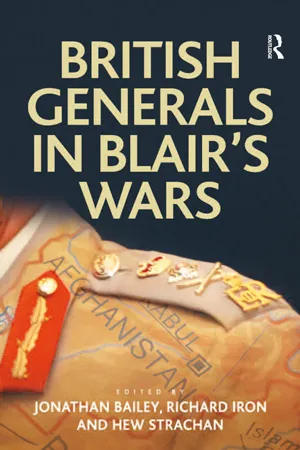
British Generals in Blair's Wars
About this book
British Generals in Blair's Wars is based on a series of high profile seminars held in Oxford in which senior British officers, predominantly from the army, reflect on their experience of campaigning. The chapters embrace all the UK's major operations since the end of the Cold War, but they focus particularly on Iraq and Afghanistan. As personal testimonies, they capture the immediacy of the authors' thoughts at the time, and show how the ideas of a generation of senior British officers developed in a period of rapid change, against a background of intense political controversy and some popular unease. The armed forces were struggling to revise their Cold War concepts and doctrines, and to find the best ways to meet the demands placed upon them by their political leaders in what was seen to be a 'New World Order'. It was a time when relations between the Government of the day and the armed services came under close scrutiny, and when the affection of the British public for its forces seemed to grow with the difficulty of their operational tasks. This is a truly unique and invaluable book. For the first time, we are offered first-hand testimony about Britain's involvement in recent campaigns by senior participants. In addition to touching on themes like civilian-military relations, the operational direction of war and relationships with allies, these eyewitness accounts give a real sense of how the character of a war changes even as it is being fought. It will be essential reading for those in military academies and staff colleges, not only in Britain but throughout NATO, and especially in the USA. It also has profound policy implications, as both the UK and NATO more generally reassess their strategies and the value of intervention operations. It will also become a primary source for historians and students of the wars, in Iraq and Afghanistan in particular.
PART I
Setting the Scene
The British Army that invaded and occupied Basra in 2003 was the child of many experiences. The chapters that follow in this section explore some of the experiences that shaped not just the army but those selected to command it.
It was by no means inevitable that the British Army would be sent to fight in foreign lands that, at first sight, have very little to do with our national interest, or take a lead in international policing alongside the United States. That we did so in Iraq and Afghanistan is partly a result of previous experience, partly because of a renewed political interest in the doctrine of liberal interventionism and partly because of the personality of political leadership. In Chapter 1, Major General Jonathan Bailey explores these issues to establish the political context in which the remainder of this book is set. As he concludes, ‘it was against this political background that a generation of senior British officers was sent off to achieve operational success … by politicians who had launched these campaigns for complex and controversial reasons’.
The 38-year campaign in Northern Ireland was one of the most significant influences on the British Army of the early twenty-first century, starting with the deployment of British troops to Belfast in August 1969, and formally ending in July 2007. It remains the British Army’s longest campaign and has caused it more casualties than any other since the Korean War. Lieutenant General Sir Alistair Irwin is one of a small body of officers whose military career almost exactly mirrors the length of the Northern Ireland ‘Troubles’. He served there at every level of command from second lieutenant to lieutenant general; there can be no better man to reflect on the challenges of command in Northern Ireland. He examines, in Chapter 2, why it was so difficult to establish a campaign plan, describes the difficulties of harnessing all aspects of Government to the fight, and provides a fascinating insight of senior leadership in a complex long-running campaign.
The primary challenge facing the British Army in the later 1990s was peacekeeping as experienced in the Balkans. Caused by the disintegration of post-communist Yugoslavia, the fighting eventually tested the United Nations and the international community’s ability to respond, eventually prompting robust NATO action in both Bosnia and Kosovo. General Sir Michael Jackson commanded a division in Bosnia as part of IFOR (the Implementation Force) and then the corps that formed KFOR (the Kosovo Force) in 1999. It is of this latter experience that he writes in Chapter 3, examining in depth the events that resulted in the deployment of NATO forces into Kosovo. He writes of the need to rebuild a country shattered by war, and of the political tightrope he had to walk between Kosovars and Serbs. He also explains the truth behind the now famous confrontation with his American commander, General Wesley Clark.
Finally in this section, General Sir David Richards (currently the UK’s Chief of Defence Staff) recounts his command of British forces in Sierra Leone in 2000, and how a comparatively small force was able to turn the tide in a country that had been ravaged by war for ten years and was rapidly disintegrating into total chaos. In a decade scarred by Iraq and Afghanistan, he concludes that:
it is too easy to surmise that overseas intervention will always be difficult and expensive; that we will always be resisted by a significant proportion of the local population; and that we will always struggle to adapt to local conditions and find a winning formula. Sierra Leone stands as an important example where overseas intervention was not only justified, it was also successful and, equally importantly, relatively inexpensive.
Chapter 1
The Political Context: Why We Went to War and the Mismatch of Ends, Ways and Means
Clausewitz urged that ‘The first, the supreme, the most far-reaching act of judgement that the statesman and commander have to make is to establish … the kind of war upon which they are embarking.’2 If a nation is to be prepared for conflict, its leaders should ensure they have understood the nature of the mission and the tasks it entails. That understanding should offer the best chance of achieving success, and marshalling the resources to deliver it. However, Clausewitz also described the frictions in military affairs that would make this simple formula difficult to execute.
Politicians provide constitutional authority for the conduct of campaigns, muster the popular support to make them domestically viable, assure their legal justification and secure sufficient international support to share risk and avoid disabling sanction. They provide the means, commensurate with the demands of a campaign, based on their understanding of its nature; and they will be heavily reliant on senior officers of the Armed Forces for professional advice in all of this.
The political decisions to launch the UK’s campaigns of the last two decades were shaped by intellectual trends and shifting cultural assumptions. These also influenced how their nature was understood, and how they were conducted and resourced. Without considering these trends and cultural assumptions, it would be hard to gauge the thinking and experiences of those sent to command these campaigns, whose accounts and insights constitute the core of this book.
It was never the intention that the Campaigning and Generalship seminar series should dwell upon the origins and merits of strategic decision-making; but events since the start of the seminars in 2005, and the furore surrounding those events in public debate and various inquiries, means that these cannot be glossed over here. It is the ongoing strategic controversy, as much as the original strategic decisions, that has added significantly to the complexity of the environment in which commanders have had to operate, and which makes their experiences the more interesting for it.
Ideological Tides and the Evolution of British Policy
Defence Policy: Assumptions and Planning
In 1998, the UK’s new Labour Government produced a Strategic Defence Review (SDR), which marked a significant break from the Cold War’s focus on the European Central Front, and sought to address the UK’s new global interests and challenges. It called for the creation of forces designed to gain rapid success on expeditionary operations, lengthy operations being regarded as undesirable. It was felt such limited operations would allow the UK to ‘punch above its weight’. Otherwise, the UK would have had to fund and create capabilities of a very different and probably unaffordable kind. The danger lay in trying to ‘punch above one’s weight’ against a formidable opponent in a bout that ‘went the distance’. More complex and potentially longer operations were deemed less likely; and the strategic premises upon which actual capabilities were built were, to an extent, reverse-engineered to align with what was preferred and affordable – expeditions in which British forces would be ‘first in, first out’.
The UK’s Ministry of Defence (MOD) was given Defence Strategic Guidance (DSG) based on the SDR, and Defence Planning Assumptions (DPAs) were derived from this guidance. The DPAs explained the concepts, force structures, equipment and the overall capabilities required to meet those assumed tasks. Such tasks appeared in the Defence Planning Directory. Contingency planning was thus shaped by foreign policy objectives; but the formulation of foreign policy and much of its execution have often proved to have been the jealous preserve of the Prime Minister more than of the Foreign Secretary. Under a Prime Minister with a keen interest in foreign policy, less inhibited by departmental strategy, it was easy for foreign policy to move sharply in a different direction from that upon which the DSG and DPAs were premised.
Meanwhile, the British constitution was undergoing rapid modification with the decline of cabinet government and the concentration of defence and foreign affairs in the Office of the Prime Minister, a quasi ‘White House’. The second dominant figure in shaping defence policy and military capability was arguably the Chancellor of the Exchequer, more so than the Defence Secretary, the latter having to persuade the Chancellor of the justification for all planned expenditure.3
The SDR of 1998 was not costed, and the strategic developments that were actually to transpire were apparently discounted. There had even been talk of a new ‘ten-year rule’4 which would have cut further the equipment judged necessary for ‘high-intensity’ conflict. What was not foreseen was an immediate need for a major re-equipping of the Army for high-intensity conflict of another prolonged sort.
Concurrently with designing military forces for rapid, decisive action and effects, an idea was growing with implications of another sort: Britain’s foreign policy was to be an ethical one, supported by armed forces which thereby became ‘a force for good’, establishing an awkward Gott mit uns connection between their actions and moral rectitude.5
The emerging thinking in the West about ideas and values entailed not merely the possible need to overthrow hostile regimes, but also to ensure their societies be thoroughly reordered to neutralise potential future threats; and to comply with Western norms of democracy, open economies and human rights. It seemed to some that national interest had become diminished in the formulation of foreign policy, replaced by the need to lead on grander global agendas.6
After the al-Qaeda attacks on the USA in 2001, a ‘New Chapter’ was added to the SDR, but there was no assessment of the realistic costs these new risks might entail. A new DSG was produced in 2005, and again in 2008, but neither was costed. The emphasis on ‘values’ that had grown in the late 1990s appeared to be validated by these emerging military threats, some of whose objects seemed, in their own words, to be the very destruction of Western values and way of life.
In the UK, a chasm thus grew between emerging foreign policy goals, the size and focus of the defence budget, and actual military planning; this had profound operational impacts after 2003. From 1990 to 2010, the UK’s defence budget fell as a percentage of GDP, and although the Government of the day asserted it had continued to rise in later years in absolute terms, spending did not keep pace with defence cost inflation. Funding was also insufficient for the campaigns after 2003 as the Armed Forces were not configured or equipped for lengthy, intense campaigns of this type. The defence budget is intended only to prepare armed forces for operations, not to pay for those operations; and between 2004 and 2009 the Government provided about a further £5 billion to meet campaign costs. Whether this funding was adequate became a matter of heated debate, both at home and in theatre.
Political Decision-Making and the Personality of Mr Blair
The key factor in the decisions to launch the campaigns that form the major part of this study was the Prime Minister of the day. Much of the criticism of Mr Blair’s decision to join the Coalition’s invasion of Iraq in 2003 was based on his unusual personality and style of leadership.7 Not all attributed Mr Blair’s failings in this respect to malign calculation, for the more sincere and intense his expression, the more likely he is to be saying something that is not the case. And what makes it worse it that, as the former Lib-Dem leader Paddy Ashdown reflected (from bitter experience …): ‘he always means it at the time’.8 Lord Owen, a former Foreign Secretary, attributed Mr Blair’s political failings to ‘three characteristic symptoms of hubris: excessive self-confidence, restlessness and inattention to detail’.9
Mr Blair seems to have believed that all men of goodwill would share his views and values, rooted in those of the British middle classes to which he belonged. He had difficulty explaining the serious differences of others, except in terms of their ‘extremism’. Today’s apparent, but frequently denied, clash of civilisations is often portrayed in terms of culture, and rights versus denial of rights, whereas in the past it was often portrayed in terms of race, and civilisation versus barbarism. In a bold construction, Mr Blair denied that there was a clash ‘between’ civilisations, rather a clash ‘about’ civilisation.10 This formula obviated any judgemental ‘them’ and ‘us’ dichotomy, for all are in fact ‘we’, presumably all belonging to a single civilisation. The issue, he claimed, is about ‘progress’ versus ‘reaction’; all of ‘us’ being in favour of what ‘we’ term ‘progress’.
‘We’, he said, ‘is not the West. “We” are as much Muslim as Christian, or Jew or Hindu. “We” are those who … believe in openness to others, to democracy, liberty and human rights.’ ‘We’ appears to be those who agree with Mr Blair, although perhaps the majority of mankind would not. His view of the world ignored the fundamental differences between the values of the cultures he cited and the modern Western constructs he would project onto all, conscripting ‘them’ as ‘us’.11Categorising ‘good’ and ‘evil’, ‘progress’ and ‘reaction’ without pondering why others might think differently does not help understanding. This incomplete and Manichean lack of a broader, more complex cultural understanding can set traps in forming foreign policy and understanding the nature of campaigns launched in the pursuit of that policy.
Lord Owen noted the dramatic change in Mr Blair’s position in the years before the invasion of Iraq. In 1998 Mr Blair maintained that, ‘We are not working to bring down Saddam Hussein and his regime. It is not for us to say who should be President of Iraq, however much we might prefer to see a different government in Baghdad.’ Three and a half years later, Mr Blair was unwilling to have a detailed discussion of the subject, ‘… Blair was a very different man from the one I had met over dinner three and a half years earlier’.12 Lord Owen reported a conversation between a concerned senior official and Mr Blair in which the latter suggested, ‘You are Neville Chamberlain, I am Winston Churchill and Saddam is Hitler.’ Lord Owen concluded that ‘[i]t is difficult to conduct a serious dialogue with a leader thinking in this emotional and simplistic way’.13 Dr Owen was concerned that ‘Actor-politicians [Blair] tend to be especially narcissistic – which makes the hero role almost irresistible’, and also that in ‘his view of himself he thinks he is always good. Someone who believes he cannot act badly will also believe they cannot lie, so shading the truth can become a habit.’14
In October 2009, Cherie Blair told an audience at the Cheltenham Literature Festival that decisions such as that to invade Iraq ‘… are not black and white … instead of being 80–20, many of them are actually more like 51–49. When taking those decisions, Tony is able to step back, absorb all the information and then choose.’ She added: ‘He is also very good at then convincing everybody else that it was a 70–30 decision all along. I think it [the Iraq war] was one of those 5149 questions.’15
Many seem to have agreed with Cherie Blair, but were less certain that he was prepared to absorb, let alone ask for, ‘all the information’. Sir Rodric Braithwaite, a former ambassador to Moscow and Chairman of the Joint Intelligence Committee, claimed that Mr Blair ‘. has manipulated public opinion, sent our soldiers into distant lands for ill-conceived purposes, misused the intelligence agencies to serve his ends and reduced the Foreign Office to a demoralized cipher because it keeps reminding him of inconvenient facts … He prefers to construct “foreign policy” out of self-righteous soundbites … ’16
Mr Blair’s reference to God in the formulation of his foreign policy in an interview with Michael Parkinson, on ITV on 4 March 2006, was indicative that conviction had become an important factor in his foreign policy. John Burton, Mr Blair’s constituency political agent, explained, ‘It’s very simple to explain the idea of Blair the Warrior. It was part of Tony’s liv...
Table of contents
- Cover
- Half Title
- Title Page
- Copyright Page
- Table of Contents
- List of Figures and Maps
- Notes on Contributors
- Preface
- Introduction
- PART I SETTING THE SCENE
- PART II HARD LESSONS
- PART III IRAQ 2006–2009: SUCCESS OF A SORT
- PART IV IMPROVING IN AFGHANISTAN
- PART V WHAT HAVE WE LEARNT?
- List of References
- Glossary
- Index
Trusted by 375,005 students
Access to over 1.5 million titles for a fair monthly price.
Study more efficiently using our study tools.
Frequently asked questions
Yes, you can cancel anytime from the Subscription tab in your account settings on the Perlego website. Your subscription will stay active until the end of your current billing period. Learn how to cancel your subscription
No, books cannot be downloaded as external files, such as PDFs, for use outside of Perlego. However, you can download books within the Perlego app for offline reading on mobile or tablet. Learn how to download books offline
Perlego offers two plans: Essential and Complete
- Essential is ideal for learners and professionals who enjoy exploring a wide range of subjects. Access the Essential Library with 800,000+ trusted titles and best-sellers across business, personal growth, and the humanities. Includes unlimited reading time and Standard Read Aloud voice.
- Complete: Perfect for advanced learners and researchers needing full, unrestricted access. Unlock 1.5M+ books across hundreds of subjects, including academic and specialized titles. The Complete Plan also includes advanced features like Premium Read Aloud and Research Assistant.
We are an online textbook subscription service, where you can get access to an entire online library for less than the price of a single book per month. With over 1.5 million books across 990+ topics, we’ve got you covered! Learn about our mission
Look out for the read-aloud symbol on your next book to see if you can listen to it. The read-aloud tool reads text aloud for you, highlighting the text as it is being read. You can pause it, speed it up and slow it down. Learn more about Read Aloud
Yes! You can use the Perlego app on both iOS and Android devices to read anytime, anywhere — even offline. Perfect for commutes or when you’re on the go.
Please note we cannot support devices running on iOS 13 and Android 7 or earlier. Learn more about using the app
Please note we cannot support devices running on iOS 13 and Android 7 or earlier. Learn more about using the app
Yes, you can access British Generals in Blair's Wars by Jonathan Bailey,Richard Iron in PDF and/or ePUB format, as well as other popular books in History & Military & Maritime History. We have over 1.5 million books available in our catalogue for you to explore.