- 144 pages
- English
- ePUB (mobile friendly)
- Available on iOS & Android
eBook - ePub
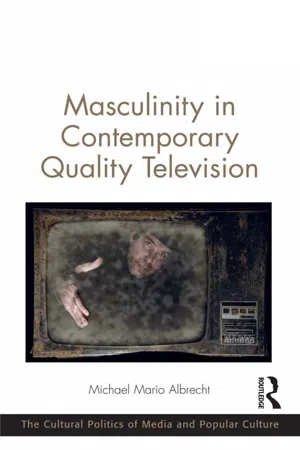
Masculinity in Contemporary Quality Television
About this book
Recent years have seen a rise in the popularity and quantity of 'quality' television programs, many of which featuring complicated versions of masculinity that are informed not only by the women's movement of the sixties and seventies, but also by several decades of backlash and debate about the effects of women's equality on men, masculinity, and the relationship between men and women. Drawing upon studies of contemporary television programs, including popular series viewed internationally such as Mad Men, The League, Hung, Breaking Bad, Louie, and Girls, this book explores the ways in which popular cultural texts address widely circulating discourses of the ostensible 'crisis of masculinity' in contemporary culture. A rich study of masculinity and its representation in contemporary television, Masculinity in Contemporary Quality Television will appeal to scholars and students of cultural and media studies, popular culture, television studies and cultural sociology with interests in gender, masculinities, and sexuality.
Information
Chapter 1 Masculinity in the Obama Era
DOI: 10.4324/9781315594170-2
The story of masculinity has become almost a caricature of itself in the cultural and historical narratives of the years since the Second World War. According to these prevailing narratives, the immediate post-war years saw a strengthening of traditional family ties lead by benevolent but firm patriarchs, and traditional gender norms proliferated. The social movements and the rise of second-wave feminism in the 1960s and 1970s disrupted the family creating a sense of crisis in family structure and of masculinity in general. In Manhood in America (2006), Michael Kimmel notes that “men’s efforts to hold fast to traditional manhood in the wake of the powerful currents of change in the 1970s and 1970s precipitated the contemporary masculine malaise” (169). By the late 1970s, the country had lost its first war, suffered a post-Vietnam “malaise,” and elected a president who wore sweaters and advocated conservation. Thankfully, in 1980 the country elected an honest-to-goodness movie star who rode horses at his ranch and borrowed one-liners from Clint Eastwood. The public flocked to see Stallone and Schwarzenegger at the box office and America was remasculinized. As film scholar Susan Jeffords (1994)explains in Hard Bodies, “Reagan reestablished the boundaries of the presidency, hard bodies reestablished the boundaries not only of the individual masculine figure but of the nation as a whole” (27).
Inevitably, this masculine prowess ended in the 1990s when a country elected an effete Yalie who promised a “kinder, gentler nation,” and then a draft-dodging, pot-smoking man-child for the presidency. This was the era of the “sensitive new-age 90s guy,” and men ran into the woods to find their mythopoetic manhood and cry on each other’s shoulders. Unsurprisingly, this apparent “softening” of masculinity brought about a new “crisis of masculinity,” a discursive strategy that seemingly emerges whenever hegemonic masculinity is called into question. As media scholar Brent Malin (2005) maintains in American Masculinity under Clinton, “these new male heroes embrace their new sensitivity with caution, their cautiousness evidencing anxieties implicit within this era of new masculinity and the contemporary crisis of masculinity” (31). The dream of the nineties died on September 11, 2001, and the country again witnessed a resurgence of macho masculinity. Many saw the events of 9/11 as proof of the feminized sensitive nation—evidence that masculinity had been in crisis. In Washed in Blood (2012), film scholar Claire Sisco King notes that “ostensibly emasculated on 9/11, the American national masculine became aggressive, or berserk, in its wake” (131). Consequently, another traditionally masculine president cleared brush on his ranch, and dressed up and landed on an air carrier while sporting a noticeable codpiece under his jumpsuit. The failure of the markets and a crippling recession (drolly labeled a “he-cession” and a “man-cession”) sparked another crisis in masculinity, and the country elected Barack Obama, a law professor who enjoyed arugula and most certainly did not have a ranch. These broad caricatures of historical eras and their leaders are less useful in identifying the historical truth of the past, but are quite useful in understanding a discursive milieu in which culture emerges and proliferates.
While stumping in Iowa during his first presidential campaign, then-Senator Barack Obama asked a crowd if anyone had been to Whole Foods lately and seen the price of arugula. Obama’s critics pounced on this supposed gaffe, as it demonstrated that the would-be-president was out-of-touch with average Americans, and Obama and the leafy green vegetable have been linked ever since. In addition to painting him as an out-of-touch elitist, Obama’s affinity for arugula supposedly revealed something about his masculinity. The man was hoping to follow in the footstep of a veritable “man’s man” in George W. Bush, a man whose palate was presumably too masculine to enjoy arugula. In a posting for the conservative blog Human Events, Jed Babbin (2008) opined that Obama was suffering from an “arugula gap” with women voters. Babbin muses that “it’s not as if you have to be Teddy Roosevelt to be president. Women, I’d guess, don’t want to vote for Rambo. But they want someone who emits strength of character and inspires confidence rather than the sighs they might have emitted in tenth grade” (“Obama’s Arugula Gap”). He goes on to add that “Obama is suffering from his effete personality […] Obama is an effetenik, a white teacup pinky-in-the-air sort” (“Obama’s Arugula Gap”). In this schema, Teddy Roosevelt stands in synechdochally for the epitome of heterosexual masculinity while consuming arugula assures that one is effete and subsequently does not emit strength or inspire confidence. Obama’s eventual rise to the presidency coincided with the worst financial crisis since the Great Depression; conterminously, popular culture and popular media have reignited discourses suggesting that masculinity as a concept and as a structuring force in society is indeed in crisis.
In this chapter and the book more generally, I focus my analysis on television shows that emerged during the “The Obama Era,” a period between 2007 and 2014, which roughly parallels the candidacy and first five years of Obama’s presidency. This period represents a profound historical and cultural moment; 2008 featured the historic election of Barack Obama as well as the greatest financial crisis in 80 years. The subsequent years have featured a period of slow economic recovery and intense political and cultural rancor. Issues of gender have emerged at the fore of many cultural discourses during the Obama era, and the subject of masculinity has emerged as central in these discourses. The era corresponded to a period in which Quality television enjoyed a tremendous surge, and President Barack Obama has even mentioned some of his favorite Quality television shows. In 2013, The New York Times ran an article entitled “Obama’s TV Picks” in which the president proclaims his affinity for Quality television shows such as Breaking Bad and The Wire (Shear, 2013).
By using popular cultural texts to examine manifestations of masculinity during a specific period, I am building upon and deeply indebted to a wealth of scholars in cultural studies, media studies, television studies, and film studies. Specifically, my book follows chronologically three books that address previous eras: Susan Jeffords’ Hard Bodies, Brenton Malin’s American Masculinity under Clinton, and Claire Sisco King’s Washed in Blood. These three authors offer critical analyses of the Reagan, Clinton, and George W. Bush eras and the complicated ways in which masculinity manifests during those eras. Examining action movies of the 1980s, Jeffords maintains that hyper-masculine representations dominated the Reagan decade. Both the president and the popular culture of the decade point to a remasculinization of the United States, as the US dealt with the decline of manufacturing, an unsuccessful and deadly war, and a corrupt president in the 1970s. In contrast, the 1980s featured larger-than-life male bodies dominating the screen and characterizing the cultural climate of the era. Malin outlines a version of masculinity that is much more nuanced and multivalent in the 1990s; masculinity surfaced as a complicated, conflicting, and often contradictory notion during this time, and the president, Bill Clinton, personified these multiple masculinities and their contradictions. Claire Sisco King examines Hollywood cinema in the first decade of the 2000s, and highlights the ideal of male sacrifice that dominated the George W. Bush presidency and the post-9/11 cultural climate. The “new man” ideal of the 1990s gave way again to a more traditional masculinity structured by a cultural trauma that surfaced after the attacks on 9/11. My analysis picks up the narrative in Obama years; I examine the manifestations of masculinity in contemporary Quality television programs that premiered between 2007 and 2012 and situate those shows within the kinds of cultural narratives laid out by Jeffords, Malin, and Sisco King.
The Obama years immediately follow the Bush years, and the shift in presidential power accompanies broader cultural shifts that are not only the result of shifting economic and political changes but are also personified and embodied in the two men who presided over the eras. Bush represents a hypermasculine rugged cowboy who is decisive to a fault and quick to use military force. Obama is an Ivy League intellectual who deliberates before making decisions and prefers arugula to Bush’s “meat and potatoes.” Mark Shaw and Elwood Watson (2011) explain that “Barack Obama’s masculinity can be framed in stark contrast to the shoot-’em-up cowboy masculinity of the Bush administration. Obama can still talk to the folks without being folksy, or needing to clear brush” (145). He ran for president on a platform of peace, and has—at least ostensibly—worked to decrease the size and scope of US military power during his administration. The Obama years also reflect a period of economic recession and slow economic recovery, an economic downturn that has disproportionally affected men. The bravado-infused masculinity of the Bush years resulted in an anticlimactic ending to two wars and a weak economy that was especially painful to men. These historical and political shifts play out in the narratives of television shows, editorial columns, and critical reviews, while often specifically engaging issues of gender and masculinity.
Obama himself stands in synecdochally for the ostensible crisis and the complicated constructions of masculinity that manifest during the Obama Era. In “Obama’s Masculinities,” Shaw and Watson note that Obama’s performance of masculinity “is full of essential contradictions” (135). They go on to state that “Obama’s contradictory brand of maleness means he does not have to prove his manliness in stereotypical ways” (144). For Shaw and Watson, Obama is able to challenge traditional hegemonic notions of masculinity without having his manhood challenged. However, critics have indeed challenged Obama’s masculine bona fides, especially in his willingness to use violent force or to speak with a bravado that accompanies traditional versions of masculinity. On a 2014 episode of Meet the Press (2014), conservative critic David Brooks worries that foreign countries do not respond well to Obama’s specific version of masculinity. Brooks opines: “let’s face it, Obama, whether deservedly or not, does have a (I’ll say it crudely) but a manhood problem.” NBC correspondent Chuck Todd immediately confirms Brooks’ statement, claiming that members of Obama’s staff are aware of this problem. They question “whether the president is being alpha male enough […] he’s not alpha dog enough. His rhetoric isn’t tough enough.” Thus, because Barack Obama performs a version of masculinity that veers away from the saber-rattling style of his predecessor, his masculinity and subsequently his effectiveness as president becomes a subject of discussion for the men on the panel.
This discussion is apparently salient even though as Chuck Todd explains “they agree with his policy decisions.” In this logic, Obama becomes the subject of critiques from neoconservative critics like Brooks for projecting “soft power” rather than “hard power.” In “Fighting Words,” women’s and gender studies scholar John Landreau (2011) explains that Obama had been praised by many liberal critics, citing “Obama’s appeals to soft rather than hard power, and to his performance of a more democratic, less authoritarian leadership style in the global community.” Landreau goes on to criticize the President for his performance of masculinity, characterizing “both Obama’s national security policies, and his performance of presidential masculinity, in a line of continuity with Bush.” Here, a liberal critic offers a critique of Obama not only for his policy decisions, but also for his performance of masculinity. Discourses about the role of masculinity proliferate in relation to the president as well as in the larger cultural environment in which Obama presides. Critiques of Obama’s masculinity circulate against a larger cultural landscape of masculinity in crisis that re-emerges with the election of Obama and the Great Recession.
Crisis as Performative
Masculinity has ostensibly been in crisis to varying degrees and in different historical formations since the Second World War (and beyond as well). The idea that masculinity is somehow in crisis is so pervasive as to seem commonsensical. Writing in 2009, men’s studies scholar Christopher Forth (2009) argues that “‘crisis’ is perhaps the most common term used to describe the state of masculinity in the West today, with journalists, novelists, sociologists, psychologists, and other scholars in numerous countries offering various accounts of the disquiet which many men have registered in recent years” (6–7). However, as historians of masculinity such as Michael Kimmel and Anthony Rotundo have cogently argued, masculinity has been in crisis in various iterations since the foundation of the United States. In Manhood in America and American Manhood respectively Kimmel (2006) and Rotundo (1993) track the history of masculinity in the US back to the seventeenth century, and variations of the idea of masculinity in crisis have circulated nearly since then.
Forth is correct to assert that the term “masculinity in crisis” is a relatively recent one though the concept has deeper historical roots; however, the notion that something harmful was happening to traditional forms of masculinity and manhood seems to pervade discussions of gender in the US. Since the Second World War—a period that coincides with the proliferation of television as a cultural phenomenon—masculinity has emerged in crisis at multiple moments: “momism” in the 1950s, “peaceniks” in the 1960s, a lost war in the 1970s, and mythopoetic men in the 1990s. To counter, narratives about the 1980s and the first decade of the 2000s feature masculinity as being rescued through action heroes such as John Rambo and Jack Bauer, and hypermasculine presidents in the personage of Ronald Reagan and George W. Bush. These narratives are obviously reductive and myopic; however, they are omnipresent in the televised media landscape and are extraordinarily powerful. As such, sweeping cultural narratives deserve a great deal of scholarly attention as they reflect and shape popular and journalistic understandings about contemporary culture.
Within the broad brushstrokes of these cultural narratives, the Obama Era exists as a moment of masculinity in crisis. The idea that masculinity in indeed in crisis circulates widely in cultural discourses during the Obama Era, but the “crisis” represents a set of cultural anxieties that have emerged repeatedly in since the Second World War. Writing in 2003, communication scholars Karen Ashcraft and Lisa Flores (2003) state that “increasingly, US representations of manhood converge on the claim that masculinity is in the midst of crisis” (2). They go on to state that popular discourses “suggest the broad resonance of this crisis narrative and the perceived need for curative forms of manliness” (2). This cultural resonance towards discourses of crisis has indeed proliferated in US cultural discourses since the Second World War. In “The End of Men, Again,” legal scholar Karen Swanson (2013) attests that the twentieth century contained myriad moments of masculinity in crisis, and avers that “the twenty-first century promises to be no different. Depending on one’s point of view, we remain stricken, gleeful, or obsessed with the perceived loss of male power (28). Through my analysis of masculinity in contemporary US culture, I work to avoid reification of the idea that masculinity is indeed in crisis on an ontological level. Rather, I look at the particular historical moment and examine the ways in which discourses of masculinity and crisis circulate and work to ossify masculinity and to exclude potential alternatives.
Sally Robinson’s analysis of masculinity in crisis provides the theoretical foundations that undergird my analysis. Robinson (2000) takes up Judith Butler’s notion of performativity and applies that to the notion of crisis, providing a version of crisis that is productive and dynamic, rather than one that is ontologically immobile. Robinson neatly tracks different historical moments in which crisis has been deployed. In Marked Men, she posits that “masculinity consistently presents itself in crisis” (11). Butler demonstrates that gender categories such as masculinity are not ontologically stable but are rather effects of iterative performances. Robinson expands this framework to include the relationship between gender norms and crises; if masculinity is a fluid category, then any assertion that it is in crisis is also contingent. Robinson goes further and contends that “the question of whether dominant masculinity is ‘really’ in crisis is in my view moot” (11). Thus, the question for scholars interested in taking up the notion of masculinity in crisis becomes this: In what historical and cultural moments do discourses of masculinity in crisis emerge and to what effects? In this book, I take up the multiple ways in which television shows in the Obama Era have presented masculinity, and the discursive performances of unstable masculinities that circulate within and around those shows.
Robinson goes further in developing her Butlerian framework. For her, “announcements of crisis, both direct and indirect are performative, in the sense that naming a situation a crisis puts into play a set of discursive conditions and tropes that condition the meanings that the event will have. A crisis is ‘real’ when its rhetorical strategies can be discerned and its effects charted” (10). I suggest that mediated representations of masculinity have swung between moments of hypermasculinity and masculinity in crisis, and the meanings attached to masculinity align with dominant cultural narratives about the United States and the ostensible state of its nationhood.
Discourses of crisis imply a diminution of male power and male privilege, but those same discourses can work to rearticulate and reaffirm masculine power. In “The End of Men, Again,” Karen Swanson (2013) notes that “crises of masculinity have served as repeated rallying cries. Instead of harbingers of the end, they have been calls to arms to preserve power and privilege” (35). Communication scholar Andrea Braithwaite (2011) expands upon this in “It’s the Beast Thing.” She writes that “crisis does not necessarily indicate the decline of white male privilege. Representations of a masculinity in crisis often renegotiate rather than relinquish male Power” (419). Quality television shows in the twenty-first century offer a site to renegotiate discourses of masculinity, and in my analysis of the series, I examine the ways in which traditional discourses inform contemporary discourses of masculinity.
The Obama presidency and the Great Recession provide backdrops for examining the ways in which these discourses work to reconfigure and renegotiate gender relations. Toward these ends, I am taking up the call of feminist scholar Tania Modleski (1991) who holds that “we need to consider the extent to which male power is actually consolidated through cycles of crisis and resolution, whereby men ultimately deal with the threat of female power by incorporating it” (7). These discourses circulate broadly across US media culture; further, these discourses work to produce versions of masculinity as they purport to describe it. The versions of masculinity on offer are multifaceted, complex, and often contradictory. These contradictions and complexities drive the narrative of many of the Qu...
Table of contents
- Cover Page
- Half-Title Page
- Title Page
- Copyright Page
- Table of Contents
- Preface and Acknowledgments
- Introduction
- 1 Masculinity in the Obama Era
- 2 The League and the Limits of the Bromance
- 3 Mad Men and Nostalgic Masculinity
- 4 Breaking Bad, Hung, and Masculinity in the Great Recession
- 5 Louie on Louie, and Adam on Girls
- Conclusion
- Works Cited
- Episode List
- Index
Trusted by 375,005 students
Access to over 1.5 million titles for a fair monthly price.
Study more efficiently using our study tools.
Frequently asked questions
Yes, you can cancel anytime from the Subscription tab in your account settings on the Perlego website. Your subscription will stay active until the end of your current billing period. Learn how to cancel your subscription
No, books cannot be downloaded as external files, such as PDFs, for use outside of Perlego. However, you can download books within the Perlego app for offline reading on mobile or tablet. Learn how to download books offline
Perlego offers two plans: Essential and Complete
- Essential is ideal for learners and professionals who enjoy exploring a wide range of subjects. Access the Essential Library with 800,000+ trusted titles and best-sellers across business, personal growth, and the humanities. Includes unlimited reading time and Standard Read Aloud voice.
- Complete: Perfect for advanced learners and researchers needing full, unrestricted access. Unlock 1.5M+ books across hundreds of subjects, including academic and specialized titles. The Complete Plan also includes advanced features like Premium Read Aloud and Research Assistant.
We are an online textbook subscription service, where you can get access to an entire online library for less than the price of a single book per month. With over 1.5 million books across 990+ topics, we’ve got you covered! Learn about our mission
Look out for the read-aloud symbol on your next book to see if you can listen to it. The read-aloud tool reads text aloud for you, highlighting the text as it is being read. You can pause it, speed it up and slow it down. Learn more about Read Aloud
Yes! You can use the Perlego app on both iOS and Android devices to read anytime, anywhere — even offline. Perfect for commutes or when you’re on the go.
Please note we cannot support devices running on iOS 13 and Android 7 or earlier. Learn more about using the app
Please note we cannot support devices running on iOS 13 and Android 7 or earlier. Learn more about using the app
Yes, you can access Masculinity in Contemporary Quality Television by Michael Mario Albrecht in PDF and/or ePUB format, as well as other popular books in Social Sciences & Gender Studies. We have over 1.5 million books available in our catalogue for you to explore.