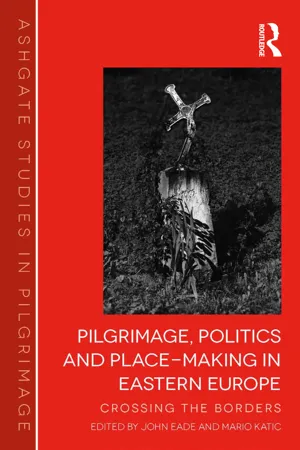
eBook - ePub
Pilgrimage, Politics and Place-Making in Eastern Europe
Crossing the Borders
- 204 pages
- English
- ePUB (mobile friendly)
- Available on iOS & Android
eBook - ePub
About this book
Since the beginning of the anthropology of pilgrimage, scant attention has been paid to pilgrimage and pilgrim places in central, eastern and south-eastern Europe. Seeking to address such a deficit, this book brings together scholars from central, eastern and south-eastern Europe to explore the crossing of borders in terms of the relationship between pilgrimage and politics, and the role which this plays in the process of both sacred and secular place-making. With contributions from a range of established and new academics, including anthropologists, historians and ethnologists, Pilgrimage, Politics and Place-Making in Eastern Europe presents a fascinating collection of case studies and discussions of religious, political and secular pilgrimage across the region.
Information
Chapter 1Introduction: Crossing the Borders
DOI: 10.4324/9781315600505-1
Background
This volume has emerged from a conference held at Zadar, Croatia, in 2012, which brought together those researching religion, politics, tourism and pilgrimage from both eastern and western Europe. The conference was born out of our desire to contribute to the breakdown of boundaries and stereotypes that have been shaped by both linguistic and disciplinary divisions. Here, we bring together scholars from very different nations across eastern Europe to challenge those divisions through explorations of the relationship between pilgrimage, politics and place-making. We see eastern Europe as an ideal area for exploring the relationship between religion and politics, and by focusing particularly on pilgrimage sites – religious and secular, old and new, as well as those which are being de-constructed. We can also study this relationship through the links between past and present. The sites we have chosen are located within nations whose histories are characterized by dramatic political, economic and social change, accompanied in many cases by traumatic conflict and shifting borders. Yet, as the deep divisions of twentieth-century Europe soften, we can now challenge long-standing assumptions about the Other – whether this be other nations, religions, or other regions within a politically changing Europe, such as ‘eastern Europe’, the ‘Balkans’ or the ‘Baltic states’.
We are focusing, after all, on an area where empires unravelled with unexpected speed during the early twentieth century. The revision of territorial boundaries after the First World War had a crucial impact on central and eastern Europe leading to antagonisms which encouraged the next, even more global conflagration in 1939. The defeat of Nazi Germany and its allies resulted in another spate of boundary movement as Stalin moved Poland's borders westwards and supported the creation of a new nation – the German Democratic Republic – at the Oder-Neisse line. The closing of the ‘Iron Curtain’ and the creation of the Berlin Wall were two more radical changes which imposed a sharp division between European countries, which had been linked by centuries of economic and cultural exchange. Not surprisingly, the destruction of the Berlin Wall in 1989 visually signified the more general collapse of the Iron Curtain and socialist political, economic and ideological structures. The eastwards expansion of the European Union, involving the formal entry of the ‘A8’ countries in 2004, Bulgaria and Romania in 2007, and Croatia in 2013, encouraged young people, in particular, to migrate to the West, at least for a time (see Burrell 2009, Black et al. 2010). Membership of the European Union was not seen as an unmixed blessing by some of these migrants and those remaining in their countries of origin (see Eade and Valkanova 2009).
There are encouraging signs that the flows of people, capital, goods, information and images across European borders are not just one way. In the academic sector, West European scholars are building networks with East European colleagues, encouraged by EU funding of the Erasmus exchange scheme and various research programmes. Research centres in former socialist countries, such as the Max Planck Institute for Social Anthropology at Halle/Saale, have also contributed to this breaking-down of intellectual boundaries. However, Chris Hann, the Max Planck Institute's founding director, warns us against painting too rosy a picture of change and mutual understanding. Western scholars have been influenced by long-established stereotypes about eastern Europe, which have been compounded by linguistic boundaries. In the sociology and anthropology of religion, for example, those stereotypes were given intellectual force by the great German pioneer, Max Weber. His understanding of secular modernity and capitalism was firmly linked to the Protestant Reformation and assumptions about the essential mysticism characterizing Orthodox Christianity (Hann 2011: 14). More recent interpretations reproduce the sharp separation in different guises. Charles Taylor, for example, in his influential A Secular Age (2007) brings Protestantism and Catholicism together into ‘a unitary “north Atlantic world”’ and ignores eastern traditions. As Hann notes, the ‘reader is left with the impression that Eastern Christendom is a radically different world’ (ibid.: 12).
Western ignorance has been compounded by a lack of knowledge about research undertaken across eastern and south-eastern Europe on local religious traditions, which has a long history; see, for example, the work of those operating within the ethnology and folklore tradition, such as Lavtižar 1933, Czarnowski 1938, Stabej 1965, Ramovš 1977, Čapo 1991, Belaj 1991, Ramšak 1996 and Psihogiou 1996. Although German universities, in particular, have acted as an important conduit for the dissemination of East European research, their global influence has been restricted by the post-war dominance of English as the global lingua franca, as well as by the power of Anglophone universities and the academic publishing industry in an increasingly globalized market. East European conferences on the sociology and anthropology of religion, ethnology and folklore have been forced to adapt to this shift in academic and linguistic power. Many of their meetings now use English as the main means of communication and we followed suit at the Zadar conference.
Even so, the adoption of English has enabled research on East European pilgrimage to cross territorial and intellectual borders. From the early 1990s, scholars from the East European region have made a significant contribution to this flow through their study of particular religious sites (for example, Vukonić 1992, Jurkovich and Gesler 1997, Buzalka 2007, Sekerdej, Pasieka and Warat 2007, Karamihova and Valtchinova 2009, Niedźwiedź 2010), religious pilgrimage routes and journeys (Jackowski and Smith 1992, Kozlowski 2008), or secular pilgrimages (Belaj 2008; Povedak 2008). They have also contributed to recent edited volumes led by western scholars (Margry 2008, Albera and Couroucli 2012, Hermkens et al. 2009). Awareness among western scholars of pilgrimage in East Europe has increased since 1989, partly through studies by western scholars of religion or some other segment of the culture (Duijzings 2000), or particular religious shrines (Bax 1995, 2000, Claverie 2003, Bowman 2010). Chris Hann and Hermann Goltzin in their edited volume, Eastern Christians in Anthropological Perspective (2010), have also helped to bring pilgrimage research within more general discussions of religious processes across eastern Europe, while studies by Kormina (2004, 2010) and Rock (2007) on pilgrimage and popular religion in Russia have shown us the danger of simply shifting stereotypes and boundaries further east.
Interestingly, there still appears to be a certain reluctance to examine the contemporary relationship between pilgrimage, politics and place-making in western Europe. Admittedly, attention has been paid to the contested nature of pilgrimage, especially by anthropologists, but even here the emphasis has often been on the play of power and resistance at the shrines themselves rather than in relation to secular political institutions. The more open route of the camino to Santiago de Compostela has encouraged researchers to look beyond particular sacred sites and to the interplay of religious and secular processes. Frey (1998), for example, has explored the multifarious religious and non-religious motivations among those using the various routes while attention has also been paid to the involvement of political institutions in Spain and Brussels and the economic forces at play (Plasquy 2010). Until the recent publications by Jansen and Notermans (2012) and Fedele (2013), the most effective analyses of the imbrication of religious, political and economic processes had been produced by those discussing the relationship between pilgrimage and tourism (Badone and Roseman 2004, Timothy and Olsen 2006), or the emergence of a particular shrine such as Lourdes (Harris 1999, Kaufman 2005, Claverie 2008). The relationship between contemporary European pilgrimage and politics has been largely studied outside western Europe in eastern and south-eastern Europe (Dubisch 1995, Bax 1995, 2000, Duijzings 2000, Belaj 2008), or far beyond the region (see Sax 1991, Bianchi 2004, Reader 2006).
This Volume
The substantive chapters in this volume are grouped into three parts. In Part I, Chapters 2 and 3 consider the role played by pilgrimage in creating new homes or reclaiming old ones. Hence, in Chapter 2, Mario Katić examines the development, and re-creation of a Bosnian pilgrimage shrine. He explores the Catholic Church's relationship towards the people, in particular, and its influence on the creation and preservation of Bosnian Croat identity through the building of a new national shrine – Kondžilo. This process of place-making involves the materialization of symbols in the landscape in order to project an image and communicate a story about the Bosnian Croat struggle and the need for national unity. Drawing on his own research and experience as a participant in the pilgrimage, he shows how building a shrine and creating new places in the sacred landscape of Kondžilo affects pilgrims, not only in terms of their religious practices and pilgrimage experiences, but also through their sense of belonging to a particular ethnic community. He shows how the Church seeks to materialize its role and influence in that community by leaving a permanent stamp on physical space. Through the building and rebuilding of the Kondžilo shrine, the Church asserts the permanent presence of Croats in Bosnia, despite their declining population and deteriorating economic and political situation.
The religious celebrations at Kondžilo enable Croats from both inside and outside Bosnia to unite in celebration of their religious and ethnic identity. This theme of return and diaspora is continued in Chapter 3 through Giorgos Tsimouris's study of the annual summer visit by Greeks to their original homeland – the island of Imvros/Gökceada – which is now part of Turkey. He outlines the historical background to their forced departure, the interpretation of the island's recent history by Turkish officials and tourist office, and how the Greek returnees contest these interpretations of ‘what really happened’ in ways that can be tolerated by Turkish officials. Their return involves pilgrimage as well as a holiday, since it coincides with the Feast of the Assumption and is their way of reclaiming their homeland – however briefly. The Turkish authorities, on the other hand, see the Greeks as tourists, who are contributing financially to the island's impoverished economy, rather than as pilgrims or exiles. They emphasize the democratic face of the Turkish republic, especially in an island that is a living testimony to intolerance and the negation of religious, cultural and national otherness. Tsimouris concludes that the Greek returnees through religious and daily rituals during their summer visits conflate past and present, mundane and sacred experience, and ethnic and national identity, and challenge fixed territorial imaginaries and national boundaries.
In Part II, we see that the interweaving of religious and ethnic identities does not necessarily lead to the contestation of space between rival religio-ethnic groups. At the local level, there are opportunities for inter-religious dialogue and the sharing of sacred space. Furthermore, competition may be just as rife within a religious boundary as across that boundary. Zvonko Martić and Marijana Belaj in Chapter 4 show, therefore, how a pilgrimage site in Olovo, Bosnia, operates as a place where different ethnic and religious groups can collaborate and coexist – in this case, Muslims and Catholics. They challenge popular and political discourses about Bosnia (and its pilgrimage sites) that emphasize inter-ethnic and inter-religious separation and conflict, and they join other anthropologists in demonstrating how pilgrimage sites can – in practice – be shared by members from different religious affiliations. They show that the reality of Bosnia is much more complex when religion and identity are not perceived as exclusionary phenomena. Inter-religious dialogue in Olovo occurs occasionally, mostly during Catholic holidays. The balance of the involvement of Muslims and Catholics in the dialogue varies, while the dialogue itself extends beyond religious belief and practice. They analyse past and present inter-religious dialogue between Catholic and Muslim believers in Olovo on three levels: as a dialogue of religious experience, a dialogue of life and a dialogue of deeds. They conclude that the inter-religious dialogue does not mean that religious boundaries are totally porous; the believers remain firmly linked to their own religion and do not avoid their differences. Religion provides rules and guidelines for action, but the space of inter-religious exchange enables opportunities to emerge for solving problems imposed by the reality of everyday life.
Competition between shrines within the same ethnic-religious community is the theme of Chapter 5. Here, Anna Niedźwiedź examines the concept of a ‘national shrine’ through an analysis of how the Polish national story (and history) is encrypted into the lived spaces and narratives of two Marian sanctuaries: Jasna Góra, seen as a traditional and historic ‘national shrine’, and Licheń, perceived as an aspiring new ‘national shrine’. The national dimension of Jasna Góra seems to be broadly accepted and recognized by Polish Catholics, at least since the 1990s – while the national dimension of Licheń is also gaining significant and competing attention. Responding to Licheń’s rapid spatial development and popularity, Jasna Góra has eagerly engaged visually and symbolically with the most pressing national issues and constructed further layers of national historiosophy encrypted into it. During the post-Communist period, the dominant national dimension of Polish popular Catholicism has been mirrored in the development of many shrines across the country but despite Jasna Góra's continued national significance, the most radical and influential expression of that dimension has developed at Licheń.
Part III contains three chapters where the secular dimensions of pilgrimage and place-making come to the fore. In Chapter 6, Konstantinos Giakoumis focuses on Albania where after the Second World War the Communist regime declared the country to be the world's first atheist nation. He outlines the history of religious place-making before the Communist regime, the development of secular pilgrimage during Communism and the subsequent revival of Christian shrines since the 1990s. He shows how various combinations of person, place, text and movement have shaped both religious and secular pilgrimages. Person-centred pilgrimages were established around the remains of secular national heroes or where the blood of Communist fighters or ‘neo-martyrs’ of the secular regime was spilt. After the fall of Communism in 1991, some Communist pilgrimages were erased, while others underwent a process of reinterpretation, thanks to their polysemy which helped to disassociate them from state-imposed Communist ideology.
Chapter 7 also investigates the contested process of place-making in the context of secular pilgrimage. Polina Tšerkassova focuses on post-Communist ...
Table of contents
- Cover Page
- Half Title Page
- Series Page
- Title Page
- Copyright Page
- Dedication
- Table of Contents
- List of Illustrations
- Notes on Contributors
- Acknowledgements
- 1 Introduction: Crossing the Borders
- Part I Creating New and Reclaiming Old Religious Homes
- Part II Inter-Religious Dialogue and Intra-Religious Competition
- Part III Reconstructing Religious and Secular Space
- Part IV
- Bibliography
- Index
Trusted by 375,005 students
Access to over 1.5 million titles for a fair monthly price.
Study more efficiently using our study tools.
Frequently asked questions
Yes, you can cancel anytime from the Subscription tab in your account settings on the Perlego website. Your subscription will stay active until the end of your current billing period. Learn how to cancel your subscription
No, books cannot be downloaded as external files, such as PDFs, for use outside of Perlego. However, you can download books within the Perlego app for offline reading on mobile or tablet. Learn how to download books offline
Perlego offers two plans: Essential and Complete
- Essential is ideal for learners and professionals who enjoy exploring a wide range of subjects. Access the Essential Library with 800,000+ trusted titles and best-sellers across business, personal growth, and the humanities. Includes unlimited reading time and Standard Read Aloud voice.
- Complete: Perfect for advanced learners and researchers needing full, unrestricted access. Unlock 1.5M+ books across hundreds of subjects, including academic and specialized titles. The Complete Plan also includes advanced features like Premium Read Aloud and Research Assistant.
We are an online textbook subscription service, where you can get access to an entire online library for less than the price of a single book per month. With over 1.5 million books across 990+ topics, we’ve got you covered! Learn about our mission
Look out for the read-aloud symbol on your next book to see if you can listen to it. The read-aloud tool reads text aloud for you, highlighting the text as it is being read. You can pause it, speed it up and slow it down. Learn more about Read Aloud
Yes! You can use the Perlego app on both iOS and Android devices to read anytime, anywhere — even offline. Perfect for commutes or when you’re on the go.
Please note we cannot support devices running on iOS 13 and Android 7 or earlier. Learn more about using the app
Please note we cannot support devices running on iOS 13 and Android 7 or earlier. Learn more about using the app
Yes, you can access Pilgrimage, Politics and Place-Making in Eastern Europe by John Eade,Mario Katić in PDF and/or ePUB format, as well as other popular books in Theology & Religion & Religion. We have over 1.5 million books available in our catalogue for you to explore.