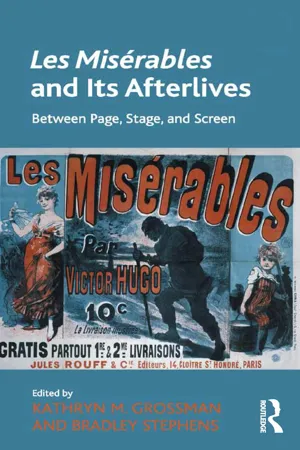
eBook - ePub
Les Misérables and Its Afterlives
Between Page, Stage, and Screen
- 262 pages
- English
- ePUB (mobile friendly)
- Available on iOS & Android
eBook - ePub
Les Misérables and Its Afterlives
Between Page, Stage, and Screen
About this book
Exploring the enduring popularity of Victor Hugo's Les Misérables, this collection offers analysis of both the novel itself and its adaptations. In spite of a mixed response from critics, Les Misérables instantly became a global bestseller. Since its successful publication over 150 years ago, it has traveled across different countries, cultures, and media, giving rise to more than 60 international film and television variations, numerous radio dramatizations, animated versions, comics, and stage plays. Most famously, it has inspired the world's longest running musical, which itself has generated a wealth of fan-made and online content. Whatever its form, Hugo's tale of social injustice and personal redemption continues to permeate the popular imagination. This volume draws together essays from across a variety of fields, combining readings of Les Misérables with reflections on some of its multimedia afterlives, including musical theater and film from the silent period to today's digital platforms. The contributors offer new insights into the development and reception of Hugo's celebrated classic, deepening our understanding of the novel as a work that unites social commentary with artistic vision and raising important questions about the cultural practice of adaptation.
Information
Readings of Les Misérables
Chapter 1
On (the Usefulness of Hunger and) Beauty
“Bed and board” [“Manger et coucher”].1 These three words, the first pronounced by Jean Valjean upon his arrival in Digne, at the beginning of the narrative proper of Les Misérables, simply and unequivocally posit the physiological imperatives of human existence. Refused by the innkeeper, who is informed of his convict status, Valjean becomes both more desperate and more insistent: “What the—! But I am dying of hunger. I’ve been walking since sunrise. I’ve covered twelve leagues. I’m paying, and I want something to eat” [“Ah bah! Mais je meurs de faim, moi. J’ai marché dès le soleil levé. J’ai fait douze lieues. Je paye. Je veux manger”; 54/51]. Multiple variations of this exchange follow as Valjean presses on, seeking food and protection from the cold (see Plate 1), first at a cabaret, then the town prison, followed by a private home. With the possibility of eating, or of sleeping indoors, increasingly remote, his attention turns wholly and instinctively to shielding himself from the elements. He takes shelter in a doghouse, from which he is chased, briefly goes outside the city walls in search of a tree under which to take cover; then, unable to find one, and vaguely affected by the menacing quality of his surroundings, returns and collapses, “exhausted and past caring” [“épuisé de fatigue et n’espérant plus rien”; 59/57], on a stone bench next to the church, before unexpectedly finding refuge—and more—with Monseigneur Myriel.
The entirety of the chapter that recounts Valjean’s entrance in Digne in “The Night After a Day’s Walk” [“Le soir d’un jour de marche”; I.2.i] brings into sharp relief the hostility of the social and natural worlds in which the former convict finds himself—man and nature in seeming total collusion to hinder his effort to satisfy the most rudimentary of physical survival needs: food, sleep, and shelter. But if nourishment is one among several demands in equal and terrible competition in this moment, the state that defines its absence—hunger—dominates Les Misérables from beginning to end. It is hunger, we soon learn, that provoked Valjean’s descent—a loaf of bread, stolen 19 years earlier, to feed his sister’s family of seven children, “a sad bunch, enveloped by a poverty that was slowly squeezing them dry” [“un triste groupe que la misère enveloppa et étreignit peu à peu”; 72/69]. And if the circumstances of the theft are particular to Valjean and his (back)story—“One winter was particularly rough. Jean had no work. The family had no bread. No bread. Literally. Seven children!” [“Il arriva qu’un hiver fut rude. Jean n’eut pas d’ouvrage. La famille n’eut pas de pain. Pas de pain. A la lettre. Sept enfants”; 72/69]—it is their unexceptional quality that is underscored through the narrator’s laconic recounting of them.
Indeed, hunger is figured in Les Misérables as both a steady state and a broad and somber denominator linking the majority of the novel’s characters. Explicitly named in the epigraph as one of the three unresolved social problems of the nineteenth century, hunger permeates and determines the novel, with Hugo making the case for its eradication above all by laying bare its hideous effects. Those of physical diminishment, for example, are seen in Fantine and Mabeuf; but more insidiously, it is the likelihood of corresponding moral deterioration that characterizes the downward trajectory from bon pauvre to mauvais pauvre, “good pauper” to “bad pauper,” witnessed most spectacularly through the irreversible and insatiable appetite of Thénardier—“Oh! I could eat the whole rotten world” [“Oh! Je mangerais le monde”; 615/592]—and in the machinations of the ever-shifting underworld ruled by Patron-Minette. Save for a few who sit squarely or socially outside hunger’s immediate reach—such as Tholomyès or Gillenormand—or whose fortunes are in some way reversed—Jean Valjean, or Cosette as saved and raised by Jean Valjean—it never lessens, only worsens, and remains in its depiction as perilous an ill at the conclusion of Les Misérables as at its opening.
It is no surprise, then, that hunger, as a principle driver of the narrative, has long been, and continues to be, probed by readers and critics alike, from the moral and ethical implications of Valjean’s desperate act and its disproportionate consequences, to the deeply embedded thematic and metaphorical dimensions of appetite and satiety.2 Hunger, as a force, compels, and all the more so—alas—through its continued relevance, through the reality of its prevalence to this day in much of the world. Yet if the stakes of physical sustenance are unambiguous in Les Misérables and play themselves out in multiple interrelated narrative threads, the novel also clearly suggests that food is neither all one hungers for nor alone (ever) enough.
The story of Jean Valjean’s redemption, of his transformation from sinner to saint, is above all else the story of the needs of the body subordinated to the needs of the soul, of the material superseded by the spiritual. Valjean’s soul is at once the locus for and the prize in the battle of good against evil, light against dark, right against wrong, a battle that is shrewdly initiated by Myriel following Jean Valjean’s second theft, that of the bishop’s silver. Leveraging a promise never in fact made to use the profit from its sale to become an honest man, Myriel engages Valjean’s dormant conscience in a decisive pact—“Jean Valjean, my brother, you no longer belong to evil but to good. It is your soul that I am buying for you; I am taking it away from black thoughts and from the spirit of perdition, and I am giving it to God” [“Jean Valjean, mon frère, vous n’appartenez plus au mal, mais au bien. C’est votre âme que je vous achète; je la retire aux pensées noires et à l’esprit de perdition, et je la donne à Dieu”; 90/86]—that sets him on a course of arduous trials and tribulations. From his immediate regression in the Petit Gervais episode, to the affaire Champmathieu, to the discovery of Cosette’s love for Marius, to his decision to save Marius at the barricades, Valjean’s trajectory is built upon successive moments of crisis, increasingly internalized and self-imposed, and each capable of fully undoing his moral progress. It is the knowledge—hard won—that “[w]e are never done … with conscience” [“avec la conscience, on n’a jamais fini”; 1134/1090] which brings Jean Valjean to his ultimate test, removing himself completely from Cosette’s life, and to his salvation and sublimation.
Les Misérables tells us, not just through Jean Valjean’s redemption but over and over, and in different ways, that “[m]an lives on affirmation even more than on bread” [“L’homme vit d’affirmation plus encore que de pain”; 429/410], contending, despite or perhaps precisely because of the omnipresence of hunger, the primacy of spiritual communion for both the individual and for society as a whole. Philosophie. Commencement d’un livre, the lengthy planned preface to Les Misérables begun in May 1860 concurrently with the novel’s completion and revision, lays out this argument even more directly, grounding the religious content of the novel in Hugo’s personal conception of man as a profoundly spiritual being who is part of an infinite, radiating universe. This universe, alternately called the “outer space” [“le cosmos”] or simply “the infinite” [“l’infini”], demonstrates by its existence the existence of an immanent divine force, co-mingled in the whole of the natural world and co-present in the soul but never entirely knowable to man.
At the same time, the preface takes the opportunity to target the materialism and the growing and—from Hugo’s perspective—corrosive and politically dangerous atheism of the 1860s. From its opening line, “The book we are about to read is a religious one” [“Le livre qu’on va lire est un livre religieux”; OCL—Critique 467], Hugo is unequivocal in both his intent to establish man’s deep relationship to a metaphysical realm governed by a higher order and to draw attention to the dire consequences in the political realm of positivism, science, and anticlericalism taken too far.3 A belief in the divine, the preface tells us, is the compass that keeps both man’s individual moral progress and collective social progress firmly and safely on course.
Although Hugo paused work on the preface in August 1860 to turn his attention fully to finishing the novel, he was satisfied enough with its shape and scope to declare in a note on the dossier’s cover that the text, even incomplete, was significant. It could serve as either a preface to Les Misérables or as a “general preface” [“préface générale”] to his body of work, or be included elsewhere in collected writings from his intellectual life (LMM XII, 13). Indeed, Philosophie. Commencement d’un livre (his own title for the text) presents both concerns particular to Les Misérables spurred by the shifts in the political climate that span its lengthy composition and key elements of a more general “philosophy” that traverses Hugo’s body of work—chief among them the primacy of the soul, the relationship between, time, history, and progress, and the dynamism of the expansive and reductive forces ever at play all around us. Establishing the imperative of the spiritual belongs at once to the preface’s specific (political) and general (philosophical) aims, and it warns in no uncertain terms of the emptiness, for those who attain it, of physical and material satisfaction and fulfillment alone: “To be well dressed, well fed, and well sheltered, … to bite into bread made from white flour, to have a nice fire to warm oneself and a nice bed to sleep in, … to never want for anything, to prosper in and from what one does, to drink well, eat well, sleep well, it counts for a lot, certainly; but if it is everything, it is nothing” [“Être bien vêtu, bien nourri et bien logé, … mordre dans du pain blanc, avoir un bon feu pour se chauffer et un bon lit pour se reposer, … ne jamais manquer de rien, prospérer dans ce qu’on fait et par ce qu’on fait, bien boire, bien manger, bien dormir, c’est beaucoup, certes; mais si c’est tout, ce n’est rien”; 527]. Body and soul need simultaneous tending.
The novel, too, is unabashed in its condemnation of those for whom material comfort and social status trump or triumph in exclusivity, for whom they come to represent a magnified and vacuous “everything”—Tholomyès, for example, or the alternate (equally indifferent) bourgeois versions of him that subsequently appear, such as Bamatabois or Théodule. It is also unambiguous in its condemnation of the notion that societal betterment is based in the betterment of physical circumstances alone, of the ideological decoupled from the spiritual.4 Its most strident condemnation, however, is that of the risks to the soul created by the conditions of misery, by absence and need, by poverty and abjection. For if Jean Valjean’s soul, sparked by his fortuitous intersection with Myriel (see Plate 10), is rescued and rehabilitated, allowing for his redemption and transcendence of the social world of the novel, the same lies decidedly beyond the reach of the majority of the novel’s characters. The sea of malnourished bodies, who bite not into pain blanc, but pain noir [“black bread”], or no bread at all, results directly and proportionately in a sea of malnourished souls, caught in the “concentric circles” of “the fathomless pit of the social Unknown” [“cercles concentriques” of “le gouffre de l’Inconnu social”; 1112/1070]. To rise in Les Misérables is above all to escape from that dormancy and atrophy of the soul, to rise above the circumstances of a harsh and unchanged social world, be it through forging one’s own path to moral salvation (Jean Valjean), through retaining innocence or idealism (Gavroche, Enjolras, Mabeuf), or through demonstrating selflessness or sacrifice in the face of self-interest (Fantine, Éponine).
Les Misérables also demonstrates the salutary effect of other forms of sustenance—aesthetic, intellectual, emotional. These forms either reinforce the spiritual or stand distinct from it, depending on how they are accessed, and by whom. The promise of beauty, in particular, is asserted by Myriel at the novel’s outset—“The beautiful is just as useful as the useful. … Perhaps more so” [“Le beau est aussi utile que l’utile. … Peut-être plus”; 21/22]—and tested at various points in its unfolding.
What of beauty, then, and of its usefulness in and for the novel?5 Myriel’s claim, made in response to Mme Magloire’s gentle chiding about the planting of flowers instead of lettuce in a corner of his garden, explicitly melds the aesthetic with the spiritual: the beauty of the natural world provides nutrients as or more necessary than those delivered by food. In this way, “He did not study plants, he loved flowers” [“Il n’étudiait pas les plantes; il aimait les fleurs”; 22/33]. Myriel grows flowers not to understand them better but to bask in the glow of their existence: an existence that affirms a higher order at work and from which he derives rich and direct spiritual nourishment.
While the “cultivation” of the mind is assiduously practiced by Myriel in the form of daily writing, reading, and reflection, the contemplation of natural beauty is in no way the domain of intellectual enlightenment, as underscored in the description of the bishop’s evening walks around his garden:
In moments like these, offering up his heart at the hour that night flowers offer up their perfume, lit up like a lamp in the middle of the starry night, full of ecstasy in the middle of the universal radiance of creation, he could not perhaps have said himself what was happening to his spirit; he felt something soar up out of him and something fly down into him. Mysterious exchanges between the bottomless well of the soul and the bottomless well of the universe! (47–8)
[“Dans ces moments-là, offrant son cœur à l’heure où les fleurs nocturnes offrent leur parfum, allumé comme une lampe au centre de la nuit étoilée, se répandant en extase au milieu du rayonnement universel de la création, il n’eût pu peut-être dire lui-même ce qui se passait dans son esprit; il sentait quelque chose s’envoler hors de lui et quelque chose descendre en lui. Mystérieux échanges des gouffres de l’âme avec les gouffres de l’univers!”; 46]
On the contrary, phenomena of natural beauty, whether they take the form of the small and tangible (an individual flower), or the large and diffuse (a constellation of stars) are spectacles that feed the soul through their aesthetic properties and immediacy of access. They illustrate the spiritual and its value in direct and deeply personal ways, ways in which the formal and rigid structures of religion—created and imposed by man, not by God—are incapable.6
Myriel, as we know, decisively marks the novel’s opening but does not enter, serving as the catalyst for Valjean’s radical change in course and as the exemplar of embodied virtue. For the remainder of Les Misérables, affirmation of the presence of God in all of nature is furnished through the metaphorical expression of God’s ubiquity and proximity to man, as manifest in both “light” [“la lumière”] and “shadows” [“les ombres”], and the preeminence of the spiritual confidently and continuously revealed through narrative commentary7. Yet for all of this certainty, the spiritual communion through the contemplation of beauty that Myriel experiences in the passage above does not extend beyond him, is never fully reproduced or realized, with few in the novel capable of apprehending le beau and thus benefiting from its “usefulness” in the manner that he does.8
The cultivation and contemplation of rare flowers that is practiced by Marius’s father, the former Napoleonic colonel Georges Pontmercy, is less a form of intimate spiritual validation and more a manner of deflection and emotional self-comfort subsequent to his wife’s death and his retreat from his son’s life for the sake of his future: “not being able to have his son, he had turned to flowers” [“ne pouvant avoir son enfant, il s’était mis à aimer les fleurs”; 509/489]. This activity of substitution occupies Pontmercy’s body and mind as he produces new floral varieties, manifestations of uncommon beauty at which all of Vernon marvels, but which draw him further and further into himself: “He had given up everything, anyway, neither aspiring nor conspiring. He divided his thoughts between the innocent things he did now and the great things he had done” [“Il avait du reste renoncé à tout, ne remuant ni ne conspirant. Il partageait sa pensée entre les choses innocentes qu’il faisait et les choses grandes qu’il avait faites”; 509/489]. Unlike Myriel, whose experience with beauty is wholly visceral, Pontmercy derives his solace from the intellectual stimulation and satisfaction of attempting—and succeeding—in rivaling God’s generative powers.
The botanical arts of M. Mabeuf are explicitly likened by the narrator to the labors of Pontmercy—“what ...
Table of contents
- Cover Page
- Half Title Page
- Dedication
- Title Page
- Copyright Page
- Contents
- List of Plates
- Notes on Contributors
- Acknowledgments
- Notes and Abbreviations
- Les Misérables A Prodigious Legacy
- Part 1 Readings of Les Misérables
- Part 2 Receptions and Adaptations
- Works Cited
- Index
Trusted by 375,005 students
Access to over 1.5 million titles for a fair monthly price.
Study more efficiently using our study tools.
Frequently asked questions
Yes, you can cancel anytime from the Subscription tab in your account settings on the Perlego website. Your subscription will stay active until the end of your current billing period. Learn how to cancel your subscription
No, books cannot be downloaded as external files, such as PDFs, for use outside of Perlego. However, you can download books within the Perlego app for offline reading on mobile or tablet. Learn how to download books offline
Perlego offers two plans: Essential and Complete
- Essential is ideal for learners and professionals who enjoy exploring a wide range of subjects. Access the Essential Library with 800,000+ trusted titles and best-sellers across business, personal growth, and the humanities. Includes unlimited reading time and Standard Read Aloud voice.
- Complete: Perfect for advanced learners and researchers needing full, unrestricted access. Unlock 1.5M+ books across hundreds of subjects, including academic and specialized titles. The Complete Plan also includes advanced features like Premium Read Aloud and Research Assistant.
We are an online textbook subscription service, where you can get access to an entire online library for less than the price of a single book per month. With over 1.5 million books across 990+ topics, we’ve got you covered! Learn about our mission
Look out for the read-aloud symbol on your next book to see if you can listen to it. The read-aloud tool reads text aloud for you, highlighting the text as it is being read. You can pause it, speed it up and slow it down. Learn more about Read Aloud
Yes! You can use the Perlego app on both iOS and Android devices to read anytime, anywhere — even offline. Perfect for commutes or when you’re on the go.
Please note we cannot support devices running on iOS 13 and Android 7 or earlier. Learn more about using the app
Please note we cannot support devices running on iOS 13 and Android 7 or earlier. Learn more about using the app
Yes, you can access Les Misérables and Its Afterlives by Kathryn M. Grossman,Bradley Stephens in PDF and/or ePUB format, as well as other popular books in Literature & Literary Criticism. We have over 1.5 million books available in our catalogue for you to explore.