- 372 pages
- English
- ePUB (mobile friendly)
- Available on iOS & Android
eBook - ePub
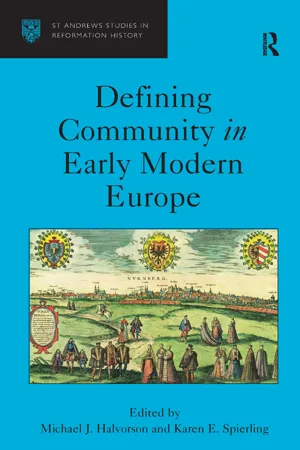
Defining Community in Early Modern Europe
About this book
Numerous historical studies use the term "community'" to express or comment on social relationships within geographic, religious, political, social, or literary settings, yet this volume is the first systematic attempt to collect together important examples of this varied work in order to draw comparisons and conclusions about the definition of community across early modern Europe. Offering a variety of historical and theoretical approaches, the sixteen original essays in this collection survey major regions of Western Europe, including France, Geneva, the German Lands, Italy and the Spanish Empire, the Netherlands, England, and Scotland. Complementing the regional diversity is a broad spectrum of religious confessions: Roman Catholic communities in France, Italy, and Germany; Reformed churches in France, Geneva, and Scotland; Lutheran communities in Germany; Mennonites in Germany and the Netherlands; English Anglicans; Jews in Germany, Italy, and the Netherlands; and Muslim converts returning to Christian England. This volume illuminates the variety of ways in which communities were defined and operated across early modern Europe: as imposed by community leaders or negotiated across society; as defined by belief, behavior, and memory; as marked by rigid boundaries and conflict or by flexibility and change; as shaped by art, ritual, charity, or devotional practices; and as characterized by the contending or overlapping boundaries of family, religion, and politics. Taken together, these chapters demonstrate the complex and changeable nature of community in an era more often characterized as a time of stark certainties and inflexibility. As a result, the volume contributes a vital resource to the ongoing efforts of scholars to understand the creation and perpetuation of communities and the significance of community definition for early modern Europeans.
CHAPTER 1
Introduction: Definitions of Community in Early Modern Europe
“Community,” says Peter Burke, “is at once an indispensable term and a dangerous one, whether we are practicing history or sociology or simply living our everyday lives.”1 For historians, understanding the way that particular groups in European society—political, religious, economic, familial, and others—defined their membership, organized themselves, and interacted with other groups is vital to a full comprehension of the dynamics of change and continuity in early modern Europe. Thus, to borrow Burke’s term, the study of community definition is certainly “indispensable,” even though the meanings and applications of this complex word have been approached in many different ways by historians, sociologists, anthropologists, philosophers, and literary scholars. The danger lies not in trying to analyze community dynamics but in attempting to impose too great a clarity, simplicity, or transparency on the operations of any particular community. The original essays presented here demonstrate the wealth of information still to be gleaned from pursuing questions of community definition as well as the need to recognize both the complexity and, in many cases, the unexpected flexibility of community definitions and boundaries in early modern Europe.
This project came into being as a result of the editors’ own discussions about a very particular aspect of community definition in the Reformation: the role of baptism in marking community membership. We each began our careers with major projects on the sacrament of infant baptism, examining the rituals and traditions surrounding the rite and the social and political significance of those practices.2 In comparing our work, we talked about the ways that infant baptism and the practices attached to it were used variously to define Lutheran and Reformed communities, to challenge the reformers’ notions of community, and to reinforce longstanding ties of community that reached beyond strictly religious definitions. In discussing our own findings about the way that a single ritual could both reinforce and contest official definitions of community, it became clear to us that while many scholars in our field were exploring issues of early modern community definition and construction, there was no single volume that brought together work on the broad topic of the definition of community across Central and Western Europe.
As we investigated ways to address this situation, we were confronted with the overwhelming variety of bases for defining early modern communities and the vast array of approaches that scholars have taken to explore historical community dynamics. Given our own scholarly grounding in the religious dynamics of the Protestant Reformation, we decided to construct this volume around the broad theme of the role of religion in defining early modern communities. Not surprisingly, however, none of our contributors examines religious definition in isolation: political, economic, familial, social, and other types of concerns appear as influential—and in some cases, primary—factors throughout the essays that follow. Thus, the discussion presented in this volume takes as its starting point a fairly broad definition of early modern community: a group of people who perceived themselves as having common interests and, thus, a common identity or self-understanding. In the studies presented here, the principal common interest was sometimes, but not always, adherence to a particular religious confession. These essays also demonstrate that individuals in early modern Europe could remain committed members of a community, convinced of their shared concerns and characteristics, even when they challenged the official religious principles and practices of that community. Further, some of the following chapters illustrate the ways in which members of a community could accept the same religious beliefs and authorities and still disagree on other fundamental aspects of community definition.
Approaching early modern communities
In exploring these complex dynamics of community membership and operation, the contributions to this volume build on over a century of scholarship on the definition and construction of early modern communities. Historians in particular have approached communities as defined by political, economic, religious, familial, and other social relations. In all of these approaches, it is common to examine notions of community in terms of the local, although there is a growing body of recent work that looks at community at the national level, or at communities that cross regional and national borders.3 In the development of the idea that a community is local, one particularly influential nineteenth-century scholar was German sociologist Ferdinand Tönnies, whose famous contrast between a pre-modern Gemeinschaft, or community based on personal (face-to-face) relationships, and the modern Gesellschaft, or impersonal, institution-based society, continues to influence and resonate in modern scholarship.4 Historical work of the later decades of the twentieth century, while often invoking Tönnies’ distinction, also took important steps to provide significant nuance to the over-generalizations and distortions of that description, highlighting the complex and often contentious nature of early modern communities, whatever their size or location.
In the 1960s and 1970s, historians began to look more closely at the religious definition of communities during the Reformation period and the existence of competing definitions of community in particular cities, especially in the German, Swiss, and French lands.5 One of the driving questions of the work of these decades was why the Reformation appealed to urban populations in particular. Scholars who took on this issue in those decades included Natalie Davis on Lyon; Robert Kingdon and William Monter on Geneva; Gerald Strauss on Nuremberg; Thomas Brady and Miriam Chrisman on Strasbourg; and Bernd Moeller on imperial cities in the Holy Roman Empire. During the 1980s, other scholars built on this work on urban centers, pushing further into the archives to explore official motivations for adopting the Protestant Reformation and the effects of both the Protestant and Catholic Reformations on different parts of the population, particularly on women. Important contributions to this phase of the developing discussion included Lyndal Roper’s work on Augsburg; Susan Karant-Nunn’s on Zwickau; Merry Wiesner-Hanks’s on Nuremberg; and Philip Hoffman’s on Catholicism in the Diocese of Lyon.6 All of these scholars have made significant contributions to current conceptions of early modern communities, improving our understanding of official and popular motivations for reform; the political, religious, economic, and social organization of these cities and the power relations at play in each; the impact of religious change on particular sectors of the population—women, journeymen, and political leaders, to name a few—and, most generally, the myriad effects the Reformation and the resulting religious divisions had on both the official definitions and the practical operations of urban communities.7
An important corrective to this focus on urban settings as the heart of the Reformation is the work of Peter Blickle, who highlights the role of communalism, with its emphasis on horizontal economic, political, and social ties (rather than a vertical structure of authority) in the enactment of religious change, especially in the first decades of the reform movement. While Blickle locates communalism in urban as well as rural settings, he emphasizes the appeal of the Reformation to smaller towns and villages and the importance of rural communities in spreading and adopting the new reformed teachings in the 1520s.8 For Blickle, “[g]iven that reformed theology was mediated through the late medieval institution of the commune, ‘Communal Reformation’ appears to be the logical term for the early Reformation,” as opposed to “Urban Reformation.”9
Additional nuance has come from the work of the late Robert Scribner, whose insights about the social and cultural dynamics of early modern communities have left an important scholarly legacy. Scribner asserted that studies of late medieval and early modern communities should focus less on the overarching concepts used to establish order or create a unifying political or religious vision and more on the competing discourses and strategies of power that reveal themselves in community conflict.10 Over the past two decades, an increasingly wide variety of scholars have begun to look more closely at the varieties of conflict inherent within most early modern communities.11 Historians who take this approach have observed that conflict is an integral part of community dynamics in both urban and rural settings. Philip Hoffman, for example, emphasizes the role of conflict as a basic characteristic of rural village communities in the diocese of Lyon:
But communal solidarity did not mean that the denizens of the countryside were cheerful altruists or that their lives were serene or egalitarian. Peasants were often extremely selfish, and inequality and internal strife were prominent features of village life, particularly as the sixteenth century drew to a close. … The village institutions—from assemblies and youth groups to confraternities—were therefore more than mere marks of solidarity; they were in fact the very ties that bound these disparate, selfish individuals.12
As Hoffman suggests for Lyon, so scholars are finding in many places: while early modern communities may not have been defined solely by their institutions, those institutions—particularly religious and legal—played a vital role in mediating community conflicts. This mediation was part of a constant process of building tension and resolution rather than a progression toward the establishment of an actual, conflict-free community.13 In other words, as David Sabean has famously asserted, “What is common in community is not shared values or common understanding so much as the fact that members of a community are engaged in the same argument … in which alternative strategies, misunderstandings, conflicting goals and values are threshed out.”14
Conflict could be embedded deep within the community, or it could erupt at points of boundary and intersection, where multiple communities overlapped or abutted one another. In exploring the interactions that take place at community boundaries, many historians have been influenced by a concept that originated with another nineteenth-century German sociologist, Georg Simmel, who argued that communities could be best studied and understood when they were thought of as collections of overlapping entities or “circles” that meet one another at points of common interest, dispute, or compromise.15 In terms of relations between communities, it is at the margins or boundaries of these circles, where insider meets outsider, where group identities are tested, shaped, and ultimately accommodated or rejected.16 In early modern Europe, these overlapping circles could be communities defined by kinship, political institutions or allegiance, occupation, economic or social status, gender, age, or religion, among other possibilities. Conflict at the boundaries of these communities might arise between the members of rival groups, but it also could be set off by the tensions inflicted on an individual or group of people caught in the competing demands of different community networks or emerging bureaucratic institutions.17 Such individuals or groups depended on their ability to move back and forth between different communities; problems arose particularly when community leaders attempted to reinforce boundaries or eliminate the overlap between circles, thus restricting what for some members was necessary movement between groups.
This issue of boundaries—their establishment, enforcement, and violation—is an embedded theme in much historical work on early modern community, especially in studies influenced by the anthropological works of Arnold van Gennep on the “rites of passage” in human lives and Victor Turner’s development of van Gennep’s concept of a “liminal phase” of ritual during which an individual is “betwixt and between” his or her previous and new stages of life.18 For his recent work on the co-existence of Protestant and Catholic communities in late sixteenth- and seventeenth-century France, Keith Luria chose the title Sacred Boundaries, establishing as a main theme the officially-set limitations of those communities and how specific restrictions developed over time. Luria is particularly interested in the variety of ways that boundaries were constructed even within a single community, and in the flexibility of officially established boundaries. As he states:
[T]he confessional boundary in early modern France was permeable. Catholics and Huguenots crossed it often in a variety of daily interactions: they lived together, worked together, married each other, shared civic responsibilities, participated in each other’s religious observances, and buried their dead together. In such exchanges the confessional boundary did not necessarily disappear, but it did not prevent people of the two faiths from living together.19
Thus, where one might expect conflict, at the official boundaries of religiously defined communities, one does not always find it in practice. Furthermore, official institutions and the regulations they established could sometimes be the source of conflict within a community, when challenged by community members, rather than the arbiters of conflict among members.
One particularly useful tool for uniting early modern communities—or at least presenting the appearance of unity despite internal conflicts—was ritual. Over the past several decades, and inspired by the methods of cultural anthropologists, historians have looked closely at a wide variety of religious and civic rituals as sources and reinforcers of community definition.20 It is by now well established that ritual—both religious and civic—was one of the most effective and public ways to define a community and demonstrate community membership, both by including members in public rituals and by excluding outsiders from ritual participation. And yet, as Edward Muir has observed in his excellent Ritual in Early Modern Europe, “Rituals are inherently ambiguous in their function and meaning. They speak with many voices.”21 As he reminds us, just as with boundaries and other aspects of community definition, rituals could operate both to maintain “community...
Table of contents
- Cover
- Half Title
- Title Page
- Copyright Page
- Table of Contents
- About the Contributors
- Acknowledgments
- 1 Introduction: Definitions of Community in Early Modern Europe
- 2 Communities of Worship and the Reformed Churches of France
- 3 Between the Living and the Dead: Preserving Confessional Identity and Community in Early Modern France
- 4 A Community of Active Religious Women
- 5 The Complexity of Community in Reformation Geneva: The Case of the Lullin Family
- 6 Child Circulation within the Early Modern Urban Community: Rejection and Support of Unwanted Children in Nuremberg
- 7 Late Sixteenth-Century Lutherans: A Community of Memory?
- 8 Jewish Communities in Central Europe in the Sixteenth Century
- 9 Demonstrationes catholicae: Defining Communities through Counter-Reformation Rituals
- 10 Lutherans Baptizing Jews: Examination Reports and Confessional Polemics from Reformation Germany
- 11 Beating the Bounds of the Parish: Order, Memory, and Identity in the English Local Community, c. 1500–1700
- 12 Breaching “Community” in Britain: Captives, Renegades, and the Redeemed
- 13 Scotland’s “City on a Hill”: The Godly and the Political Community in Early Reformation Scotland
- 14 Competing Visions of the Mennonite Gemeinde : Examples from Early Modern Krefeld in Their Dutch Context
- 15 “I can’t imagine it won’t bear fruit”: Jesuits, Politics, and Heretics in Siena, Montepulciano, and Lucca
- 16 Contesting Vesuvius and Claiming Naples: Disaster in Print and Pen, 1631–1649
- Select Bibliography
- Index
Trusted by 375,005 students
Access to over 1.5 million titles for a fair monthly price.
Study more efficiently using our study tools.
Frequently asked questions
Yes, you can cancel anytime from the Subscription tab in your account settings on the Perlego website. Your subscription will stay active until the end of your current billing period. Learn how to cancel your subscription
No, books cannot be downloaded as external files, such as PDFs, for use outside of Perlego. However, you can download books within the Perlego app for offline reading on mobile or tablet. Learn how to download books offline
Perlego offers two plans: Essential and Complete
- Essential is ideal for learners and professionals who enjoy exploring a wide range of subjects. Access the Essential Library with 800,000+ trusted titles and best-sellers across business, personal growth, and the humanities. Includes unlimited reading time and Standard Read Aloud voice.
- Complete: Perfect for advanced learners and researchers needing full, unrestricted access. Unlock 1.5M+ books across hundreds of subjects, including academic and specialized titles. The Complete Plan also includes advanced features like Premium Read Aloud and Research Assistant.
We are an online textbook subscription service, where you can get access to an entire online library for less than the price of a single book per month. With over 1.5 million books across 990+ topics, we’ve got you covered! Learn about our mission
Look out for the read-aloud symbol on your next book to see if you can listen to it. The read-aloud tool reads text aloud for you, highlighting the text as it is being read. You can pause it, speed it up and slow it down. Learn more about Read Aloud
Yes! You can use the Perlego app on both iOS and Android devices to read anytime, anywhere — even offline. Perfect for commutes or when you’re on the go.
Please note we cannot support devices running on iOS 13 and Android 7 or earlier. Learn more about using the app
Please note we cannot support devices running on iOS 13 and Android 7 or earlier. Learn more about using the app
Yes, you can access Defining Community in Early Modern Europe by Michael J. Halvorson, Karen E. Spierling in PDF and/or ePUB format, as well as other popular books in History & World History. We have over 1.5 million books available in our catalogue for you to explore.