eBook - ePub
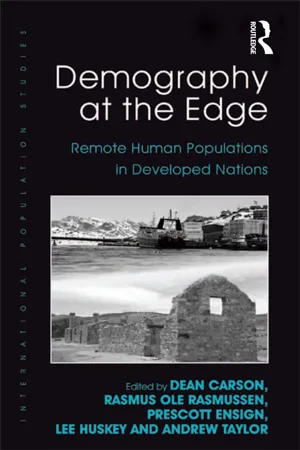
Demography at the Edge
Remote Human Populations in Developed Nations
- 370 pages
- English
- ePUB (mobile friendly)
- Available on iOS & Android
eBook - ePub
Demography at the Edge
Remote Human Populations in Developed Nations
About this book
Addressing the methodological and topical challenges facing demographers working in remote regions, this book compares and contrasts the research, methods and models, and policy applications from peripheral regions in developed nations. With the emphasis on human populations as dynamic, adaptive, evolving systems, it explores how populations respond in different ways to changing environmental, cultural and economic conditions and how effectively they manage these change processes. Theoretical understandings and policy issues arising from demographic modelling are tackled including: competition for skilled workers; urbanisation and ruralisation; population ageing; the impacts of climate change; the life outcomes of Indigenous peoples; globalisation and international migration. Based on a strong theoretical framework around issues of heterogeneity, generational change, temporariness and the relative strength of internal and external ties, Demography at the Edge provides a common set of approaches and issues that benefit both researchers and practitioners.
Methods, Models and Data
Chapter 1
Perspectives on ‘Demography at the Edge’
The intent of this book is to examine the relationships between ‘remoteness’ and the demographic characteristics of populations who live in remote areas. It is concerned with the remote parts of developed nations, and so it faces the challenges of demographic research at the sub-national level. The grand theories of demography have been developed around observations of human populations at the national or supra-national scale. While propositions such as the demographic transitions are not universally accepted, they have proven very useful for researchers and policy makers concerned with the characteristics of relatively large populations (Burch 2003). Far less attention has been paid to formal or behavioural demography as it applies to smaller (particularly sub-national), more dynamic and more open populations (Swanson 2004). There are numerous studies about such populations, but they tend to be concerned with data quality issues, methods of data analysis and the production of localised descriptions of population characteristics (see, for example, Wilson and Bell 2004, Wilson and Rees 2005). Processes of industrialisation and post-industrialisation have effected how regional populations change and how they interact with one another (Pierson 1998). A focus on migration, including models of rural-to-urban migration and counter-urbanisation (Bosworth 2008) has been a main feature of sub-national demography. Population changes have been interpreted in the light of theories of economic development such as the staples thesis and various core-periphery models (Barnes et al. 2001). Overall, however, there have been few attempts to synthesise knowledge about how sub-national populations work into general models, despite calls for attention to the issue over at least the past two decades (McNicoll 1992).
One of the reasons for poorly developed regional demographic models may be the diversity of small and dynamic populations which are available for study. Small area demographic studies have been concerned with cities and urban centres (for example, Haase et al. 2007), suburbs and the rural fringes of cities, agricultural and rural districts (Kandel and Brown 2006) and more nebulous ‘remote’, ‘peripheral’ or ‘marginal’ regions (Gurung and Kollmair 2005). These latter are to be found in all parts of the world, with this book specifically interested in remote regions of developed nations. Developed nations are well progressed along the various demographic transitions and contrast with developing nations, which are still in the process of technological, economic and demographic change (Attanasio et al. 2006).
Regional development theories suggest concentration of a developed country’s human and economic resources around mainly urban population nodes (Currie and Kubin 2006). These nodes have critical mass both of producers and consumers. They are well connected to markets and information through hard and soft infrastructure. They also tend to become centres for the creative industries, sports and recreation, education and learning because they have both the population and the economic wealth to invest in these activities. The more distant one gets from these centres (although the relationship is not strictly linear), the more difficult it has proven to bring together and sustain development resources (Polese and Shearmur 2006). Consequently, just as different demographic patterns are observed between nations, there are important sub-national differences (Coleman 2002).
The researchers whose work is featured in this volume are particularly interested in demographic conditions in the more remote regions of Australia, Canada, the United States and the north of Europe. While these regions are ‘at the edge’ geographically and economically, they receive disproportionate attention from policy makers and service providers. Sometimes, this is because they contain natural resource wealth critical to the economic growth of the nation and sometimes because they are home to high proportions of Indigenous people and other ‘at risk’ populations. Remote regions have relatively low population densities (although they can have high concentrations of population in a small number of dispersed settlements) and low total populations when compared with the rest of the country. Understanding the demography of these regions is critical in designing and evaluating policy, workforce planning and the implementation of social services.
There are no existing universally accepted rules for defining what constitutes a ‘remote’ region. The relationships between remoteness, peripherality and marginality have not been well defined. In some literature, these terms are used interchangeably, while in other cases they are seen to have important differences. What is clear is that they are relative terms defined in part, if not in whole, by what is accessible, core or central. They are also purposive terms, implying the need to state a ‘remoteness from’ an activity, function or amenity (Wakerman 2004). Any operationalising of remoteness will likely attract criticism because of the issues of relativity and purposiveness.
In the academic literature, ‘remoteness’ has commonly been associated with health care service provision and indexes of remoteness have been developed in Canada (Leduc 1997) and Australia (Australian Institute of Health and Welfare 2004) that reflect the relative level of (geographic) access to various health services. Spiekermann and Neubauer (2002) reviewed a set of approaches to defining remoteness that were more concerned with the density of transport networks. For them, the ease or difficulty of the journey between places was more important than the level of services at the origin or destination. The term ‘peripheral’ is widely used in various streams of geographic and economic research, but it is mostly used as an a priori label for places (those which are ‘known’ to be peripheral). Gurung and Kollmair (2005), among others, have provided conceptual definitions for peripherality and marginality, suggesting that they have spatial and social dimensions, but are difficult to apply uniformly across nations, continents or the globe.
Remoteness, peripherality and marginality are subjective terms, defined at times by those outside and at times by those inside. Remoteness can be nested within a region, such that the region itself is remote from some core, and there is an internal organisation within the region of central and peripheral locations. Borgatti and Everett (1999) talked about multiple cores and multiple peripheries, which can overlap one another and which do not need to have one-to-one relationships. The four jurisdictions of interest in this book may consider themselves remote or peripheral to a core ‘down south’, a conception about where decisions are made and where the focus of decision makers lies. Similar attitudes may be held towards the political centres of these jurisdictions by those living in the ‘truly remote’ parts.
While there may be continuing disagreements about how remoteness is defined, even cursory examination of maps of Australia, North America and northern Europe reveal where the ‘extreme cases’ (Flyvbjerg 2006) of remoteness are most likely situated. Each map has areas where there are many labels for towns and cities and where there exists a spider-web like network of roads and railway lines. As the eye moves (generally north) from these areas, the number of labels diminishes, along with the number of alternative transport routes between towns and cities. Ultimately, in the far north (and more so towards the west in Australia and North America), the level of human infrastructure is very low and population centres are small and widely dispersed. In Canada, the transition from high density human and transport networks occurs within a few hundred kilometres north of the border with the United States. The Yukon, Northwest Territories and Nunavut are jurisdictions most obviously ‘remote’ from the main population centres, but so are large northern sections of the more southerly provinces. In Australia, the Northern Territory embodies remoteness, along with the northern and eastern parts of Western Australia and the north and west of Queensland. Alaska in the United States has a population density of 0.42 persons per square kilometre, by far the lowest density of all States and comparing to 31 persons per square kilometre for the country as a whole. The northern European situation is more politically complex. The Nordic Council of Ministers has identified the ‘Northern Sparsely Populated Areas’ (NSPA) which includes parts of Norway, Sweden and Finland, along with the Faroe Islands, Greenland and Iceland.
Formal demography is concerned with the statistics that describe populations – age and sex profiles determined by births, deaths and migration (Rowland and Trevor 2003). Formal demography is concerned with methods for enumerating populations, for estimating fertility, mortality and migration rates and for constructing life tables. Behavioural demography looks for explanations for demographic outcomes (Hobcraft 2006) – why are fertility and mortality patterns as they are? Why do people migrate from one place to another? Why are particular population structures correlated with particular health or economic outcomes? Why family structures like they are and what are might be the reasons for differences between populations? Many researchers interested in these questions would not consider themselves demographers at all – they are geographers and economists and sociologists and anthropologists and health scientists. The intent of this book is to construct knowledge of formal and behavioural demography using perspectives drawn from a range of disciplines. The aim is to describe both how and why remote populations change over time and the extent to which their ‘remoteness’ can be considered a factor in those change processes.
General Characteristics of Remote Populations
Australia, Canada, the United States and Europe’s Northern Sparsely Populated Areas face substantial challenges in including their furthest jurisdictions in the processes of post-industrialisation and the development of knowledge economies. It is now widely accepted that such processes are human ones – innovation diffusion relies on the interactions between people and the organisations they construct (Francois and Zabojnik 2005). People provide the core inputs for networks and clusters. People are the entrepreneurs in economic systems. The collections of people as producers, intermediaries and markets constitute the critical mass which drives innovation. People are not just central to Markey, Halseth and Manson’s (2006) qualitative competitive variables; they also feature as inputs to quantitative variables such as economic structure and productivity. The role of people is not limited to economics and neither should economics be seen as the sole justification for the existence of remote populations. People sustain social, political and cultural capital – forces for social development, creativity and cultural enrichment which do not necessarily have to have immediate economic returns (Woodhouse 2006).
The population dynamics of the remote regions described in this book differ from each other in some important ways, but many of the fundamental characteristics are similar. Similarities are around how the regional populations compare with their national averages and how the regional populations are internally structured. Comparative elements include small size, low population density, high proportions of Indigenous people, high mobility, young age structures and high sex ratios. The comparative statistics conceal some critical internal dichotomies. The ‘split’ between Indigenous and non-Indigenous populations is most commonly cited (Taylor 2003), but this split does not completely explain structural differences. Remote populations typically have areas of very high population density separated by areas that are barely inhabited on a regular basis. They have one or two comparatively large population centres, with the average population of other settlements consistently low. They have some highly mobile groups and some that appear to be very stable. Their unusual age/sex distributions reflect both a young median age and an ageing population. High sex ratios are often reported, but are not apparent in all sub-populations or at all ages.
While demography of remote populations is a methodological challenge for demographers – from measurement to inferences drawn, it is a practical challenge for those who want to use demographic data to inform research or policy making. Presenting northern policy makers with summary statistics and then explaining why they cannot be used in the same way as their southern counterparts are used can be difficult. At the same time, there is obviously a limit to the number of views one can provide of a population while still enabling evidence-based decision-making. Each of the chapters in this book struggles with that dilemma. Here we propose seven ‘D’s which at least help describe why standard demography is inadequate and perhaps provide some insights into alternative approaches.
Perspectives on Remote Demography
The challenges in understanding the behaviour of remote human populations include an information challenge, a knowledge challenge and a management challenge. Formal demographers want information that can accurately measure the characteristics of individuals (age, sex, fertility, migration events and so on) and describe those characteristics at a population level. Behavioural researchers want knowledge about why individuals act as they do and how this manifests in characteristics of the population system. Policy makers want to understand how the population system might respond to interventions and how different system structures influence the supply of labour, housing needs, the demand for services, social inclusion and so on.
Much of the thinking around these challenges has situated itself in the context of national and supranational investigation, with assumptions that populations at this scale are largely closed systems in which fertility and mortality are the driving forces of change (Caldwell 2004). Models developed under such assumptions may have limited utility when applied to remote populations in developed countries. For example, general methods for population projections appear inadequate because of the comparatively high contribution of migration and the substantially different demographic characteristics of Indigenous compared with non-Indigenous populations (Wilson and Bell 2004). Harris-Todaro type rural-to-urban migration models have struggled to adequately account for dynamic internal migration patterns subject to cultural and historical influences (Petrov 2007). The observed relationships between demographic structures and economic innovation appear different in remote areas (Markey et al. 2006). It is not clear whether existing approaches to demographic inquiry simply need to be adjusted to account for remote conditions or whether new approaches need to be developed (Wilson and Rees 2005).
Remote contexts have inspired theorising in some related disciplines, principally regional economic development. A group of (primarily) Canadian researchers starting with Mackintosh and also Innis in the 1920s have examined how a reliance on a small number of export ‘staples’ (largely unprocessed commodities such as minerals, timber and agricultural products) influences the economic development of remote regions (Brownsey and Howlett 2008). Regions in Canada, the United States, Australia, New Zealand, South Africa, Argentina, Uruguay and Brazil have been examined in light of the staples thesis (Schedvin 1990). Different researchers have viewed staples economies as essentially positive in helping to overcome the limitations imposed by remoteness, while others portray the staples economy as a condition that needs to be diversified out of if long term growth is to be achieved. Both views may have merit from an economic point of view (Watkins and Wolfe 2006). What is interesting for demographers is the implications of the staples thesis for understanding population growth and change. Employment in resource-based industries is often male dominated and temporary (Barnes et al. 2001, Halseth 1999. A focus on serving the needs of export partners may also reduce the motivation to invest in services for the young and old, stimulating high outmigration of specific age cohorts and of families (Jackson et al. 2008). Indigenous people are often marginalised, which contributes to those populations maintaining different demographic structures from other residents (Kassam 2001).
Versions of Friedman’s (1966) core-peri...
Table of contents
- Cover Page
- Title Page
- Copyright Page
- Contents
- List of Figures
- List of Tables
- Notes on Contributors
- Foreword
- Preface and Acknowledgements
- PART I METHODS, MODELS AND DATA
- PART II THE DYNAMICS OF POPULATIONS AT THE EDGE
- Index
Trusted by 375,005 students
Access to over 1.5 million titles for a fair monthly price.
Study more efficiently using our study tools.
Frequently asked questions
Yes, you can cancel anytime from the Subscription tab in your account settings on the Perlego website. Your subscription will stay active until the end of your current billing period. Learn how to cancel your subscription
No, books cannot be downloaded as external files, such as PDFs, for use outside of Perlego. However, you can download books within the Perlego app for offline reading on mobile or tablet. Learn how to download books offline
Perlego offers two plans: Essential and Complete
- Essential is ideal for learners and professionals who enjoy exploring a wide range of subjects. Access the Essential Library with 800,000+ trusted titles and best-sellers across business, personal growth, and the humanities. Includes unlimited reading time and Standard Read Aloud voice.
- Complete: Perfect for advanced learners and researchers needing full, unrestricted access. Unlock 1.5M+ books across hundreds of subjects, including academic and specialized titles. The Complete Plan also includes advanced features like Premium Read Aloud and Research Assistant.
We are an online textbook subscription service, where you can get access to an entire online library for less than the price of a single book per month. With over 1.5 million books across 990+ topics, we’ve got you covered! Learn about our mission
Look out for the read-aloud symbol on your next book to see if you can listen to it. The read-aloud tool reads text aloud for you, highlighting the text as it is being read. You can pause it, speed it up and slow it down. Learn more about Read Aloud
Yes! You can use the Perlego app on both iOS and Android devices to read anytime, anywhere — even offline. Perfect for commutes or when you’re on the go.
Please note we cannot support devices running on iOS 13 and Android 7 or earlier. Learn more about using the app
Please note we cannot support devices running on iOS 13 and Android 7 or earlier. Learn more about using the app
Yes, you can access Demography at the Edge by Rasmus Ole Rasmussen,Prescott Ensign,Lee Huskey, Dean Carson in PDF and/or ePUB format, as well as other popular books in Social Sciences & Geography. We have over 1.5 million books available in our catalogue for you to explore.