- 218 pages
- English
- ePUB (mobile friendly)
- Available on iOS & Android
eBook - ePub
About this book
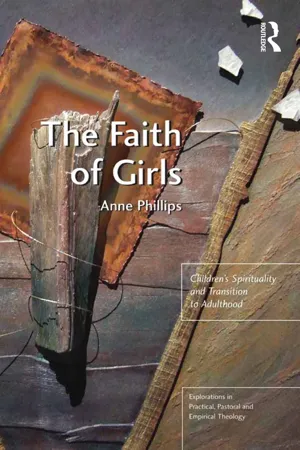
Exploring the spirituality and faith of girls on the verge of adolescence, this book presents fresh insights into children's spirituality and their transition to adulthood. Phillips has listened to girls' voices speaking in depth on the themes of self, God, church, and world, and reflected on their experiences and understandings in the light of current psychological, philosophical and sociological thinking, all placed into dialogue with a feminist approach to contemporary theology and bible. Phillips offers 'wombing' as a metaphor for their transition to young adulthood, and suggests strategies faith communities might adopt to companion girls more effectively through the fragility of puberty. This book will appeal to all those exploring areas of youth ministry, pastoral care, Christian education, nurture and childhood studies, psychology and theology.
Information
Chapter 1
Introduction
Naming Girls
She conceived again and bore a daughter. Then the Lord said to him, ‘Name her Lo-ruhamah, for I will no longer have pity on the house of Israel or forgive them’ … When she had weaned Lo-ruhamah, she conceived and bore him a son.1
This exploration of the faith of girls in this book opens with scripture, and begins with a girl who, unusually for one of both her age and gender, has a place in biblical theology.
Hosea and Gomer had three children. Biblical scholars have paid a great deal of critical attention to Gomer’s story, and feminist study is redeeming her reputation and that of the original author, assigning the unbridled patriarchy of the final text to later redactors. The couple’s two sons, Jezreel and Lo-ammi, have had the significance of their names for Israel subjected to detailed comment and analysis, but Lo-ruhamah is rarely accorded more than a passing mention on the way to her younger brother’s story with which hers is closely linked. The middle child of three often struggles with identity. That Lo-ruhamah is a girl has not been noted as of any significance even in feminist exegesis, the children’s birth and the sequence of their naming being accepted as a naturally and arbitrarily occurring order (boy-girl-boy).2 However, Lo-ruhamah is almost alone in scripture as a named pre-pubescent girl. More usually, girls are identified by their connection with a male relative or adult figure: so sister and daughters ‘belong’ to Moses, Jairus and the Syro-Phoenician woman respectively, while both Naaman’s wife and her slave girl are anonymous.3
I bring Lo-ruhamah to the foreground of attention as her treatment represents for me the fate of girls, from birth to puberty both in the bible and in the church: her distinctive characteristics, history and identity are fused with those of more dominant males, and so the unique part she has to play in the story goes unrecognised. She is named by her father in response to YHWH’s command. The control that biblical fathers have over their daughters is absolute: even at an older age, two daughters, Leah and Rachel, submit to their father Jacob’s duplicity, while for Jephthah, a vow to YHWH takes precedence over his daughter’s life.4
Lo-ruhamah means ‘not pitied’ or ‘not loved’. Many commentators deny that the naming of Hosea and Gomer’s children has any personal reference to them as individuals, that this is merely a rhetorical device to convey a strong message to Israel. Sherwood argues strongly against such a dismissal, as it contradicts the normative connection between a name and the meaning it is intended to convey, either for the individual or for a community. The force of this is summed up by Bal who points out that names have a ‘specific meaning that integrates character into (its) life’ to which she adds that it ‘can also imprison it there’.5 Happily, Lo-ruhamah is released from such imprisonment when she is re-named Ruhamah.6
Her names have a root connection with the Hebrew rechem, meaning ‘womb’;7 its negative form therefore denotes something deeper and more unnatural than the English translations suggest. It signifies a complete rejection both of the parental bonding at birth and of any loving or caring instinct, which is a denial of moral living. That not only the individual but also the nation was formed ‘in the womb’ becomes a theme of worship and hope in the exilic period, and YHWH’s remembrance of the child she bore is proclaimed by Deutero-Isaiah to be immutable even where a human mother’s may fail.8 The text of Hosea in its redacted form is part of this exilic and post-exilic corpus of prophetic and wisdom literature, so while there is no reason to doubt the veracity of Hosea’s family history (Gomer’s name has no other symbolic significance, and the name of the older son, Jezreel, is best understood in the context of pre-exilic history), Lo-ruhamah’s name does carry these resonances. Israel’s story is founded on call and covenant, re-call and new covenant, not once but many times. Integral to that story is Israel’s wandering which draws from YHWH a mother’s compassion and love, the desire to rescue. So, prior to the making of ‘my people’ (Ammi), and the motivation for their rescue which became the determinative act for the faith of Israel, of Jew and of Christian, was YHWH’s compassion for the suffering people. That these feelings are identified with the personification of YHWH as female is significant in the prophetic literature from the exile. I suggest, therefore, that Lo-ruhamah’s gender is significant to the prophetic message, that there is a holistic balance between the two acts of having compassion and people-making, first rejected then re-established. Thus, the naming of a girl here, in contrast to her sisters’ anonymity elsewhere in biblical literature, becomes in feminist reading culturally symbolic, redeeming girls from oblivion to a central place within God’s saving purpose for humankind.
There is a further feature of interest in this story. When she is named by her father, her mother is sidelined. That a father could imagine such unnatural rejection of his own child is truly appalling. However, Gomer silently rejects the name and its signification. As Sherwood shows, by breastfeeding her daughter for three years, the norm in those days, she ‘subverts the master-text’. ‘Not loved’ is loved; by showing that the ‘negatively depicted harlot is also a nurturing mother’ the father’s action is seen to be deviant. This has been commonly overlooked because ‘critics usually focus on what rather than how the text means’.9 This story, and Gomer’s part in it, often disregarded as a mere tool of patriarchy, offers evidence of a resistance to male domination similar to that which in Exodus chapters 1 and 2 has become highly celebrated by feminist scholars.
A Personal Journey
My ‘discovery’ of Lo-ruhamah comes at a stage in my own journey where I have become aware of the neglect of girls in studies of childhood, and it is this which has motivated my research, the fruits of which are found in this book. For many years, as a teacher, mother, ordained minister and college tutor, I have worked at local, national and international level studying children and their faith, promoting good practice in their care and nurture, and resisting their marginalisation in the church. In the course of my ministry I have experienced gender discrimination to a degree I had not encountered in the teaching profession of my earlier years. In response, my intellectual journey has taken me into feminist theology and hermeneutics in order both to take a stand in dialogue with men on a sound biblical and theological basis against values I consider to be inimical to the gospel of Jesus Christ, and to become more confident in my own identity as a woman made in the image of God.
Along the way, I have become aware not only of discrimination but also of avoidance of discussion of gender on the part of many well-meaning people in the church, both men and women, as if the goal of Galatians 3.28 was to discount gender differentiation in favour of some form of androgyny. This naïve approach refuses to acknowledge the power structures operative in any society, which, as clinical psychologist Robert Kegan holds, translate ‘we are really all the same’ as ‘you are really all like me’.10 The theology and biblical understanding we live by is primarily constructed by men (overwhelmingly white, western and middle class), and we do not immediately perceive the bias built into our dominant worldview. There is still work to be done to analyse the context and standpoint of those who construct our theologies and ecclesiologies, and open our eyes, and theirs, to the partiality of their vision and to the consideration of other viewpoints. In his first book, The Evolving Self, Kegan somewhat idealistically proposes that we seek a ‘universal language’11 that transcends gender and cultural differences. In his later work, in which he addresses his earlier lack of clarity on the importance of gender styles, taking more serious account of the research findings of Jean Baker Miller and Carol Gilligan,12 he recognises the power games people play, and proposes a way forward in which people would learn self-awareness which would respect all diversity.13 He still, however, seems to believe it possible to achieve this kind of mutuality by cognitive endeavour alone. He says:
this kind of learning cannot be accomplished through informational training, the acquisition of skills, but only through transformational education, a leading out from an established habit of mind.14
History and faith testify that humans are rarely capable of such transformation by their own efforts. Kegan’s vision of crossing a ‘consciousness threshold’ needs a spiritual foundation, as St Paul recognised.15
Even when we have taken into account the cultural differences Kegan identifies, and the divisions in the early church Paul names, there are yet further areas of power differential. One of these is generation. Children are not always treated with the respect they deserve, nor are they accorded the dignity and protection which it is their right to expect and which is enshrined in the United Nations Convention on the Rights of the Child (UNCRC). Girls are particularly vulnerable. My own experiences as a woman in the church, and my work promoting good practice in child protection and supporting survivors of abuse who are mostly female, have fuelled the concern I have for girls within churches. In my own faith story, it was as a girl and early adolescent that I had my most formative spiritual experiences, but growing within a system where faith was defined by men, I moulded these experiences to fit existing paradigms, and shaped my life-course within those patterns. I now see that overlooking, or even denying, that my encounters with God were as an embodied woman deprived me at an early stage of owning and there...
Table of contents
- Cover Page
- Title Page
- Copyright Page
- Dedication
- Contents
- List of Tables
- Preface
- 1 Introduction
- 2 Breaking the Silence around Girls in Transition
- 3 Methods for Learning from Girls
- 4 Girls in Transitional Space
- 5 Theological Reflection 1: Lucy
- 6 Girls in Godspace
- 7 Theological Reflection 2: Rosie
- 8 Girls in Nurturing Space
- 9 Affirming Girls through Transition
- Bibliography
- Author Index
- Subject Index
Trusted by 375,005 students
Access to over 1.5 million titles for a fair monthly price.
Study more efficiently using our study tools.
Frequently asked questions
Yes, you can cancel anytime from the Subscription tab in your account settings on the Perlego website. Your subscription will stay active until the end of your current billing period. Learn how to cancel your subscription
No, books cannot be downloaded as external files, such as PDFs, for use outside of Perlego. However, you can download books within the Perlego app for offline reading on mobile or tablet. Learn how to download books offline
Perlego offers two plans: Essential and Complete
- Essential is ideal for learners and professionals who enjoy exploring a wide range of subjects. Access the Essential Library with 800,000+ trusted titles and best-sellers across business, personal growth, and the humanities. Includes unlimited reading time and Standard Read Aloud voice.
- Complete: Perfect for advanced learners and researchers needing full, unrestricted access. Unlock 1.5M+ books across hundreds of subjects, including academic and specialized titles. The Complete Plan also includes advanced features like Premium Read Aloud and Research Assistant.
We are an online textbook subscription service, where you can get access to an entire online library for less than the price of a single book per month. With over 1.5 million books across 990+ topics, we’ve got you covered! Learn about our mission
Look out for the read-aloud symbol on your next book to see if you can listen to it. The read-aloud tool reads text aloud for you, highlighting the text as it is being read. You can pause it, speed it up and slow it down. Learn more about Read Aloud
Yes! You can use the Perlego app on both iOS and Android devices to read anytime, anywhere — even offline. Perfect for commutes or when you’re on the go.
Please note we cannot support devices running on iOS 13 and Android 7 or earlier. Learn more about using the app
Please note we cannot support devices running on iOS 13 and Android 7 or earlier. Learn more about using the app
Yes, you can access The Faith of Girls by Anne Phillips in PDF and/or ePUB format, as well as other popular books in Theology & Religion & Religion. We have over 1.5 million books available in our catalogue for you to explore.