- 228 pages
- English
- ePUB (mobile friendly)
- Available on iOS & Android
eBook - ePub
Crowd and Rumour in Shakespeare
About this book
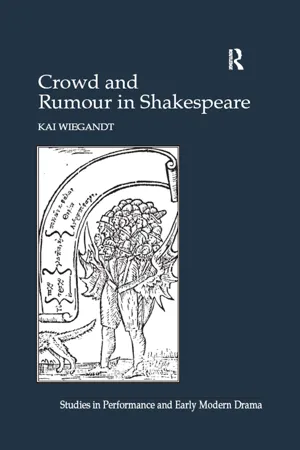
In this study, the author offers new interpretations of Shakespeare's works in the context of two major contemporary notions of collectivity: the crowd and rumour. The plays illustrate that rumour and crowd are mutually dependent; they also betray a fascination with the fact that crowd and rumour make individuality disappear. Shakespeare dramatizes these mechanisms, relating the crowd to class conflict, to rhetoric, to the theatre and to the organization of the state; and linking rumour to fear, to fame and to philosophical doubt. Paying attention to all levels of collectivity, Wiegandt emphasizes the close relationship between the crowd onstage and the Elizabethan audience. He argues that there was a significant - and sometimes precarious - metatheatrical blurring between the crowd on the stage and the crowd around the stage in performances of crowd scenes. The book's focus on crowd and rumour provides fresh insights on the central problems of some of Shakespeare's most contentiously debated plays, and offers an alternative to the dominant tradition of celebrating Shakespeare as the origin of modern individualism.
Information
Part 1
Body
Chapter 1
‘The Greatest and Most Savage Beast in the Whole World’: The Idea of the Crowd in Shakespeare’s Time
Shakespeare inherited a way of imagining the crowd whose roots reach back to Plato’s Republic. Plato lets Socrates, in a discussion with Glaucon, attempt to refute the ‘assertion that wrongdoing paid the man who combined complete injustice with a reputation for justice’.1 In order to illustrate the necessary consequences of this assertion in case of its truth, Socrates constructs a composite creature, the many-headed beast, rendering it as an image of uncontrolled affects and lust on the one hand, and on the other hand, pointing to ways of controlling the beast in order to make the creature follow the principle of justice. Socrates begins:
‘Let us construct a model of the human personality, to show him what his assertion really implies.’
‘What sort of model?’
‘Like one of those composite beasts in the old myths, Chimaera and Scylla and Cerberus and all the rest, which combine more than one kind of creature in one.’
‘I know the stories.’
‘Imagine a very complicated, many-headed sort of beast, with heads of wild and tame animals all round it, which it can produce and change at will.’
‘Quite a feat of modelling’, he replied; ‘but fortunately it’s easier to imagine than it would be to make.’
‘Add two other sorts of creature, one a lion, the other a man. And let the many-headed creature be by far the largest, and the lion the next largest.’
‘That’s rather easier to imagine.’
‘Then put the three together and combine them into a single creature.’
‘Done.’
‘Then give the whole the external appearance of one of the three, the man, so that to eyes unable to see anything beneath the outer shell it looks like a single creature, a man.’
‘That is done, too.’
‘Then let us point out to say that it pays this man to do wrong and not to do right, is to say that it pays him to give the many-headed beast a good time, and to strengthen it and the lion and all its qualities, while starving the man till he becomes so weak that the other two can do what they like with him; and that he should make no attempt to reconcile them and make them friends, but leave them to snarl and wrangle and devour each other.’
‘That is just what it means to approve injustice and wrongdoing.’
‘On the other hand, to say that it pays to be just is to say that we ought to say and do all we can to strengthen the man within us, so that he can look after the many-headed beast like a farmer, nursing and cultivating its tamer elements and preventing the wilder one growing, while he makes an ally of the lion and looks after the common interests of all by reconciling them with each other and with himself.’
‘That, again, is exactly what it means to approve justice.’2
This passage makes clear that both the depiction and an explanation of the crowd as a many-headed monster derive from Plato. It defined the image of the crowd in Western culture and has provided a starting point for theorizations of the crowd. Plato determined the direction crowd theory would take in thinking of the crowd as inseparable from leaders. When Plato reflected upon the crowd, he was above all interested in the character of popular leaders. From The Republic one can learn that the sophist earns his living by teaching men how to control a large and powerful animal, the crowd. A citizen can learn to control the crowd himself by carefully watching its moods over a long period of time, but the sophist can pass on his own knowledge of its passions and pleasures more quickly.3 In fact, some crowd theories after Plato still resemble manuals for crowd leaders. Only Canetti, in Masse und Macht, published as late as 1960 and discussed in the next chapter, evades Plato’s intellectual heritage by thinking the crowd independent from leaders.
Shakespeare’s contemporaries also frequently had Horace’s tag ‘Belua multorum es capitum’ in mind when referring to the crowd and it is worth noting that the many-headed multitude in both Plato and Horace is explicitly informed by its urban location.4 Further, the Bible played a significant role in people’s view of the crowd. Orthodox thinkers of the early modern age directly or indirectly blamed the crowd for the death of Jesus or held the belief that it had a share in his murder.5 A more recent influence on the Elizabethan conception of the crowd came from Machiavelli. He addressed the crowd in his principal work The Prince (1513). While the political philosophy outlined in this work is known for advising the prince to employ cruelty and cunning with cold rationality in order to assure his power, it is striking how much power Machiavelli attributes to the populace. While he advises the prince to cheat peers and nobles, he admits that the people must be treated with care:
The people are more honest in their intentions than the nobles are, because the latter want to oppress the people, whereas they want only not to be oppressed. Moreover, a prince can never make himself safe against a hostile people: there are too many of them. He can make himself safe against the nobles, who are few. The worst that can happen to a prince when the people are hostile is for him to be deserted; but from the nobles, if hostile, he has to fear not only desertion but even active opposition. […] I shall only conclude that it is necessary for a prince to have the friendship of the people; otherwise he has no remedy in times of adversity. […] But if it is a prince who builds his power on the people, one who can command and is a man of courage, who does not despair in adversity, who does not fail to take precautions, and who wins general allegiance by his personal qualities and the institutions he establishes, he will never be let down by the people; and he will be found to have established his power securely.6
One must not mistake the wolf for a sheep by thinking that Machiavelli speaks warm-heartedly of the people. Rather he advises the prince to make the populace dependent on him so that it will be faithful not only in times of peace but also in war.7 What is interesting, though, is that Machiavelli justifies his advice of striving for a good relationship with the people not only by referring to the nobles but also by addressing the dangers of crowd behaviour:
[…] the populace is by nature fickle; it is easy to persuade them of something, but difficult to confirm them in that persuasion. Therefore one must urgently arrange matters so that when they no longer believe they can be made to believe by force. Moses, Cyrus, Theseus, and Romulus would not have been able to have their institutions respected a long time if they had been unarmed, as was the case in our time with Frà Girolamo Savonarola who came to grief with his new institutions when the crowd started to lose faith in him, and he had no way of holding fast those who had believed or of forcing the incredulous to believe.8
In paying special attention to the people’s belief, Machiavelli acknowledges the role of rumour in the relationship between the prince and the crowd, a relationship well-known to the theories of crowd and rumour. It does not matter whether the prince is a good man as long as the subjects believe that he is one. If the people do not believe in his virtue, the prince should have the means of forcing them to do so. But he hardly ever has them, certainly not in a full-blown rebellion, and not even under normal conditions because of the people’s sheer number. The prince must therefore assure the people’s belief in him by milder methods. To please everyone, the prince should ‘appear a man of compassion, a man of good faith, a man of integrity, a kind and religious man. […] The common people are always impressed by appearances and results. In this context, there are only common people, and there is no leeway for the few when the many are firmly sustained’.9 The satisfaction of the majority is imperative, because it is the only way of preventing the prince’s nightmare, conspiracy, that robs him of life and reign by an attack from within despite all power and riches he may have amassed and despite all fortresses erected against enemies from without:
Now, as far as his subjects are concerned, when there is no disturbance abroad the prince’s chief fear must be a secret conspiracy. He can adequately guard against this if he avoids being hated or scorned and keeps the people satisfied: this, as I have said above at length, is crucial. One of the most powerful safeguards a prince can have against conspiracies is to avoid being hated by the populace. This is because the conspirator always thinks that by killing the prince he will satisfy the people; but if he thinks that he will outrage the people, he will never have the courage to go ahead with his enterprise, because there are countless obstacles in the path of a conspirator.10
Shakespeare’s tragedies and history plays bear witness to this mechanism. Intrigues and conspiracies are more likely to happen in states that suffer from the emergence of riotous crowds than in realms that are securely ruled. Conversely, riotous crowds are more likely to emerge when the king does not succeed in keeping the rumour of his virtue in circulation. Hamlet’s Claudius, who is about to be discovered and is losing the faith of the people, is confronted with harmful rumours that are stirring up an angry mob. The ‘people [are] muddied, / Thick and unwholesome in their thoughts and whispers / For good Polonius’ death’ (HAM 4.5.77–9), and Laertes ‘wants not buzzers to infect his ear / With pestilent speeches of his father’s death; Wherein necessity, of matter beggared, / Will nothing stick our persons to arraign / In ear and ear’ (HAM 4.5.86–90). A messenger then proves Claudius’s fears to be correct:
The ocean, overpeering of his list,
Eats not the flats with more impetuous haste
Than young Laertes, in a riotous head,
O’erbears your officers. The rabble call him lord,
[…]
They cry ‘Choose we! Laertes shall be king.’
Caps, hands, and tongues applaud it to the clouds,
‘Laertes shall be king, Laertes king.’ (HAM 4.5.95–8, 102–4)
As is often the case in Shakespeare, the emergence of rumour and crowd heralds impending ruin. Similar to the walking forest in Macbeth, the crowd is pictured as an image of natural catastrophe (a flood) that insinuates a revenge exacted by the forces of nature or by God. The link between the crowd and the forces of nature is an ancient one. Canetti explains that both the sea and the forest are old symbols for the crowd.11
Laertes and Hamlet, the ‘man of the crowd’ and the diametrically opposed ‘individual’, present two mutually dependent threats to Claudius. Laertes leads the crowd motivated by rumours about intrigues; Hamlet’s potential (counter-) intrigue is dangerous because the crowd is on his side.12 As Machiavelli teaches, crowd and intrigue are interdependent. Claudius’s nervous musings testify to this:
How dangerous it is that this man goes loose!
Yet must not we put the strong law on him.
He’s loved of the distracted multitude,
Who like not in their judgement but their eyes,
And where ’tis so, th’offender’s scourge is weighed,
But never the offence. (HAM 4.3.2–7)
Machiavellian thought thus informs not only the climate of Elsinore full of spying; it also informs the role of the crowd intricately tied up with the intrigues at court.
The early modern discourse of the crowd soon took the form of a vituperative commonplace, the ‘many-headed monster’. This commonplace originated from Plato’s Republic but was also gleaned from Horace’s tag mentioned above.13 Christopher Hill is the historian who has studied the discourse of the ‘many-headed monster’ most comprehensively.14 He has shown that the term played a significant role in class struggles betwe...
Table of contents
- Cover Page
- Half Title page
- Series Page
- Title Page
- Copyright Page
- Dedication
- Contents
- Figures
- Acknowledgments
- Introduction
- 1 Body
- 2 Voice
- Appendix I Crowds and Rumours in Shakespeare’s Time
- Appendix II Overview of Relevant Previous Studies
- Works Cited
- Index
Trusted by 375,005 students
Access to over 1.5 million titles for a fair monthly price.
Study more efficiently using our study tools.
Frequently asked questions
Yes, you can cancel anytime from the Subscription tab in your account settings on the Perlego website. Your subscription will stay active until the end of your current billing period. Learn how to cancel your subscription
No, books cannot be downloaded as external files, such as PDFs, for use outside of Perlego. However, you can download books within the Perlego app for offline reading on mobile or tablet. Learn how to download books offline
Perlego offers two plans: Essential and Complete
- Essential is ideal for learners and professionals who enjoy exploring a wide range of subjects. Access the Essential Library with 800,000+ trusted titles and best-sellers across business, personal growth, and the humanities. Includes unlimited reading time and Standard Read Aloud voice.
- Complete: Perfect for advanced learners and researchers needing full, unrestricted access. Unlock 1.5M+ books across hundreds of subjects, including academic and specialized titles. The Complete Plan also includes advanced features like Premium Read Aloud and Research Assistant.
We are an online textbook subscription service, where you can get access to an entire online library for less than the price of a single book per month. With over 1.5 million books across 990+ topics, we’ve got you covered! Learn about our mission
Look out for the read-aloud symbol on your next book to see if you can listen to it. The read-aloud tool reads text aloud for you, highlighting the text as it is being read. You can pause it, speed it up and slow it down. Learn more about Read Aloud
Yes! You can use the Perlego app on both iOS and Android devices to read anytime, anywhere — even offline. Perfect for commutes or when you’re on the go.
Please note we cannot support devices running on iOS 13 and Android 7 or earlier. Learn more about using the app
Please note we cannot support devices running on iOS 13 and Android 7 or earlier. Learn more about using the app
Yes, you can access Crowd and Rumour in Shakespeare by Kai Wiegandt in PDF and/or ePUB format, as well as other popular books in Literature & Literary Criticism. We have over 1.5 million books available in our catalogue for you to explore.