eBook - ePub
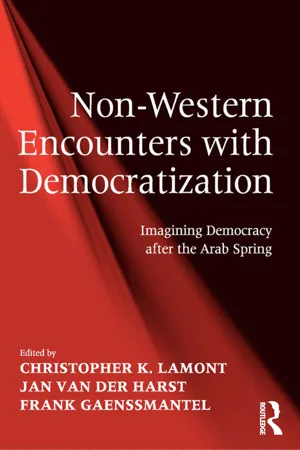
Non-Western Encounters with Democratization
Imagining Democracy after the Arab Spring
- 256 pages
- English
- ePUB (mobile friendly)
- Available on iOS & Android
eBook - ePub
Non-Western Encounters with Democratization
Imagining Democracy after the Arab Spring
About this book
Non-Western Encounters with Democratization offers diverse perspectives on democracy and transition spanning the Middle East and North Africa to East Asia. This unique collection of essays, drawn from contextually rich case studies presents readers with a variety of non-western encounters with democracy and provides important insights into the dramatic political and social transformations in these regions over the past decades. The book offers a deeper understanding of democratization and challenges the image of western democracy as a universal model to which non-western societies aspire. Taking the events of the Arab Spring as the starting point, international contributors look at why the uprisings that rapidly spread across North Africa and the Middle East had a strong resonance in East Asia but failed to inspire similar revolts. Through direct engagement with non-western experiences of political transition the book demonstrates a unique coherence across two regions relatively under explored in democratization literature.
Information
Imagining Democracy
Chapter 1
A Universal Understanding of Democracy?
The Arab Spring or Arab awakening refers to a series of protests and demonstrations throughout the Arab Word that either brought about the exit from power of long-time autocrats, as in Tunisia, Libya and Egypt, or mobilized popular opposition to regimes, as witnessed in Jordan and Bahrain. It also led to pro-democratic stirrings, albeit to a lesser extent, in East Asia, such as the popular movement which took place under the Jasmine revolution label in China. These uprisings raise many questions of both political and legal nature including whether people and movements in the Arab World and China strive for democracy? If so, does the Chinese Jasmine revolution call for the same kind of democracy as the Arab Spring? And if yes, is this conception of democracy identical to the Western conception of democracy?
To grapple with this set of questions, I will start by outlining the classical theoretical framework on the meaning of democracy. The definitional debate took place both in political science and international law. Next, I examine whether scholars and the international community accept that there exists one sole definition of democracy applicable and relevant to all regions or whether there exists a variety of different definitions that are regionally distinct. Finally, I compare the demands to the definition(s) of democracy in order to provide a framework for thinking about democracy and democratic demands elucidated in the forthcoming chapters.
Democracy in Political Science: A Centuries-Old, Essentially Contested Concept
The concept of democracy has been the subject of fierce discussion during the course of several centuries. The discussion can be traced back to ancient Greece. Etymologically, the word is derived from the Greek ‘δημος’ and ‘κρατειν’ meaning respectively ‘people’ and ‘power’. In political science in general, the discussion of democracy deals with the organization of a state and the exercise of power. The scope of the discussion is however very broad. The main issues that are discussed are the meaning of democracy, the sources or preconditions of democracy (Lipset, 1960; Huntington, 1993), the various forms of democracy (Dahl, 2005) and any consequences a democracy might generate (Kant, 1970).
Contrary to other political theories, such as for instance communism, democracy does not have a(ny) founding father(s). Consequently, democracy’s scope and meaning has not been developed by a limited number of people during a limited period of time. Throughout its long history, the concept has had several different meanings, some of which would be considered contrary to today’s interpretation (Crick, 2002; Dahl, Shapiro and Cheibub, 2003). Its current meaning is the result of a several centuries long evolution (Graham, 2006).
In current political discourse, there does not exist agreement on one particular definition of democracy (Dahl, Shapiro and Cheibub, 2003). All core concepts in political science, including democracy, are considered to be essentially contested concepts meaning that all elements used to define them are contested themselves (Devos, 2011). Given that so many different views exist, it is accepted that there will never exist a consensus on one particular definition (Devos, 2011). Consequently, many different views exist on how democracy should be defined and thus, on its meaning. Both the merits and possible flaws of the various theories have been acknowledged and well documented. The three most dominant views in political discourse with regard to the meaning of democracy are the procedural approach, the substantive and the deliberative approach (Dahl, Shapiro and Cheibub 2003; Marsh and Stoker, 2010; Devos, 2011). It should, however, be acknowledged that many theories cannot be easily divided into one of these three approaches. Many conceptions fall somewhere in between. A comprehensive account of all the different conceptions of democracy would lead us too far and therefore is not intended here. The following section will only briefly discuss the arguments set out by the most influential proponents of the three main theories.
Proponents of the procedural view emphasize practices and institutions that characterize democratic regimes, without specifying any outcome these regimes are supposed to bring about and without paying much attention to how preferences are formed. Influential proponents of such a minimalist conception are Joseph Schumpeter (1883–1950) and Adam Przeworski (born 1940).
Schumpeter justifies his choice for a procedural view by identifying what he considers to be flaws in Jean-Jacques Rousseau’s interpretation of the social contract, who in turn was influenced by Thomas Hobbes (1588–1679), generally considered to be the founding father of contractarianism (Cudd, 2008; Hobbes, 1950). Contractarianists argued against the idea that monarchs were divinely empowered to legislate (Hobbes, 1950). Variations of Hobbes’ contract theory can be found in the writings of John Locke (1632–1704), Immanuel Kant (1724–1804) and Jean-Jacques Rousseau (1712–1778), John Rawls (1921–2002) and David Gauthier (born 1932). The discussion of the differences between these theories falls outside the scope of this contribution. However, Rousseau’s suggestion will be briefly outlined as it constitutes the starting point for Schumpeter’s procedural view.
Rousseau argues that when people reach the point where the obstacles to their preservation in the state of nature prove greater than each individual’s strength to preserve oneself in that state, the human race will perish if it does not change its mode of existence (1822, p. 21). Rousseau considers the only way for people to preserve themselves to be the union of their separate powers in a manner that they are strong enough to overcome any resistance and so that their powers are directed by a single motive and act in concert. He belies the social contract to be the perfect form of association which will defend the person and goods of each other with the collective force of all, and under which each individual, while uniting oneself with the others, obeys no one but oneself, and remains as free as before (1822, pp. 22–4). Thus, each person puts into the community his person and all his powers under the supreme direction of the general will (la volonté générale i.e. the public interest). Whoever refuses to obey the general will shall be compelled to do so by the whole body (i.e. the other members of the community) (1822, p. 31).
Schumpeter rephrases Rousseau’s suggestion into following definition: the democratic method is that institutional arrangement for arriving at political decisions which realizes the common good by making the people itself decide issues through the election of individuals who are to assemble in order to carry out its will (Schumpeter, 1959). Schumpeter rejects this approach to democracy mainly for the reason that it assumes that ‘the people’ hold a definite and rational opinion over every individual question and that they give effect to this opinion by choosing representatives who will see to it that that opinion is carried out (1959, p. 269). Therefore, he defines the democratic method as that institutional arrangement for arriving at political decisions in which individuals acquire the power to decide by means of a competitive struggle for the people’s vote. Schumpeter’s minimalist definition of democracy has proven very influential as it has been embraced by many other political scholars (Huntington, 1993; Lipset, 1960; Linz and Stepan, 1978; Powell, 1982; Vanhanen, 1990; Palma, 1991; Przeworski, 1999)
Adam Przeworski defended Schumpeter’s minimalist approach but on other grounds (Przeworski, 1999). Similar to Schumpeter, he renounces the eighteenth-century theories for being ‘consensualist’. He accepts two assumptions namely, one, that there are conflicts of values and interest in any society and, two, that people want to resolve these conflicts peacefully. Based on these assumptions he argues that the mere possibility of being able to change governments can avoid violence and secondly that being able to do so by voting has consequences on its own. First, the very prospect that governments may change can result in a peaceful regulation of conflicts. He distinguishes between two groups of people the ‘winners’ i.e. the incumbent government and the ‘losers’ i.e. the ones currently not in power. He argues that the incumbent rulers behave well in office due to electoral incentives i.e. the desire to be re-elected and because of the realization that should they lose the next elections they are in the same position as the losers are now. The losers accept the outcome of elections if they have a sufficient chance to win and a sufficiently large payoff in future elections. He refers to this situation as a ‘self-enforcing equilibrium’. Secondly, Przeworski believes that voting induces compliance. Voting reveals information about passions, values, and interest and as such they inform the losers. Even if voting does not reveal a unique collective will, it does indicate limits to rule. He writes ‘the miracle of democracy is that conflicting political forces obey the results of voting. Conflict are regulated, processed according to rules and thus limited. This is not consensus just limited conflict’.1
The second view is the substantive view. Advocates of this view see procedures as necessary but insufficient to bring about democratic results. Influential proponents of the latter view include Larry Diamond who defends the idea of a liberal democracy (Diamond, 1999), Carole Pateman arguing in favour of participative democracy (Pateman, 1970) and Robert Dahl who introduces the concept of polyarchal democracy (Dahl, 1956). The minimalist Schumpeterian conception of democracy has been criticized by other scholars as well (Karl, 1995; Schmitter and Karl, 1991; Diamond, 1999).
Carole Pateman calls for the re-appraisal of the early writings on democratic theory by defending the theory of participatory democracy (Pateman, 1970). The theory of participatory democracy is built round the central assertion that individuals and their institutions cannot be considered in isolation from one another. The existence of representative institutions at national level is not sufficient for democracy; for maximum participation by all the people at that level socialization or ‘social training’, for democracy must take place in other spheres in order that the necessary individual attitudes and psychological qualities can be developed.
Dahl stresses the need for realism as the modern world is not a world comprising perfect democracies, in which all citizens have roughly enough equal political resources and in which government is completely responsive to all citizens. Therefore, he introduces the concept polyarchy to characterize the more limited form of democracy that has been attained today. He defines democracy as a state of affairs constituting a limit and all actions approaching the limit are labelled maximizing actions. He offers a list of eight defining characteristics of a democracy, all being institutional arrangements focusing on the electoral process. The more one possesses these characteristic the more democratic one is, recognizing that democracy is a theoretical utopia which can never be fully reached. He thus argues that the democratic relationship is one of a number of social control techniques that in fact co-exist in modern democratic polities and that this diversity must be taken into account in a modern theory of democracy.
In addition to the procedural and the substantive view, there is a third view i.e. the deliberative view. Adherents of the deliberative view question preferences between the procedural and the substantive view, arguing that appropriately deliberative procedures transform them into felicitous ways for democracy. For instance, Amy Gutmann and Dennis Thompson defend deliberative democracy, being a form of democracy in which deliberation is essential to decision-making. The core idea is simple: when citizens or their representatives disagree morally they should continue to reason together to reach mutually acceptable decisions (Gutmann and Thompson, 2000). In their minds, deliberation is the most appropriate way for citizens collectively to solve their moral disagreements not only about policies but also about the process by which policies should be adopted. Deliberation is not only a means to an end, but also a means for deciding what means are morally required to pursue our common ends. In the ‘Voice of the People’, James Fishkin demonstrates the viability of a different form of opinion polling and thus, in his mind, a different form of democracy (Fishkin, 2003). He admits that implementation of his idea is not inconceivable, but unlikely. However, the image helps to clarify an ideal, i.e. a picture of the reconstructed role of citizen (2003, p. 28).
In addition to the above outlined dichotomy between ‘thin’ or ‘minimalist’ and ‘thick’ of ‘substantive’ conceptions, the search for a definition is also complicated by the fact that there exist disagreement on whether democracy is a question ‘of kind’ or one ‘of degree’ (Sartori, 1987). The former interpretation is a binary one, i.e. a political system is either a democracy or not. The latter, in contrast, is gradual i.e. democracy is a question of degree (Petersen 2008) The lack of consensus on this issue is clearly visible if one compares, for instance, the writings of Joseph Schumpeter to the argumentation of Robert Dahl. Whereas the former labels a country democratic if free and fair elections are organized, the latter considers democracy to be an ideal which can never be fully realized. He believes that what we call democracies only possess ‘a certain level of democracy’. While Schumpeter’s and Dahl’s conception may appear to be mutually exclusive, they do not have to be. Some authors adhere to both. For instance, Adam Przeworski argues that the struggle for democracy always takes place on two fronts: against the authoritarian regime for democracy and against one’s allies for the best place under democracy (1991, pp. 51–2). Analogous, Petersen argues that democracy has two dimensions: a binary one, which differentiates between democracies and non-democracies and a graduation, which distinguishes between democracies of different quality (2008, p. 37).
The next section will examine if – and if yes, in what manner – these three views have influenced the definitional process in international law.
Democracy in International Law: A Recent but Contested Concept
Contrary to the long history of democracy theories in political science, the discussion on democracy in international law is a recent one. It was only after the Cold War that international law dared to address the issue of democracy which previously was considered to be a ‘domestic’ issue and thus one not subject to international scrutiny. Before the end of the Cold War, international law’s neutrality towards the legitimacy of regimes and the manner in which governments are formed was a principle firmly established in international law. Examples of this neutrality are plentiful (Nicaragua v. United States of America, 1986; Great Britain v. Costa Rica, 1923; Moore, 1906, Oppenheim, 1905). The ‘shift in attitude’ is explained by the events of 1989–1991 – also referred to as the ‘Third Wave of Democratization’ – which led to the embrace of democracy in many countries, primarily in Eastern Europe (Franck, 1992; Huntington, 1993)
While the discussion in political science focuses on the organization of a state and the exercise of power, the debate in international law primarily focuses on the ‘democratic entitlement’ or the ‘right to democracy’. In particular, the debate on democracy has focused on three aspects: the democratic entitlement’s content, its sources or normative status and its consequences. The expressions ‘democratic entitlement’, ‘right to democracy’, ‘norm of democratic governance’, ‘entitlement to a participatory electoral process’, ‘right to political participation’ and ‘electoral rights’ are used with relative interchangeability (Marks, 2000), adding significantly to the complexity of the debate.
Contrary to political science, where democracy constitutes an essentially contested concept, the theoretical feasibility of defining democracy in a manner that is universally acceptable appears to be generally acknowledged in international law. In the practice of states, as exercised within the United Nations the issue is not questioned.2 To the contrary, within the United Nations framework democracy is defined as a universal value, which is said to mean two things: first, it is defined as a concept with an unchangeable core and second, the international community accepts that a democracy can take root anywhere. Furthermore, human rights bodies and scholars – when interpreting the phrase ‘necessary in a democratic society’ – have never questioned the feasibility of defining democracy in a manner than is acceptable to all (Garibaldi, 1984). Finally, in the writings of legal scholars on the democratic entitlement the issue barely...
Table of contents
- Cover Page
- Half Title page
- Title Page
- Copyright Page
- Contents
- Figures
- List of Contributors
- Acknowledgements
- Introduction Imagining Democracy after the Arab Spring
- Imagining Democracy
- Imagining Democracy in the Middle East and North Africa
- East Asian Perspectives
- Index
Trusted by 375,005 students
Access to over 1.5 million titles for a fair monthly price.
Study more efficiently using our study tools.
Frequently asked questions
Yes, you can cancel anytime from the Subscription tab in your account settings on the Perlego website. Your subscription will stay active until the end of your current billing period. Learn how to cancel your subscription
No, books cannot be downloaded as external files, such as PDFs, for use outside of Perlego. However, you can download books within the Perlego app for offline reading on mobile or tablet. Learn how to download books offline
Perlego offers two plans: Essential and Complete
- Essential is ideal for learners and professionals who enjoy exploring a wide range of subjects. Access the Essential Library with 800,000+ trusted titles and best-sellers across business, personal growth, and the humanities. Includes unlimited reading time and Standard Read Aloud voice.
- Complete: Perfect for advanced learners and researchers needing full, unrestricted access. Unlock 1.5M+ books across hundreds of subjects, including academic and specialized titles. The Complete Plan also includes advanced features like Premium Read Aloud and Research Assistant.
We are an online textbook subscription service, where you can get access to an entire online library for less than the price of a single book per month. With over 1.5 million books across 990+ topics, we’ve got you covered! Learn about our mission
Look out for the read-aloud symbol on your next book to see if you can listen to it. The read-aloud tool reads text aloud for you, highlighting the text as it is being read. You can pause it, speed it up and slow it down. Learn more about Read Aloud
Yes! You can use the Perlego app on both iOS and Android devices to read anytime, anywhere — even offline. Perfect for commutes or when you’re on the go.
Please note we cannot support devices running on iOS 13 and Android 7 or earlier. Learn more about using the app
Please note we cannot support devices running on iOS 13 and Android 7 or earlier. Learn more about using the app
Yes, you can access Non-Western Encounters with Democratization by Christopher K. Lamont,Jan van der Harst in PDF and/or ePUB format, as well as other popular books in Politics & International Relations & Essays in Politics & International Relations. We have over 1.5 million books available in our catalogue for you to explore.